Kevin Anthony 0:05
Welcome to the Love Lab podcast, the place to be for honest and real talk about relationships and sex. Whether you’re a man or woman, single or couple, this is the show for you. I am your host, Kevin Anthony, and I am here to help you have the relationship of your dreams and the best sex of your life.
Kevin Anthony 0:27
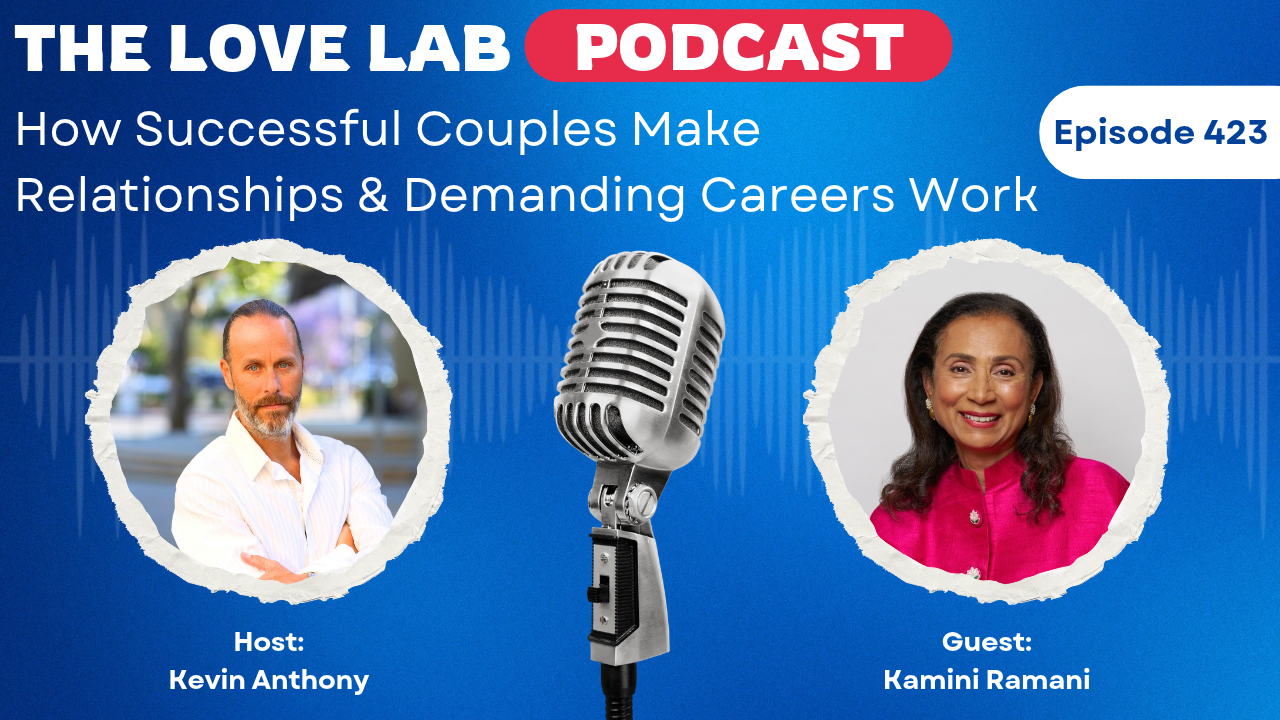
Welcome back to the Love Lab podcast. This is episode 423, and it is titled “How Successful Couples Make Relationships and Demanding Careers Work. So you know, we’ve talked about this a little bit from time to time throughout the years on the show. You know, we try to give tips and try to help couples figure out, like, how do they navigate this complex world that we live in now? How do they both have careers? How do they manage children with that? You know, how do they manage the finances or the distribution of duties, like all that kind of stuff? And it’s become increasingly more difficult in our society these days because of the demands placed on all of us. And you know, throughout the years, I’ve been teaching my audience some things that I sometimes get some pushback on. You know, when I say things like, “You can’t really have it all at once, right? People will push back on that; especially women will push back on that because they want to believe that they can have everything all at once.
Kevin Anthony 1:32
And so I have a guest on today who has interviewed over 100 women, very successful women, and she has learned what made them successful. And you know, when we spoke in the pre-interview, as you know, my listeners know we do a pre-interview call with the guests. I was really, I wasn’t surprised to hear what she was sharing, but I was pleasantly surprised that it was so in line with a lot of the things that I have been teaching, and so I can’t say that, you know, we’ll be in agreement on everything. But her general approach, I think, is really great, and I think it’s really good advice. And I hope that throughout this episode, we’ll get to bring a lot of that out, and that it will allow couples to make better decisions about how they approach all of this. So that really is the goal. We’re going to do our best to accomplish that in this episode.
Kevin Anthony 2:29
As always, before we get started, a short word from my sponsor: Are you ready to build deeper intimacy and a more passionate relationship? Introducing Intimacy Mastery, the sex, love, and intimacy app for singles and couples. Your personal guide to mastering love, sex, and connection. Get a personalized plan tailored to your unique relationship goals. Enjoy daily lessons, real-world challenges, and guided reflections. All designed by me, Kevin Anthony, your trusted guide and coach. Track your growth, celebrate your wins, and get expert feedback every step of the way. Access exclusive resources, videos, and proven tools right at your fingertips. Whether you’re single or partnered, this app will help you create the love life you truly desire. The app is available right now at https://www.kevinanthonycoaching.com/go/app. That’s https://www.kevinanthonycoaching.com/go/app.
Kevin Anthony 3:26
Okay, my guest today is Kamini Romani, and she is a Silicon Valley marketing leader, author of the USA Today bestseller Lotus Leadership, an Indian immigrant, and a San Francisco resident. Welcome to the show, Kamini.
Kamini Ramani 3:41
Thank you, Kevin. It’s great to be here.
Kevin Anthony 3:44
So I’m excited to have this conversation because so many of the things you shared with me in the pre-interview, I’m like, yes, yes, more people need to hear this. But before we get started, you know, you wrote this book, Lotus Leadership, and one of the things that you did is you went out and you interviewed 100 successful women. What were you seeking to learn from doing these interviews?
Kamini Ramani 4:10
I started about three years ago because I had this idea that a lot of Indian American women in my network. You know, I’m Indian. I grew up in Bombay, India, and I emigrated here over 40 years ago. So there were a few different Indian women in my network, very powerful, very successful, and I kept wondering, was there a playbook for how they got to the top? Because as you may know, there are some you know well known examples of Indian American men as well: the CEO of Google, the CEO of Microsoft, the CEO of Mastercard, etc. So my goal was really to start talking to mostly Indian origin women to just understand how they get to the top, because I observed that they seem to have. This formula to rise without burning out, which is very rare.
Kevin Anthony 5:06
So you were originally seeking to find out, you know, how these Indian American women were being so successful. Did you expect to find sort of a formula for how all women could be successful, or couples in general? Was that a surprise to you?
Kamini Ramani 5:23
The most surprising part of the book was the couple dynamic, because, as you know, the narrative and I’m sorry, the reality is that when you’re partnered, it’s very hard for both of you to both fulfill your ambitions and have a meaningful life. It feels like you have to choose, and more often than not, it’s the woman who chooses to take a step back from her career for caregiving, or, you know, whatever else the family needs. And the part of the research that was really surprising to me was how these women had built long-term relationships based on a dynamic hierarchy with their partner, which actually allowed them to both have a meaningful life and a meaningful career.
Kevin Anthony 6:12
Yeah, and we’re going to dive into exactly how they were able to do that. But one, I want to just say it is possible. So, you know, I think your research shows that. And I also want to just tease a little bit for the, you know, the rest of the show that it’s probably not in the way that most people think it’s possible. And then that’s what we’re going to dive into. So, doing this research, you found that there were certain things that they had in common, and I created a list of these things that, when we were talking the first time, I kind of want to go through each one and let’s just talk about them a little bit. So the first one on my list is that their life partner was their cheerleader. So what does that mean exactly, and how did that factor into this?
Kamini Ramani 7:00
Yeah, you know, I feel so strongly that when young women or men are evaluating someone who’s going from, you know, a date to a relationship to somebody they want to spend their life with, they should ask some questions that go beyond what the church tells you to do or what different religious groups say, which are finances, children, and religion-those three are your counsel to talk about. But actually, the real devil is in the details of scenario playing. What happens if I’m in this job and I have to get transferred to headquarters? Then what would you do in that situation? For example, right. So I feel very strongly that there should be a separate checklist on how you evaluate if your partner is going to be your cheerleader.
Kamini Ramani 7:49
Because by cheerleader, I mean someone who’s just there to watch you succeed, who’s celebrating you, who’s helping in that process, and it’s different. Sometimes it’s the man. Sometimes it’s the woman. So I’m not saying this is a gender-based role. Obviously, the women I spoke with, there’s one couple that’s a same-sex couple- but otherwise, everyone else was in heterosexual partnerships. So in most cases, when they talk about their cheerleader, it’s a man. But it’s it goes both ways.
Kevin Anthony 8:23
Yeah, this concept of being a cheerleader is absolutely one. In fact, I’ve been using that same word for years now about being like your partner’s cheerleader, right? Which is like, you know, and unfortunately, we do see. I mean, I see because I do coaching work around couples. I do see a fair number of couples who are often competing with each other for who’s more successful, and of course, you know, in our sort of standard society, we have this idea that the man is supposed to be the one that’s more successful. He’s supposed to make more money, and so I’ve seen in relationships where she’s more successful in making more money. That causes problems, right?
Kevin Anthony 9:04
Because it’s hurting his ego, and then there’s all this kind of stuff. And I always think it’s just so misplaced because it doesn’t matter who is successful in the relationship. I always view it as, and I use this term all the time too, that we’re creating a team, and what’s good for the team, right, is good for both members of the team. And I just look around at society and think, you know, you’re dealing, of course, with people who are CEO level, right? Like, you know, people who’ve really made it to the top echelon of, you know, career success. And I just think that, you know, the chances of getting to that level are so small because there are only so many people that ever make it there compared to the vast majority of people who don’t. That, like, you know, if somebody’s lucky enough, right? I understand it’s hard work and they go to school, and they put in the time and all that, but like if somebody’s lucky enough to make it to that. As a whole couple, we should just be like, somebody made it, right?
Kevin Anthony 10:05
Somebody achieved that level of success. And I used to say the same thing to my wife too, because when we started out, she was more successful in this business than I was. And for years, we operated the website. Everything was under her name because she had already established that she was well known out there. She was already getting asked for interviews regularly, and people didn’t know who I was. I said, “Great, let’s do it. Let’s run with it. Let’s see how far we can take that, right? And if we reach a ceiling, or if somehow I start, like, whatever, it doesn’t matter because it’s good for the couple. And I really wish more people would see it that way.
Kamini Ramani 10:42
And Kevin, kudos to you. You’re a secure man. You have conviction. You had this teamwork mentality in your partnership with your wife, not just in a work situation. That’s all it takes, honestly. You have to. I think of it as success is a family project. So think of it as whoever succeeds, the family is uplifted. So why do you have to say it’s his or hers or yours or mine? Think of it as a family project. The other thing I would say is there’s a wonderful story in the book which comes from Indian mythology, which is there’s a competition for warriors who have to shoot a bow and arrow, where they have to pierce the eye of a fish, and the person who does that successfully wins the hand of the princess. Now the trick is they have to look at the reflection of the fish in a bowl of water to shoot the eye of the fish. So you don’t even get to look at the fish directly.
Kamini Ramani 11:50
And the moral of that myth is that the person who wins that competition just focuses on the eye of the fish in the reflection and zones out with everything else. And sometimes I think couples should do that. You know, decide what your key priorities are, both your careers, some caregiving responsibilities, maybe some outside work hobbies that nurture your soul. Maybe, you know, giving back to your community, being involved in a spiritual group, whatever, you know, being in nature- decide on a couple of key priorities and just blur out everything else, and then it becomes that much easier to succeed.
Kevin Anthony 12:35
Yeah, I just, I really wish more people would see it from the point of view of working together as a couple, and what’s good for the team is good for everybody. You know, that kind of brings me to the second one on the list, which is that they didn’t attempt to create a 50-50 equal relationship. This is one of the things that drives me crazy in current-day relationship advice, where you see a lot of people recommending this, like you got to divvy up everything 5050, so that nobody feels like, you know, they’re doing an undue you know share of whatever. And you know, again, in my relationship with my wife, what we used to do was we didn’t divvy things 5050. We looked at, okay, who’s got the best skills for this particular task, and who likes to do which task more, right?
Kevin Anthony 13:26
So, like, I use this as an example because it’s kind of funny, but, like, my wife loved to cook. That was like her hobby. If she had free time on a Saturday, she’d be experimenting with new recipes. You know, like I’m okay to do it every once in a while, but it’s not really like it’s not something that brings me a ton of joy, right? So she took over the lion’s share of that responsibility, whereas, say, with managing the trash and, you know, the dead animals in the backyard that we would get because the coyotes or the hawks were, you know, eating animals and leaving half-dead carcasses around. She’s like, I don’t even want to look at that. I’m like, I have no problem with that. I’ll go scoop it up, bury it, whatever. Like, so we would divvy it up based on who has the best skills and who enjoyed doing what the most. There was none of this 50-50 stuff. Tell me what your research showed when it comes to that.
Kamini Ramani 14:16
Yeah, you know, there are actually books and playing cards written. There was a very famous book, I think, a couple of years ago. Eve Rodsky is the author. The book is called Fair Play, and out of that, they created cards where couples are literally looking at points based on who did which chore, and that feels like a very contentious way of doing things. Versus, these women talked about Let’s think about the long term, you know, and different things we can do. And by the way, they freed themselves from gender constructs as well.
Kamini Ramani 14:48
Like, for instance, you’re talking about how your wife loves to cook, and she cooks. In these situations, in some cases, the women did love to cook. The husband was a better cook. There’s a woman who’s a very. Senior person at Google TV right now. Prior to that, she was at YouTube. Before that, she was at Pixar, and her husband is really a good cook. And she told me the story when I was interviewing her that that particular day she was actually presenting to the CEO of Google, but they had some friends coming over for dinner, and her husband said, “I’ll take care of the cooking. You just go do your work and come back, and we’ll have a nice evening. So sometimes we also have to free ourselves from these gender constructs, but we definitely have to free ourselves from this keeping score in the moment. That doesn’t really lead to satisfaction, and it leads to a lot of fiction.
Kevin Anthony 15:41
I was not aware that card decks like that actually existed, and I’m telling anybody who’s listening to this, please don’t buy that. Please don’t buy that. If you get into the nitty-gritty of oh I get four points for this and you get four, you are going to have a miserable relationship. Please don’t do that.
Kamini Ramani 16:00
Right, right.
Kevin Anthony 16:01
So yeah, I mean, and I agree. It’s not based on gender constructs, which, I mean, the examples I used pretty much fell right into this typical gender construct. But that’s just who we were, right?
Kamini Ramani 16:14
Yeah, it’s based on your preference, not based on you being the woman, so you have to cook. It was based on her passion for doing it.
Kevin Anthony 16:22
Exactly, and that’s why I prefaced it the way I did, which is that we looked at who had the best skills for it and who liked doing that thing the most, right? Because if you enjoy doing it, or at least if you don’t hate doing it, yeah, then the chances of building up resentment for having to do it all the time are significantly less, right? It’s usually when you feel like you’re forced to do something that you really don’t want to do, and the other person’s not helping you out. That’s when the resentment starts to creep in, and we don’t want that, right? We don’t want resentment building up in the background of our relationships.
Kamini Ramani 16:53
I think the other thing to think about is that there are seasons. So there were 10 years in my career. I worked in Silicon Valley for 40 years, but there was a decade in which I worked part-time as we were raising our daughters, and my husband was working full time. So I did all the afternoon preschool and school pickups, the birthday parties, the soccer practice, the, you know, scheduling of the play dates, and the cooking and the, you know, grocery shopping and everything, but then when our older daughter went off to college, the younger one was still in, I think, high school at the time. I went back to work full time, and I had a two-hour commute every day on top of my job because we live in San Francisco, but I commuted down to Sand Hill Road, which is in Silicon Valley, where all these venture capital firms are headquartered, and my husband worked in the city, so he started to take over much more of the domestic responsibilities. So that’s the other thing to remember: you’re not caged into this is your role, and it’s going to be your role for life. You should have to think in seasons.
Kevin Anthony 18:02
Yeah, and so you’ve mentioned a few of the other things on the list, and I would put that one under: they see life and career as a long game, right? So this idea of seasons, like, just because you’ve decided that this is the arrangement right now that’s working, doesn’t mean that you’re forced to stick with that exact arrangement for the rest of your life. That’s just a season that you happen to be in, and that’s what’s working best in that moment.
Kamini Ramani 18:30
Correct, and so that’s what I call, you know, a dynamic hierarchy over time. Sometimes one person’s career is front and center, and sometimes the other person’s. One of the most famous interviewees in my book is Indra Nooyi, who was CEO of PepsiCo for many years, and she’s so open about her husband supporting her. She had to move from, I think it was from Chicago to Connecticut for the job, and he had a very thriving career, but he was perfectly happy to move to support her. I have another example of a woman in my book who was-they were in China, and both of them had thriving careers in China, and they also had help. You know, you can get household help easily over there, even if you’re a middle-class family. So they had help and everything, but then she got a call from the CEO of the company to move back to Phoenix, where there was a big initiative going on, and that would have been the next big job within that company. And she was hesitant, and it was her husband who told her to lean in and take that opportunity and said, “I’ll move. It’s okay. We’ll figure it out. And she was like, “Who’ll do our laundry? You know, and you know. And he was like, “We’ll figure it out.
Kevin Anthony 19:49
Yeah. You know, I mentioned in the pre-interview that my wife and I had something similar, where she was not a citizen of this country. She was on a green card. At a certain point, there was potentially going to be an issue with the green card, and she was like, “Well, what if I have to move back to Switzerland, which is where she was from originally? I just said, “Then we move to Switzerland. Like, what’s the big deal, right? It’s that idea of looking at it as a team, right? So, okay, so I mean, Switzerland’s a beautiful country to live in. It’s crazy expensive, but it’s beautiful. Like, okay, so we’ll go there. We’ll figure it out. We’ll get the green card thing solved, right? That’s another example of, you know, that idea of what is best for the team and how we can make that happen,
Kamini Ramani 20:36
Kevin. It takes a generosity of spirit to think like you. Let’s be honest. You know, for you to say, “Yeah, we’ll figure it out, would have removed so much pressure from her, as she was fearing this outcome. So that’s what being a cheerleader is: having that generosity of spirit and saying that and meaning it, you know. And that doesn’t sadly come naturally. But if it doesn’t come naturally, you can cultivate it.
Kevin Anthony 21:01
Yeah, and I want to talk about that too. How we cultivate it, but you know, I mean, for me, it just really came down to like, this is somebody that I love. This is somebody that I want to spend my life with. So we figure it out, right? Like, life is always going to throw crazy stuff at you, right? And you just, like, if you intend to stay with somebody and you know enjoy that relationship and love them, then you just, you’re gonna have to figure stuff out. Whether that’s a move or a change for a job or a health crisis or kids or whatever it is, you’re gonna have to figure it out. And if you don’t have that mentality of we’ll figure it out. You’re gonna have a difficult relationship, and it’s probably not gonna last that long.
Kamini Ramani 21:48
Yeah, for better or for worse, we say that, right? You gotta mean it. I mean, I’ve been watching this show that I don’t know if you’ve been watching on Netflix called The Diplomat. You know, it’s about, you know, it’s set in the American ambassador’s world. She’s married to the vice president, etc., etc. But there’s a subplot of this couple where she’s the head of the CIA, and he’s in the embassy in London, and they have a very honest conversation where she says, you know, if I get posted somewhere, you won’t know where I am if I have to go out into the field, and you won’t even know any details except if I’m dead. Somebody will come and knock on the door and tell you that I’m dead. Are you ready to accept that reality? So these are the kinds of things you just have to. And he says, “Oh, you’re saying for better or worse or worse or worse? Okay.
Kevin Anthony 22:42
Well, you know, that’s the perfect segue into the next one that was on my list, which was that they described it as being in the foxhole together. That’s one of the things that the women you interviewed described it as being in. So you know, foxhole. I mean, that’s pretty much, you know, that conjures up images of, you know, not just for better, but really for worse too.
Kamini Ramani 23:05
Yeah, and you have to remember these women I spoke to-they’re brown immigrant women. They have a trifecta of challenges on their way to the top, and they don’t want to also have the challenge of a contentious relationship with their life partner. So I think they work really hard to build that nurturing inner circle, and it’s with their life partner, but also with an inner circle of friends and, you know, trusted colleagues. Because there are a handful of women who ended up in the final book. I had 33 leaders who are not partnered right now, and that’s perfectly fine because they have a great inner circle of friends. They have academic colleagues, for instance, that they respect.
Kamini Ramani 23:46
One of them is a top professor of astrophysics and so on. So I think that they really value the two of us being in the foxhole together, and the world is out there, and that is more of an immigrant mentality. Because truly, sometimes you’re in the foxhole together as you’re getting your papers, as maybe you’re running into discrimination and so on. But it’s just a metaphor also to say, you know, the foxhole can be a cozy place. It doesn’t have to be only a place you shelter when you’re at war, right?
Kevin Anthony 24:22
You know, as you were describing that, what was coming to mind was I was wondering if this was a conscious decision or just something that they just sort of realized, like I need this versus like okay, if I’m going to go through these challenges and I’m going to face discrimination for you know being a woman, being brown, being an immigrant, whatever. Like, I’m going to need a support system, so let me build that. And I, you know, in some cases maybe it was conscious, and in others it wasn’t. But it doesn’t necessarily matter because whether it was conscious or not, they stumbled upon something that was important to get through. You know, a challenge like this, right?
Kamini Ramani 25:02
I don’t think. I mean, maybe in some cases it was conscious, but I think in some cases it was circumstantial. I mean, literally, when you arrive here, people can’t pronounce your name. Sometimes they can’t understand your English if it’s accented English. You arrive in a small town in the Midwest. Some of them came to, you know, Shawnee, Oklahoma, and Clemson, South Carolina, and, you know, Flint, Michigan, and State Street, Pennsylvania. So you stick out. Maybe you get bullied. You know, people are making fun of the food you eat, or, you know, your traditions, and so on. And you’re trying so hard to assimilate that I think you build this kind of force field around yourself that says I’ve got to protect me, and then when you bring someone else into that, especially if it’s another immigrant- in many cases, their husbands are also, you know, of Indian origin and immigrants- then maybe you just, and not in all cases, but in many cases, you unite and get in that, and you know, often you don’t have the money when you start out. You’re building your family’s, you know, nest egg. Now, of course, you know they’re CEOs, they’re board members, you know they’re millionaires, they, you know, even multimillionaires, but you know they built it by themselves as they went along.
Kevin Anthony 26:20
Yeah, absolutely, and I think that is- I think they kind of stumbled upon a universal truth about what it means to be successful in a relationship, and it sounds the way you’re describing it. They stumbled upon that out of necessity, right?
Kamini Ramani 26:34
Yeah, yeah, absolutely.
Kevin Anthony 26:37
So, let’s talk about a couple of the other things in here. This one I’m laughing at because some of the men are probably not going to like it. But one of the things that you mentioned was that, you know, because you were interviewing women who are very successful, this maybe doesn’t show up as much in the other if the dynamic is the other way around. But you said that the men could not have fragile egos. Talk about that a little bit.
Kamini Ramani 27:01
Exactly. I mean, like I said about you, Kevin. It’s that you have to have that sense of self-worth inside you of who you are and what you’re bringing to the relationship that is not threatened by your partner’s ascent, and it’s not a zero-sum game. We have to remember that when both of you, when one person succeeds, you know, outpaces the other, the team is, you know, getting to the big leagues, right? So the contention comes when the man is feeling like, oh my God, you know, I’m not the CEO, and who’s the CEO in the family? You know, or who’s wearing the pants? I mean, those terrible metaphors and figures of speech that we’ve inherited and we use sometimes. We just have to leave them at the door. It’s about, you know, I’m so proud of my partner who’s being recognized for her contribution. It’s not easy in the working world to do that. How great is that? And yes, it’s going to bring some extra attention to me because she’s getting a more public persona now. She’s on the most powerful women lists. She’s on the covers of magazines. She’s, you know, getting awards, and I’m there in the audience versus up there receiving the award, but you know how great is that? Let me celebrate that.
Kevin Anthony 28:25
Yeah, absolutely. I have always tried in all my relationships in life to try to improve the situation of my partner, and that could be in simple ways, you know, or it can be in bigger ways. Because again, this is somebody I say I care about. Why would I not want them to be successful, right? And I’ve, you know, granted, I’m not the CEO of a company or anything like that, but I’m pretty sure that if I were at that level, or I should say, if my partner were at that level, that I would not have a problem with that because again, it’s like what’s good for her is actually good for us as a team.
Kamini Ramani 29:06
Yeah, and I want to be clear, Kevin. It doesn’t. She doesn’t have to be the CEO of a company. I mean, I have women who are CEOs of $40 billion companies and whatnot. But the journey with the partner began when they were both just starting out, proving themselves and building up their credibility, and trying to have a family and trying to be available to their community. So the cheerleader instinct starts from day one, and it has to sort of grow as you grow. I think it’s not something you bolt on at some point conveniently. It’s a way of being together that you just have to be fused and join and commit to from day one.
Kevin Anthony 29:50
Yeah, I love how you know the things that you’re saying are flowing right into the next thing I want to talk about; basically, you’re just saying it starts early on, right? It’s not just when they reach CEO level. This is something that started when they had no money, they didn’t have the credibility yet, and they were working on it, right? So, one of the things that you mentioned to me when we were talking about this in the pre-interview call was that the women you interviewed seemed to have done a better job of identifying a man early on who would be supportive in the ways that we’re talking about today. Talk about that a little bit.
Kamini Ramani 30:26
Let me get personal here, because you know I’ve been very lucky. My husband and I are going to celebrate our 35th wedding anniversary next year, and we met five years prior to that. So I feel like I’ve known him most of my adult life. We met while we were graduate students at Stanford, and we came from very different backgrounds. I’m fully Indian and Hindu, raised in India. His mother was Dutch, raised, you know, Dutch Catholic, and his father was Pakistani Muslim. So we have multiple religions, multiple nationalities, multiple races. So we come from real differences. But I observed a couple of things about him that encouraged me when we were dating early on. One, he’s the older brother to two sisters, and I noticed that he was such a nurturing older brother, and equally respected the sister who was a stay-at-home mom, who’s now a best-selling author of fiction, but not at the time.
Kamini Ramani 31:27
At the time, she was a stay-at-home mom supporting her husband’s career as a professor, and the other sister was an award-winning journalist, and he didn’t value one over the other. He cared about both of them equally and was equally proud of them. I also noticed another thing about him: his mother was no more, but she was a very fierce, outspoken advocate for women and girls, and he was all in on her commitment to that. So you got to see some of those hints and signs, even in your partner, to say what they value in women, not just what they value in me, but just observe them, and that was some good kind of, you know, hints for me.
Kevin Anthony 32:16
Yeah, and so I’m glad, and I shouldn’t say amazed because obviously you’re an intelligent woman. You would be looking for those things, but like, you know, I do a lot of work around dating, and you know, people who are looking for partners. So I don’t work with just people who are, you know, already in relationships, but I work with a lot of people who are looking for it. One of the conversations that comes up very often is, what are the qualities that you should be looking for in a partner? It’s a conversation that I have frequently. I’ve done whole episodes on what you should be looking for, and it always amazes me how many people are not looking at the exact things that you just mentioned.
Kamini Ramani 32:58
Yeah.
Kevin Anthony 32:59
You were looking at his behavior. You were looking at how he treated other women? How does he treat his sisters? How does he value one career over another career? Right? You were noticing these things and going, “Wow, this guy is a good guy.
Kamini Ramani 33:12
Yeah.
Kevin Anthony 33:12
I just I I don’t see enough people looking at the things that really truly matter. Right, the deeper thing.
Kamini Ramani 33:21
One other thing I would say I observed, and I’ve noticed with these women, is that early on he didn’t make me shrink. I had a couple of bad relationships before him, so it’s not like I, you know, found the perfect guy from day one. And one of the things I noticed with one of the prior relationships is, it’s almost like he felt I was too much. I mean, you can tell my personality. I’m an outgoing person. You know, I’m confident. I say what I think. You know, I speak up. And there was a prior partner who was threatened by that, and so I felt myself shrinking and shrinking to fit because, you know, I wanted the relationship to succeed. We all want that, and I’m so glad it didn’t. Even though there was heartbreak, I found a partner who just lets me grow and expand rather than shrink to fit.
Kevin Anthony 34:16
Yeah, and that is so, so important. Again, one of the most important things that you should look for is somebody that allows you to grow and continue growing into who you will become. You know, it doesn’t matter. I mean, obviously, if you meet a partner when you’re in your 20s, there’s going to be significant growth. But just because you meet somebody in your 40s doesn’t mean that they’re going to stay exactly like that for the rest of their lives. In fact, you really hope they don’t. If they’re static for the next 30 to, you know, 50 years of your life or their life, then that’s probably not a good sign. You want somebody who continues to grow and evolve.
Kamini Ramani 34:57
And also, Kevin, you have to be willing. You, the woman in the relationship, have to be willing to also be flexible and accommodate as the other person evolves. I mean, a good example is, you know, when I met my husband, he was in the MBA program at Stanford. He already had an offer from a consulting firm, you know, big job, big salary. But a couple of years into it, he really didn’t want to do that, and he wanted to go make documentary films, and I was like, “Oh God, right? I was like, “Oh my God, you’re an artist disguised as an MBA, you know, like that wolf in sheep’s clothing thing. And he went and tried it for a few years. It didn’t go anywhere, and you know, I was the primary income generator at the time, and it was hard. And then, thankfully, he realized that maybe I could do that as a side hustle. Follow my passion. Let me go get a real job. But you know, you have to also be willing to accommodate as your partner evolves, because I think there’s a lot of pressure on men these days. You know, in this whole manosphere and all the, you know, things we’re reading about, you have to be a certain way, and then as a result, the woman is a certain way, and you know we shouldn’t get into these rigid roles. You know, people have dreams; people evolve. You know, we have to give ourselves space to accommodate that.
Kevin Anthony 36:15
Absolutely, I completely agree. We are a little bit more than halfway through the show, so I’m going to pause for a moment for a break, and when we come back, I’ve got a couple more things that I want to talk about as far as the things that you found through your research that were traits of success, and then after that, I want to get to I want to talk a little bit about the lean-in mentality, what that means, and how sometimes that actually can be a not-good thing. So stay tuned for that one as well.
Kevin Anthony 36:50
All right. If your relationship feels disconnected, if your sex life has lost its spark, or if you just know something needs to change, then relationship and intimacy coaching can help. I have created transformational coaching programs for men, women, and couples, all designed to help you create deeper intimacy, better communication, and the kind of passionate relationship you actually want. Whether you’re struggling with intimacy, confidence, desire, emotional connection, or recurring relationship challenges, you don’t have to figure it out alone. The best place to start is with a free strategy call, where we’ll talk through your challenges, get clarity on what’s really going on, and create a personalized plan for moving forward. Go to kevinanthonycoaching.com today to book your free strategy call with me. That’s kevinanthonycoaching.com. The link is in the description.
Kevin Anthony 37:43
Okay, so we’ve been talking about traits of, you know, successful couples and how they got there. What were they doing? How did they, you know, divide, you know, responsibilities and all of that kind of stuff? There were a couple others here, some of which you kind of already talked about, but some maybe that you haven’t. So one of them is that they had a shared belief in reverence for elders, which led them to not feel as much pressure to achieve success right away. This was something really interesting that I didn’t expect you to share when we spoke the first time. I wonder if you could develop that a little bit more. Like, what are we talking about there?
Kamini Ramani 38:24
You know, it’s amazing when you grow up in a culture that actually looks at age as wisdom, not as irrelevance. So, you know, the Indian culture has that. The Chinese culture does have that. Many cultures have that. And what that does is, when you’re thinking about, as I grow older, I’m going to be even more valued. Then you don’t feel you have an expiration date. A good example is that I read an article last week about women in midlife who are not being hired. This is after you turn 40, when you’re looking for jobs. It was in the Financial Times. There was an article about it, and I thought, yes, that’s absolutely true. They were calling it gendered age bias, and that’s absolutely true.
Kamini Ramani 39:07
But there are also so many counterexamples from my interview set. You know, there’s a woman who’s just turned 59, and first of all, she’s open about her age, which not many women like to talk about in the corporate world, and she’s the CEO of a public company, and she’s decided to spin out a second company just to take advantage of the AI mentality, where she’s going to be the CEO. I mean, you know, she could retire at this stage, but she’s going after a new opportunity. There’s another woman who was a senior executive at Amazon, also in her 50s, who’s taking on her first CEO role now. So there are many, many examples of women who are feeling the permission to continue to ascend and achieve and fulfill their ambition, regardless of their age.
Kevin Anthony 40:00
Yeah, and I think one of the reasons I wanted to talk about that is the way it sort of factors into this idea of the team, and you know, you you mentioned seasons in life and looking at the career as the long game, and I think that a lot of times people look at it from the point of view of I have to be successful early on in life, and if I take time off to have a baby, or if I take time off to you know handle the domestic duties because you know suddenly my husband’s career, or or vice versa, whatever, that somehow you’re going to miss the boat and that’s it. It’s over. And I think what you’re saying here is you have examples from the research that show that that’s not necessarily true, especially in cultures that value elders.
Kamini Ramani 40:48
Yes, and you know, an example might be a good example is a woman who, you know, was at a big software company, felt a little burnt out, wanted to go pursue her passion, and had a wonderful champion male boss. That’s also really important. He gave her one year for a sabbatical, where she went and conserved wildlife. You know, she worked with cheetahs in Namibia, lions in South Africa, penguins in Antarctica, and she came back so refreshed that she was actually able to help that company completely change its software business model-a very radical move-and then got promoted to become president of the entire company, which at the time was valued at $72 billion. So here’s a great example of someone who, you know, didn’t feel that anxiety about, let’s say, leaning out when she needed to, and came back to even greater strength.
Kevin Anthony 41:51
Well, she had a really good boss. I tried that strategy. So I used to work for a bunch of big tech companies as well before I did what I’m doing now, and at a certain point, I got very burnt out from it as well, and I went to my boss and said, “Hey, like I need, I need to do something. I pitched a couple of different ideas, you know, for ways that we could do that. Every single one of them was a flat no. Yeah, yeah. It comes down to the boss, the culture, and the economy. Sometimes, you know, you don’t have the luxury. Right now, there are enough companies doing layoffs that are not AI-forward companies, so you know it may be a hard time. They’ll say, “Yeah, take that sabbatical and never come back. Yeah, you know.
Kevin Anthony 42:32
But the other part of that is, you know, that sort of joke about real life aside, is this idea that you know you could actually be more valued later on in life because of your experience and your knowledge. You know, when I worked in tech, I always felt like, you know, the older I got in tech, the less valued I was because it was always considered to be a young person’s game. One of the things I like about what I do now is, you know, a couple of people have said to me, like, you know, why do you let the beard grow in? It makes you look older, you know, like it’s so gray. And I said, because in my industry, when I’m older, I actually get more respect. In other words, people look at somebody who’s offering advice, right, and coaching as like, oh, he’s been around the block a little bit. He might know something.
Kamini Ramani 43:24
Yeah, yeah. No, I agree with you. There is, you know, there’s a phase in life in the Hindu sort of belief where you act. It’s called, like, you become a forest dweller, which means you commune with nature and you give advice to the young. That’s a specific phase, and you know, I turned 63 years ago when I got the idea for this book, and part of my motivation was I’d built a very successful career for four decades in Silicon Valley. I was ready to hang up my work boots, and I said, “How can I give back to the next generation, like our own daughters who are now 26 and 32, and so you feel like you feel you have things to impart, and honestly, people can benefit from what you have to impart, like you in your coaching practice, and you have to feel valued to do that.
Kevin Anthony 44:17
Yeah, one of the things I hope that we can do through having conversations like this is sort of shift that narrative a little bit. That, you know, when you get older, you’re basically useless. Which is, societies are never successful when they throw away their old people, right? Because you lose so much knowledge and experience and perspective when you do that. So, I hope maybe that this is an example, and we can maybe start to begin to shift that narrative a little bit. That you know, you’ve been around, you have experience, you have knowledge, and that’s valuable.
Kamini Ramani 44:51
Yeah.
Kevin Anthony 44:52
Okay. We only have, you know, roughly about 15 minutes left. I have a couple of other things that I really want to talk about that I think. Really important. So the next thing I want to go to is this idea of the lean-in mentality. First of all, describe what the lean-in mentality is.
Kamini Ramani 45:09
So there was a book that came out in 2013. The title was Lean In. It was written by Sheryl Sandberg, who was the number two person at. It was called Facebook at the time. She was the chief operating officer, and basically the message was that it gave women permission to pursue their ambition. It said if an opportunity comes your way, don’t take it because of some imagined reason or future. And one example, for instance, is a young woman who was being offered a promotion, and she thought, ” Oh, I want to start a family next year, so maybe I shouldn’t take the promotion because what if I get pregnant and then I have the kid and then I won’t be able to handle the additional responsibility? And her boss said to her, “Don’t think of the imagined future. You’ll figure that out when you get there. Take the promotion. You deserve it. So that’s an example.
Kamini Ramani 45:59
So it gave women a lot of permission to pursue their ambitions. It was a great book for that, but it also came with some anxiety that if you leaned out, if you took time off, or if you didn’t take that promotion, or if you didn’t, you know, do that next thing, you would become irrelevant. And that part was really hard because, especially for women who maybe didn’t have the caregiving support, or maybe financially couldn’t afford to, you know, get childcare, pay for childcare. It made them feel guilty and boxed in, and that they wouldn’t be able to succeed. So that is the lean-in mentality that, you know, came out of that book, and I have example after example of women in my book who leaned in, either like the person who did the wildlife sabbatical, or in the case of another amazing leader, she had a ruptured brain aneurysm while at work. Okay, you can’t do anything. She had to. Luckily, she got the medical help, 18 months of rehab, and she came back to this big job.
Kamini Ramani 47:09
And her boss asks her what she’d like, and she says, “Give me a showstopper project, because I want to show that I’m back. And she did that, and she did amazing work at another company. She’s still running. She’s the CEO of a startup now, an AI startup, and so she’s gone from strength to strength. But that was nature that forced her to lean out. And if she had that mentality that said, “Okay, I’m never going to come back in, you know, I’m never going to achieve my potential. You know what a loss that would have been.
Kevin Anthony 47:44
Yeah, you know, I agree that the sentiment behind the lean-in mentality is a good one. Like, you know, the first example you shared was great. Like, why are you worrying about a future that hasn’t even happened yet? Like, take the job now, and, you know, from a third-party perspective, you know, stepping outside of that, it seems like a simple decision to make. But when you’re in it, it’s not necessarily right. So having, you know, a book or, you know, people in your life that can help you make those types of decisions, I think, is a good thing. But then the flip side of that, right, the other side of that coin is that that mentality taken too far can mean you’ve got to push, push, push, push, push all the time, and never actually lean out because if you do, it’s over. Like you only get one shot. This is it, right? You know, as the song goes.
Kamini Ramani 48:37
Yeah, and the hustle and the burnout- all that comes because you don’t feel you can, you know, take a break on the road. This Google TV leader who was at Pixar, she talks about it from Cars. There’s a character, you know, Speedy McQueen, who feels he always has to go really fast, and then he gets off on a side road, and he actually finds community in that side road, and really grows, and then he gets back on the highway, refreshed and energized.
Kevin Anthony 49:05
Yeah, you know, I mentioned at the beginning of the show that sometimes the advice that I give gets a little bit of pushback, and I think this is a good. You know, we’re talking about lean in versus lean out. I think this is a good time to come back to one of those pieces of advice, which is, and I just came to this because of doing coaching work and observing people and how their lives and relationships were working, and I started telling people like, you know, if you decide you want to be CEO and you also want to be mom to three kids at the same time, likely what’s going to happen is you’re not going to do either one to its fullest, to its best ability. Either you’re going to put too much on one or the other. You’ll put all your time into business, and you’ll be really successful there, and you’ll miss half of your kids’ lives, and they’ll resent you for it.
Kevin Anthony 49:57
Or you’ll put more time into your kids, and you. Know people will be saying, “See, this is why we shouldn’t hire women for these jobs, right? Like, like something, or you just half and half it, right? And both of them are pissed off at you. Yeah, and that’s why I would often say, like, you know, focus on, you know, one or the other because you can always do the other one later. And that has traditionally gotten a lot of pushback, but what I’m hearing you say when you’re talking about this lean-in mentality is that that is really a better approach. As you lean in when it’s right to lean in, you lean out when it’s right to lean out, and then you can always lean back in potentially later on.
Kamini Ramani 50:39
And also this thing about you can have it all, just not all at the same time. I’ve heard you say that, right? So it’s okay, you know. Look, I took 10 years off for parenting, but I came back to be the chief marketing officer of a venture capital firm that had $3 billion under management, and I did so much really important work with founders. So you can have it all. It just isn’t all at the same time. And give yourself that permission because what happens when you feel you have to do it all at the same time? There’s nothing but anxiety, and always feeling that you’re less than, and just feeling, you know, stressed. I mean, life is too short. You know, give yourself that permission.
Kamini Ramani 51:26
In Indian culture, we have this thing called a pressure cooker. You know, it’s a device in which you cook lentils, and it’s based on the pressure in the pot that it cooks. And if you take the top of the pot off early, the lentils are undercooked, but if you wait too long to take it off, it can blow up in your face. So it’s kind of about taking the lid off the pressure cooker at the right time, and all of us in Indian kitchens know to wait for the three whistles, and then it’s ready.
Kevin Anthony 51:54
Yeah, absolutely. I think one of the reasons why a lot of people, and especially women, feel like they can’t lean out. It’s because they feel like there’s going to be negative consequences for their career if they do so. What was your experience interviewing these 100 women, some of whom have leaned out and back in? Did they really experience negative consequences? Is that a real fear or a perceived one?
Kamini Ramani 52:22
You know, I do think the statistics show. As I said earlier, midlife women are finding it hard to get rehired, for instance. So I don’t think it’s completely perception versus reality. But I think for these women, the thing that we haven’t talked about, and I’ll just say this as the last thing, is that they really nurtured their curiosity, so even if they were taking time off or you know were taking a slower job, you know because there was other responsibilities, they kept sort of keeping themselves relevant, learning new things, you know zigzagging, not just saying I have this rung of the ladder and you know I just got to work till the next rung. I mean, an example of a woman who heard her friends speak to a device. She’s like, “I want to go work for that company.
Kamini Ramani 53:10
Turned out it was Alexa from Amazon, and Amazon wouldn’t even tell her what it was when she was interviewing. They were so secretive, but she went ahead and did that for three years, very successfully, and then got tapped to be the CEO of a company by a legendary venture capitalist because she had nurtured her curiosity along the way. Even though when she moved from one company to the other, from Intel to Amazon, it was a lateral move. But she didn’t think of that as a lateral move. She said, “I’m pursuing this whole new way of interacting with technology, so I think you have to, you know, be able to, you know, do those kinds of things and nurture your curiosity when you’re not actively in a top role for whatever reason, so that you can come back and maybe mitigate some of those negative consequences.
Kevin Anthony 54:00
Yeah, I wonder if those negative consequences. I mean, obviously, you know, you were sharing that women over 40 were having difficulty getting back in, according to some of the statistics. I wonder if that varies by industry as well. You have any thoughts on that?
Kamini Ramani 54:19
You know, I guess, for instance, in academia, it takes you so long to prove yourself and get tenure and publish that original piece of work, and everything that maybe that’s not as prevalent. And also, we know the 80-year-old professor who really shouldn’t be lecturing, who’s still lecturing, right? So maybe that one is more forgiving. You know, you and I have talked about tech, and you talk about it as a young person’s business? And yes, I do know. I mean, I live in San Francisco. These AI startups are being founded by college dropouts. You know, 20-somethings, whatever, 18-somethings.
Kamini Ramani 54:51
However, these women have shown, and many of them are in tech, that by knowing different. Inflection points in the history of technology. It’s actually made them more valuable now because nobody knows the rules in AI. We’re making them up as we go along, but there have been learnings from the dot-com wave, or, you know, from the cloud and mobile wave. So somebody who brings that historical perspective is actually being valued. So maybe even tech, which is used to be seen as only a young person’s industry, maybe even that is changing.
Kevin Anthony 55:27
Yeah. Well, I think if it is changing, that’s a positive change, right? And I agree. Historical perspective can be extremely valuable. I’ve been on the board of a nonprofit for 20 years now, and I’m one of the only people that I think I am the only person that’s been there that long with it. And so, these days I don’t do a whole lot of the day-to-day stuff. My primary role is to offer them a historical perspective of where the group has been, what we’ve been through, and what we’ve done. Fortunately, I have a pretty good memory, so I can remember most of it. But yeah, just the idea that’s a valuable thing to have in any industry.
Kamini Ramani 56:10
And in the industry, for the last 20 years I was in venture capital, which is, you know, an investment class where you invest in early-stage companies and help them grow. Like, we were the early investors in Lyft, for instance. You know, Uber and Lyft, the ride-sharing pioneer, and venture capitalists talk a lot about pattern recognition, and that only comes from decades of experience. Oh, I’ve seen this particular kind of company use this kind of business model, and even though yours is different and we’re in a different era. Maybe some of the wisdom applies.
Kevin Anthony 56:43
Yeah, that’s a really good point. That’s actually one of my primary skills: pattern recognition, which is why I’m good at doing coaching and counseling work.
Speaker 1 56:52
Right.
Kevin Anthony 56:53
Recognizing patterns.
Kamini Ramani 56:55
Yeah.
Kevin Anthony 56:56
All right, Kamini, I want to thank you for coming on the show and sharing your wisdom. I really hope people got value out of it, and I would love for you to take an opportunity to share with people where they can find more about your book and anything else that you want to share.
Kamini Ramani 57:11
So here’s the book. It came out two weeks ago, and I think, as Kevin said, it’s a USA Today bestseller. So I’m very excited. I’m taking the framework and this wisdom framework to many different companies where rising star leaders, men or women, Indian or not Indian, are benefiting from it. So, if anybody wants to invite me, I would love that, and they can find me at lotusleaders.org.
Kevin Anthony 57:39
That link will be in the description, and I know you know we talked about a lot of the sort of indicators of success, but I highly encourage people to read the book because there’s a bunch we didn’t get to, of course, and I think, you know, if you’re somebody that’s in one of these situations, you’re having to make these life choices. I think reading that would probably be very, very helpful and give you a lot of inspiration, where you get to read real stories about other people’s lives and how they navigated it and how they made it through. So, I encourage people to go check that out.
Kamini Ramani 58:11
Thank you, Kevin. I appreciate it.
Kevin Anthony 58:13
You’re welcome. Well, thank you one more time for coming on the show and sharing your knowledge.
Kamini Ramani 58:19
Bye.
Kevin Anthony 58:21
All right, everybody. That’s all the time I have for this episode, and I will see you next week. I hope you liked this episode of the Love Lab podcast. If you enjoy this show, subscribe, leave me a review, and share it with your friends. And for more free, exclusive content, join me in the Passion Vault at https://www.kevinanthonycoaching.com/vault/. That’s https://www.kevinanthonycoaching.com/vault/. Thanks for listening, and remember, as Celine used to say, you’re amazing.

Kevin Anthony is a Certified Sexologist, Tantra Counselor, NLP Practitioner and a Sex, Love & Relationship coach. For over 10 years he has worked with men, women, and couples to have the relationships of their dreams, and the best sex of their lives! He is also the host of “The Love Lab Podcast”, creator of the popular YouTube channel Kevin Anthony Coaching, and creator of the popular online course series “Power and Mastery” as well as other online courses for both men and women.







Leave A Comment