Kevin Anthony 0:05
Welcome to the Love Lab podcast, the place to be for honest and real talk about relationships and sex. Whether you’re a man or woman, single or couple, this is the show for you. I am your host, Kevin Anthony, and I am here to help you have the relationship of your dreams and the best sex of your life.
Kevin Anthony 0:26
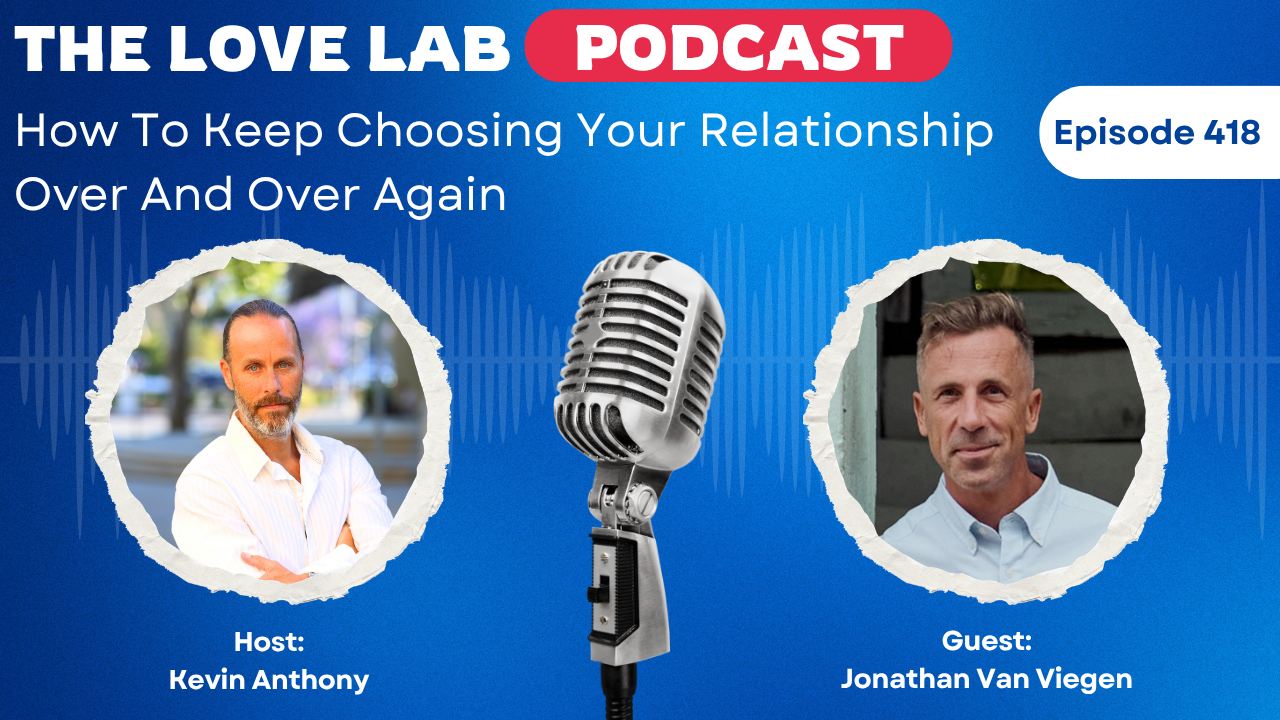
All right, welcome back to the Love Lab podcast. This is episode 418, and it is titled “How to Keep Choosing Your Relationship Over and Over Again. You know, this is something that I’m really passionate about, especially when it comes to relationships, this idea that you have to constantly be choosing your relationship over and over again, and what that really means, because anybody that’s ever done any sort of, you know work around coaching relationships for any amount of time has seen over and over and over again that the majority of problems and issues that couples have, it’s because they just, after a certain amount of time, went on autopilot, right? It’s like we did all the courting process, we got married, we popped out the first kid, and now we just focus on other things in life. Like that part is done, and now it’s time to focus on kids, careers, whatever, and the relationship just runs on autopilot.
Kevin Anthony 1:25
But anybody, anybody who has either done this work for a living or has even spent a little bit of time trying to understand relationships, like you read a couple of good relationship books, you would know that that’s not the way it works. Relationships take care; they take nurturing. They just take effort and energy, and that requires you to choose them over and over again. So I have a guest today who’s going to help us explore this in more detail. We’re going to be talking about, you know, how to feel chosen and cherished in your relationship, and why that might be important. We’re going to talk about why it’s important to create likeability in your relationship, and how do you cultivate that? How does curiosity come into healthy relationships? Forgiveness. We’re going to talk about apologies. In case you’ve never seen the episode I did on ” Your apology sucks. You’re probably going to get a little bit more information on that one today, and then we’re going to talk about what my guest calls identity-level wounds. So we’ve got a lot to talk about today, and I hope that after listening to this, you will be inspired to keep choosing your relationship over and over again.
Kevin Anthony 2:44
All right. Before we dive in, a short word from my sponsor. Are you ready to build deeper intimacy and a more passionate relationship? I hope so. Introducing Intimacy Mastery, the sex, love, and intimacy app for singles and couples. Your personal guide to Mastering Love, Sex, and Connection. Get a personalized plan tailored to your unique relationship goals. Enjoy daily lessons, real-world challenges, and guided reflections. All designed by me, Kevin Anthony, your trusted guide and coach. Track your growth, celebrate your wins, and get expert feedback every step of the way. Access exclusive resources, videos, and proven tools right at your fingertips. Whether you’re single or partnered, this app will help you create the love life you truly desire. The app is available right now at https://www.kevinanthonycoaching.com/go/app. That is https://www.kevinanthonycoaching.com/go/app.
Kevin Anthony 3:41
All right, my guest today is Jonathan Van Viegen, and he is a couples therapist, registered psychotherapist, creator of the Chosen and Cherished method, and author of Choosing Us. For more than a decade, he has helped 1000s of couples strengthen their marriages, while his relationship insights have reached millions of people worldwide through more than 100 million online views. Welcome to the show, Jonathan.
Jonathan Van Viegen 4:07
Thank you so much for having me. It’s a pleasure.
Kevin Anthony 4:09
Got to make sure I get your book out here. We’ll show this again later on. All right.
Jonathan Van Viegen 4:14
Believe it or not, I’ve not held a physical copy.
Kevin Anthony 4:17
Really? So I’ve actually held a physical copy before you have.
Jonathan Van Viegen 4:22
Yes, you have. It’s pretty amazing to see it there on the screen.
Kevin Anthony 4:26
And here it is, right here. And my copy says advanced review copy. So you know that’s what the publishers do to the media peeps. They’ll send out the advance copies. But you know, I’ve read a lot.
Jonathan Van Viegen 4:38
Nice.
Kevin Anthony 4:38
I’ve read a lot of advanced copies, and they always tell you, like, ” This is an advanced copy, so if there are any mistakes, blah blah blah. And honestly, I rarely find mistakes in the advanced copy. Oh, that’s good.
Jonathan Van Viegen 4:49
That’s good to know because, like, my wife and I, we were well. She’s my secret weapon. She’s been the editor of the entire book. She’s read it probably three or four times, and believe it or not, up until. I think the last version we were still finding stuff that needed fixing, so hopefully we got it all. But
Kevin Anthony 5:08
I think you most likely did because you’ve got a you’ve got a publisher here, and they generally won’t let these things out unless they’re pretty good. All right, we’ll talk more about the book later. Let’s just dive into this idea of choosing your relationship over and over again. So, you often use the phrase “building a marriage that makes you feel chosen and cherished. Obviously, most people have their idea of what they think being chosen and cherished means. But what do you mean when you’re talking about that?
Jonathan Van Viegen 5:42
Well, it was funny because when you when you were saying that in in the introduction, I wrote down the word drug, and to me, feeling chosen and cherished is the not the negative drug, but it’s the positive drug. It’s the medicine, kind of the elixir of life, and when you find yourself in a marriage that makes you feel chosen and cherished, I think there’s a completeness, there’s a wholeness that we all feel. It’s it’s kind of this love that you know we we can. It it’s almost like a force field around us that that provides that warm blanket, that safety, that protection-that I’m going through this life with someone who not only chooses me but chooses to cherish me at the same time. And so, to me, what that means is I’m getting everything out of a relationship that I could ever ask for, that’s what chosen and cherished is. That would be to me the the drug of choice.
Kevin Anthony 6:47
So why why would why would somebody think that that’s an important thing to have? I mean, it sounds like a silly question, but we do want to be you know really clear about like. So we’re talking about feeling chosen and cherished, and you just explained what that means. Why is that important?
Jonathan Van Viegen 7:04
Well, I think it’s important because, in that explanation, what that means is I’m beloved. Because we, none of us want to be in a relationship with someone that we don’t like, someone that we don’t, you know, enjoy, or someone that we don’t look forward to when they walk through the front door at the end of the at the end of the workday, right? And to be in that relationship that makes you feel chosen, cherished, reminds you that there’s someone that you want to spend your day with, someone that you want to wake up next to, someone that you choose to be with on the weekend, the first person you call, the first person you’re the first person they call with good news, bad news, whatever it is, and so when you when you were describing that, you know, relationships take effort, care, intention.
Jonathan Van Viegen 8:01
I agree completely with them, but when you really enjoy doing something, it doesn’t feel like effort, you know. And so for me, it becomes that drug of choice because it’s something I want more of, you know. A lot of us drink coffee, you know, to write the book. A little secret: I got addicted to Zins there for a while, and you know, so we’re all searching, you know, for other people. It could be alcohol, other people; it could be sex. But wouldn’t the best drug of choice be our relationship in a positive way, not a codependent, you know, manipulative way, but a truly positive way in which everything that we pour into, we get poured back into and return to me. That would be, you know, just a fantastic place to be in a in a marriage. So,
Kevin Anthony 8:49
Well, I agree. I think that is a fantastic place to be, and I like the point that you made too. Is that, you know, when you’re actually in one of those relationships, it doesn’t feel like work, because one of the biggest objections that you get from people when you’re teaching this stuff is, you’re like, okay, relationships take effort, right? You’ve got to put in some time; like, you’ve got to do stuff, you know. And especially guys will start to roll their eyes and be like, ” So much work. Like, why can’t it just, you know, be easy, you know? And the point you made is that if you’re actually in one of these types of relationships, it feels easy. It doesn’t actually feel like work. So you end up with basically what sort of a self-perpetuating situation in either the good way or the bad way, right? So in other words, if you’re doing all these things and you’re nurturing your relationship and your relationship is thriving, and you love each other, and you love being around each other. Then it starts to feel less and less like work or effort. Whereas if you’re not doing these things, it starts to feel more and more and more like work and effort. Right? It’s like trying to push the boulder up the hill rather than rolling it down.
Jonathan Van Viegen 9:59
Yeah, and. You know, there’s a simple language shift that I would have all your listeners make today, instantaneously, to turn on easy mode when it comes to your relationship. And I write about this all the time. Take the word needs and banish it from your lexicon. Do not ever express your needs to your partner, and that gets a lot of pushback. I, you know, people when they hear me say that, they call me ridiculous. Whether they’re my peers in the therapist world or my followers on social media, what people don’t understand is that the language that we use inside of our relationship first needs a framework because, without a framework or context, we wouldn’t be able to pick the right word.
Jonathan Van Viegen 10:50
And then, once we’ve chosen the word we want to use to describe what’s going on for us, that word’s going to bounce off your eardrums, and you’re going to take that physical vibration and, you know, through those little hair follicles in your eardrums, send meaning to your brain. And what I try to tell couples is that word needs. If you follow my breadcrumbs for a second, it implies that we live in a relationship that is scarce, because any one of us who has had children, and I’ve got a 13-year-old and a 10-year-old, knows that children don’t describe their reality through their needs and what needs are being met. Kids just don’t talk like that. If they want ice cream, this they they’ll scream at the top of their lungs that they want ice cream. They won’t say I need ice cream, right? They express what they want, and there’s a big shift.
Jonathan Van Viegen 11:48
And I spoke about the context. I’m going to elevate my wants and desires to a need because, emotionally, I worry that what I want is actually going to be denied, so I need to elevate it on some deeper emotional level to justify my wanting it in the first place. And so, what I teach couples is to work from a place of abundance. That which you have wants and desires. I chose you, and so I choose to do whatever’s in my power on a day-to-day basis to help you get what you want and deeply desire. That’s an abundance mindset. So couples have a choice. They can say We want to have a scarcity mindset for a relationship or an abundance mindset for a relationship.
Jonathan Van Viegen 12:39
And the couples that choose the word ” need ” describe their needs, and your needs aren’t being met, and why won’t you meet my needs? You know instantaneously whether they’re a therapist, a coach, or whether they’re their clients. You know instantaneously when someone’s using the word need, they have scarcity inside of their relationship. That’s a really interesting way of looking at it, because I think what you’re saying here is, and you used a great analogy with children, because this is perfect, right? Because children will always elevate their wants to needs. It’s like I’m going, you know, with a young child, it’s like I’m going to die if I don’t get ice cream, right? And as a parent, you’re like, ” Ah, no, actually, ice cream. If you eat too much of it’s going to help you die. Like, we’re going to make sure that doesn’t happen to you, you know.
Kevin Anthony 13:25
But I think that’s the big problem, and I think why your method or your theory on that kind of work is that too many people confuse wants and needs, right? Yeah. And that line gets blurred real quickly, and it’s something we learn early on in life that, you know, we’re like more likely to get our wants met if we elevate them to needs, and so I think what you’re attempting to do is to take that out altogether and look at it from that point of view. And actually, this is really great too because this is something that I talk about all the time in relationships. When you are in a relationship with somebody. One of your goals, right, should be to help that person become the best version of themselves that they can be. Their wants shouldn’t be seen as negative. Like if they want, you know, to get to a certain level in their career or whatever it is, right?
Kevin Anthony 14:18
They want to master a hobby or a skill, right? You, as their partner, should want that for them if that’s something they really want. Like, your partner wants to, I don’t know, learn a musical instrument, and you know that’s going to take a lot of, you know, time, right? It’s going to take effort and hours of practice, and probably a lot of not-so-comfortable listening in the house, right? You know, because that’s what it takes to learn an instrument. From you know that point of view, you would say, “Hey, I know this is important to you. I know this is something that you’ve always wanted to do since you were a child, and your parents wouldn’t buy you that instrument because they felt you wouldn’t stick with it, right? But I want to help you do that. In fact, I’m going to help you by either buying it for you or contributing to it.” To buy it and create some space in the relationship for you to do that, because I actually want that for you. When you come from that place, right? The wants are no longer a negative thing, right? And so we don’t even necessarily need to distinguish between needs and wants anymore at that point.
Jonathan Van Viegen 15:17
100%. It’s my eldest. She wants a horse. She got into horseback riding, and she loves riding horses. She came to me one day, and she said, “Dad, I want a horse. And I said, “You know, I’d love to help you get it. Let’s put our heads together and figure out the best way to do that. And I could have been that parent that shuts her down and says, “I’m not buying you a horse, but then I could be saying no to a future Olympian who is an equestrian rider, right? So we want to cultivate and build a home in which everyone in that home believes that when they express something that they want, the automatic reply of their partner, their parent, their sibling is, “How can I help you get what you want? It’s such a simple statement. It doesn’t mean you’re going to give it to them, but you want to cultivate this type of relationship in which people feel safe enough to express what they want without having to elevate it to a need.
Jonathan Van Viegen 16:12
Which was the second part I was going to make about, or the second point I was going to make about: we have the context, and we have the word choice. Now I’m a sigma, so I don’t do anything that anyone asks me. But I, so I’m, but I don’t think I’m completely unique. I actually think when people hear the word needs, when someone when their partner approaches and says I need something, I believe all of us see the hair stand up on the back of our necks. I think we hear that word, and we recoil, and so, just, you know a just an easy tip would be to eliminate that word needs from your relationship, and you’ll adopt a truly abundant mindset for your relationship.
Kevin Anthony 16:55
Yeah, I would love to hear from people. You know, if you listen to this episode and you actually try this, you implement this in your relationship. I’d love to hear in the comments if you notice a shift and how that works for you. I love the idea of seeing the relationship from the point of view of, you know, more of a positive, abundant mindset rather than a negative one. I mean, I don’t really know how a relationship could survive long-term or have any real development or happiness if you’re constantly looking at it through a negative lens, which I know a lot of people do, and I think that’s why they struggle so much.
Jonathan Van Viegen 17:34
Yeah, and I think that’s why you and I do the work that we do. Like we’re trying to help people move beyond those types of relationships, yeah, and enter the ones that feel safe, you know. And to me, I think ultimately that’s what chosen and cherished is. It’s they’re they’re prettier terms to me than safe because I can do something with it. I can tell you I choose you. I can tell you that I cherish you. Saying that I want a safe relationship is, to me, a dangerous word because of safety. We don’t often see it on a spectrum. You hear people when they use when they talk about the word safe; they say I am safe or I am unsafe. Whereas, you know, a better word than safety would be connection. See connection. I’m more connected, or I’m less connected. Connection tends to live on a spectrum, whereas safety is usually a binary. I’m either this or that. And to me, chosen and cherished is basically the delivery mechanism of connection.
Kevin Anthony 18:37
Yeah, you know, it’s interesting. I understand when people say that they want a safe relationship. I would caution them not to make that the main focus or the main thing. It’s a component of a relationship, but, you know, I mean, if we even go back to our founding fathers, right, and we talk about their idea of, you know, safety versus liberty, right? Like you can have a very authoritarian type situation where it’s safe, right? Because somebody’s got complete and total control over everything, or you can have liberty, which maybe feels a bit more dangerous, but you’ve actually got freedom. It’s a little bit of an aside. It’s not a perfect analogy, but I just caution people to say that, like, if safety is the main thing you’re going for in your relationship, you could end up with a very safe but very boring and very unhappy relationship. Right?
Kevin Anthony 19:35
It’s safe because you both decided neither of you was going to go anywhere, but there’s no spark necessarily. There’s no joy in it. There’s no development, right? That kind of thing. So safety is great, and we want to feel safe. But I would say it’s not the main thing that you’re going for. It’s a component of. So I think that’s in alignment with what you were sharing, and that’s I think. Part of why you chose to use different words,
Jonathan Van Viegen 20:02
Yeah, 100%. Well, I mean, you’ve seen the image of the lion in the cage, and then the lion on the savanna, and it’s like one gets three meals a day, and the other’s got to figure out his own food. Which lion would you rather be? And I think you make a great point there because safety is about building the bars around our relationship, and usually the bars that we use are boundaries and/or privacy. These are two other buzzwords that get thrown around a lot that I don’t really like. Rules would be another one, and all of them trace their roots back into this place of scarcity, where I can’t get what I want, and therefore I need to elevate that. I’m operating from that scarce mindset, and then you’ll build these rules, boundaries, and privacies around yourself, around your relationship.
Jonathan Van Viegen 20:58
The only trouble is that people are all just wired to mess up. Like we’re wired to be thoughtless, lazy, and insensitive. Usually, multiple times a day. For me, half a dozen times before lunch. So if I have to remember rules, boundaries, and your privacies, I’m gonna mess up. And then when I do, you’re going to be deeply disappointed in me. And to me, you know, whether I’m working with clients or what I’ve written in the book, I I want to I want to move us towards us pointing our noses in the same direction. And it’s why I rely heavily on the idea of sameness. You know, we are one. We are together. I like Mark 10 verse eight. You know, to become one flesh. I truly believe that that chosen, cherished marriage is when two people look like that elderly couple that is recently retired, and they’re you know they you you run into them and they’re jogging on the footpath down by the water, and they got the exact same shoes and the same running outfits, and you know that they bought them at the exact same time, except their colors are a little bit different. To me, that’s like the ultimate physical manifestation of sameness, where they look the same, dress the same, talk the same, and is because they’re moving in the same direction through life together. They’re not trying to live these independent lives, right?
Kevin Anthony 22:23
Yeah, and for anybody who’s like, “What, I have to give up my independence? That’s not what he is saying. I just want to nip that in the bud right now. Thank you. You know the term that I use a lot. I use it in my sales page for my couples coaching program, stuff like that. I have T-shirts. I can’t turn the camera over there, but my T-shirts are over there. I have a whole symbol for it. I use the term relationship synergy, right?
Jonathan Van Viegen 22:48
Oh, I love that.
Kevin Anthony 22:49
And and I I wish I could grab it. Unfortunately, I can’t grab it at the moment. I have a pile of T-shirts over here, but the one I need is actually on a mannequin at the moment, so I can’t grab it. But I designed basically a version of the ancient Chinese symbol of the yin yang, and it’s blue and pink. And in the little dots, the opposite dots have the male and female symbols. And what I was trying to capture with that when I created it was this idea that you’re talking about, where the two come together as a whole, yet they still have their own senses. Like, you know, they haven’t, because you’ll hear this in relationship talk all the time about, you know, abandoning yourself, right, and losing yourself, and they haven’t lost themselves.
Kevin Anthony 23:33
They’re still themselves, but they come together in that way. And when that happens, you do tend to do things like, you know, buy the same jogging outfit, or you’ll get dressed independently because one of you got dressed earlier. You’ll go downstairs and meet at the breakfast table, and you’ll realize you’re both wearing the exact same colors, the same color top, same color pants, or whatever. And you’re like, we didn’t even do that intentionally. I didn’t even see you dressed, right? But it just starts to happen. Things like that, where you’re you’re you’re working, or you’re operating in this realm of synergy that just sort of happens naturally.
Jonathan Van Viegen 24:09
Yeah, I 100 agree, and I think I think where that that sameness, what what kind of fuels it, or at the very least, what kickstarts it- if you’re not experiencing it now in your relationship, is growing the likability for each other. That’s cultivating a deep fondness and admiration for each other. I like who you are, and more importantly, I choose not to attach my perception or judgment of you to your behavior. And this is the, you know, the big shift that I try to help people make is understand that your partner is more than their worst behavior, and, in fact, their behavior says nothing about who they are as a person. You know, we all know the homeless people on the big city streets, and you know we could see the drug addict, or we could choose to see the. Son, the brother, the neighbor, the friend, right? So we’ve got to separate what people do from who they are, and so I teach couples: let’s go and like each other again and grow that fondness and admiration.
Jonathan Van Viegen 25:13
And you will see that when someone feels good about themselves because I’m affirming who they are as a whole person, you will see them sweep their own side of the street. They don’t need to be told to behave better. They intrinsically want to do that because they feel that the reward at the end of that behavior is being reminded again that they’re liked by their partner, which is why being beloved to me is better than being loved. To be found beloved by your partner is the the end goal.
Kevin Anthony 25:43
Yeah, I mean, and you’re absolutely right. When you’re in a relationship where, you know, to use your words, you feel chosen, you feel cherished, you feel liked by your partner, you do naturally just want to do the things, you know, to keep that going, right? Because everybody wants to be liked, right? Like you, and again, you feel like this person has chosen you; they’re cherishing you. You hopefully feel the same way back towards them, so you naturally want to step up and do the things, even though some of those things sometimes are not necessarily things that you would normally do or even want to do, but you do them because you know it makes the other person happy or it makes them feel good or you know whatever that is.
Kevin Anthony 26:30
So I think that is a version of the difference between the carrot and the stick, right? Whereas I think a lot of times in relationships, people get into this place where it’s like, I’m going to threaten. I’m going to threaten to leave you. I’m going to threaten to withhold sex from you. I’m going to, you know, berate you, criticize you, complain, and your only real motivation to do the things that you’re supposed to do is to avoid all of that, right? So, that’s like I’m just trying to avoid pain, right? It reminds me of actually one of my favorite movies. You ever see Office Space? Yes, one of my all-time favorite movies. When he’s talking about how he has eight different bosses, and he says, “My only real motivation is to not get yelled at by eight people, you know, or some version of that. And I think, unfortunately, that’s the way a lot of people operate in their relationship. It’s that sort of negative side again, instead of the positive side.
Kevin Anthony 27:29
Whereas on the other side is, like, if I do, you know, the things that you know I should be doing to nurture my relationship, to help it grow and to keep it alive and happy, and to, you know, help my partner become the best version that they can be. There’ll just be a natural reward. There’ll be more love. I talk about this all the time when it comes to sex with guys, right? Because a lot of times guys can be a bit selfish in the bedroom, right? And it’s more about them and their orgasm. And I say, guys, look, if you do a good job and you make it really good for her, she’s gonna want more of it, right? The reason she doesn’t want sex a lot of the time is that it’s not really good for her. It’s too short. She never gets to her orgasm. She doesn’t get the things that she needs out of it. So she’s like, ah, well, I could take it or leave it, right? But if you do a good job, she’s like, yeah, I want more of that. And so, just a couple of different sorts of analogies to help illustrate that point of when you’re doing those things, your partner will respond, and then you create this positive reinforcement.
Jonathan Van Viegen 28:31
Well, and and but it’s it’s also on that note to me. It’s we have a choice on what action we’re going to take to improve our relationship. So we’ve got 98% of therapists and experts and coaches out there telling you to communicate your needs better, set better boundaries, establish your privacy. That is one path people could go down, or you could go down a path of better expressing your wants, reminding each other that I choose you, and reminding you that I cherish you. What direction would you want to go if you wanted to build a better relationship?
Jonathan Van Viegen 29:06
One to me just seems far more divisive, far more negative, and filled with friction than I would ever want. I couldn’t even spend five minutes going down that path. I can’t even make content. I you will not find on any of my insight. I can’t literally say the words, avoidant narcissist. These words literally can’t come out of my mouth because I think what people forget is that the wife you’re calling anxious or the husband you’re calling avoidant. At the end of the day, you still need to go and sleep next to them, and you need to wake up next to them. And the danger we run, or get really close to, you know, letting it consume our relationship, is that we put them in a corner where they don’t feel good about themselves. I just don’t know anyone who feels like they want to show up better in the relationship when they’re not feeling good.
Kevin Anthony 30:06
Yeah, you know, I don’t think there’s anything wrong with establishing boundaries and doing those things. I think the problem comes in when people interpret those things because, you know, setting a boundary can be a very good thing, or it can be divisive, depending on how you choose to see it, right? And so I think maybe one of the challenges that you know we as professionals have, and I see that you’ve found a way to work around that challenge, which is by changing the language. I think one of the challenges is is is if you just tell somebody like, hey, you need to set some boundaries, or hey, you know your partner is you know an avoidant or an anxious attachment style, without really explaining to somebody how to use that in a positive proper way, there’s there’s there’s real a real chance that they might use it the wrong way. So just to take one thing as an example, attachment styles like attachment styles, it’s a nice frame to be able to understand somebody and how and why they behave the way they do.
Kevin Anthony 31:14
But if you use it the wrong way, you can wield it as a weapon. You would never do this because you’re, you know, avoidant or you right now it becomes accusatory. Now you’re hitting somebody over the head with it, right? Rather than using it as a tool to try to understand why somebody is, you know, manifesting the behavior that they’re doing. So yeah, without some real guidance, I can see how those types of things could be taken out of context, and I think that’s maybe one of the big limitations for people when they’re sort of doing the self-help thing, right? You know, you go out and you read a book about attachment styles, and you go, “Oh, see, I knew it. I knew my partner wasn’t avoidant, and right, and now, now you’re gonna you’re gonna see everything through that lens and wield it as a weapon in the relationship, rather than as a tool for insight to understand.
Jonathan Van Viegen 32:05
Well, I think arriving at that final destination of that label really, for a lot of people, ends the curiosity journey. So I now have the diagnosis. I now have the full understanding, and so I stop asking questions. And so, you know, when I say people don’t need to set boundaries, the boundary that the way I set boundaries would be like this: in the bedroom, this doesn’t feel good to you. That’s all I need to know. I’m gonna trade what doesn’t feel good with what does feel good, so rather than saying I’m not gonna do this, I’m not gonna worry about what I’m not gonna do. I’m gonna worry about what I should do in the exact same way that you described. You know, when you show up for your partner in the bedroom, and you make it about her and you, you know, cherish her in the bedroom. She’s going to want to cherish you back, so we can just skip over what we don’t want, which is what all those boundaries are meant to define. And we could just jump right into what you want, right? And in knowing that there’s no fear, shame, guilt, or embarrassment around you expressing what you want, you can just tell me what you want, and I exist to help you get it.
Kevin Anthony 33:22
Yeah, you know, if I could sum up your sort of philosophy with this, I would say it’s very much a glass-half-full versus a glass-half-empty. You know, because a lot of a lot of like the ideas are still very similar. It’s just you’re choosing to view them as, hey, I got a glass that’s half full, rather than looking at it from the point of view that it’s half empty, right, and potentially getting worse. So, and I think that’s beautiful. I think we need a lot more of that positive outlook in life these days, because there is a lot of difficulty in the world these days, and I think that also bleeds over into people’s relationships and sort of reinforces seeing things from the negative side. So I think anything that helps people see it more from the positive side is a good thing.
Jonathan Van Viegen 34:15
Well, and it’s and I know you’re about to say something, but it’s just about what do you want to timestamp? Like, do you want to timestamp the pain, or do you want to timestamp the connection and the joy?
Kevin Anthony 34:25
Right. So that is a good point for sure. Put more energy and focus on the things you actually want to create. Yeah, rather than the things that you’re trying to get rid of. Okay, we still got a lot to talk about. We’re a little bit more than halfway through the show, so I need to take a quick break for my second sponsor, and then when we come back, I want to dive more into the curiosity and even the likeability a little bit more, because I want to talk a little bit more about those.
Kevin Anthony 34:55
If your relationship feels disconnected, if your sex life has lost its spark, or if you just know. Something needs to change. Then relationship and intimacy coaching can help. I have created transformational coaching programs for men, women, and couples, all designed to help you create deeper intimacy, better communication, and the kind of passionate relationship you actually want. Whether you’re struggling with intimacy, confidence, desire, emotional connection, or recurring relationship challenges, you don’t have to figure it out alone. The best place to start is with a free strategy call, where we’ll talk through your challenges, get clarity on what’s really going on, and create a personalized plan for moving forward. Go to kevinanthanycoaching.com today to book your free strategy call. That is kevinanthanycoaching.com. The link is in the description.
Kevin Anthony 35:42
Okay, so we covered quite a lot actually in the first half, and there were a couple of things I wanted to dive into a little bit more. First thing, which I wanted to cover earlier, but we just went down another path, and it’ll be super quick. You know, when people hear the words chosen and cherished. Any guy that’s done at least some work to be a decent partner has come to the conclusion, hopefully, that his woman wants to feel chosen and cherished. This is like you will hear this language coming from women all the time. I want to feel chosen. I want him to choose me, right? I want to feel cherished and loved. You will rarely actually hear men use those particular words, right? My question to you, and I already know what you’re going to say, but I want you to I want you to say it in your words for the audience. Yeah, is it only women who want to feel chosen and cherished in their relationships?
Jonathan Van Viegen 36:41
Well, that’s a great question, and it’s funny that you brought up your T-shirt with the yin and yang, and I hope to get one so that I can wear it and on one of my YouTube videos. I see those words as having, well, each of those words has a slightly more dominant side to them. So to me, the word “chosen” tends to apply to a greater degree to women, and “cherished” tends to apply to a greater degree to men. And the way I explain it, and not saying that we don’t all want to feel both- I just think there’s a dominant side to each of us, to both genders. Women want to feel chosen primarily because if you were to ask 100 women, 99 of them will tell you that they want to be the only woman who occupies real estate in her husband’s or her man’s mind. They and it. I’ve seen couples where he came into the marriage with a daughter from a previous marriage, and his new wife will feel in competition with his daughter.
Jonathan Van Viegen 37:56
So even in that scenario, there is no competition. There’s no competition because his daughter doesn’t sleep in the same bed with him at night. There’s, he needs to be a father, and he also needs to be a husband. Those roles don’t need to compete. But in that woman’s mind, even that can sometimes feel like she’s losing to another woman; it could also be her mother-in-law, for example. That you’ll see this quite often too, and really, but it. And I should also actually add that it’s why women absolutely can’t handle a man liking, commenting, or DMing with women on social media. They see that that that that pain when they discover that their husband’s got an Instagram account that he’s liking other girls; that may as well just be as big of an earthquake as cheating, and it’s because it goes back to this desire, this absolute want to feel like she’s chosen, so she’s got to be the prize. Ask 100 men what they want, and 99 of them will tell you they want to. They want peace at home, and they want to feel respected.
Jonathan Van Viegen 39:11
And so, with men, it’s a little bit difficult because they won’t actually come out and say, “I want to feel cherished, but they will. They definitely want to feel liked. And the way I extrapolate that is that no woman would ever cherish a man if she didn’t like him. So she’s got to like him enough, and if she does like him enough, she’ll make his food. She’ll be intimate with him. She’ll want to be close with him. She’ll be affectionate. She’ll give him that peace. She’ll understand that he’s not a perfect father, but she won’t hammer him on it every single time he makes a mistake. She will cherish him, to use his words, if he wants that peace and that quiet when he walks through that front door. So, I think men tend to choose more than they want to be cherished. Women definitely want to be more chosen, but that’s how. I would kind of divide it. No, I again think that we all want a little bit of both, but I just think that we have our dominant side.
Kevin Anthony 40:07
Yeah, I mean, I agree. We both want both. We would probably use different language to describe it if you ask. It’s just like you said. If you ask 100 women or you ask 100 men, here are the answers you’ll get. And I just kind of wanted to sort of get that out of the way. I didn’t want anybody listening to this thinking, “Well, but this isn’t really just women who want this. And like, what about the men? You know, trust me. I read the comments. I read every comment on my YouTube videos. I hear this stuff from people, and it’s like, no, we all want to feel chosen. I want my woman. I want to feel like my woman chose me because she sees me as, you know, a solid man, a good person, a good provider, a good protector, like all that stuff, right? Like I want to know that she chose me because of that, and I also want her, of course, to like me. You know, like, here’s a great way that men like to feel cherished. So you’re out. You’re with a group of people, right? And does your woman say positive things in front of the group, or does she criticize you in front of the group? Right? You will see a lot of women negatively criticize their men in front of other people. This is death to a relationship, and it’s the absolute opposite of cherishing your man.
Jonathan Van Viegen 41:27
100% Yeah, I I I use that, like, to me, the analogy that comes to mind in my own marriage is my wife, and I just recently got into watching Homeland, and you know we’ll we’ll the kids will be hanging out. My wife and I will have dinner, and after dinner, we’ll put on an episode of Homeland, and she’ll just, in the middle of the episode just reach over and start playing with my hair, right? And that, to me, is the chosen and cherished marriage. That, to me, is truly feeling cherished. That after 18 years, this woman likes me despite all the tremendous amount of flaws that I bring into our relationship, enough to want to, you know, stroke my head, right? That’s what men are after. That’s what the drug should be. You know, like how we got started, and this is what I say to men: like, wouldn’t it be fantastic to come home and to know that your wife is excited that you walk in that front door?
Kevin Anthony 42:22
Yeah, well, you know, I will say you do have some pretty nice hair, so maybe that hasn’t happened. Just kidding. I’m just slightly jealous of your hairline because mine seems to be getting a little further back.
Jonathan Van Viegen 42:33
Am I sitting in the back? Don’t worry. Yeah. At 50, we all age, but I also think it’s good for us, too, because I think no one wants to take couples therapy advice from a 25-year-old man, right?
Kevin Anthony 42:51
Yeah, I totally agree. So, you know, I’ve only had the beard here for about the last four years. So, when my wife was alive, I did not have a beard. You watch any of our older shows or old videos? There was no beard, and I had no intention of growing one. But in my mourning period after she passed, I just couldn’t bother to do simple things like shave, you know. And it used to be that when it got to a certain point, it would just irritate me so much. I’m like, I can’t deal with this. I’d have to shave it off. But for some reason, probably because I was so distracted with what was happening, I didn’t even notice. And one day, I looked in the mirror and was like, “Oh wow, it’s almost basically a beard at this point.
Kevin Anthony 43:33
And I was like, “Oh, yeah, I kind of like it, actually. Kind of looks good. So I decided to leave it, right. But then people would say things like, “Yeah, but it makes you look so much older because it’s so gray. You know, like you don’t have gray anywhere else, but your beard is really gray. And I said, you know what? I’ve noticed since I’ve left this grow and kept it, people actually take me more seriously now in my line of work. They really do, because, you know, I always had a little bit of a baby face. I always looked a lot younger than I actually was, and actually, people because I would get comments like that on my YouTube videos. People say, “Why should? Especially my wife was younger than me, and she was beautiful, so she looked even younger than she was. And people would comment on the videos like, “Why should we listen to these two? They’re too young. They don’t know anything. Like, seriously, those were almost exactly the words in YouTube comments. So now, yeah, looking a littleolder helps a bit.
Jonathan Van Viegen 44:27
100% percent agree. It’s why I let the gray grow in on the side.
Kevin Anthony 44:33
So that’s right. It makes us as men look a little bit more distinguished, as they say. All right, we’re getting close to the end of the show, and I got so many other things that I really want to talk about. But one of the things I really wanted to come back to, since we’ve already approached it here in this show, is the idea of curiosity in the relationship. Can you talk a little bit about, you know, again, what that means and why that would be important?
Jonathan Van Viegen 45:00
Yeah, you know, I love curiosity for couples that, for for not just couples in distress, but also couples that want to build a stronger relationship. When you think of the work that you and I do, the only tools we have are questions. That’s all we can do. I can’t prescribe medicine. I can’t give you electroshock therapy. Not that I’d want to. All I can do is ask you questions to help you get more insight. And I’m assuming that if you get more insight, you’ll be able to have a direction about how to move forward. To me, that all stems from those wh- questions: the who, what, when, where, and how, not the why question. Though the why question is the wrong question to use for curiosity.
Jonathan Van Viegen 45:49
A lot of people do: Why did you do this? Why did you say that? Why couldn’t you have done this? Like that’s the why question just leads us down the path of being the investigator, the interrogator. We don’t want that. I’m talking about the, you know, what made you choose a bob over a bang trim for your haircut that you’re going to ask your wife, right? Or how does your day look? I’d love to take you out for lunch. I’m asking you guys to use curiosity to neutralize pain and resentment, because the fastest way you can take someone out of a negative state of mind is to be curious about them, their lived experience. I’ve done applied suicide intervention training, and you know, even the people I was the person that you would call when someone’s, you know, standing on the edge of a building or a bridge, and we’re just taught to get the person talking. Please do this as well. They they they try to talk to someone in a crisis situation just to get them feeling like someone sees them and is interested in them and hears them.
Jonathan Van Viegen 46:56
And so the clinician in me, you know, learned early on that not only am I doing this with my clients, but men, particularly, aren’t nearly as curious as they could be about their wives. And if you kind of trace it back to, you know, early men, we have our physical prowess: if we need to neutralize a threat, I could literally fight you. Women, on the other hand, can only neutralize a threat through conversation. They have to talk, right? They’ve got to talk that threat down to a normal level in order to be able to extract themselves from feeling unsafe. While women today still love to talk, and men still think that they don’t need to talk, if I wanted to make my wife feel chosen and cherished, I would just get really curious about her, and I would start asking her a ton of questions. So, to the men out there, I would say, I don’t even care what your questions are. I know the questions I could ask my wife. I could, but what another man should ask his wife-that’s neither here nor there. There, just go through the wh questions, start asking her questions about her day, her hopes, her dreams, her life, and you will see the resentment and that pain melt away because now, for the first time in perhaps a very long time, she actually feels like she’s that you’re seen or that she’s seen by you, right? So,
Kevin Anthony 48:25
Yeah, I completely agree, and you’ll definitely hear that a lot from women that they want their partners to ask them more questions. You know, even myself who asks people questions for a living, I still hear that from my partner. Like, you know, you could ask me some more questions, and I’m thinking, I thought I already did ask a lot of questions, but I guess, I guess I could be asking more. So yeah, that’s definitely something that you hear a lot from women, and I think it’s actually not that difficult for us to do, y
Jonathan Van Viegen 49:03
No. The wh-questions. Honestly, it doesn’t matter. Now, I mean, it helps if you can read the room a little bit. So you know, like if you see your wife walking in, you know, it’s a very good analogy that I give a lot of men. Do you know the name of the man or woman who cuts your wife’s hair? If you don’t know that level, or that deep of a level of her world- that you know that her hairdresser’s name- that’s where you should want to aspire to grow to. That you get to know your wife. You know why she does? You know why my wife wears running shoes versus sandals, or how do how do am I know, based on the weather if she’s going to wear a skirt or if she’s going to wear pants? Right, you want to get to know your wife to that degree, and if you do, if you remind your wife that you choose her and you’re curious about her, she will never leave. Your relationship will never end; she will never leave.
Kevin Anthony 50:03
I agree. You know, when my wife passed, my father, who’s still alive, you know, flew out because you know he understood that you know when you go through something like that, you’re not necessarily thinking clearly, and it’s helpful to have somebody else around to help you make all the decisions that have to be made. So he comes out, and he’s like, “Okay. He’s like, “You need to figure this out. You need to get this information. You need to figure out that. And I just looked at him, and I said, “I know everything. Everything. You ask me any question about her, her family, anything that would need to be handled. I know it off the top of my head; I don’t have to look anything up because I had that level of knowledge. And yes, it comes from asking questions. It also comes from listening skills, and it also comes from observational skills.
Kevin Anthony 50:56
A lot of times in relationships, you know, people are just they’re focused on whatever they’re focused on, and their partner’s doing their own thing over there, and they’re not really paying any attention. Or when she comes home from, you know, work or shopping or dealing with the kids or whatever, and she’s talking and telling you all about it because that’s what she wants to do to connect with you. You kind of hear it, but you’re also doing something else, and you miss half the details in between, so paying attention. You know, like my wife was an amazing cook. Like could have been a professional chef. She was so good at what she was able to do. And after, you know, she was no longer here, obviously I had to make all the meals myself. And like, I would occasionally cook meals for other people, and I’m actually pretty good at it. And they would say, “Well, how did you learn how to do it? I said, “Honestly, the only meal I ever cooked in all the years we were together was breakfast. Like, breakfast was kind of my domain. Like I could master omelets and pancakes and breakfast stuff, right?
Kevin Anthony 51:57
But I never really touched anything else in the kitchen. So how is it that I could actually cook all that stuff? Because cooking was a passion of hers, and I simply paid attention to something that she loved. I learned just by watching her. I would see her in the kitchen making meals, and I’d say, “Oh, how come you do it that way? Oh, why did you put that in there? I never had any intention of cooking it. Never thought I would at least anyway, but I just paid attention, and I was curious, and I asked questions, and so you learn that kind of stuff. Okay, I got one more thing that I really want to get to before we wrap up, and that is the idea of forgiveness. So you also say that forgiveness is essential in a relationship. Let’s talk a little bit about why that is, and then we’re going to have to talk a little bit about exactly what forgiveness is, because you will see people say they’ve forgiven, or they’ll use the word forgiveness. It’s not really forgiveness if you really, if you really analyze it, so let’s talk a little bit about that.
Jonathan Van Viegen 53:04
Well, you know, I, I, I think one of the biggest issues with forgiveness is that people are afraid to forgive because they feel like they’re that the behavior that they have to forgive is going to be a recurring behavior, right? Now, another, you know, whether it’s an earthquake like an infidelity, there’s, you know, there could be a giant shock like that that needs forgiveness too. And I think that takes a lot more time and a lot more effort. To me, forgiveness means that I choose to separate you from your behavior. I choose to separate what you did from who you are. And when I’m looking at your behavior, and when I’m saying I’m forgiving your behavior, it means that I will make you whole again, and I will keep you as that whole person.
Jonathan Van Viegen 53:52
And so, when someone almost pridefully says that I don’t forgive people, and I’ve worked with people in the past who have said that they almost say with a sense of pride, that I don’t forgive, I think to myself, you know, one of the risks with that is that you’re basically saying that I’ll never see you as a good person again. I’ll never see you as someone who’s more than your worst behavior, and the danger in that is that the person on the receiving end, or, you know, that should be on the receiving end of that forgiveness, will eventually leave your relationship, even if they are the ones who cheated, because if they can’t be made whole and be seen as a good person again inside of their current relationship, they’ll leave that relationship and go and establish a new one, because none of us can walk around being 60% of ourselves or partially good. We need to be seen as, you know, completely good. This goes to the identity-level messages that I that we all crave to know about ourselves.
Jonathan Van Viegen 55:00
So, for example, I want to know that I’m stable. I grew up with a deep, livable wound- an abandonment wound as a child- and so I want to know that I’m stable. My wife wants to know that she’s good enough, which is very common for a lot of women. And so, I’ve had to then say to my wife that, sweetheart, no matter what behaviors you have, they are never going to go away. Like my wife, you know, if she’ll send an email to the wrong email list, she’ll have a really difficult time just saying, “Oh, sorry, that was my mistake. She will try to talk her way out of it or defend her way out of it. I finally had to say to her, “I said, you know, sweetheart, you will be by me unconditionally forgiven for everything because I love you and you’re perfect. I may get irritated by your slip-ups, but I’m not holding those or attaching those mess-ups to your identity. I’m just seeing those as mistakes, and we all make mistakes. We’re we we we’re all prone to being thoughtless, lazy, and sensitive, you know. If we weren’t, then we would be like Jesus on Earth, right? But the reality is, we’re all going to mess up, and so, to me, forgiveness is about saying that you’re a whole person. That’s the whole purpose of forgiveness.
Kevin Anthony 56:15
Yeah, I couldn’t imagine being in a relationship where I felt like my partner was still holding those things, right? And that there was never any way that you were ever going to be able to remove them or get rid of them. Like that’s that’s not a sustainable situation. No,
Jonathan Van Viegen 56:36
And they’ll never apologize. And I just wrote about this last week. That there’s a there’s a reciprocity. It’s very transactional in relationships, but it it should be transactional in a good way. So if I know that I’m going to be forgiven for the things that I mess up by you, I feel safe to go to you with the deepest apology. I can look you in the eye. I can be genuine, sincere, and say, “I’m sorry, I messed up, because I know you’re going to protect my identity on the back end by saying, “I forgive you.
Kevin Anthony 57:13
Yeah. So, yeah, and I think it’s important too. I mean, obviously, some things are bigger and more difficult than others, but take time. But what you were saying is, yeah, everybody does make mistakes, and if we attach those mistakes to who they are as a being and what their worth is as a person and as a partner, that’s a big, big problem. Because, you know, we were talking about this idea of cherished and chosen, or synergy, or sameness, or like, we’re talking about all these words, but how could you possibly see your partner as that if you keep dinging them down with, you know, attaching all of these negative things to who they are as a person? Like, how are you going to really cherish somebody that you basically don’t respect because you’ve attached all this negativity to who they are?
Jonathan Van Viegen 58:07
Yeah. Well, and the more negativity you attach, the more likability you lose. Yeah. Right. We we we just tend not to forgive people we don’t like. So if you struggle with forgiveness in your relationship, the bigger red flag is your lack of likability for your partner, and then you have a choice. You either decide to grow your fondness and likability for them, or you cut them loose. But if you think that the recipe for a long-term happy relationship is not liking your partner, I mean, you may go the distance, but it’s going to be an unhappy one.
Kevin Anthony 58:45
If you think that’s what’s going to make a good relationship, you have a lot of work to do. I certainly hope nobody out there. Well, I’m sure there are some, but I certainly hope that there isn’t anybody out there thinking that’s the secret to a successful relationship. Oh my! Well, hey, you know that’s that’s a lot of the work that you and I are doing is trying to change those narratives and sort of reprogram any of those thoughts that might be out there. So, all right, so we are at the end of the show. There were a couple more things I wanted to get to, but I think we did a pretty good idea, or a pretty good job. Sorry for explaining the idea that we mean when we say choosing your relationship over and over again, and what that really means.
Kevin Anthony 59:35
And obviously, of course, if people want to know more, if they want to go deeper into any of those things, like I wanted to go a little deeper into the likability thing. I wanted to talk a little bit more about, like, forgiveness and apology, identity-level stuff. So there’s a lot more to explore there that we just didn’t have time. You did write a book, yeah, called Choosing Us, which we showed at the beginning, and I have a copy here. So tell people where they can find out more about your work and the book that is coming out.
Jonathan Van Viegen 1:00:07
It’s a great, great segue. Probably the best is to go to my website jonathanviegen.com, if they want to find out more about the book. jonathanviegen.com forward slash book. We’ve got a lot. We’re full on the pre-order campaign right now. So everyone that goes and pre-orders their copy, we’ve got a bunch of live events planned. But the biggest one is once the book launches, I’m going to be running a six-week live program called My Chosen and Cherished Marriage Intensive that everyone’s going to get a seat in. So we’re really excited about launching that. And another really great place to find me is on YouTube: Jonathan Van Vegan. I’m putting out more YouTube videos these days. It’s a lot of fun. Although I’m a writer, that’s why I always gravitated towards Instagram, so they can find me over there. But you know, my writing tended to get kicked off on Instagram. That’s kind of where, where everything grew out of. And then these days I’m on Substack. I enjoy writing essays on Substack and go a lot deeper. There’s no caption limit there, so people can come find me on Substack. It’s just Jonathan Van Vegan over on Substack as well. So
Kevin Anthony 1:01:19
Excellent. Well, of course, the link to your website will be in the show notes. So, if you think you know how to spell Jonathan Van Vegan, you may not. So, please just go into the notes. Like, it’s just click, you know, more, and then you know, you can click directly through to his website. You don’t have to remember how to spell it. Jonathan, I want to thank you for coming on the show and sharing your sort of unique approach to things that I think people haven’t really heard before, so that’s really cool. It’s it’s it’s fun to get sort of a new perspective that we haven’t heard in a while. So I want to just thank you for coming on and sharing that.
Jonathan Van Viegen 1:01:59
Yeah, thank you so much for the invitation. It’s been such a pleasure. It’s been a great conversation. So I really enjoyed it. Thank you so much. You’re welcome. I enjoyed it as well. All right, everybody. That’s all the time I have for this episode, and I will see you next week.
Kevin Anthony 1:02:20
I hope you liked this episode of the Love Lab podcast. If you enjoy this show, subscribe, leave me a review, and share it with your friends. And for more free exclusive content, join me in the Passion Vault at https://www.kevinanthonycoaching.com/vault/. That’s https://www.kevinanthonycoaching.com/vault/. Thanks for listening, and remember, as Celine used to say, “You’re amazing!”
Kevin Anthony is a Certified Sexologist, Tantra Counselor, NLP Practitioner and a Sex, Love & Relationship coach. For over 10 years he has worked with men, women, and couples to have the relationships of their dreams, and the best sex of their lives! He is also the host of “The Love Lab Podcast”, creator of the popular YouTube channel Kevin Anthony Coaching, and creator of the popular online course series “Power and Mastery” as well as other online courses for both men and women.