Kevin Anthony 0:01
Kevin, welcome to the Love Lab podcast, the place to be for honest and real talk about relationships and sex, whether you’re a man or woman, single or couple, this is the show for you. I am your host, Kevin Anthony, and I am here to help you have the relationship of your dreams and the best sex of your life.
Kevin Anthony 0:27
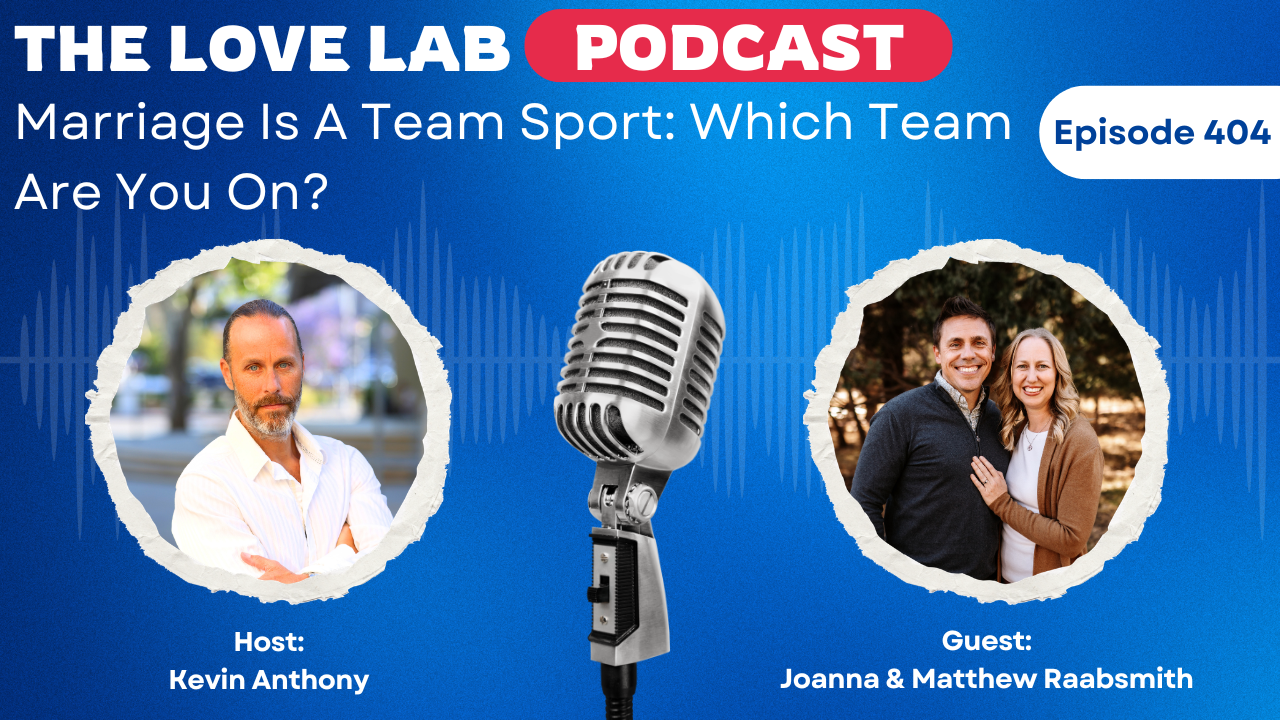
All right. Welcome back to the Love Lab podcast. This is episode 404, and it is titled Marriage is a team sport. Which team are you on? And I always, I always like to say it like that, because I’m really excited to have this conversation today. So, I have some guests. If you’re watching on YouTube, you can see them already, and I’m excited to talk about this because the whole idea of being a team in a relationship is something that I have been teaching from the beginning of my coaching career.
Kevin Anthony 1:06
It is something that my wife, Celine, when she was alive, and I would always teach people, it’s like you got to function as a team, and unfortunately, what we saw, and what I continue to see to this day, is people who are in a couple, whether they’re married, they’re dating, whatever it is, but it’s like they’re operating on opposite teams, they’re competing with each other within the relationship all the time, and then they’re wondering why things aren’t going smoothly, and it’s not working, and they’re not happy, and like they’re not achieving all the things they want to achieve, and I’m like, because you’re seeing each other as on opposite teams, and you’re competing with each other, so I’ve been focusing a huge part of what I do in my career, I’m trying to help couples come together and realize they’re on the same team. That was the whole point when you decided to be a couple: you decided to become a team.
Kevin Anthony 1:52
So I have some experts on this who focus on this whole concept of marriage as a team as well, and we’re going to unpack this. We’re going to talk about things like why this is important. What do we even mean when we say team? What does that look like? Like, what are some examples of what a healthy team looks like? Where do couples go wrong? I mean, obviously I mentioned competition, but that’s not the only way that people go wrong when they’re not functioning as a team, and so much more, so we’ve got a lot to dive into and unpack, and you know, I always love to bring different voices onto the show, because you know, I love the fact that my followers, you know, they like to listen to me, they tune in, they appreciate my advice, they share good comments, and all, but I also want people to know that, like, it’s not just me, like I’m not the one that sort of magically came up with this idea that marriage is a team sport, right? Like I want people to understand that these are tried and true, time-tested ideas that we’ve gotten away from, and I think we need to get back to. So that’s what we’re going to talk about on the show today, as always, before we get started, and add from my sponsor.
Kevin Anthony 3:05
Are you ready to build deeper intimacy and a more passionate relationship? I hope so. Introducing Intimacy Mastery, the sex, love, and intimacy app for singles and couples, your personal guide to mastering love, sex, and connection. Get a personalized plan tailored to your unique relationship goals. Enjoy daily lessons, real-world challenges, and guided reflections, all designed by me, Kevin Anthony, your trusted guide and coach. Track your growth, celebrate your wins, and get expert feedback every step of the way. Access exclusive resources, videos, and proven tools right at your fingertips. Whether you’re single or partnered, this app will help you create the love life you truly desire. The app is available right now at https://www.kevinanthonycoaching.com/go/app. That is https://www.kevinanthonycoaching.com/go/app.
Kevin Anthony 3:57
That link, of course, is in the description. I’ve been getting really amazing feedback, you know. I don’t think any sort of app is a replacement for, you know, coaching with actual humans, but the thing that I love about the app is it’s something that you have with you every day on your phone. It’s giving you little reminders. I can’t work with you every single day, like that’s just not possible. So the app would work really great in conjunction with working with somebody like my guests or me today, or it could work really well, as maybe you can afford coaching, you might be able to afford the app. So check that out, Kevin Anthony coaching.com forward slash go forward slash app.
Kevin Anthony 4:38
All right, my guests today are Joanna and Matthew Rab Smith, and they are sought-after relationship experts, speakers, and authors who help high-achieving couples rebuild trust and create deeply connected relationships after betrayal. They co-lead the Rab Smith team, a coaching collective offering transformative coaching programs and community support. They are also co-authors of Building True Intimacy and creators of The Intimacy Pyramid, a proven framework guiding couples from disconnection to safety and flourishing intimacy. Welcome to the show, Joanna and Matthew.
Joanna Raabsmith 5:14
Thanks so much for having us. We’re excited to be here.
Matthew Raabsmith 5:16
We are. We are. Yeah.
Kevin Anthony 5:18
All right, so as I said before, you guys are like experts on how to be a team in a relationship, so we really want.. I’m going to pick your brains on as much as I can in this hour about what this actually means. So, my first question is, why is it important for couples to see the coupleship as a team?
Matthew Raabsmith 5:43
Yeah, I think part of it comes from our own lived experience, you know. We’ve found that the way to become an expert on anything is to acknowledge you don’t know anything about that subject. And when Joanne and I got married, we really wanted to have a great relationship ourselves, but we recognized that we didn’t know what that actually meant and look like in the day-to-day, and I think why this matters so much is that a lot of couples out there, as you said, they marry with good intentions, they couple with good intentions. The idea is that we’re going to work together, we’re going to strive together, we’re going to build something together, and that’s what they want, but when the practicalities of day-to-day life and joining two lives together come about, a lot of times. Those hopes and dreams start to fall apart, and that can be really painful, really difficult.
Joanna Raabsmith 6:27
Yeah, I think every couple we work with, they usually want the same thing. They want thriving intimacy, they want this felt sense of connection and us-ness. And to get there, it’s impossible to get there if you are not on the same team, if you don’t function as a team together.
Kevin Anthony 6:46
Why do you think, I’m jumping ahead now, but I mean, this just begs the question, like, if they all say they want the same thing, why do you think that they don’t act as a team?
Joanna Raabsmith 7:00
It’s amazing, right? How well, and the reality is, a lot of times they are acting as a team, right? That was our experience. The clients we work with, there’s a reason they’re together, that’s because they do have moments of functioning as a team, but then it’s in those moments of breakdown where they stop functioning as a team that creates the hurt, the pain, the disconnection that starts to destroy the hope of building what they really want, and the reason that you stop functioning as a team, even when you’re capable of it, it really comes down to the biology, it comes down to the way our brains function in relationship, we are constantly picking up on the environment of the relationship, the verbals, the nonverbals, the looks, the glances, the body posture, anything that happens between us.
Joanna Raabsmith 7:58
My brain is trying to create meaning out of it, and if anything that happens feels like a threat, an attack on me, or a threat of even disconnection, my amygdala, the part of my brain that’s responsible for the fight or flight response, gets triggered, and all of a sudden my brain is telling me you are in danger, and this person is the threat, right? And so I’m all of a sudden I’m relating to this person who I want to be connected to, I’m relating to them because of my biology as the enemy, as the opposite team, and it happens really fast and very unconsciously for most of us when we go into that emotionally dysregulated state, start reacting with those fight-flight responses that ultimately are going to injure the relationship.
Matthew Raabsmith 8:54
This is why you see couples break down over the silliest things. It’s, it’s hilarious. Couples will come into our office, and they’ll be like, ‘Hey, how’d it go this week? And they’re like, ‘It’s pretty good. And then we were talking about peanut butter, and then all of a sudden, you know, our life is unraveling, and we’re trying to make a decision on whether we’re going to stay together. And I’m like, ‘Okay, how did you go from peanut butter to divorce or separation? And it’s that process, it’s that breakdown process, this cycle that really kind of feeds on itself, and it’s difficult to explain to people how much your body is sensing and taking in. Even as Joanna was talking, she was, you know, using this finger to point at me, and I can even sense in my own body, like, wait, am I in trouble? Did I, am I, am I the bad guy now? And those are the kind of things that couples experience, and especially early on in relationships, when we’re still establishing the safety and trust of our partnership, it can be really easy to assume that kind of lack of team, that lack of coordination, that lack of unity, and to work from that place as more adversaries rather than as teammates.
Kevin Anthony 10:01
Yeah, we’ll dive into a lot of what you just said a little bit later. I definitely want to come back to that, but you know, you made me laugh when you mentioned the peanut butter thing. I had a guest on the show two months ago, or so, named Lee Balcom, and he was talking about, like, one of the number one things that couples fight over is, like, how to load the dishwasher, and so, so we had this whole conversation. I said, “Well, of course, because you realize it’s not actually about the dishwasher, right? That’s just the trigger that brings out all the other stuff, and so was the peanut butter, right?
Matthew Raabsmith 10:35
Yeah.
Kevin Anthony 10:36
Ok, so we will definitely get into more of that in a moment, but before we jump too far ahead, I really want to make sure that we sort of define for the audience what we even mean when we say work together as a team. So that’s really my next question, is like when we say you got to work together as a team, right? A couple comes to you and is like, and you’re like, look, here’s what’s going on. I can see the dynamic; you guys are not working together as a team. What does that mean? Like, how do we define that for somebody?
Matthew Raabsmith 11:07
Right. Yeah, we really have loved the term us and us-ness, the idea that when we’re in a relationship, there’s a third thing that exists. It’s not just me and you, but it’s also who we are together, and so when you really think about operating as a team, it’s about saying, hey, we’re not only going to be responsible to care for ourselves, right, as regular adults who have responsibilities, right, we have to do self-care, I have to see that I’m at my best, I’m also agreeing in my relationship with you to care for the relationship itself and to nurture that relationship, and that’s the thing that we’re working on together. It’s that goal, and you see this a lot in sports environments, right? They have a goal for their team, it’s we want to win, we want to be the champion for a relationship, a romantic relationship, it’s not much different, it’s saying, hey, what’s the goal for our us, what do we want our us to be, and how are we each going to contribute to that together and unify that process together.
Joanna Raabsmith 12:09
And so when there’s a decision that maybe individually we’re coming to from very different angles, which could easily spark an argument or competition, if we’re both considering how the decision will impact the health of our relationship. It’s a lot easier to land on the same solution to that problem. Kind of a silly example we’ll sometimes use is we have very different tastes in food, and we could argue for hours about, you know, if we’re going out to eat, where we’re going to go out to eat. Are we going to go eat Indian food or Mexican food, or what kind of food do we want? And we can get into this competition. Well, our relationship thrives on new experiences and novelty. We love to be adventurous together. It helps us feel connected. So, instead of arguing about whose preference will win out. We work together to pick a new experience, maybe a restaurant we haven’t been to yet, and so in that way, we’re making a decision that nurtures the connection that we feel relationally, and when that’s the focus and the priority, like I said, it’s easy for us both to land on the same solution to that issue.
Kevin Anthony 13:23
Yeah, well, I love that you said it’s more like an us-ness. So, my wife, my longtime listeners, they know Celine. She was a co-host on this show for 223 episodes, so they know who I’m talking about when I mention her. When we got together, we actually called ourselves Team US, and like, we had a whiteboard, because we were doing this work together, and we literally had to team us written on the whiteboard, because that’s how we always viewed it, right? And so it’s really cool to hear you say, oh, you know, when we talk about a team, we’re really talking about an us ship, and I’m like, ” Yes, team us.
Matthew Raabsmith 13:58
In love with that. Well, I love that, and one of the things we’ll often do with couples is we’ll have them name their us, right? They’ll give it a name, they, they personify it, they really decide this is something worth fighting for. And because what we see is that when the relationship wins, I don’t lose. I’ve never lost when my marriage wins. I’m always winning because of that. I’m getting what I’m looking for in my life through that relational win, and to know that it’s something that I’m responsible for caring for, right? That third thing helps that process, because I think a lot of people have in mind that relationships are okay, I’m here to take care of her, she’s here to take care of me, and if we both do that enough, we’ll be fine, but that really sets up relationships for this kind of transactional, this like kind of really parent child dynamic versus being able to say, hey, we are two fully capable adults who can care for something besides themselves, and because of that, that’s why we’re going to experience this great thing between us.
Joanna Raabsmith 14:59
And when we teach about relating as an us will sometimes lay out the different ways you can’t, different options, right. We’ve already talked about competition, where we’re both fighting for power in the relationship. Who will win? It’s me versus you. We’ll also talk about compromise, though this is not the best example of usness, because it’s really, we’re just taking turns losing, which is how we look at that transactional relationship. There’s also compliance, where someone is constantly giving up their kind of position or voice in the relationship, where it’s kind of you instead of me, and the idea behind the usness is really cooperation. It’s that we’re working together because we believe that there is an option where you and I and our relationship can win if we work together.
Kevin Anthony 15:53
Yeah, and this is like this whole idea of working together as a team is exactly everything that you guys have just been saying. In fact, you even used Matthew earlier on this idea of like an actual team, you know, like whether it’s a sports team or whatever, and you share this common goal of winning, right? And that’s exactly what I have been teaching all these years with couples. I’m like, you have to understand that that you’re the goal of a successful relationship is shared by both of you, and so, as you stated, both of you stated in different ways this idea of like when I’m looking at, I have to make a decision or there’s something happening that needs to be handled, or whatever, like, is this good for the relationship, like thinking about not just yourself, and this is an interesting thing, right, like I’ve been doing these lives on YouTube and other social media, and, and I had somebody on one of them recently who was just like, I don’t want to be in a relationship. He’s like, I’m perfectly fine by myself, I’m not looking for it, like, no way, don’t want it, right?
Kevin Anthony 16:55
And I was like, okay, that’s fine, if that’s what worked for you, I would suggest maybe you look into that a little bit, and ask yourself why that is, but be that as it may, the point is, is if you’re not that person, if you’re the person that says, I would like to be in a relationship, right, well, then you have to understand that when you get into one, you are creating a team, and as such you have to always think about the team, which Matthew, as you said, is like this third entity, right? There’s each individual, right, who still has their own autonomy and is still their own person, but then there’s this third entity created, which is the relationship, and if you want that to thrive and grow, you actually have to think about it, and you actually have to make choices that are in the best interest of the team.
Kevin Anthony 17:45
That brings me to now, you already talked about, so I had a question on here, where do couples go wrong, and you already mentioned three of the things, the competition, compliance, and compromise, but I want to dive into those a little bit more, because they are big ways in which people tend to go wrong, so if I tell you, if I say you’ve got to work together as a team, you’ve got to think about the relationship point from the point of view of is this good for the team, people could potentially take that the wrong way and go, well, okay, I just need to compromise because it’s good for the team, right, so that’s why I think it’s really important to make the distinction for people. Yes, we’re telling you that you need to be a team, and the team is really important, but what does that mean? So, let’s dive into, let’s just start with competition. I want to go through each one a little bit and just kind of define them and explain to people what they look like, so they can recognize them in their own relationship, so talk a little bit about how competition manifests in the context of a couple or team.
Matthew Raabsmith 18:47
Yeah, competition is really interesting because it can show up in different ways. It can show up in traditionally understood ways of like heated emotions, right? This are people who get very loud and big, and they might be kind of yelling at each other across the room, they’re trying to kind of dominate with energy, you know, these big, these kind of big blow-ups, but they can also be incredibly intellectual, they can be this just kind of back and forth sharing of data, and it’s, it usually kind of does sound like you’re you’re listening to some type of political event or some type of debate, where it’s, hey, I have my position, you have your position, we’re going to argue which position is right, and it’s a lot of that rightness. Am I going? Who’s going to win? Am I going to be right? And what’s funny is, the best couples still fall into these traps. I mean, Joanna and I are both pretty smart individuals, and we will go to, you know, go to the table, like wanting to be right, like I am going to convince her that the vision I have is the correct one, and we’re just going to keep going at it, and it’s usually experiences that conversation where you’re both talking, but you’re getting nowhere, no one’s listening, no one’s actually going, “Oh, wow, I didn’t think about that. It’s usually…..
Joanna Raabsmith 19:59
And a lot of times it’s driven, because you actually are feeling unheard or unimportant. My partner doesn’t care about what I’m saying, or they, I misunderstood, and so I’m just going to explain it more, because if I could just explain it the right way, they’d finally get it and admit that I’m right.
Matthew Raabsmith 20:14
Yeah, and it’s coming from that place of wanting to feel loved, seen, heard, united, and so what I’m believing in my brain is, if I can, if I can get this person on my side, then I’ll feel those things, and so part of a lot of what we help couples with is recognizing when that’s firing, so that you can slow the process down and really kind of ask yourself some questions of wait, hold on, in this relationship, what’s really true, because I can, in a moment, feel like Joanna doesn’t care about me, I’m not important to her, but when I look at our relationship, I look at our history, all that we’ve been through, everything she does, I know without a shadow of a fact that I am incredibly cared for and loved, and when I feel that I don’t need to win, I’m not out there trying to fight to win.
Matthew Raabsmith 21:03
I’m way more open, and so that competition is usually that firing of those emotions, and then that kind of back and forth dance, and it’ll usually end with someone kind of giving up, usually a competition ends with someone waving the white flag and going fine, have it your way, and and there’s that winner, but then on the other side of the relationship there’s the loser, and because you have a loser in the relationship, that’s why the relationship loses, the relationship doesn’t feel good about the solution, and we’ve all had those solutions that we’ve decided on as a couple that we go, I know we’re not aligned in this, and we know they’re not aligned because once that topic comes up again, they’re gonna go right back to that same fight, you know. We see couples in our office who’ll say, like, “Yeah, we had a big fight, but we resolved it. I go, “Okay, tell me about it, and within 30 seconds they’re fighting about it again, and I’m like, “This doesn’t actually look resolved. Yeah, I guess not.
Kevin Anthony 22:00
Usually, what they really mean is we agreed to come to a completion in that moment, not that they actually resolved. Yeah, exactly, they signed a temporary no-fire treaty. Exactly, it is really interesting, though, because you’re right, a lot of people just, they really, really want to be right, they get really attached to their ideas, which is interesting to me, because you know, and this can appear really similar sometimes, but like I can be really, she asked my partner, she’ll tell you I can be really strong in my opinions, right, but not because I want to be right, it’s because I want to be successful, right?
Kevin Anthony 22:39
So but it can appear to her sometimes like I’m doing that competition thing because I just want to be right, but so for me I need to sometimes take a step back and realize, like, okay, like, how can I explain this to her in a way that comes across differently, because it’s not about me being right, it’s I want us to be successful, and I’m doing what I think is the best for us to do that right, but that’s not always true for a lot of people. A lot of times, they get really egoistic, they get in their ego, they’re like, no, I’m right. The other thing I often see when it comes to competition is people basically vying for power in the relationship all the time. It’s like each one wants to be the powerful one in the relationship, and you know, I say all the time, relationships aren’t supposed to be a zero-sum game, right?
Kevin Anthony 23:26
So it’s like, as you said, Matthew, like, okay, great, you won, but now you created a loser on your team, right? It’s not supposed to be a zero-sum game; we’re supposed to have a win-win in the relationship as best we can, right? Yeah, so I just, I think that one is really interesting. I always tell people it’s the first one I always talk about, because it’s the one I see most often. I’m like, you’re competing against each other, like, pause for a moment and ask yourself, is this ultimately going to benefit the relationship as a whole? And nine times out of 10, if you pause them and ask them that, and they’re honest, they’ll say, yeah, you’re right, it’s not.
Joanna Raabsmith 24:07
Absolutely.
Kevin Anthony 24:09
Let’s talk about the next one, then, which is compliance. This one definitely shows up a lot. One of the things I see, and you can tell me if you see something similar, but in competitive relationships, yes, you can see two people who are like both super competitive, but a lot of times you’ll often see one that’s more competitive than the other, and then the other person, then, of course, has to employ some sort of strategy to be able to deal with that. One of those strategies is simply compliance. So, talk a little bit about that, and if you see something different than what I shared.
Joanna Raabsmith 24:45
Yeah, absolutely. One thinks back to the power dynamic, compliance is where one person is giving away their power in their relationship, they’re choosing not to be assertive, not to use their voice, and sometimes. It’s just different personalities in the relationship come together, and one person tends to be less assertive, and so they comply more often in the relationship, and the danger in that is that it creates an imbalance where one partner’s voice kind of dominates the relational space, and it’s going to start to feel unbalanced, which can start to feel unfair, which means the compliant partner can tend to start to get resentful, build up resentment, and this can happen where it’s more one partner tends to be more compliant most of the time in that way, it can also go back and forth in the relationship.
Joanna Raabsmith 25:43
There’s a really interesting research study that shows that the lower desire partner, and originally the research study was kind of more around in terms of sexual desire, but they realized that it happens for any issue in relationship, the lower desire partner actually holds more of the power in some ways, because you can’t force the other person, right, the person with the lower desire to do something, and so it is this weird power move in some ways, and so it can flip flop, depending on the issue, if one person holds more desire around that topic or feels more strongly, you can again shift into that compliance where the lower desire partner complies or gives in, or to maybe manage the other person’s emotions, or what they’re feeling, or how they respond, and so it can go back and forth, but it still creates that imbalance of power that’s going to be really toxic for the relationship, ultimately.
Matthew Raabsmith 26:44
Yeah, and I, interestingly, I’ve actually seen that work with a lot of guys who struggle with getting into kind of compliance, and they typically will sometimes do it for two reasons. One, it’s because they will often report, I feel like I know less about relationships than my wife, she’s the, you know, she knows more about us and the relationship, and that’s kind of her domain and emotions, and so I kind of just give everything over to her. I let her decide, I let her make all the decisions, and I just support and say yes. The other side of it, I see people who are very compliant because they do have big emotions, and they are worried about what those big emotions will produce, they are scared they’re going to get angry, they get big, they get out, they’re afraid they’re going to get out of control.
Matthew Raabsmith 27:28
So they learn to comply as a way of kind of keeping themselves in emotional, kind of stable spaces. And so I’m going to kind of say yes, anything. What they don’t realize, like Joanna was talking about, they start building resentment, they start building a sense of powerlessness in the relationship, and all of a sudden those emotions that they’ve been kind of abandoning and ignoring come to the surface, and then usually explode.
Joanna Raabsmith 27:51
Or they may even be complying in an altruistic way, thinking, okay, I’m just gonna let my partner have whatever they want, and isn’t that so nice, and it can look nice on the outside, but that the experience of that partner isn’t, oh, I’m being so well cared for. It’s usually I’m alone, I’m abandoned in relationship, I don’t have an equal partner who will meet me on this issue as an equal and work through it together, and so it’s actually really awful feeling for that partner on the other side, and so realizing no, this isn’t a kindness you’re giving to your partner, it’s actually hurting them.
Kevin Anthony 28:30
I love how you both answered that question and answered different aspects of it, and in doing so, you completely preempted my next question, which is great, which is great, but the question I was going to ask you was whether or not you see, you know, because we were talking about power dynamics, right, and how one person will give away their power in compliance, and so it was kind of a leading question, because I knew you were going to say exactly what you said, but I wanted the audience to hear it, was I was going to ask you if you saw that more with one gender or the other, like, do you see women complying more, so because I think if you, if you actually went out and polled people, they’d probably say that the women do it more often, however, like you mentioned, Matthew, I’ve worked with a lot of men too, and what I’ve seen is a lot of like disheartened, broken men in relationships who just give up and just comply because it’s easier, right?
Matthew Raabsmith 29:32
Yeah.
Kevin Anthony 29:32
And it’s sad, really, because you can see like it’s like they lost the desire for life, they’re not, you know, being their true, you know, masculine selves anymore, because they’ve just given up, right now, not to make this all about the men, and there’s plenty of opportunities for us to talk about how women will do this too, because, you know, of unhealthy dynamics, but that was the main point I wanted to make. And bring out, which you guys beat me to the punch, which is that when we talk about compliance, we’re not just talking about the woman giving up to some, you know, patriarchal, you know, masculine figure, it goes both ways in relationships, and pretty frequently too.
Matthew Raabsmith 30:18
Yeah, yeah, and it’s really about that, avoiding conflict, we’re avoiding that competition, because many times they’ve had some competition around some things, and they went, “ooh, that didn’t work, that left us feeling worse, and so this somehow feels better, because we’ve avoided the fight, or the accusations, or the arguments, but, like I said, it’s a kind of slower league, it’s still the relationship not coming together and not having that sense of solving something, and a lot of times it can even be just in terms of expertise, like, oh, well, they know more about this, we’re just going to let them make all the decisions, and I can kind of comply, and like I said, that can sound good, but what it ends up is usually resentment on one side and feelings of alone on the other, and them not really understanding why we get a lot of couples that are like, we don’t fight, you know, like we don’t get in lots of fights, but we don’t feel close to each other, we don’t feel like we’re actually part of something, and so helping them recognize that you can only feel close to someone when you strive with them, not striving with them will actually alienate the, you know, from your partner and leave you feeling less connected.
Kevin Anthony 31:26
Yeah, absolutely. Okay, I need to take a break for a moment, but when we come back, I want to get to the third one, which is compromise, because Joanna, you mentioned something earlier about compromise that I think is a little different than the advice most people get, right? And so I want to come back to that one. I want to make sure we talk about compromise and what that really means, which, of course, leads then into some of the things people are told about marriage that aren’t actually healthy. I want to talk a little bit about that as well when we come back. So, quick break, and then we’ll come back and pick up with those things.
Kevin Anthony 32:04
If your relationship feels disconnected, if your sex life has lost its spark, or if you just know something needs to change. Then, relationship and intimacy coaching can help. I have created transformational coaching programs for men, women, and couples, all designed to help you create deeper intimacy, better communication, and the kind of passionate relationship you actually want. Whether you’re struggling with intimacy, confidence, desire, emotional connection, or recurring relationship challenges, you don’t have to figure it out all alone. The best place to start is with a free strategy call. This is where we will talk through your challenges, get clarity on what’s really going on, and create a personalized plan for moving forward. Go to https://www.kevinanthonycoaching.com today to book your free strategy call with me. That’s https://www.kevinanthonycoaching.com to book your free strategy call.
Kevin Anthony 32:56
And, of course, I say this all the time, I always have amazing guests on this show, I’m really fortunate that I have amazing people on the show. Part of that is because I get to choose them, so I get to weed out the ones that aren’t amazing, but part of it is like I get a lot of amazing people coming and wanting to be on the show, and so I say all the time, like, you know, if you are resonating with what Matthew and Joanna are sharing, and you would like to work with them as a couple. By all means, I will give them a chance at the end of the show to tell you how you can do that. But my biggest goal really is for people to get the help that they need in their relationship. I don’t want people sitting there in unhealthy relationships, miserable, not doing themselves, their kids, their spouse, the world any good, like there’s no need for that. So, whether you work for me or work with me or work with somebody like Joanna and Matthew, just if you’re struggling, there’s no need to do that on your own.
Kevin Anthony 33:56
Okay, so we were talking about the places where people go wrong, and we talked about competition. We also talked about compliance, and then I mentioned just before the break that Joanna had said something about compromise. It’s a little contrary to what most marriage advice is. For instance, you have heard this a million times in marriage. Well, when you’re married, you just have to learn to compromise, that’s just what it means. Marriage is all about compromise. Tell me, both of you, what your viewpoints on compromise and relationship are.
Joanna Raabsmith 34:32
I feel very strongly, and I grew up hearing those same things, right? And even seeing decently healthy marriages, but hearing this touting of you have to learn to compromise, and even just the way it’s said, it already sounds like a negative, so I don’t know why that’s then the default, that we’re like, yeah, I guess that’s just the best we can hope for, is learning to compromise, but it really becomes this civil way to compete. Right, really right, because you still have a winner, you still have a loser, you just alternate taking turns, is really what compromises, and unfortunately it can, because it looks so civil, it can go on for a long period of time in relationship before you realize the damage it is really doing, and so what starts to happen, because whenever someone, right, whenever you have the compromise, there’s an imbalance of power in one direction, and then you go back, and then the next compromise, you balance it the other way.
Joanna Raabsmith 35:32
Well, our bodies like fairness, like balance, that’s a way we read safety in the relationship, but if we’re constantly compromising and shifting the balance, our brains start to keep a tally to make sure it stays in balance, right? That I haven’t compromised more than my partner has compromised, and so that’s where it starts to become this very transactional relationship, and even if we can keep it in balance, it will probably feel very disconnected. It won’t feel intimate. We’re not a team, we’re not an us anymore.
Matthew Raabsmith 36:10
Yeah, and it’s one of those where I think what we see a lot of times is that compromise is still that kind of conflict avoidance. It’s that I’m trying to avoid the striving together in hopes that we can just kind of keep the peace and move things forward, and so it’s a compromise when we’re talking about it. It’s not necessarily, are we working together, we’re striving, that’s more than cooperation, that collaboration, but it is transactional, I give, you give, I give, you give, and because of that, it’ll feel even. The thing we see with relationships that have a lot of compromise is that their only form of moving forward and caring for their relationship is that it usually lacks a lot of passion. Those relationships don’t feel as passionate. Interestingly enough, couples who have competition will feel more passionate about the relationship because they’re actually striving.
Matthew Raabsmith 37:00
Now, if that competition goes unchecked, that’s where things will start to break down, and so it’s in the disagreement that we actually grow, and part of what compromise does is it tends to stunt growth, and so relationships are designed to bring two different people together and to let those differences help shape them into something together that’s really wonderful, but also better versions of who they are individually, and so that compromise, like compliance, really kind of cuts that process out, and it kind of gets this idea that I don’t really have anything that I’m going to learn or gain or take for my partner, where they actually might be right, they might have a vision for something that’s better than my vision or different than my vision in a way that I really need to begin to latch on to, and so that’s what that process is, and it’s one of those where it’s really subtle, and because people have talked about it in such a kind of positive way, I don’t know that we’ve really given couples guidance on when something turns from collaboration to that transactional compromise.
Joanna Raabsmith 38:06
Like Matthew is saying, it doesn’t force us to do the hard work of creating unity in our relationship, creating oneness, creating that secure attachment, intimacy, same team, right? We get to opt out of the hard work that has to go into building the type of relationship that most people say they want, but when it comes down to it, I’m uncomfortable leaning in and going, “No, I’m not willing to make a decision around this until we are really unified on what the solution is. That takes more time, effort, and emotion to get to that place.
Kevin Anthony 38:45
Yeah, absolutely. I had another guest on recently. Forgive me, I can’t remember her name right now, because I want to quote her, because her quote was collaboration over compromise, right? And that’s exactly what you guys are just saying now, right? It’s this idea that it’s not about compromising, which you know some people would define as neither of you gets your needs met, you’re both pissed off, versus collaboration. I’m wondering, because we’re telling people right now, like, your compromise is kind of like a four-letter word, you know, in a lot of our spaces, when it comes to relationship coaching, so we’re telling them don’t compromise, but at the same time there are going to be things that they’re going to need to discuss and work on, where there may be disagreements, so that’s where the collaboration comes in. I’m wondering if you can just talk a little bit more, like what does that process look like if we tell people you’re not supposed to be doing a compromise per se. Well, what does it look like then? How do they navigate these situations?
Matthew Raabsmith 39:49
Yeah, absolutely. It’s really about the how, right? We talked about, like, with our clients, and there are a lot of times we’re process experts, like we’re not experts on any topic, but we are experts in how it’s supposed to look. And collaboration is really about the process in which you undertake, and so Joanna and I actually had a living kind of breathing situation that happened to us at a big moment in our life, where we were moving, we’re living in California, we’re living in LA, we’re moving to San Diego, we had to pick out where we wanted to live, and there was a couple of different options, and we really weren’t in agreement, I wanted one thing and she wanted the other, and so we competed.
Matthew Raabsmith 40:23
We would sit and we’d talk about why my idea was better, and she would talk about what her, why her idea was better, and we would, and we went around about this for months, and we actually joked, we were like, hey, we actually know how to do this, let’s maybe follow our own advice, and so what we did was, instead of compromising, instead of competing, we worked to collaborate, and how we collaborated was, is we started the whole process over, and we said, What are all the possibilities, instead of just standing where we are, and are kind of one, these two singular ideas, and pretending like they’re the only possibilities, you know, and so we really opened the field, and then we worked together, rather than kind of as adversaries, we worked together to go, what are the best ideas, what, what are all the things that could work, and we really kind of got a collaboration of three or four things that we felt like this could work, and we whittled it down to two.
Matthew Raabsmith 41:15
Now, here’s what’s really interesting: when we got to the last two, it was the same two that we’d had before, but because of the process of working together, we really felt differently about those two, and we both kind of looked at each other and went, you know, I think either way this is going to feel good for us. We’re either one of these could work, and we’re happy to go with one of them, and so we chose one of them, and it was an absolute dumpster fire of a decision, and shows the absolute wrong place to live. It was the worst apartment in the worst place, and there’s all.. I mean, I couldn’t tell you all of the horrible things about that choice, but here was what was great: we didn’t fight about it. It didn’t feel like a loss. It actually felt like a win, because we had made the decision together, we owned it together, and we worked on it together, and we solved the problems together, and that’s what actually built our us-ness was the process of staying unified through everything.
Joanna Raabsmith 42:15
And we even have the couples we work with will often have them go through a similar process, and one of the reasons we have them come up with at least 10 possible solutions for whatever the issue is that they decide, not because they need that many, but their brain needs to be in a space where it’s open, it’s curious, it’s creative, it’s willing to work together and collaborate on possible options that lets us know that they’re regulated, their defenses are down, they’re not reading their partner as a threat. Now they can actually work together to come up with an us decision, and part of what makes an us decision is that we both fully brought our authentic selves into that process, our voices, our perspectives, they were heard, they were understood by our partner. I heard, and I understood my partner’s perspective. And then, taking all of that together, we worked as a team to come up with a solution. There’s a balance of power the entire way through that process, so when we make that unified decision, it truly does create unity in our relationship, because it’s been balanced the whole way through.
Kevin Anthony 43:31
Yeah, that’s beautiful, and that’s a beautiful process to work through. Yeah, I’m wondering, because we’re getting close to the end of the show, and I have a bunch of other questions I really wanted to dive into, like more sort of bad relationship advice, but I always love, I always love to leave people with like positive things that they can take away from and actually use in their relationship, and so where my mind was going as I was listening to you share that process that both of you went through was, you know, like, what are some other things that couples can do. In other words, if they’re listening to this, or at least one of them’s listening to this, and they’re like, like, man, we really sound like we’re in the competition, or like, man, I just realized I’m always compromising, and that sucks, right? Like, if somebody realizes they’re not working together as a team. What are just a couple of things that they could start doing right away that would help them come more into collaboration?
Joanna Raabsmith 44:31
Absolutely, one of the things we always recommend is that before even diving into those different relating dynamics, those styles of relating start by just learning how to create a healthy connection with the other person, because if we’ve created a healthy, safe connection, I’m less likely to dive into competition, compromise, or compliance, because I trust my partner. I see them as a teammate, just starting off, and so one of the things we recommend is creating a daily structured habit of checking in with each other, of connecting, and we actually created a worksheet that makes it super easy for couples to know, like, what are the things we’re supposed to share to create emotional connection, because a lot of us, we didn’t learn that growing up, but we don’t know what those things are, and so following that sheet allows them to just create this honest connection point every day, and as they do it day in, day out, it’s these little daily habits that really are going to make the big transformational shifts in your relationship, by doing that, you start to secure this foundation of safety, of trust, of intimacy in your relationship. When those, so when those decisions do come up, and when you’ve tended to fall into those other unhealthy ways of relating, you’re more likely to stay securely connected and work together in that collaborative way.
Matthew Raabsmith 46:00
Yeah, the other thing that comes to my mind is actually just agreeing to be on a team, like sometimes just couples forget, yeah, and that’s where that team name can kind of have a dynamic that really helps.
Joanna Raabsmith 46:13
We literally will say, hey, we’re on the same team, our same team, our team name is the Rabsmith team, it’s literally our business name too, but it came from my last name was Rab, Matthew’s last name was Smith. When we got married, we combined our last names, and so it really is our team name.
Matthew Raabsmith 46:33
Yeah, it represents that, and that can really help just from the very beginning of the process. The other thing is being able to name where we tend to fall apart, and we will have couples say, “Hey, last time we took on this conversation, what was something I did that didn’t help us function as a team? And I, you know, I’ll have men that I’m working with say, “Hey, I realized that I really wasn’t open to your ideas. I came in with my decision already made, and there was no way we’re ever going to work together, and I know that if we do it differently this time, I’ve got to come in open.
Matthew Raabsmith 47:03
I think sometimes just getting honest about where things break down as a couple, that can be incredibly helpful to lower the defenses, because a lot of times what couples do is they begin to kind of automate and really start to think, hey, this is what it’s going to be every time, every time we talk about the kids, every time we talk about the dishwasher, it’s going to devolve into this kind of conversation, and so when we can kind of name, hey, we know we haven’t done this well in the past, I see how I’ve contributed, but I’m here, I’m here as your teammate to do something different, that goes a long way, you know, we, Joanna and I, have always had some topics between us that can be those topics that set the sparks, and so we’ve learned that if that topic’s coming up, we approach it a little differently. We don’t do what we’ve always done, which ends up making it worse. We do things a little differently, and that can make a big, big change.
Kevin Anthony 47:55
What’s your guy’s team name? I’m curious. Do you have one?
Matthew Raabsmith 47:58
So, we have.. well, so Raabmith is kind of part of it. Our team name was actually a joke that someone teased us with early on in our relationship. So, Joanna’s brother and his wife at the time were called us the super couple, and that was because we were like really happy, and we were like so excited to be together, and we were going to change marriages for the better, and they would be like, “Oh, here comes the super couple, and they would kind of tease us, and so we got them back by engraving in our rings, our wedding rings, super couple, and size mine. Both have a super couple, so you know, I’m going to a jeweler, and I’m like, you know, this is……..
Joanna Raabsmith 48:33
Would you like something engraved on your ring, sir?
Matthew Raabsmith 48:36
And I’m like, I can’t just say super couple, so I kind of spell it, I’m like, s u p e r c o u p l e, he’s like super couple, like yep, that’s it, super. So we’ll, we’ll sometimes look at each other when we’re, when we’re struggling, like, hey, we’re the super couple, like we’ve got this, and it helps just to be reminded of that, because they’re things that are easy to forget in the hard moments when the emotions are charged, sometimes just reminding what is it that we have between us. The US, between us, can help go a long way.
Kevin Anthony 49:07
Yeah, so I mentioned earlier that my wife and I were calling ourselves Team US, but the US was actually also an acronym, which for us meant unstoppable success. That’s what we came up with with Team US, and then we’re like, okay, but let’s make the US like stand for something, you know, and that’s what we came up with at the time, and that was really our goal. So I think it’s cool that you guys actually have a team name. We had a team name, and this reminded me, though, that I do not currently have a team name with my current partner, so we’re gonna have to come up with a team name now.
Joanna Raabsmith 49:45
Absolutely, yeah, what you come up with.
Kevin Anthony 49:48
All right, I’ll report back and let you know what we come up with. One last thing before we wrap up, so I had asked you, like, what are some things that people can do? To you know, if they find that they are not operating as a team, and you gave some great advice, one of which was, you know, they need to agree to be on a team, and one of the things that sort of popped into my mind in that moment was there’s a mindset shift that has to happen there, and I’m curious if you have any advice, like how does somebody go from every relationship they’ve ever had, they’ve watched their parents and other friends, family members always in competition mode. How does somebody then change their mindset to truly believe that they are a team, not just giving it lip service and giving it a name and thinking that suddenly they’re operating as a team when they keep repeating the same patterns.
Matthew Raabsmith 50:43
Yeah, yeah, you know what’s amazing is that stories hold so much power. The stories we tell really shape what we believe. And you know, Joanne and I have been married for 17 years, and we can tell different stories about our marriage. We can tell stories about the fights and the disagreements, and where we’ve not been aligned, we can tell stories about the financial struggles and the mistakes. We can tell stories about my own infidelity and betrayal of our relationship. There are lots of stories that represent we’re not a good team, that represent we shouldn’t be together, that represent she shouldn’t trust me or I shouldn’t trust her, but we choose to tell the stories that remind us that we really are a great team, that we are a super couple, that we have, we have persevered through challenges, that that we made a life for ourselves out of nothing, and we continue to tell those stories. So, for people out there that are struggling, I will usually ask them, what story are you telling? If you’re telling a story that your partner doesn’t believe in you and you’re not a team, then saying we’re a team out loud won’t necessarily flip that switch, that mindset switch. I have to tell those stories, and even to do that daily,
Joanna Raabsmith 51:59
and this could be a whole episode on its own, but understanding, learning to understand why you maybe struggle to be able to name those stories and moments of pain, and for most of us, we’ve had moments of pain and relationship that started long before I met my current partner, and those pieces of pain, those stories, those narratives creep into our present moment interactions, and could be keeping me from building connection with my partner, and so there may be some deeper work that needs to be done to uncover some of those stories and to heal some of that, so you can show up in that way with your partner.
Kevin Anthony 52:44
Yeah, that’s really interesting. What is the saying? The saying is something along the lines of where attention goes, energy flows, right? So it’s that idea of like if you’re always focusing on all the areas where the relationship isn’t working, you’re gonna see a whole lot more of that, and experience a whole lot more of that, whereas if you, if you focus on the areas where it just is working, you’ll get more of that. So, yeah, I think that’s a great way to start changing the deeply worn grooves in your mind about how things have been or should be. Just keep focusing on the positive things, and where you come together, that of course does not mean denying the areas that don’t work.
Kevin Anthony 53:27
We’re not saying, you know, compartmentalize them and lock them away somewhere, because they’ll just surface later and cause a whole lot more problems, but not focusing on not giving them so much energy and attention. Yeah, yeah. Well, I think this has been a fascinating discussion. I really hope that the people have gotten some good value out of it, and I hope that we have convinced people that if they’re not operating as a team, they absolutely should be, and given them a little bit of practical advice on how to start operating as a team, so before we wrap up, I just want to make sure that you have an opportunity to share with the listeners where they might be able to find more of your work and anything that you want to promote.
Matthew Raabsmith 54:12
Absolutely, so they can find us at Raaabsmithteam.com and if they go to Raabsmithteam.com/free that check in that Joanna was talking about, that nice little daily framework that helps them connect emotionally and really just kind of touch base relationally on a day-to-day basis, build that team just little bits day by day. We give you that for free, as well as a kind of 30-day guide on how to really incorporate it into your relationship, because it’s amazing what 10 to 15 minutes of connection daily will do for a couple. A lot of times, couples think that it’s these big overarching experiences that are going to determine whether we’re happy or not, when it’s really that day-to-day thing. And so that’s a great way to get in touch with us, really connect with us, and learn more about what we do.
Kevin Anthony 54:59
I’ll. Awesome, and as always, that link will be in the description. So, if you’re interested in checking out Matthew and Joanna, go to Rab Smith team.com link is in the description. Well, I want to thank you both for coming on the show, sharing your wisdom, and being a positive example of a couple who functions as a team, and I, you know, I want to point out one last thing, though, before we go. You know, you at the end shared some of the struggles, like you haven’t always been like the perfect super couple, right? And I think that’s important for people to understand, because you know, when, when Celine, my wife, was alive, they used to look at us all the time and say, “Well, sure, that’s easy for you guys, because you’re just like perfectly matched, and you’re like the perfect couple, and blah blah blah, to which I always used to say, okay, yes, we are very well matched, but we are actually doing all the things that we’re telling you you should be doing, because no matter how well matched you are, if you don’t do those things, it eventually implodes,
Joanna Raabsmith 56:00
Absolutely, absolutely, well, and we’re a great example of perfectly mismatched in every single personality or whatever quiz work polar opposites in every sense, and so even if you’re mismatched, you can still do it if you do those things.
Kevin Anthony 56:14
And that’s a beautiful point to bring up, because man, it’s like I’m trying to wrap up the show, and now we’re going into a whole new thing, but, but, but, that’s a really good point to bring up before we end here, which is that you know people, there’s a lot of people are going to listen to this, and they’re going to realize that they’re in a relationship already, and maybe they’re not as well matched as they could be, and I want people to know that that doesn’t mean, oh, well, we just have to just end the relationship and move on and try to find somebody we’re more compatible with that. If you actually do the work, you can make it work, and I think that’s an important thing for people to know.
Matthew Raabsmith 56:48
And it’s absolutely worth it. When you get there, and you experience it, you’re like, yeah, this is what I’ve always wanted.
Kevin Anthony 56:55
Yeah, man, like all these thoughts are coming into my mind now. I’m trying to end this show, but we have this idea. I just have to voice this for a moment, but we have this idea that previous generations, like, you know, our grandparents and maybe beyond, the reason why they stayed together, you know, and the divorce rate was a lot lower, and they stayed together for 50, 60 years, was because they were absolutely miserable and just stuck with it anyway, you know what I have come to learn through doing this work and through my own development is that because there were, say, religious or societal pressures to not divorce, it forced them to figure out how to make it work.
Kevin Anthony 57:35
Now, that doesn’t mean they were all blissfully happy, but there were a lot of people who got together when they were 17 years old, and didn’t even know who they were yet, right? And changed a lot, but stuck it together all those years because they figured out how to make it work. And I think that’s something that is really lacking in society today. It’s like when it starts to not work out, we just go, forget it, I’m out of here, cut and run, go find something else rather than actually doing the work to make it work.
Joanna Raabsmith 58:04
Yes, 100%
Kevin Anthony 58:06
Thank you for listening to my rant at the end. All right, I’m really wrapping up this time. Thank you both for coming on the show and sharing your knowledge and wisdom.
Joanna Raabsmith 58:18
Thanks so much for having us.
Kevin Anthony 58:21
All right, everybody. That’s all I promise. That’s all I have for this episode today. And I will see you next week. I hope you liked this episode of The Love Lab Podcast. If you enjoy this show, subscribe, leave me a review, and share it with your friends, and for more free exclusive content, join me in the Passion Vault at https://www.kevinanthonycoaching.com/vault/. That’s https://www.kevinanthonycoaching.com/vault/. Thanks for listening, and remember, as Celine used to say, you’re amazing!

Kevin Anthony is a Certified Sexologist, Tantra Counselor, NLP Practitioner and a Sex, Love & Relationship coach. For over 10 years he has worked with men, women, and couples to have the relationships of their dreams, and the best sex of their lives! He is also the host of “The Love Lab Podcast”, creator of the popular YouTube channel Kevin Anthony Coaching, and creator of the popular online course series “Power and Mastery” as well as other online courses for both men and women.