Kevin Anthony 0:00
Welcome to the Love Lab podcast, the place to be for honest and real talk about relationships and sex, whether you’re a man or woman, single or couple, this is the show for you. I am your host, Kevin Anthony, and I am here to help you have the relationship of your dreams and the best sex of your life.
Kevin Anthony 0:26
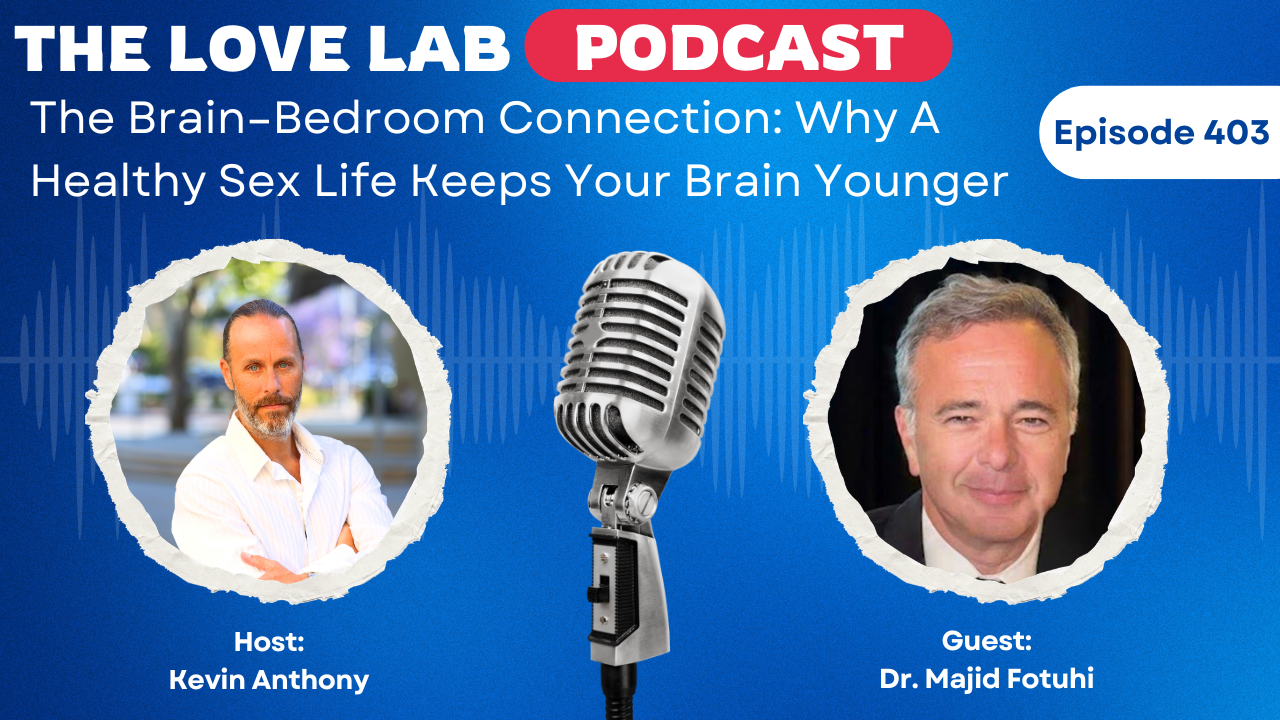
All right. Welcome back to the Love Lab podcast. This is episode 403, and it is titled The Brain Bedroom Connection: Why a healthy sex life keeps your brain younger. So we have a really fascinating conversation. I have a really brilliant guest on today who’s going to help us unpack this. We’re going to be talking about, you know, the connection between keeping your brain healthy and your sex life, and I think that’s something that a lot of people, they probably don’t think about when it comes to sex life, they think about, you know, you know all the different things they can do to maximize their sexual function from a physical point of view of, you know, their genitals, and you know that kind of stuff, but I don’t think a lot of people really realize the brain bedroom connection, and that’s why I wanted to have this conversation today, because it’s an aspect that I don’t hear talked about very often, and from the pre-conversation I’ve had with my guest, apparently is actually quite important. So, since we here on the Love Lab podcast are all about helping you have the relationship of your dreams and the best sex of your life, we want to look at and investigate every aspect that we can that can help you have those things, so that’s what we’re going to talk about today.
Kevin Anthony 1:46
As always, a short break for my sponsor. Are you ready to build a deeper intimacy and a more passionate relationship? I hope so. Introducing Intimacy Mastery, the sex, love, and intimacy app for singles and couples. Your personal guide to mastering love, sex, and connection. Get a personalized plan tailored to your unique relationship goals. Enjoy daily lessons, real-world challenges, and guided reflections, all designed by me, Kevin Anthony, your trusted guide and coach. Track your growth, celebrate your wins, and get expert feedback every step of the way. Access exclusive resources, videos, and proven tools right at your fingertips. Whether you’re single or partnered, this app will help you create the love life you truly desire. The app is available now at https://www.kevinanthonycoaching.com/go/app That is https://www.kevinanthonycoaching.com/go/app.
Kevin Anthony 2:47
Okay, my guest today is Dr. Majid Fotuhi. He is an MD and a PhD. He is a world-renowned neurologist, adjunct professor at Johns Hopkins, and author of the USA Today bestseller, The Invincible Invincible Brain, the clinically proven plan to age-proof your brain and stay sharp for life. Welcome to the show, Dr. Fotuhi.
Dr. Majid Fotuhi 3:12
Yes, thank you very much for inviting me.
Kevin Anthony 3:14
Well, I think it’s fascinating, this idea of this connection between, you know, your brain health and also your sex life, and so I’m curious, how did you figure out that there was a connection between these two things? Like, where did this come from? Because not something I hear a lot of people talk about.
Dr. Majid Fotuhi 3:34
The sexual pleasure takes place in the brain, and all the things around sex really emanate and originate from how well your brain is functioning, so when you are at the sexual peak, it’s not anywhere below your neck that that experience happening, it’s above your neck and your brain where you’re experiencing the pressure, the dopamine release, the all the intricacies of sexual pleasures are all in your brain, so to me it’s obvious that if you want to have a sex life, you need to keep your brain healthy, since that’s where the sexual pleasure takes place anyway.
Kevin Anthony 4:16
Why, why do you think that more people don’t talk about that? Because I mean, doing coaching around sexuality for a long time, you know, I’ve, I’ve seen a lot, right, and I’ve interviewed a lot of people, I’ve talked to a lot of people in this industry, and it’s not something that I hear about frequently. Why do you think that is?
Dr. Majid Fotuhi 4:39
I think most people just have not been taught that the pleasure takes place in the brain when you eat something delicious, the experience of reward is happening inside your brain when you kiss someone, when you win an award, when you get promoted in your job. All the things that bring excitement and pleasure to you happen in your brain, so I think you and I are doing a good job of maybe starting a conversation and letting people know that the most important part of having a better sex life is to have an optimal brain. Let me give you a simple example. You may have difficulty with direction with one partner, but with the same condition, you will have great sex with another partner, and it has to do with your perception of what this person is, how they treat you, what you interpret things to be, and that’s simple example that it’s really your brain where sex happens, sexual pleasure happens, sexual activity happens below your neck, but sexual pleasure happens in your brain.
Kevin Anthony 5:48
Yeah, I completely agree, and you know it’s one of the reasons why the work that I can do as a coach is so effective, because a lot of times people will come to me, you know, saying they have some sort of sexual dysfunction, but there really isn’t anything physically wrong with them. So, if there’s anything physically wrong with them, what are we doing? Well, we’re working up here, right? We’re changing habits, we’re changing belief patterns, we’re working with trauma, we’re doing all those types of things instead. So, from what I’ve seen personally in my own practice, I completely agree with that, and I’m just surprised that more people don’t necessarily talk about that.
Kevin Anthony 6:25
Here’s another question I have for you around brain health, because I’m not an expert in brain health at all, and you are, so I want to pick your brain a little bit. I do read a lot, and one of the things that I see in just the media in general is, I see a lot of stories about challenges that, like increased challenges people are having in today’s society with their brain health and brain function, so you know, higher incidences of dementia and Alzheimer’s, and all these types of things, and I wonder if you could speak for a moment about what you see generally in the population, as far as people’s brain health, is it getting better, is it getting worse, is it staying the same?
Dr. Majid Fotuhi 7:09
I think that there has been more attention to brain health in recent years, which I think is a good thing. You know, more and more of our people, more and more of people are living to their 80s, and because people are living longer, there are more people who have a diagnosis of Alzheimer’s disease, and that’s one reason that you know there’s a great deal of concern about developing this disease when you’re in your 50s, and that’s where a lot of media attention has been. Now it is true that lifestyle factors make a huge impact on the health of your brain. There are five pillars of brain health: exercise, optimal sleep, optimal nutrition, stress reduction, and brain training.
Dr. Majid Fotuhi 7:58
And when these five pillars are addressed and have become a part of your day-to-day life. Your brain performs at its peak, whether it’s at your job, whether in a senior relationship with family members, whether in sex, whether it’s performing in sports. Your brain performs at its peak when these five pillars of brain health are a part of your daily life. Unfortunately, there are many people these days who are stressed out a lot, they don’t get enough sleep, they eat a lot of junk food, they don’t have time for exercise, and they definitely don’t have time to sit down and challenge their brains in effective ways. So to me it’s very simple, if you want to have peak brain performance in all aspects of your life, you need to focus on these five pillars of brain health.
Kevin Anthony 8:53
Yeah, and I definitely want to talk a little bit more about those five pillars in a moment, but I kind of want to come back to this idea of what I perceived, at least, anyway, from reading the media, as this increase in brain difficulties, like diseases, basically, that people have in the brain, and the reason why is because I’m just sort of probing and wondering, is there a connection, because we are seeing an increase in sexual dysfunction as well, so what my mind starts thinking is, wow, if the brain is this important to sexual function, and we see an increase in, you know, issues with, you know, brain-related diseases, and we’re also seeing an increase in, you know, sexual dysfunction. Is there, is there a connection between the two?
Kevin Anthony 9:40
That’s where I was going with that initial question, and, and I like how you, you pointed out that you know people are living longer, there’s more focus on it, potentially we have better screening now, so maybe we’re picking up more of it, but you’re one of the things I teach is there’s there’s no reason why if you’re healthy you can’t still have. Satisfying sex life right through your 80s, but that doesn’t seem to be the case for a lot of people, so I’m just curious, your thoughts on that connection.
Dr. Majid Fotuhi 10:09
Okay, so two sides of this story that I like to elaborate: one is that conditions that affect brain health also affect sexual performance, things like obesity, depression, diabetes, poor sleep, too much stress, sleep apnea, all the things that affect blood flow to the brain also affect blood flow to the genital organs. So, when there are problems with blood flow to the brain, everything is affected. So, there are two things that happen in parallel. Now, if your brain is not healthy, you can’t perform well in anything anyway. However, it’s not the brain problems that cause the sexual problems. The same problems cause both sets of issues; that’s one thing. The other thing is that the reverse is true. People who are sexually active usually have better memory for the same reason, because the same things that allow you to have a good sex life, which is, you know, exercising, not smoking, not drinking too much, you know. Make sure your medical issues are taken care of. Also, affect your brain.
Dr. Majid Fotuhi 11:29
Many studies have shown that people who maintain sexual activity in later life and have a lot of intimacy, they live longer and are less likely to get Alzheimer’s disease, so when I see patients, I use that to encourage them to work on their brain health. Let me give you an example. I had a patient who was a truck driver, gentlemen, he was in his late 50s, and his wife had brought him to me because he was forgetful, he was repeating himself, he was grumpy, he was not doing much other than just driving, coming home and driving, coming home, no exercise, not much other than, you know, drinking beer, watching football on weekends, and then I talked to him about the fact that you know if it continues at that rate he’s going to have a high risk of developing strokes and heart attacks, and he will be at very high risk of developing Alzheimer’s disease, because sedentary lifestyle, poor sleep, poor diet, not doing anything, not challenging his brain, there were all the things that were horrible for his brain, but I realized that I was not getting through to him. I said, “Sir, let me tell you something, there are things you could do to improve your sexual life.
Dr. Majid Fotuhi 12:53
All of a sudden, his eyes lit up. I was like, I was giving a lecture about brain, he was just passively listening, and when I said to him, you know, give you things that it’s going to improve your erection and you’re going to have much better orgasm, and all of a sudden it was like, oh, doc, tell me, tell me, doc, what’s up, and I said, listen, blood flow is very important for every organ in your body, your brain, your liver, your kidney, your penis, everything needs blood, and inflammation is a horrible thing for all organs. So I’m going to tell you four things to do to improve blood flow to your brain and to your sexual organs, and to have better sex, because these things are going to improve blood flow everywhere, so if you want to have better erection, you have to avoid junk food, and you have to have your sleep apnea treated, and you need to sleep eight hours a night, and you need to at least walk 5000 steps a day. If you do those things, you get more blood flow to your penis, and you will have a better sex life, and the fact that you have other things, it will be like a side benefit, like their bonus. All of a sudden, it was all in. Said, “Are you serious, Doc?
Dr. Majid Fotuhi 14:10
I said, listen here. I know, turn around my computer monitor, I Google some stuff for him, blood flow, penis things to do. It came, exercise, eat a mini chain diet, treat your sleep, reduce the stress, all those things were things that I was telling him before he was not paying attention to, and now he was, so we put him on our program to do those things, and he was working on it because he wanted to have better sex, and I was doing it because I wanted to have a better brain function, but it was a win-win, because he did that, and you know, 12 weeks later he couldn’t believe that he was actually had more libido, he had better erection, he had better sexual performance, and his wife was happy because he was more into. Thing, the guy had become more interesting. Instead of coming home and just sitting there watching TV, he was saying to him, to her, ‘Let’s go for a walk, let’s go, you know, check out this park in the city, and things like that. So, sometimes I direct my conversation to people who are more interested in sex than their brains from that angle, and that seems to work.
Kevin Anthony 15:23
That’s a fascinating story, and I’m not at all surprised to hear it. I’m curious, because technically, you’re a brain doctor, right? And so, when people are coming to you, they’re coming to you because they’re experiencing memory issues, or you know, something along those lines, and yet this is a conversation I believe that you have with a significant number of your patients. I’m curious, do they all respond as well to it as this particular patient did? Like, how is it bringing up that conversation when somebody comes to you and is like, you know, my husband’s having some forgetfulness issues or whatever, and then you come around to the topic of sex? How do most of your patients take that?
Dr. Majid Fotuhi 16:03
I don’t do that with all my patients, you know. If I feel.. I mean, I talk to them about brain health, I talk to them about the fact that, you know, you don’t want other people to change your diapers, you don’t want to be dependent on other people, and you definitely don’t want to have a stroke and have half of your body be paralyzed, and so usually I don’t have to go to the point of talking about how I’m going to help you improve your sex function. Occasionally, when I see somebody who’s really not paying attention to what I’m telling you about their brain health, I will take that angle, but the thing is, the bottom line is this: there are principles that apply to all organs. Let me give you an example.
Dr. Majid Fotuhi 16:51
One day I was home, and I was just watching PBS, and there was a show on how to reduce your risk for prostate cancer, and I thought, you know, I’m a man of my 50s, I should know that stuff. And then the guy was talking about exercise, sleep well, reduce if you have sleep apnea, treat it, eat a Mediterranean diet, don’t eat junk food, and make sure you reduce your stress, and meditate. I was thinking, like, what does meditation have to do with prostate cancer, and it was so interesting to me that exact same spiel that I give to my patients was being offered to help reduce the risk of prostate cancer, and that just goes to tell you that the same principles apply to all organs. All organs function better when there’s increased blood flow, and there’s reduced inflammation.
Kevin Anthony 17:48
Yeah, you know, I couldn’t agree more. And it’s one of the reasons why I really wanted to have you on, because you know your credentials are impressive, right? And when somebody like you comes on and says, ” Look, you got to exercise, you got to sleep right, right, you got to eat well, like that means something. And it’s all things that I agree with and teach, and what. So, one of the reasons I asked you that question about how people respond to you when you bring that up is because you know a lot of people come to me as a coach wanting to figure out how to fix their, you know, sexual dysfunction, and this is a big part of what I teach them. I have whole handouts on, you know, what supplements they should be taking, and exercise and like things to maximize, you know, physical activity they can do to maximize their testosterone if they’re a man, and I honestly have to say that I do get some pushback on that.
Kevin Anthony 18:41
Because a lot of times people will come to me, and they, what they’re thinking in their mind is, I just need this, you know, quick solution, I just need this technique thing that I got to learn, and somehow that will magically fix it, and I believe the same thing that you do, that you know, this is this is a holistic system, and it all works together, and if we want to fix that area, we got to fix the other areas as well, and so, because I’ve experienced a little bit of pushback from people in those things, I was curious, how your patients were responding to that type of advice, because it, you know, I would imagine that there’s at least a certain percentage of people that show up to your office, figuring that you’re going to say, well, we’ve got this new brain drug, and if I just put you on this, you know, it will solve all your problems. And then they hear, wait a minute, I got to do work, I got to get up off my butt and do something.
Dr. Majid Fotuhi 19:33
Yeah, sometimes I write on a prescription pad, I write walk 5000 steps four days a week, and I give it to patients because I want to make the point about how exercise is more powerful than any medicine I can give them, and it’s true, when you exercise, you reduce the footprints of Alzheimer’s disease in your brain, nothing else can do that and. And I recently gave a lecture to the American Academy of Neurology to 5000 neurologists from 120 countries. It was a major speech, and my speech was about how lifestyle interventions are more powerful than any medications we can give to patients to prevent Alzheimer’s disease or to treat early stages of Alzheimer’s disease, so these interventions are simple but powerful.
Kevin Anthony 20:25
Yeah, I’m so grateful that there are people like you out there actually teaching this stuff, because it really is that important. Let’s talk a little bit about, so you talk about the five pillars, right? Let’s talk about each one of those a little bit. Some of them, I think, are maybe kind of obvious, how they work and how they’re affecting this, but maybe others are not quite as obvious. Let’s talk about some of them a little bit, so maybe we can again inspire people to get on board with this a little bit more by explaining to them how these things are actually going to improve their lives. So, like, number one, exercise – it’s probably the most obvious one, but let’s talk a little bit about how exercise is actually changing their brain.
Dr. Majid Fotuhi 21:10
Let me give you a story before giving you the science behind the benefits of exercise for the brain. Seven years ago, not 700 years ago, seven years ago, in the 1950s, people were skeptical that exercise has any benefit for anything. In fact, cardiologists would tell patients who had heart problems to rest and take it easy. The idea was that your heart can beat so many times in your lifetime, so if you exercise and your heart beats a lot, then you’re using up how many times your heart is going to beat in a lifetime. And there was a study that was done in England to look at the incidence of heart attacks in bus drivers and bus conductors.
Dr. Majid Fotuhi 21:55
Bus conductors were the ones who were going up and down the steps of the bus to collect tickets from people and send them up the floor or down the floor, so they were always walking around where the bus drivers were sitting, and they were all men in their 30s and 40s, those same population of people, and the findings showed that bus drivers had far more heart attacks than bus conductors, and that was the first time that people thought maybe being active is a good thing, and so in 1960s 1970s there were people who were starting to say, hey, did the Harvard study, and it turns out that people who exercise have fewer heart attacks, mostly men, not so much in women, and then in 1980s there was an article in the first page of New York Times that the title was some cardiologists believe exercise is good for your heart. It was so controversial that there are some cardiologists who are saying that you should exercise, like, go to your way to exercise now.
Dr. Majid Fotuhi 23:01
I mean, these days we exercise, and nobody questions that it is good for you, but it hasn’t been like 1000s of years that people have known that you know it’s only a recent thing that you know exercise. The benefits of exercise have become clear now. Exercise is obviously good for your heart, but there are specific benefits of exercise for the brain. When you exercise, you increase the number of blood vessels in your brain, so your brain cells need nutrients and oxygen, and these capillaries, which are like the tips of branches of a tree, grow more when you exercise, and you also grow new neurons in the memory part of the brain. This is called neurogenesis. So, you have more neurons, and you have more proteins called BDNF, brain-derived neurotrophic factor. So, you have more neurons, more BDNF, more blood vessels, and the whole brain grows. People who exercise regularly for 12 weeks grow the size of the brain area for memory, called hippocampus, is usually the size of your thumb, and it’s easy to be identified on a brain MRI, because it’s a very distinct structure, and so you can see with naked eyes that hippocampus literally grows when you exercise for 12 weeks, so that’s a no-brainer, really, exercise is by far the best thing you could do for your brain.
Kevin Anthony 24:24
Yeah, that’s amazing. I didn’t know that the hippocampus actually grows when you exercise. I mean, I obviously would have thought of, okay, you’re increasing circulation, blood flow to the brain, that’s gonna, you know, help it perform, but your brain, at least parts of it, will actually grow in size just from exercising, that’s fascinating.
Dr. Majid Fotuhi 24:44
I know in 12 weeks, not in like 10 years, in a matter of three months, your hippocampus grows so much, so you can see it with the naked eye on a brain MRI. It’s not only that the growth happens at the cellular level, it actually happens to such a high degree. See that we can see it by just looking at two MRIs side by side.
Kevin Anthony 25:04
Yeah, that is fascinating to me. I did not know that that was the case. So, yeah, even more, it’s funny because I exercise a lot. I love exercising. I’ve been doing it my entire life. I was actually thinking about today, you know, since technically we are recording on a holiday, and both of us are working. I was like, maybe I’ll cut it short and get outside and do some exercise today. And now I’m listening to you, and I’m like, for sure, that’s it. As soon as we get off this, I’m gonna go outside and exercise, because it’s amazing. It’s amazing all the benefits it has. Let’s talk about another one that maybe isn’t quite as obvious, which is optimal sleep. How does optimal sleep actually affect your brain and then, of course, your sexual performance?
Dr. Majid Fotuhi 25:52
During sleep. Your brain goes through a rinsing and cleaning process, literally. Your brain takes the trash out during the deep stage of sleep; the science of it is amazing, and it’s beautiful. I teach about that at Johns Hopkins, but for the purpose of our conversation, I just want to emphasize that with each pulse during deep sleep, the brain gets rinsed, and when you don’t get this rinsing, it’s like no, not taking the trash out of your house for a long time, you know, things accumulate and it becomes a really ugly place when the trash builds up, and that’s what happens in the brain. And one of the pieces of trash that’s taken out is called amyloid, which is the hallmark of Alzheimer’s disease.
Dr. Majid Fotuhi 26:34
That’s why people who sleep fewer than six hours a night on a regular basis are at far higher risk of developing Alzheimer’s disease, and the hippocampus is 40% smaller if they’ve had insomnia for 20 years or so. If it’s insomnia for two to three years, and they get back to regular sleep, it is as if nothing ever happened. So, sleep is also important for sexual function, because again, sexual function is mostly in your brain. Your brain needs to be in optimal health for it to provide you with the experiences that you expect during a sexual encounter. You don’t get sexual activity for anything below the neck; the pleasure happens in the brain. So, if you want your brain to be healthy and experience pleasure, then you need to make sure that you have enough sleep.
Kevin Anthony 27:34
I’m a big proponent of sleep, I always have been, mostly because even before I understood any of the real sort of health or scientific benefits, but mostly just because of how I used to feel, you know, before I did what I do now for a living, and I worked for corporate, and I worked long hours, and I’d have to get up early in the morning. I just knew how I would feel, I would feel off, and I had a very.. my listeners, most of them know that you know, in a prior lifetime I was a computer engineer, and so I had a job that required me to use my brain a lot, and I noticed that when I didn’t sleep well, I was just off. The next day at work, I was off. I couldn’t focus, I couldn’t concentrate the same, and so I’ve always been a big proponent of trying to get enough sleep, which for me is a minimum of eight hours. I kind of feel in my sort of perfect zone if I get nine. I don’t always get nine, but if I can get nine, that’s when I feel really great the next day. But eight is fine too.
Kevin Anthony 28:37
But what’s interesting is, you know, what I do now, you know I’m even though I’m a coach, I’m in the entrepreneurial space, like I’m running my own business, and because of that I spend time around a lot of other entrepreneurs, and one of the things that I see is there’s this culture in entrepreneurship of sort of being proud of the fact that they’re surviving on four hours of sleep a day, and how much work they can get done, and I’ve always been opposed to this, and I’ve always tried to tell people I wouldn’t do it if I were you. I really think you should prioritize getting more sleep, and so now here we are, we’re speaking today, and you’re sharing exactly why that is, and you know, some of the real benefits you can get from sleeping more, but also the downsides if you don’t.
Dr. Majid Fotuhi 29:27
Yes, I think it’s important to have efficiency in what you do, and not so many hours in what you do. And when your brain is healthier and it’s functioning better, you have better quality work, like when I exercise, actually, you know, I think about all the issues that are going on, and I come up with ideas, so the time that I’m exercising is not wasted time, and when I sleep, my brain goes through rinsing process, a lot of memories get consolidated, so. All day have more creativity in what I do, so I think you know it’s good to have stamina and perseverance and work hard. However, you should always respect and protect your sleeping seven to eight hours a night. Now, some people need six hours, some people need nine hours, as long as you’re comfortable, that is, you wake up feeling rested during the day, you don’t feel groggy.
Dr. Majid Fotuhi 30:27
What I think happens when you don’t get enough sleep is that your processing speed is a little slower. That’s why there are far more car accidents during the days right after when you change the spring and winter time changes during those few days where people are getting one hour less sleep or more accidents, because that processing speed of being slower by two milliseconds, five milliseconds is enough to call cause car accidents, so I don’t think smart to cut back on how much sleep you get.
Kevin Anthony 31:05
I completely agree, and you know, I wish in the entrepreneurial culture there wasn’t so much emphasis on, you know, how many hours you worked and how long it’s been since you took a vacation, so maybe, maybe if anybody listening to this is in that space now. You have a new motivation to get a little bit more sleep.
Dr. Majid Fotuhi 31:26
Actually, you know, I was talking to some people in France, and in France, they look down upon people who work extra hours. It just implies that you were not efficient in getting your work done within your working hours. So, if you work a lot of hours outside the office, it means you’re not doing a good job doing your regular hours.
Kevin Anthony 31:46
Yes, there are some things that Europe does better than us, for sure. And they definitely have a culture around taking more days off. France, I think, if I recall, has one of the highest numbers of paid days off, yes, than any other country.
Dr. Majid Fotuhi 32:02
And then they have fewer hours per week, but their productivity is among the highest in Europe.
Kevin Anthony 32:07
Yeah, yeah, yeah. I’m not surprised at all to hear that, because I know for myself that when I feel rested and relaxed, my stress levels are lower. I’m absolutely more productive. It’s actually why, so it’s a Monday, as we’re recording right now, this is why I record on Mondays, because after a weekend I’m rested, I’m relaxed, I’m refreshed, and I’m much sharper, and I want to show up for these interviews in this podcast, you know, as sharp as I can. So, yeah, I think getting good sleep and being more efficient, so that you can have more time off, is really important, and I will definitely celebrate that in the French culture for that. Okay, I need to take a short break. When we come back, I want to talk about a couple of the other pillars, and then I want to get into, you know, how people could potentially recognize maybe that they’re having a problem with their brain, maybe some of the things that they can do. Obviously, we’re talking about the five pillars, but there’s a little bit more that we can talk about in that regard as well. So, we’ll do that on the other side of this break.
Kevin Anthony 33:17
Men, life is too short to fall short in the bedroom. In today’s day and age, it’s no longer acceptable to be mediocre at best, or even worse. If you’re struggling with erectile dysfunction, premature ejaculation, ejaculation control, or poor skills in the bedroom, then power and mastery are for you. This three-course program will have you rise to the occasion every time, last as long as you want, and wow her with your skills in and out of the bedroom. Join the exclusive club of men who have taken charge of their sex lives by going to https://www.powerandmastery.com/sexual-mastery. That’s https://www.powerandmastery.com/sexual-mastery.
Kevin Anthony 33:56
Okay, so we were talking about the five pillars we covered: exercise and optimal sleep. I want to get to stress next, because this is a really big one, and this is what I actually, of all of these, this is the one that is probably the most challenging for me. As I mentioned, being an entrepreneur, having to wear so many hats and do so many things and keep so many balls, you know, in the air, so to speak, in order to keep the business functioning. I find that I tend to, you know, get a little on the stressed side and have to figure out ways to deal with that. So, how is stress impacting your brain and your sexual function?
Dr. Majid Fotuhi 34:35
Stress is associated with higher cortisol levels in the blood, and when cortisol levels are higher, the memory part of the brain, the hippocampus, shrinks. Remember, I told you, and people who have had insomnia for a long time, their brain shrinks and shrinks. The same happens when you have high stress levels. Several studies have shown that high cortisol levels shrink the hippocampus in a dose-dependent manner, so if you have a low level of cortisol, the shrinkage is small, and if you have high cortisol levels, the shrinkage is significant. Now I want to emphasize that the brain has a lot of flexibility and a lot of malleability, and your brain can recoup and recover, even if I had stress for a long time, but you should definitely not stress out on a daily basis. If you are doing too many things, you should rethink which things can be eliminated from your list of things to do.
Dr. Majid Fotuhi 35:36
You know, we all can only do so many things in a day, and as much as we would like to see a lot of things get done, we have to respect our physiology, and again, I always emphasize that you need to work on efficiency to improve your productivity. It’s not always how many hours you do things, it’s how efficient to get things done. Sometimes a phone call or a simple say no can save you so many hours. You know, a lot of people do a lot of things, and when you question it, the reasoning they have doesn’t always make sense. They have a narrative in their head that they need to do this, they need to do this, they need to do this, if this, then that, then that, and then when you press them on, well, really, you know, so I know for a fact that I do my best not to stress over things. Let me give you a little story.
Dr. Majid Fotuhi 36:37
So, I give a lot of lectures, and when my daughters were younger, they would come to some of my lectures. So one day I was talking to my daughter, who was in her second grade, and I said, “Sweetheart, you have this book to read and write a review about in two days, and you haven’t even opened the book yet. And she said, “Dad, you’re stressing me out, and that’s not good for my hippocampus, because she had come to my lectures, and you know, I shown how more stressed, more engaging hippocampus, and it’s true on a daily basis opportunities arise when you can get frustrated, and when that happens to me, I ask myself, is it worth my hippocampus? Sometimes it is, you know, if your kid is involved in a car accident, if there is a family emergency, if somebody loses a lot of money on the stock market, or there’s a divorce, or no, there are things that are stressful, and that’s fine. Everyone’s life has stressful events, and that’s how life is. The important thing for people to appreciate is not to let everything stress them out. We need to have a bar that’s high enough for you to get stressed out.
Kevin Anthony 37:55
Of course, leave it to children to use our own words against us, right? Hey, but it shows she was paying attention to your lecture.
Dr. Majid Fotuhi 38:05
Yeah, yeah.
Kevin Anthony 38:06
Yeah, that’s great. So I’m curious, and you don’t have to share this if you don’t want to. So you mentioned that you personally do your best not to allow certain things to stress you, and we should all do that for sure. And at the same time, life is going to bring up things that stress us. So, what are some of the things that you personally do to try to manage your stress levels?
Dr. Majid Fotuhi 38:30
Well, the first step is not let anything get to you. You know, I used to stay calm. I mean, I must say there were times in my career where, for example, I had a full-time job as a neurologist, I was writing a book, and I was doing things for my family, so I was running around all the time, but you know, there was a stage of my life where I was doing that, and now I’m a stage of my life where my job is lighter, I teach at Johns Hopkins, my schedule is more flexible, I have more time for my family, so I’m fortunate that these days, you know, there are not too many things that stress me out. The one thing I do something happens to stress me out is that I do these too many breathing exercises.
Dr. Majid Fotuhi 39:16
When you breathe slowly, something magical happens when you slow down and breathe about five per minute, you increase the activity in parasympathetic nervous system, which is your rest and relaxed part of your peripheral nervous system, automic nervous system, and you know when you stress out, it’s your sympathetic nervous systems as the overdrive, and you can really put the brake on that sympathetic overdrive by this breathing exercise. So, we can do it together. So, what you do is you breathe in for the count of six, you hold for the count of three, breathe out for a count of six. We just do two. Are you ready? Here we go: one, two. 23456123123456 Now you just need to do that for two minutes, not 20 minutes, not half an hour, just two minutes, and you’ll be amazed how quickly you calm down, and you get clarity in what goes on.
Dr. Majid Fotuhi 40:29
Nothing is really worth our brains, you know. Yes, you’re missing a flight, you’re running to the airport, you want to catch that flight, that’s where our system is designed to make us run faster at the cortisol level to increase blood pressure to run because we don’t want to lose that flight, but most other things, being stuck in traffic, what people told you, you know what people think of you, how much money you’re making are really not things that should stress you out. You make what you make, and it is what it is. It will be nice to make more, but if you’re stressing out so much that you’re not making more money, you’re really losing, you know. It’s not that the math doesn’t work. So, I think you have to always keep in mind, is this problem worth my hippocampus? And one simple solution, if you stress out, is to do breathing exercises. A more important solution is mindset. You decide what stresses you out. You’re not always a victim, you’re not always a passive part of this equation, you create your stress, you know. If somebody tells you something that makes you angry, you can’t blame them; it’s on you.
Dr. Majid Fotuhi 41:55
If somebody tells you something that makes you angry, or somebody cuts in front of you while you’re driving and makes you angry, or somebody does really mean things in your job, a co-worker, a boss, and you get angry, it’s not their, I mean, I can’t say it’s not their fault, but if you get angry, it’s because you chose, and you decided that this is what’s going to make you angry, and it’s up to you to decide what merits that increase in sympathetic nervous system, which is going to restrict your hippocampus. So, the most important thing to do is to have the mindset and set the bar high for what merits an activation of your sympathetic nervous system, but on a practical level, just do breathing exercises that calm you at the moment.
Kevin Anthony 42:44
Yeah, I’m gonna, I’m gonna have one of those. Remember those bracelets that used to say, like, you know, what would Jesus do? I’m gonna get one that says, ” Is this worth my hippocampus? And every time I get stressed out, I’m gonna snap that thing and look at it and go, this is not worth my hippocampus.
Dr. Majid Fotuhi 43:02
It really isn’t. And it’s, and this is not hypothetical, you know. They studied in Japan, they took a group of people, and they did MRIs on them. They also measured the cortical cortisol levels; they didn’t do anything fancy, and they said, “Look, you can go home. They brought them back seven years later. Some people at baseline had high stress levels and high cortisol levels, and some people didn’t, and these people just went on to live their lives. There are no instructions given; they were not asked to do anything; they were just asked to come back seven years later. They came back seven years later, and they did MRIs on them again. It turns out that people who had high cortisol levels at baseline, they still have high cortisol levels. It is what it is. This is their kind of people who stress out a lot and have high cortisol levels at baseline, and they still were doing it.
Dr. Majid Fotuhi 43:53
What was interesting was that the hippocampus was much smaller in the stressed-out individuals. People were stressing out had a small hippocampus, so this is as clear as you can tell in a longitudinal fashion that if you stress out every day, your hippocampus shrinks to such a high degree that you can see it with the naked eye on an MRI. See what I find amazing and beautiful about the brain is neuroplasticity, which means your brain changes every day, every day, not every month, every day, for better or for worse, based on your lifestyle habits and choices. If you’re exercising every day, you’re going to increase the size of the hippocampus just a little bit every day, but if you do it regularly for 12 weeks, then that change is measurable with MRIs.
Dr. Majid Fotuhi 44:50
I mean, the change happens at a microscopic level, but we can’t put a microscope and look at people’s brains on a microscope living in person, but we can look at MRIs of people. It, and then, if you stress that every day, and you do it every day for an hour or two, or a whole day, then over 12 weeks, then that adds up, and that comes up to measurable changes in MRI. So every day you’re in control of your brain’s destiny and what shape your brain will have, that’s that’s beautiful, which means you decide what kind of brain you will have, and if you do all the right things, if you do all the five pillars of brain health, your brain is at its peak, and you perform well at your work, in your relationships, in bed, and everywhere else.
Kevin Anthony 45:41
Yeah. Yeah, so what I hear you’re saying, Doc, is that in this case, bigger is better. I’m just being silly and making a joke.
Dr. Majid Fotuhi 45:52
No, actually, when I was writing my third book, one of the titles we considered was Size Matters, and you know, we actually consider that, because you know, everything has to do with the size of hippy campus, and the size of the campus really does matter, and the bigger, the bigger is better. So we decided not to in the end, but actually something I consider.
Kevin Anthony 46:19
Well, there you go, audience. Finally, for the first time in the Love Lab podcast history, we have come to the conclusion that bigger actually is better when it comes to your brain.
Dr. Majid Fotuhi 46:31
That’s right.
Kevin Anthony 46:33
I want to just come back to, so you know, I had asked you some of the things that you do, and you’re, you were showing some of the things that you can manage, you know, stress in the brain, and you talked about breathing exercises. I was really happy to hear you share that, because I read an ad earlier at the, you know, the mid-roll ad for, you know, a program that I have that’s called Power and Mastery, and it’s to help men have, you know, better sexuality, whether it’s their physical function or all the other soft skills, and in that there are two different breathing exercises that I teach them for the exact reason that you’re talking about, about how that affects whether we’re in the sympathetic or parasympathetic nervous system, and which is a big piece to managing things like premature ejaculation and stress levels and all of that kind of stuff.
Kevin Anthony 47:22
So I’m really happy to hear again somebody with your credentials and your experience sharing with people that there’s real science behind this, because again, I’ve been doing this stuff for a long time, and I remember 15 years ago trying to teach men breathing practices and telling them, trust me, just trust me, this is going to be good for you, you know. They’re rolling their eyes at me, like just humoring me. Okay, fine, I’ll do it. You know, but now here we have, you know, some real solid research behind it, and I’m curious. Oh, go ahead. Well, what I was going to say is, so.. so there’s that, and then you also just briefly mentioned at one point meditation, and I was curious to hear your take on that as well.
Dr. Majid Fotuhi 48:05
Yes, what I was going to mention is that these results happen when you do them regularly for six weeks to 12 weeks, so don’t expect to breathe in, do the two minutes breathing for like two days, and suddenly see, you know, magical changes. The same thing if you go to a gym, if you want to build bigger biceps, you can’t just go to a gym and exercise two or three times and expect to see noticeable results. There are changes at a cellular level in your muscles when you exercise for two or three days; they’re definitely the changes that happen, but if you want to see the changes and notice them in your day-to-day life, you need to do them regularly for six to 12 weeks. Now, meditation is very similar to the breathing exercises.
Dr. Majid Fotuhi 48:58
In fact, it’s possible that the most benefit from meditation is the fact that people breathe slowly. It’s not necessarily so much the thought, and you know, the mind part of the meditation as it is the breathing. The fact that you slow down your breathing, that has all the benefits. There are dozens of studies that people that show that people who do meditation have better brain functions and a larger hippocampus. One study, which I show that figure when I give lectures, took people and put them in two groups. One group was meditating for 45 minutes, five days a week, and another group was just sitting in a room listening to music, pretty comparable group, and they saw that the group that was meditating had a measurable increase in the size of the hippocampus in 12 weeks, and the group that was listening did not have any significant changes in the size of the hippocampus. Office, so you know this goes to tell you again and again that your brain has a high degree of malleability. Your brain changes very easily, and therefore, if you do little things, you can see results. You have a big return on your investment by putting very little effort into your five pillars of brain health.
Kevin Anthony 50:25
Yeah, that’s fascinating. That’s kind of a new piece to know. I’m familiar with some of the research on meditation and its benefits, but the new little piece that I just learned from you was the fact that there’s, there’s actually a higher correlation with just the fact that when people meditate, they slow their breathing down, and that’s primarily where a lot of the benefit is coming from. That’s fascinating.
Dr. Majid Fotuhi 50:47
Yes, I have it in all of these things in my book, The Invincible Brain. It was published last month. It actually became a best seller already. I’m very proud of it. I also have an online course, free, The Invincible Brain, and I have a free app with the same name, The Invincible Brain, in the App Store, and in them I have these questionnaires that people can do for themselves. There are three questionnaires, each one of them takes about three minutes, and it really gives you a reflection of your state of mind and where you are, and what are the specific things that you can work on. The bottom line is this: if you work on the things that are important and relevant to you, you will see results in 12 weeks. You can see major improvements in your brain health and your brain performance in 12 weeks.
Dr. Majid Fotuhi 51:40
The challenge is to find out what needs to be done for you. The five pillars of brain health are the major principles, but every person is different, and you need to figure out what needs to be done for you. And these questionnaires that I have on the app help you identify the things that are important to your case and have a personalized brain portfolio, and once you have that, you can see how it can, what things need to be done, and you will see results quickly.
Kevin Anthony 52:09
Yeah, so I mean, that’s the perfect segue into how they can find out more about you, because you mentioned you’ve got your book, right? You still work with people, I assume you still see patients, you’re teaching right, you have your app, so what’s the best way for people to find all of that stuff?
Dr. Majid Fotuhi 52:28
All of the information that we’ve been talking about, all the science behind it, and a lot of patients’ phrases are in my book, The Invincible Bright. I’m also putting posts on Instagram, Dr_Fotuhi, F O T U H I, and I’m on LinkedIn, and I’m on YouTube. I love educating the public, and most of the things I do, except that the book is free. So, if you search for The Invincible Brain, you’ll find a lot of my material.
Kevin Anthony 53:00
Wonderful, and there will be a link for, you know, finding that, of course, in the show notes. Dr. Fatui, I want to thank you for coming on the show. It was a fascinating conversation. I have a bunch more questions for you, but we’re pretty much out of time, so I just want to thank you for coming and sharing your knowledge and expertise, helping to educate people, and really, you know, sharing what, what I feel are really some just absolute truths about, you know, sort of life and our physical bodies and our brains, you know, like getting back to those core issues of those five pillars is just so important, and I was really happy to hear that, that is such a big piece of the work that you’re doing out there.
Dr. Majid Fotuhi 53:45
What a pleasure talking to you, Kevin. Thanks for inviting me.
Kevin Anthony 53:48
All right, everybody, I hope you learned something today. I learned some things today, so hopefully you did too, and I hope you are more motivated now to get out there and work on your five pillars, both for your brain health and also for your sexual function, and with that, that’s all I have for this episode, and I will see you next week.
Kevin Anthony 54:14
I hope you liked this episode of The Love Lab Podcast. If you enjoy this show, subscribe, leave me a review, and share it with your friends, and for more free exclusive content, join me in the Passion Vault at https://www.kevinanthonycoaching.com/vault/. That’s https://www.kevinanthonycoaching.com/vault/. Thanks for listening, and remember, as Celine used to say, you’re amazing!
Kevin Anthony is a Certified Sexologist, Tantra Counselor, NLP Practitioner and a Sex, Love & Relationship coach. For over 10 years he has worked with men, women, and couples to have the relationships of their dreams, and the best sex of their lives! He is also the host of “The Love Lab Podcast”, creator of the popular YouTube channel Kevin Anthony Coaching, and creator of the popular online course series “Power and Mastery” as well as other online courses for both men and women.