Kevin Anthony 0:00
Welcome to the Love Lab podcast, the place to be for honest and real talk about relationships and sex, whether you’re a man or woman, single or a couple, this is the show for you. I am your host, Kevin Anthony, and I am here to help you have the relationship of your dreams and the best sex of your life.
Kevin Anthony 0:23
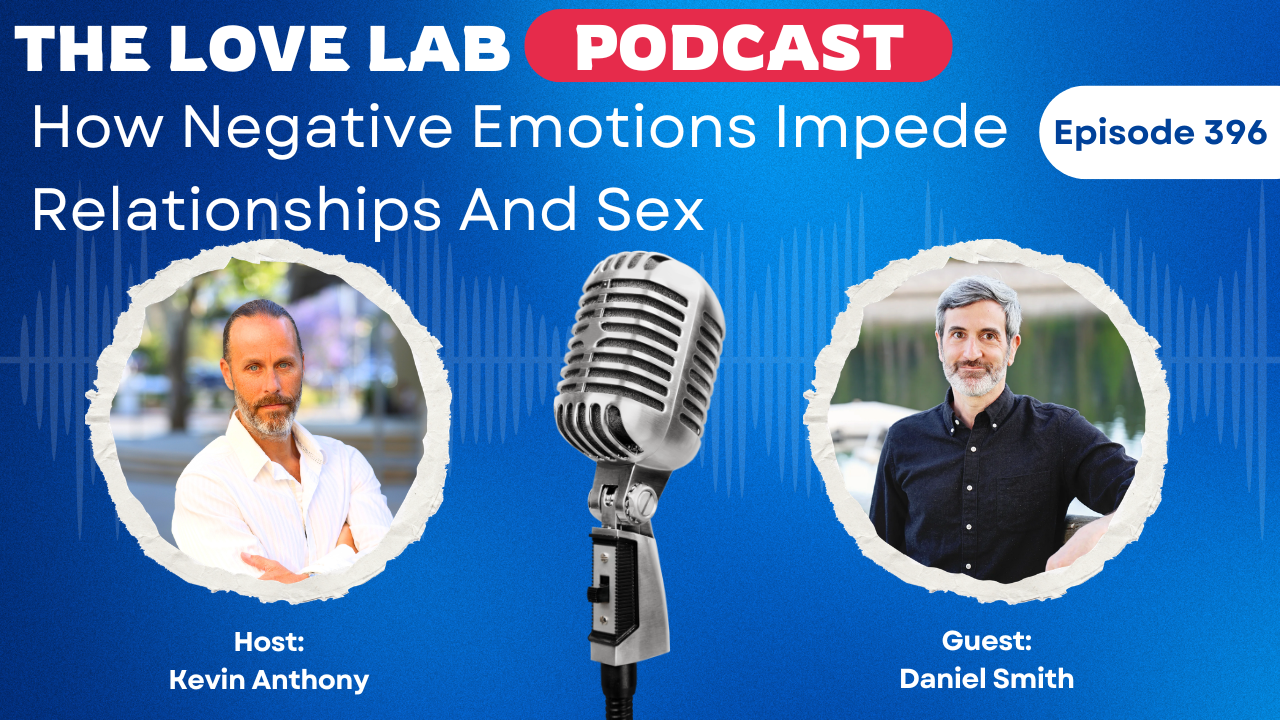
All right, welcome back to the Love Lab podcast. This is episode 396, and it is titled, How Negative Emotions Impede Relationships and sex. Now, listening to that title, you might be thinking, Oh, man, why do we have to dive into negative emotions? Well, the reason really is because nobody has a problem with the positive emotions, like when you’re happy, and things are flowing, and they’re working in your relationship. Nobody ever questions that. Nobody’s seeking help with that. They go, life is great. Let’s rock on, right?
Kevin Anthony 0:57
Where the challenges come in is when the negative emotions are there. And what’s interesting about that? And you know, if you’re watching on YouTube, you can see I have a guest with me today. Is it may sound it just may sound simple, like, yeah, of course, I know what a negative emotion is. I’ve experienced it. But not all negative emotions are equal, are they? Some are easier to realize that they’re happening than others. And so we’re going to dive into that today. We’re going to talk about, you know, what exactly is an emotion? We’re going to talk about the science behind them. We’re talking about different types of negative emotions and how they can potentially impact your relationship and your sex life.
Kevin Anthony 1:38
And then, of course, we’re going to talk about maybe some things that you can do to maybe recognize when these patterns are happening and start to solve them so that you can have better relationships and a better sex life. So that’s what we’re going to be talking about today. I definitely say Hang in there, because just in the pre-interview call, we had a great discussion, and it was getting deep, and I was like, Okay, wait, we need to have this on the air, so definitely tune in for that. All right, couple of quick ads, though, to pay the bills.
Kevin Anthony 2:12
Men, life is too short to fall short in the bedroom. In today’s day and age, it is no longer acceptable to be mediocre at best, or even worse, if you’re struggling with erectile dysfunction, premature ejaculation, ejaculation control, or poor skills in the bedroom, then power and mastery is for you. This three-course program will have you rise to the occasion every time last, as long as you want, and wow her with your skills in and out of the bedroom. Join the exclusive club of men who have taken charge of their sex lives by going to https://www.powerandmastery.com/sexual-mastery. That is https://www.powerandmastery.com/sexual-mastery. That link, of course, is in the description.
Kevin Anthony 2:51
And lastly, ladies, I have something for you also, after so many women commented on my viral video titled What men consider a good blow job, saying they didn’t know that’s what men really wanted. I created the blow job Mastery program. I teamed up with Coach Reid Duong of Eternal Love to create a program designed to teach you exactly what will drive your man wild and make him look at you like the goddess you are. This program gives you step-by-step guidance and includes multiple live demos to show you how to master the techniques. He will never look at you the same way again. Go to https://www.sacredfemininearts.com/bjmastery. That is https://www.sacredfemininearts.com/bjmastery.
Kevin Anthony 3:28
Okay, my guest today is Daniel Smith. He is a psychotherapist and the author of Muses, Mad Men and Prophets, and Monkey Mind. His writing has appeared in The Atlantic, the New York Times Magazine, and The New Yorker, among other publications. He lives in Brooklyn, New York. Welcome to the show, Daniel.
Daniel Smith 3:51
Thank you so much for having me.
Kevin Anthony 3:54
All right, we need to start because we’ve titled this, or I’ve titled this, how negative emotions impede relationships and sex. And although I know a lot of people, you know, if you ask them what an emotion is, they say, of course, I know what an emotion is, but it’s deeper than just I feel happy, I feel sad. So let’s start by defining, like, what actually is an emotion. And you know, maybe we could also start to get into what some of the science says about emotions as well.
Daniel Smith 4:22
Yeah, this is a really difficult one to answer, and in a way, was the hardest part of the book to write, because it turns out that there is no obvious definition of emotion. They have done surveys of scientists in the field, and the interesting result is that nobody agrees. It’s like one of those concepts. It’s like, it’s like canvassing a bunch of theologians on what is God, or what is grace, or what is faith, or canvassing a bunch of philosophers to ask them what the ultimate question is? Question: What are the questions that are most valuable to ask in philosophy? And how do you go about doing philosophy? It’s just, it’s just the most heterogeneous group of answers, which, as I write in the book, I kind of find beautiful, because there is something very human about not being able to define something as as as important, as fundamental, as central to human life, as emotions that that said there there are kind of two essential camps in the field.
Daniel Smith 5:36
One of them, which has been around for many decades, is called the basic emotions theory, and the key figure is a psychologist. I started as a clinical psychologist under a behaviorist named Paul Ekman, and Paul Ekman’s contribution was to say that we have kind of set programs in the brain for certain basic emotions. These emotions developed over the course of human evolution. They have sort of discrete programs in our nervous systems. Think of it almost like inside out, you know, those little kind of homunculi in the brain. This is anger, this is sadness, this is joy. And anywhere around the world, you’ll be able to find these emotions, and you could have, and there are universal expressions that are identifiable across cultures. So this, this is a very, sort of easily digestible idea, you know, we have these evolutionary programs for a small set of emotions. How many there are has been in dispute. Some say five. Some say nine. I don’t even remember all the numbers, but the theory that I find most congenial, the central figure is a woman named Lisa Feltman Barrett.
Daniel Smith 7:01
She was a professor up in Boston, and she has a theory called the Theory of Constructed Emotions, which I’m sure I’ll mangle in trying to explain. But essentially, it views the brain as somewhat different. And feel free to jump in here if you have any questions. It views the brain as predictive. Our brains are always ranging around trying to understand the world and what’s happening in the world before it happens. If we didn’t do this, we’d be caught flat-footed every time. So it’s taking input from inside our bodies, respiration, heart rate, hormones, and it’s taking information from our senses, and it’s trying to make predictions using concepts. The concepts that we have are concepts in the emotional realm, or concepts for emotions.
Daniel Smith 7:57
The theory of construction, constructed emotion, says there are no universal emotions. Anger has many different types. Fear has many different types. The CERT, the feelings that we may associate with fear, elevated heart rate, and active respiration, could also go along with surprise, joy, or sexual excitation. So there’s a sort of contingency and flux within theory of constructed emotion that, having read through all the evidence, or a lot of it anyway, I find a lot I don’t know, seemingly from what I can tell, first of all, the scientific evidence is believable and verifiable, and also it just seems to fit experience better in my mind.
Kevin Anthony 8:48
Yeah, you know, if I were trying to describe emotions, I would probably say, you know, it’s more of a spectrum, right? Because, as you said, there’s no real clear definition of exactly what anger is or exactly what fear is. There are different types of it, right? And so why I think that’s so important when we’re talking about relationships and how we navigate relationships, and obviously we can dive into this deeper later on, but just to voice it now, is this idea that when your partner comes to you and says I’m afraid or says I’m angry about something, we automatically think we know what that means, right? Because we have our definition of what angry means, or what being afraid means, or any other emotion, whereas with our partner, they might not have the same idea of exactly what that means, because we have different definitions. And I think it’s a bit more of a spectrum. What do you think about that idea?
Daniel Smith 9:41
I mean, I think it’s absolutely on point. You’re you’re you’re saying. I think a couple of things at once. One of them is that in order to understand another person’s emotions requires an act of translation, whether it’s across cultures. Whether it’s simply sitting down across the kitchen table from one another, you have to understand what that person means by that word, that word anger to them, that word fear to them, comes encoded with all sorts of other things, their development, their childhood, their experience in other relationships. How is that anger or fear related to other things? Are they using anger as you mean the word anger? Are they using it as a word for something, some other emotion that’s harder to express, like say, shame or sadness? People you in order to understand another person’s emotion, particularly in an intimate relationship, you have to always, I think, get pretty deep into context.
Daniel Smith 10:55
You have to sit and actually listen and try to understand what that concept means to them in that particular moment. As you say, it’s a whole range of things that anger means, one thing when they’re being cut off in traffic, and another thing when it has to do with a kind of slow burn of some resentment within the relationship. So we can get a little bit too duped by words and by the simplicity of concepts and by our understanding of what a word or concept means. Oh, I know what anger means. I know what anger feels like. Well, no, you don’t, actually, you don’t know. You know what anger feels like to you, at least the anger that you assume that she’s feeling. But if you stopped and reflected, you’d understand that you have 1000 different angers. Those 1000 angers may overlap with the 1000 angers of your partner, or they may be different. And so you know, as I express in the book, and as I think I have this ethos in my clinical work. The primary virtue is always curiosity. I think it begins and ends there.
Kevin Anthony 12:12
Yeah, and one of the reasons why I appreciated what you shared about the science behind it is that the science basically confirms exactly what you and I were just saying. The fact that science can’t come up with an exact definition, right? I think it speaks to this idea that it means different things to each of us. And so I appreciate you sharing that, because I think a lot of times people get really confused when it comes to emotions, right? And they don’t necessarily understand that we have these different ideas of what something actually means. And so if they can wrap their minds around, okay, it’s not just me that, you know, doesn’t have a, you know, a clear definition of it, but all the study that we’ve done so far is even struggling to come up with, you know, a real definition of what these things are.
Kevin Anthony 13:03
I think that’ll just help people feel a little bit better about, you know, their own challenges and struggles in this area, one, and hopefully, too, it will bring some awareness to the fact that, oh, okay, it would be helpful. Then, when my partner comes to me and says, I’m really angry about something that you did. It would be helpful for me to maybe ask some clarifying questions about, okay, you’re telling me you’re angry. What does that really mean? Can you tell me a little bit more? What are you angry about? How do you know if you can really go there? How are you feeling in your body, about it, right? Because, like you said, you know, like, I mean, I grew up, I know you’re over in the Northeast. I grew up in the Northeast. I grew up in an Italian family, getting excited, raising your voice, you know, doing that was just common, right? And then five minutes later, everything was fine and normal again, right?
Daniel Smith 13:57
Yeah, absolutely, yeah. And that was part of how you learn to experience, express, process, and understand emotion. I mean, it’s interesting, because not only does it take a lot of curiosity to understand the emotions of our partners or our friends or whatever we’re dealing with, I think we understand ourselves pretty meagerly, and it takes a lot of effort. I mean, before this podcast started, I told you that I was feeling kind of anxious, right? Why was I feeling anxious? I don’t know. I know that my body feels a certain way, but what am I bringing to the situation? I know that earlier in the day, I was almost scammed by someone over Venmo. I know that the last time I did a podcast, it wasn’t as positive an experience, right? I have to stop and reflect on what my body is actually responding to the signals that I’m receiving. Is it the hour of the day one? 30 pm, East Coast time, where I am, it’s usually when I know my sort of physiology spikes up. What about what is this? Is this, in fact, nervousness, or is this something else?
Daniel Smith 15:11
If I listen to it, if I simply say, Oh, I’m afraid, I’m anxious, then I’m believing it, I’m sort of acceding to that experience, as opposed to stopping and having some reflection, having some capacity to reflect on what’s going on with me. And it’s that curiosity that usually allows us to understand and to deal with the emotions more. I don’t know what I want, I almost said effectively, but I don’t want to place a kind of metric on it like that. I almost want to stay more in a way that’s more enriching and lightning and human.
Kevin Anthony 15:56
Yeah, and there are two really big things that you mentioned there that come up for me, which is, you know, the first one is when we’re experiencing an emotion ourselves, taking that time to check in. Why are we experiencing that? What’s underneath it? Like you just listed the things that happened in your day that led you up to, you know, feeling a little bit anxious, and that’s important to recognize. And I think a lot of times when something happens within a couple, right? Since we’re primarily talking about relationships here, something happens in a couple, we tend to think it’s just all about that thing in that moment, right, whereas it’s also about all the stuff that both of you brought to it prior to that. Right?
Kevin Anthony 16:35
Could be built up resentments from the past. It could be almost getting scammed by somebody on Venmo and bringing awareness to that, and realizing that, hey, I’m really triggered now about this thing, and yeah, it might be partly about that thing, but if I really take a step back and reflect, I realize there’s also this other stuff here that doesn’t have anything to do with that. So there’s that. And then the other side of that is, if you’re on the other side, taking a step back and realizing that your partner’s bringing all that other stuff in too. So here comes that curiosity that you mentioned earlier, right? Which is the idea of, okay, you’re telling me you’re angry. Okay, what’s going on? What’s happening? What are you feeling me? Maybe you can even ask, like, you know, how you just came home from work and now suddenly you’re super angry. Like, did something happen at work? Is there something that you want? What do you want to talk about, like that curiosity to understand more about what’s happening there?
Daniel Smith 17:28
Yeah, absolutely. And I think the broader point embedded in everything you just said, which I agree with, is a willingness to actually sit with the so-called negative emotions, right? I mean, I think you sort of alluded to this in your intro, what our first response usually is to this subset of human emotions is to feel a kind of aversion, to feel that they’re threatening. So when we hear that our partner, our spouse, is angry, we can be afraid of that. When we feel anger, we want to get rid of it. A lot of the time, when we feel bored, we want to get rid of it. When we feel shamed, we want to get rid of it. And so we move away from it. It’s a sort of, it’s the opposite of curiosity.
Daniel Smith 18:17
I think our impulse, particularly in 20/21 Century American culture, Western culture, is that we see these emotions as aversive, as problematic, and as something to quell, something to mitigate, something to get rid of, to cleave off from ourselves, and we need to actually learn how to remain with them. The first step is to not see them as, quote, unquote, negative, to not see them as something other than what they are, which are phenomena, experiences, messages, information about ourselves in the world. That doesn’t mean that we don’t want to cultivate a life in which we’re suffering less. It is to say that thinking of these emotions as problems alone is one of the things that creates the suffering.
Kevin Anthony 19:18
Yes, yeah, and that’s a really big point, because when we label something negative generally, what that means is it’s something we want to get rid of, like we want to do whatever we can to get rid of this, to not experience this, like this is bad. It needs to go away. And I think what you’re saying here is that what we really need to do is recognize that this is just part of our experience, right? And that we want to learn how to work with that, right? And, you know, potentially transmute it into something more positive, right? And as you said, obviously, we are hugely motivated as humans to move away from suffering, you know, and towards, you know, something better. And so that’s more. Rather than looking at it from the point of view of I need to get rid of this. I don’t want to have these. These shouldn’t exist, too okay, this is giving me information. This is telling me something about what’s happening in my experience, and how I can learn from that and then adjust.
Daniel Smith 20:13
Yeah, I think that’s absolutely right. I mean, you know, the Buddhists would say don’t attach to the positive or the negative. Don’t even think of them as positive or negative. Just notice them. I think maybe the psychoanalytic analog to that would would be to get curious about all of them, to reflect on all of them, to open out and open up the context of all of them, so we can see why they’re there, what they’re doing there, what the experience is, and to kind of welcome all the different parts of ourselves, including the angry, the frustrated, The bored, etc. And for our partners as well. Like, like, if what you desire in life is some deeper intimacy and deeper connection, which is what a great many of us desire. If you understand that the central meaning in life, or if you feel that the central meaning in life, deep inside of you, is connection with others, then you’d better learn to get more comfortable with these experiences. Or you’re just going to cut yourself off from intimacy and connection. Yeah, you’re just going to run from people.
Kevin Anthony 21:38
Absolutely and unfortunately, I tend to feel like it’s kind of a big ask, but it is so critically important. In other words, what I see a lot is people who are really ruled by their emotions, right? So emotions happen. They’re not talking, they’re not diving in with the awareness that you’re talking about to figure out why. They’re just letting the emotions run the show, so to speak. And I think what you’re saying is, you know, really, that next level skill is to not let the emotions run the show and dictate, but to have more awareness, right? And go, Okay, I’m having an emotion. I’m not going to attach to it, either way, good or bad, right?
Kevin Anthony 22:20
But I’m going to get curious. I’m going to figure out why I’m having this emotion, and then figure out how I can move forward from there. And I don’t know that a lot of people are actually living their day-to-day that way. I see a lot of people in reactionary mode due to their emotions. So I’m hoping what they’ll learn from this is that they don’t have to be in that reactionary mode. They don’t have to be ruled by I’m angry, and therefore I’m going to react out this way, right? That there is another way, and that other way is, as you’re saying, get curious, ask questions, figure out what’s underneath.
Daniel Smith 22:54
Yeah, and I mean, I don’t think we live in a culture that’s all that conducive to a patient sort of consideration of our emotions. We live in a we live in a culture that inspires a great deal of reactivity. Also, you know, there are places where being reactive feels really good, like being reactive watching sports is is a lot of fun, and, like, you know, a good, useful way to to to use that part of you that just wants to react and doesn’t want to reflect, and, you know, let’s, let’s also be honest, it’s, it’s time consuming to do this. It takes effort, and it takes patience, and it can be very hard, right? I mean, what emotions are, are forceful, or at least the emotions we’re talking about, right? They, they, they also can feel very much like kind of salt tablets or food coloring drops that go into our brain. So how do you, how do you actually consider what’s going on when that’s completely defined the machine for that moment when you’re angry, it’s very hard to be both the observing self and the experiencing self and and a lot of the trick, I think, with emotions, as it is in psychotherapy, as it is in writing, I think, as well and other creative endeavors and in human intimacy, is to develop a capacity to both have the experiencing self and the observing, reflecting self, to be able to sort of toggle back and forth between the two so that it’s it is a big ask, I think you know, because the risks are huge, particularly in relationships.
Daniel Smith 24:53
I mean, being with another human being with any sort of intimacy is not for wussies. Like, it’s the scariest thing there is; the stakes are super high. And so to sit there and listen and notice and to ask the other person to do the same, or to wait while they regulate, to give them the opportunity to regulate, it takes training. It takes education. It takes learning. Sometimes it takes therapy, because that’s the root that our culture sort of offers to developing these capacities.
Kevin Anthony 25:35
Yeah, I agree it is a very challenging thing to do in the moment, but the mastery skill is, as you just said, being able to switch back and forth and be able to do both of those. I’m curious. I have some things that I will often share with couples in those moments, but I’m curious what you would recommend, and what I’m talking about is, there’s a situation that happens with a couple, and there is that reactivity, there are those, you know, emotions, those negative emotions that are coming up big time. And as you pointed out, it’s really hard in that moment to be like, Okay, let me hold on here. Let me do, you know, a personal inventory and figure out why I’m feeling like most people. That’s a really challenging thing. So when somebody’s in a situation like that, like, how would you recommend they navigate that?
Daniel Smith 26:21
You’re talking about when I’m doing couples therapy? Sure, yeah. Oh, I mean, Sue Johnson, who was a very great couples therapist, who developed Emotionally Focused couples therapy, was a kind of master at regulating people, very often by just sort of slowing down, quieting things down. You know, it’s someone who comes into my office, or a couple comes into my office, and one of them is very dysregulated. She’s doing this. I hate when she does this. It’s so annoying. I can’t stand it anymore. You you listen, and you try to provide some sort of atmosphere in which they can down regulate, which they could, they could, they can settle somehow which you’re not denying what they’re feeling, you’re not arguing, you’re not disputing, but you’re allowing them, you’re sort of setting the tone so that they can actually wonder and get curious about what else is going on with them. What is, what is the sort of underlying experience? What is the barrier to the end of intimacy? What is it that they want, if they want to get closer? What’s preventing that?
Daniel Smith 27:56
I mean, if I get into an argument with my wife, or if she’s very upset about something. It’s not going to do me any good to say you’re getting angry or you’re acting angry, like she’s just that, that’s just going to make someone defensive. I might need to step away myself in the moment, but really, it’s just like noticing, okay, you’re angry at me. I get that like, tell me what’s going on, an invitation to say more, an honest, compassionate, empathic, genuine invitation to say more, usually does wonders, and if it doesn’t do wonders in that session or at that moment. It’ll usually work down the line. But if you if you leave that field open, if you keep that invitation open, if you don’t run away, if you don’t try to sort of twist somebody or argue them out of their emotions, but instead, sort of like try to allow them to deepen it and contextualize it, then you’re going to get to the good stuff.
Kevin Anthony 29:06
Yeah, so in the context of, you know, a therapy situation, which is a lot of what you were just sharing, I love that idea of helping them basically regulate first, right? Calm that situation down, regulate first, as best you can, before you start to go into, you know, the actual. Okay, let’s see if we can work through this problem. And I think that’s really important. I had a really great reminder of that in my own work recently, which was, I don’t really see people in person much anymore. Do mostly everything remotely. But I did have a couple come to work with me. And what was interesting about it is that they got into this sort of situation. The short story is this is that they were actually calm, and so I didn’t recognize it. Right away, one of them was actually in a massive trigger pattern, because they were so calm, right? Normally, when you see that, the signs are really clear.
Kevin Anthony 30:11
But then I started to figure out in that session that, oh, wait a minute, there’s that there’s actually a trauma response that’s going on here, and that’s why this person is saying these particular things. It’s a response to something that triggered their deeper past trauma. And so once I realized that, then I shifted into the mode that you were talking about, where I went from. We’re not talking about the issue right now. We’re just working on how we can, basically, as you said, regulate, right? How can we bring this down? Calm it. Calm the trauma response down. And that was literally the whole rest of the session. Was just trying to calm the trauma response down. But it was such a good reminder for me, because that one wasn’t really obvious. Usually, they’re obvious, you know, that somebody’s stuck in a trauma pattern or something like that. And this one really wasn’t, and that was really like, Oh yeah, okay, I got to pay a little bit more attention..
Daniel Smith 31:09
Well, that’s, I mean, that’s because a lot of trauma responses are not elevated, they’re dissociative, I think so. So you might, and that might seem like calmness, that might, that might seem like a kind of, like an openness or willingness, but it’s but in fact, it’s a, it’s a, it’s a, as you say, a trauma pattern and and it can, you’re right, it can be very hard to notice those in the moment. But this goes, this goes along with what we were talking about earlier, which is the privacy of emotions, not all anger, not all disgust, not all shame is actually expressed or noticeable in any clear or dramatic way. And understanding what someone’s going through means is doing what you did, essentially, which is just sort of tuning in more, right?
Daniel Smith 32:12
I mean, starting to see this is sometimes why it can be hard to be married for a long time, because your partner knows you well enough that they know they know the small signs. So not only do you have the feeling, but you’re being seen. You’re sort of being observed. They know that that posture or that pattern of silence, or that way that you’re clearing your throat, or that way that you’re walking, they know that signal. They know that that means something is happening. So you could want to hide it, but you can’t. And if you’re blessed, if you’re lucky, you will have a partner who also knows how to let you hide, but not completely, who allows you to like have those moments of needing to hide, but won’t let you do it in the long term, because then end up, everyone ends up in their separate corners, and you have a kind of quiet desperation that takes hold in a relationship and in a session, in a therapy session.
Daniel Smith 33:26
Of course, you know your job is, is to calibrate somewhat similarly, to allow people to have their defenses as needed. Sometimes that defense is dissociation, without trying to yank them out of it, but to find the opportune time to invite them and welcome them and maybe coax them gently, sometimes forcefully, into a different place. But timing is everything, and calibration is everything, and noticing, as you did in that session, is something that also takes practice, is noticing what the emotional signals are for each particular person.
Kevin Anthony 34:15
Yeah, and I think you hit the nail right on the head in that moment. It was very much dissociative, and I think that’s why it was, was was really difficult. And for me, you know, I’m not a psychotherapist. I don’t actually usually work with people who are in deep trauma. What you know, when somebody comes and presents that I’m like, No, you need to go see an actual psychotherapist. I’m doing more coaching work. I’m trying to help you reconnect with your partner and have a better sex life, and that sort of thing. However, in that work, as in that moment, these things do come up, so for me as a coach, my growth edge is trying to learn how to be better at recognizing that and recognizing when somebody needs that level of care. I got a bunch of books up there on recognizing trauma patterns and things like that, because I’ve been trying to get better at recognizing. That’s faster and getting people, you know, the help that they really need when they need it. But I like what you shared there in that it isn’t always so obvious.
Kevin Anthony 35:12
Because what I’d like to do now is I’d like to take a break for a moment, and then when we come back, I want to talk about some of the negative emotions, specifically, and how they show up in relationships. Because, as we talked about a little bit already, and then, of course, a little bit in the pre-interview, some of them aren’t as obvious as you would think, and yet they are still there, affecting how you’re relating with your partner. So I’d like to cover some of those. And then obviously, if we have a little time left over. I’d love to talk about, you know, some things that people can potentially do to recognize when these emotions are happening and potentially work with them. And the nice thing is, we’ve actually been giving them a few little tips along the way, as we’ve been talking about it, about, you know, regulating their nervous system, about, you know, bringing in the awareness, about the curiosity. So we’ve been giving them some actionable tips along the way, and then maybe at the end, we’ll just tie it all up and make it a little bit clearer, so that they really have something to take home. Sounds good.
Kevin Anthony 36:15
All right. Are you a couple? Are your relationships in your sex life, where you want them to be? Are there changes you would like to make, but just don’t know how maybe you think there is nothing that can be done if you’re not 100% happy with where your relationship or sex life is, then get help today and change your life. Go to https://www.kevinanthonycoaching.com/couples/ and schedule a strategy. Call with me today so we can map out a strategy to get you where you want to be, so you can have it all your way. That is https://www.kevinanthonycoaching.com/couples/. And like I said, anybody that’s been following my work for a long time, you know that my goal, I always say that I like to help people have the relationship of their dreams and the best sex of their life. And so the primary focus of my work is, you know, helping you connect and communicate well and share a wonderful life together, and of course, also have, you know, a great, fulfilling life in the bedroom as well. So if you’re needing help with anything like that, check me out https://www.kevinanthonycoaching.com/couples/. And of course, at the end, I will give Daniel an opportunity, not only to talk about his book, which could be very helpful, but also, if you’re interested in potentially working with him, if he’s even got openings for that, we’ll find out in a little bit. But, you know, I say this all the time in the show. You know, my primary goal really is that people get the help they need. Like, there’s no point in struggling in unhappy marriages or relationships, or just going, Ah, that’s just the way it is. Or being stuck in your own trauma, like there are enough people out there that can help you, just find the person you resonate with and get whatever help you need.
Kevin Anthony 37:53
Okay, so let’s come back to the negative emotions. I know when we talked in the pre-interview, I had asked you for what some of those are, and you gave me a list of a bunch of them. And I wanted to talk about a few that I think are pretty common in the context of relationships. And the first one is annoyance. And you know, when I when you mentioned that, when you were like, Oh, this one’s really common for couples. Talk a little bit about, you know, this annoyance and how it shows up and how it can affect somebody’s relationship. And why is it so common for couples?
Daniel Smith 38:30
I mean, I think it’s common for couples because everyone comes from their own sort of tribes with their own mores and their own systems, their own way of doing things. People come in having learned how to act in the kitchen, how to organize things in the home, how to deal with finances, and then they come into a relationship, into a marriage, into a partnership, and they are confronted with someone who has a completely different set of trainings and, mores, and, systems, and codes. And so what often happens is there’s a kind of battle of wills or a battle of systems between those two people. I mean, the clients around which this most commonly manifests itself is the dishwasher. Couples always bring up the dishwasher, it seems, who loads it incorrectly? Who loads it correctly? And it seems like a small thing. In a way, it is a small thing. We’re not talking about sex or child rearing, but we are talking about power. We are talking about control. We are talking about who’s in charge of the environment at any one time, and that can be very hard to contend with.
Daniel Smith 39:58
You know, there’s I. In the chapter that I write about annoyance, I sometimes think of it in terms of power, right? I mean, I think about how teenagers are often blasting music, right? Teenagers often make a lot of noise while doing things that sort of classically annoy the grown-ups around them, being irreverent. Sometimes, some of that may just be hormonal or cultural, but I think it’s also because a lot of times, adolescents and teenagers don’t feel like they have much power. They’re being asked to do a lot of things. They’re being required to do a lot of things. They have a lot of pressure on them, but they do not have power. They don’t have financial, political, or familial power. And one way that they can exert it and sort of get one over on everyone else is by blasting the stereo in their car or something like that that happens on the domestic level all the time, and learning to kind of quell one’s annoyance, I use that word again, is an important thing in a in a couple, I think, learning to allow people to to to act in the way that feels right for them, and finding the right balance right you don’t like the way they they load the dishwasher, learning to make your peace with the fact that the dishes aren’t always going to come out clean.
Daniel Smith 41:25
You might have to run it a second time, instead of fighting the battle over it, sort of shifting, shifting the conversation from an endless litigation over who does what and how to do it differently, and sort of balancing the scales in a relationship that is impossible. This is not going to happen. You’re never going to feel like the ledgers are going to be completely balanced. And shifting the conversation to getting what you need at a deeper level, having greater sexual satisfaction, having a grading set, a greater sense of mutual understanding, and having a shared sense of meaning. It’s, it’s always remarkable when those things are cultivated; the annoyance doesn’t go away, but it usually becomes sort of manageable. Yes, the annoyance becomes secondary.
Kevin Anthony 42:19
This is really interesting that you’re talking about this sort of power balance, right? Because you’re right. I see this in relationships a lot, this constant jockeying for who’s got the power in the relationship. And one of the big things that I do when I work with couples is I try to reframe that for them, and I say, you’re a team, you’re on the same team, and what’s good for the team is good for both of you, right? So, rather than constantly jockeying for who’s got the power, how can we look at it from the point of view of how each of our actions can better the team as a whole? And it’s interesting because, you know, I teach that to a lot of couples, and they look at me like it’s the first time they’ve ever heard that.
Daniel Smith 43:05
Yeah, it’s like a novel idea, a fresh idea for them. Yeah, yeah. I like that. I like that. I think I, I think I tend to think in terms of safety and closeness. I like your approach. And yet I’m noticing that that I think I tend to think in terms of, do people feel within the relationship, a sense of safety, closeness, and gratitude, which I think follows closely on the heels of safety and closeness. So that if you know that you’re allowed to feel whatever you feel, if you know that person accepts you at that level of a human being who’s allowed to have all these feelings, who has their own experiences, then it’s going to be a lot harder to be annoyed When they chew their food, loud play, or something like that, because you’re going to be tuned in on a more regular basis. And I know I keep sort of using words like this, but at a more fundamental level, you’re going to be more attuned with what you’re receiving and what you’re able to give in turn.
Daniel Smith 44:21
You’re going to be able to feel more generous because less afraid of either being engulfed by them, taken over by them because they’re listening curious, or abandoned by them because they’re listening and curious, not at every moment. We’re not perfect. Everyone gets tired, exhausted, and frustrated. I think I’m temperamentally pretty annoyed. I get annoyed pretty easily, but, but, but feeling close to my spouse, feeling like I have that partner, that I’m not being rejected for who I am, means that. But when I feel the annoyance, I’m gonna be like, Oh, that’s just annoyance. Like, who cares? Like, who cares? In the grand scheme of things, I’m not going to fight these battles because I’m not going to see them as important, because I’m already winning the relationship. I’m already here. I’m with this person. I feel grateful and not that’s, that’s what, that’s what I think reduces annoyance within couples.
Kevin Anthony 45:29
Yeah, that’s great. I love, I love the way that you look at it, because those things that you said are absolutely essential. They’re essential to, you know, functioning in a highly functioning, happy, and mutually satisfying relationship; you need to feel, you know, the safety and all of that stuff that you talked about. So, yeah, absolutely.
Daniel Smith 45:48
They’re proxy battles a lot of the time. There are ways. There are ways to fight because you don’t know how to talk about the other things. Well, not always. You know, sometimes you know, people need to learn how to reload the dishwasher better, but they’re proxy fights a lot of the time.
Kevin Anthony 46:05
That’s a great point that you bring up. I remember we actually talked about this in the pre-interview, when you mentioned that idea of the dishwasher, one of the things I said was, well, you know, it’s usually not really about the dishwasher, right? Which is what you’re saying is proxy wars. It’s just like that was the straw, the last straw on the camel’s back that made some other issue that was underlying come out.
Daniel Smith 46:26
Why can’t she see that this is important to me? Why can’t she see that it’s so easy just to load the dishwasher the way I want to load the dishwasher? Why can’t she understand, right? Like, why? Why am I so misunderstood? Why am I so ignored? Why are my needs not noticed? Well, if your needs are noticed, if you’re if, if, if your humanity is recognized, if you feel like you’re being heard and seen, then the then you’re going to see the way that she loads the dishwasher as just that, the way someone puts bowls in a rack.
Daniel Smith 47:09
It’s not going to be about those deeper things, and you’re going to feel a greater sense of responsibility to get your own act together and be like it’s small. It’s small because you have the big stuff in sight. I mean, I, you know, I worry that this makes it sound a lot easier than it is, because obviously people have very deep problems in their relationships, and need to come to this sometimes. But they can, and they do, and there’s a lot of hope there.
Kevin Anthony 47:45
I mean, obviously, sometimes when you talk about these things, it does make it sound easy. And they, they are not necessarily easy. They take time. They take a high degree of emotional maturity and intelligence. They take potentially, you know, working with a therapist or a coach, so they can be challenging, and yet, at the same time, sometimes people go into these things thinking that they’re insurmountable, right? And so what I hope that they get is not that it’s too easy, but also that sometimes some of these things aren’t as complicated or as terrible or as unfixable as they think they are, right?
Daniel Smith 48:23
So, yes, yes. I mean, what I know, what you often see in couples therapy, in highly conflict couples, is that if she or if he can’t learn to change the way he or she does this, I can’t make this work. And, you know, sometimes there, there are things to adjust. You know, maybe one of the spouses is not doing enough around the house and needs to try to learn to attend more to the domestic or, you know, to whatever the emotional labor in the household is the domestic labor in the household. But a lot of times it’s about, sort of, as we talked about earlier, like saying, Yes, I hear that, and then sort of shifting to the more basic needs, the deeper and more basic needs, and seeing that, where that gets you in the relationship.
Daniel Smith 49:25
Okay, I see why he isn’t as good with finances. I know the way he was raised, and that I have this training, and I’m going to be more aware of that. I still want him to learn more and to get better at it, but he’s going to be more willing to change. If you take that approach. Just to take one example, he’s going to be less ashamed, less angry, less less less having i. Things guard up less if there’s an awareness of the full context, the full scope of things?
Kevin Anthony 50:06
Yeah, absolutely, man, I want to keep diving into that one even deeper. However, we are getting close to the end of the show, and I want to talk about two more things before we wrap up. I know in the pre-interview, you mentioned six negative emotions. There’s no way we will have time to go into all of them, but I want to pick just one more, because I know it’s a common one that you mentioned shows up in the bedroom, and that’s a shame. So maybe we could just spend a couple of minutes talking about how shame shows up and how that can potentially negatively affect people’s sex lives.
Daniel Smith 50:43
I mean, it shows up so frequently, and in so many different ways, it’s hard even to know where to start. I mean, shame is about a sense of inadequacy. Shame is about being seen for being inherently flawed. So I mean, just to take the thing that comes first to mind, if, if a man is having erectile problems, he may, he may feel that he’s inadequate as a man, and what may come of that is any number of other emotions, either, typically with shame, either rage, a sense of kind of, I mean, it’s an idiom, but it suits this situation quite well. Of impotent rage, right? I’m being seen as inadequate. The only way I can fight back, the only way I can regain a sense of pride, a sense of myself, is with anger. How dare you right?
Daniel Smith 51:59
And that will be alienating or, with avoidance, the prototypical reaction to shame, the prototypical reaction is either rage or hiding, hiding the face, don’t look at me, an avoidance of being seen. And so sexually, there is such, I think I in my second book Monkey Mind, I used, I was talking, I was telling an anecdote about sex that uses the verb perform. And I have a I have an index card framed over there from one of my favorite writers, rather, to name Annie Dillard, who read the book and wrote to me, never use any version of the any form of the intransitive of the of the intransitive verb to perform in the context of sex, because in It’s, it’s, it’s going to be conducive to shame if you think about performance, if you think about I’m doing this right or I’m doing this wrong, as opposed to thinking about presence, connection, pleasure, joy, right?
Daniel Smith 53:19
How are you supposed to get hard if you’re having trouble getting hard? If you’re afraid that you’re going to be ashamed about getting hard, it’s a paradox; it’s an impossible situation, so shame comes up all the time, and not just in the bedroom. As I said, you know, it’s one of the hardest things in the world to be in an intimate relationship, because it’s so frightening. So people come in and in all sorts of ways, the two most powerful, usually being financially and sexually, feel a sense of inadequacy, worry that that person across from them, who, who, whose love and high regard means everything to them, maybe judging them, or maybe seeing them as inadequate, and if you are at all prone to shame, that’s going to create a kind of, I don’t know, a kind of implosion of The Self. As one therapist wrote, one psychiatrist wrote, and I think the larger context of everything we’ve been talking about, the negative emotions, so-called, is that we want to avoid shame.
Daniel Smith 54:34
We want to avoid the sort of twin reactions of either pushing someone away or hiding away; we want to remain in place and shame. Shame is the enemy of remaining in place of attending and both sexually and emotionally, and any intimate. In the realm we want to talk about, we have to avoid or learn to notice or deal with shame, one of whose responses is also dissociation. You know, I’m ashamed, so I’m going to shut down. Well, you’re not going to have very good sex. You and I think men are particularly prone to shame for some of the reasons I just mentioned, and for reasons having to do with a belief that they’re supposed to have a socialized belief in their own unbreakable power, that they’re supposed to be manifesting some strength and power, nothing against strength or power. But if you have a narrow definition of it, then you’re going to be in real trouble, especially as the body starts to age and the frailties build up. You’re screwed. Gotta look, you gotta look out for that, and you gotta be with a partner who can, who can be there with you.
Kevin Anthony 56:12
Yeah, all of that was really well said. As I said, I would love to dive into some more specific parts of that, but we are a bit out of time. I’ll just say the reframe on performance was really important. I really hope that people heard that, because that is absolutely right on and so important. I just want to make sure that we have time to do the last two things. One is, you know, you’ve been giving people tips all along the way of sort of, you know how to work with this stuff, but if there’s any last advice you could give to people who might be noticing some of these negative emotion patterns, if you could just share that, and then after that, of course, tell people where they can find your book and you know where they can work with you if you have openings for for your clients.
Daniel Smith 56:59
Yeah. I mean, my own therapist, I’m going to mangle what she said too, but she said something like, the first duty we have to our emotions is simply to notice them, right? We were talking about concepts earlier, but having a sense of what the emotion is, not just letting it take you over, but actually noticing that you’re having it and pointing at it is, is always the first step, and always, almost always kind of soothing. Maybe too strong a word, but maybe not right. We, instead of being knocked around by these emotions, actually notice, oh, I’m having an emotion. That’s the first step, that’s the door, that’s the portal that opens up to self-understanding or understanding of others.
Daniel Smith 57:54
So that’s, that’s, that’s the basic tip. It’s a broad one, but I think it’s also like a rinse-and-repeat one. You just have to keep on doing that. Like, oh, I’m having an emotion, you know, and the strong one that’s taking me away or knocking you sideways, I’m just gonna, like, honor it. Like, have some, have some damn respect for the fact that you’re having an emotion, like you’re human. So, so what is it? What’s going on in the book that you have is hard feelings. Everywhere books are sold. Thank you. My practice is a little bit crowded right now, but I think I might have an opening or two. My website is www dot Smith, M H C, S M, I, T H, M, H C, for mental health counselor.com, and people can find me and contact me there.
Kevin Anthony 58:50
Awesome. Thank you so much. And I really recommend people, if you liked what Daniel was sharing today. I mean, we barely scratched the surface in there. There’s so much more that we could get into. And so if you liked that, go check out the book. Here it is, Hard Feelings by Daniel Smith, definitely worth your read. Daniel, I just want to thank you for coming on and sharing your knowledge. I think that what you shared today was really valuable. Well said, concise, I think, even easy to understand. And I think you shared a lot of value with our audience today.
Daniel Smith 59:27
Thank you so much. I really enjoyed it. I really liked talking to you.
Kevin Anthony 59:31
I enjoyed it as well. And, you know, I got the book a little late, so I haven’t had a chance to read it yet, but I’m actually really looking forward to it, because the conversation itself was great, so I’m sure it’ll be like a continuation for me of this conversation. All right, everybody, that’s all the time I have for this episode, and I will see you next week.
Kevin Anthony 1:00:00
I hope you liked this episode of the Love Lab podcast. If you enjoy this show, subscribe, leave me a review, and share it with your friends, and for more free exclusive content, join me in the passion vault at https://www.kevinanthonycoaching.com/vault/. That’s https://www.kevinanthonycoaching.com/vault/. Thanks for listening, and remember, as Celine used to say, you’re amazing!

Kevin Anthony is a Certified Sexologist, Tantra Counselor, NLP Practitioner and a Sex, Love & Relationship coach. For over 10 years he has worked with men, women, and couples to have the relationships of their dreams, and the best sex of their lives! He is also the host of “The Love Lab Podcast”, creator of the popular YouTube channel Kevin Anthony Coaching, and creator of the popular online course series “Power and Mastery” as well as other online courses for both men and women.

Leave A Comment