Kevin Anthony 0:00
Welcome to the Love Lab podcast, the place to be for honest and real talk about relationships and sex, whether you’re a man or woman, single or a couple, this is the show for you. I am your host, Kevin Anthony, and I am here to help you have the relationship of your dreams and the best sex of your life.
Kevin Anthony 0:23
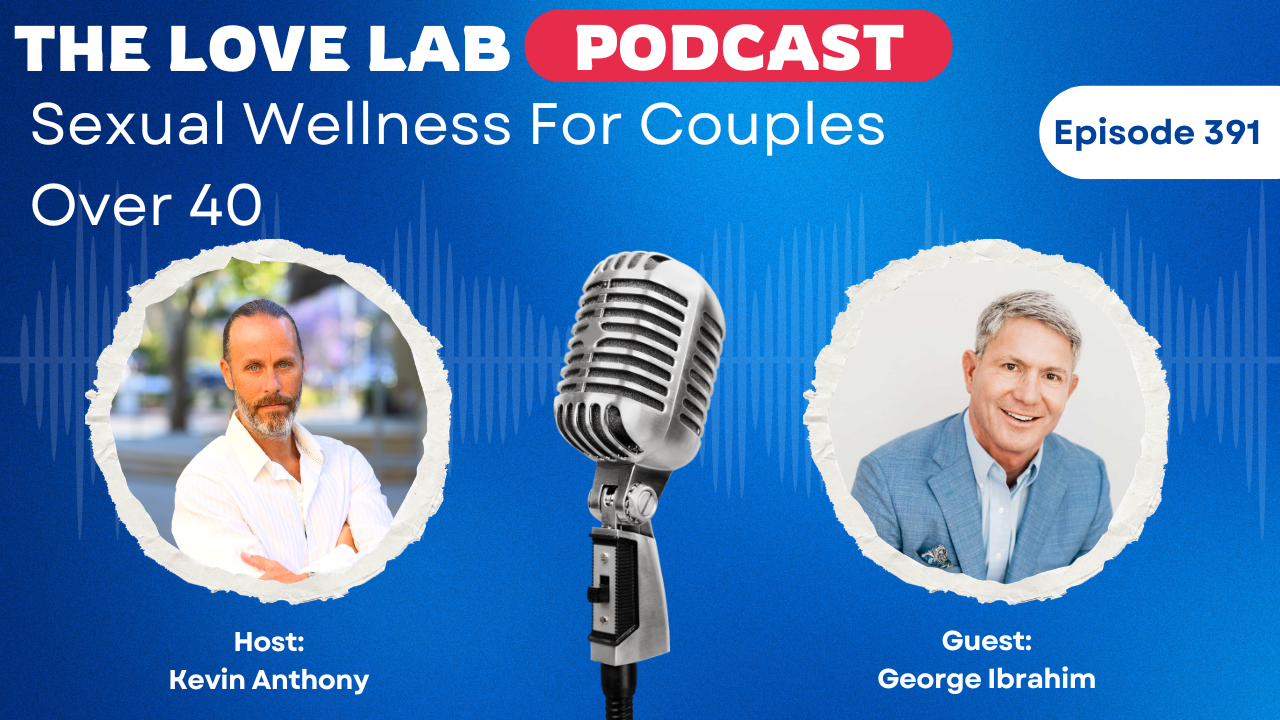
All right, welcome back to the Love Lab podcast. This is episode 391, and it is titled Sexual Wellness for Couples Over 40. This is a topic that comes up a lot, and I’m really seeing, you know, over the years, a much, much larger segment of the people that come to work with me being in the older categories. And when I look at my metrics on my YouTube channel and even on this podcast, I can see a really large segment of people, you know, over 50 and even over 60, which has kind of surprised me a bit. And on the one hand, I think that’s amazing that people you know in that age group are still interested in wanting to have a healthy, functioning sex life and relationship. So on that hand, I think it’s fantastic, but it also shows me that they’re looking for a lot of advice. They need help in this area. And I hear it all the time from, you know, my husband or wife just passed, and now I’m back dating again, and I want things to work again, and it’s been a long time, or like, there’s a million different scenarios that show up.
Kevin Anthony 1:41
So I think it’s a very relevant conversation that we’re going to have today. We’re going to talk about some of the common problems that show up for people, and not just couples, but anybody, men and women both, what types of things tend to come up when it comes to their sexuality or their sexual wellness as they age, because there are some realities and things aren’t quite what they were when we were younger, right? So the good news is, however, that we have far more options now than we’ve ever had, and that’s what we’re going to talk about. So I have a guest coming on with me in just a moment, after, as you know, if you’ve been listening to the show, after I read a couple of ads, I will introduce him, and we’re going to have a really great conversation about sexual wellness for couples over 4o.
Kevin Anthony 2:31
We have to pay a few bills, though. One of the ways that you can help support this show is to purchase the courses that I have put out there, and I have spoken about two of them many, many times. The first one, of course, is for the ladies, right? Ladies, did you know that the overwhelming majority of men consider receiving oral sex a must in their relationship? Well, I’m sure that you did, because men have been asking you for it your whole life. But do you feel confident in your ability to give great oral sex if you tend to avoid it because you don’t feel like you’re good at it, or if you feel like you’re pretty good at it, but want to get even better, then my new blow job mastery course is for you. You know, it says in the ad, it’s the new course. It’s been out for about a year, almost a year now, and it’s really been doing great. We’ve had amazing feedback. I built that with another coach named Ry Duong of Eternal Love. She’s the one teaching it, and she’s based it, not only on her own knowledge and skills there, but also on what I had put out in my viral video about what men like. So go check that out at https://www.sacredfemininearts.com/bjmastery. That’s https://www.sacredfemininearts.com/bjmastery.
Kevin Anthony 3:40
And then, of course, Power and Mastery 3.0, which is the latest version of the popular men’s sexual mastery course. If you’re struggling with erectile dysfunction, premature ejaculation, or simply want to increase your skills in the bedroom, then power and mastery is for you. Join the exclusive club of men who have taken their sexual performance into their own hands and become sexual masters. Mastering your sexuality is a key component to becoming the man she has always dreamt of and craves. Don’t leave your sexual performance up to chance or the throw of the dice. Becoming a sexual master today by going to https://www.powerandmastery.com/sexual-mastery. You know what we’re going to be talking about today. Just goes hand in hand with the sexual mastery course. So if you’re struggling with any type of physical thing where you need some medical, you know, care or intervention, then you would go see somebody like my guest, and once you’ve got that under control, then you come and take my course to learn all the other stuff, and to take it to the next level, they would go together. So so well, so definitely keep that in mind.
Kevin Anthony 4:48
All right, enough of the ads today. My guest is Dr. George Ibrahim. He is a retired Duke urologist now doing hormonal optimization, ethics and sexual wellness for both men and women. Welcome to the show, George.
Dr. George Ibrahim 5:06
Thank you so very much for having me. I’m gonna have to get some of those books for my office.
Kevin Anthony 5:09
I do believe they could definitely help some of your clients, for sure. So let’s just dive right and we’re talking about sexual wellness. For you know, people who are over 40, what are some of the most common complaints that people come to you with? So obviously, people who are over 40 are coming to you; they’ve got a complaint about something. What are some of the most common things that they’re seeking help in?
Dr. George Ibrahim 5:40
Okay? And I’ll start off with men, then I’ll go to the women. But men, what you’re seeing are these guys are they’re they’re getting fat, they’re getting out of shape, they’re losing muscle mass, they no longer have morning erections. They have a very difficult time getting an erection with their partner. They may get an erection and then lose it pretty quickly. And you know, it all goes back to the basics, and almost always it’s going to be relatively low levels of testosterone. And when I say relatively low levels, men peak their testosterone levels around the age of 22, maybe 25, by the time a man is 50, 100% of men who are 50, I know you mentioned 40, but I’m just going to use 50 in this example, because the math works easier. Are at one-half of their peak testosterone level.
Dr. George Ibrahim 6:35
All right, back, you know, when most of us were in our 20s, and we could go at it two and three and four times a night, every single night, at least when I was in my 20s. Viagra hadn’t been invented yet. You know, so somebody 50 years old is probably not Viagra or Cialis deficient; more than likely, they’re going to be testosterone deficient. And you know, if your primary care doctor got your labs and they said, Oh, your testosterone is normal. The lab report does not say normal or abnormal. This is the reference interval, and that includes 95% of everybody they test. And what it doesn’t tell you is that you’re half of what you used to be at your peak. So that’s you’ve got the men that are coming in tired, gaining weight, and able to get it up, or get it up enough to have a good job with it. That’s what I’m typically seeing.
Dr. George Ibrahim 7:26
On the women. 40 is getting to be around what we call perimenopausal, and we use the number 50 as when most women are reaching menopause. But a woman can become menopausal at 38. I’ve seen it, and she might not be menopausal until she’s in her early 60s, but 50s, around that age. So in the 40s, a woman’s coming in, she’s complaining of dryness, sex hurts. She might be starting to have hot flashes. She has very little to no desire. Her libido has gone away, and all that is due to a lack of testosterone. When a woman goes through menopause or her testosterone level just basically falls off a cliff, so do her estrogen levels, and nobody wants to have sex with a dry vagina.
Kevin Anthony 8:13
Very, very true. So let’s start talking about the men first, and then we’ll come back to the women. I’m really happy to hear the way you shared what’s going on for men with testosterone, because it’s a conversation I have a lot, and I think it’s something that a lot of people still don’t quite understand. A lot of men, and I hear this from a lot of men, they go to their doctor, and their doctor does a, you know, maybe if they requested a hormone panel, and then it comes back, and they say, everything’s fine, right? Yet, the men themselves are saying, but how can it be fine when I’m experiencing symptoms, right? When I have low libido, or when I’m having erection challenges, but they’re telling me it’s fine. And the problem is exactly what you just described, which is they’re just quoting you a reference range, and it has nothing to do with where you actually were at.
Kevin Anthony 9:08
And you know, a lot of like, nobody tests testosterone when you’re young and healthy. Why would they right? So we have no idea what somebody’s reference range is, and those ranges vary quite a bit. Somebody could have been 1200 normally. Somebody could have been 800 normally. Then they go, when they’re 50 years old, and they get a test, and they say, well, you’re, you know, 375, you’re perfectly normal. And it’s like, but that’s not perfectly normal if you were 800 or 1200 or whatever. So it’s a huge problem that I think a lot of people still don’t really understand, and unfortunately, part of the reason why they don’t understand it is that the medical doctors don’t really understand.
Dr. George Ibrahim 9:51
You hit the nail on the head. We were not taught this whatsoever in medical school. I mean, I did not realize that those two numbers were on some of them. The labs did not represent a normal range. Not until I started doing hormones did I realize it said reference interval. I inquired, What does that really mean? And that’s two standard deviations around the norm, which includes 95% of everybody they test by definition. In other words, it doesn’t turn to the letter L or low until you’re below 2.5 percentile. I mean, it’s crazy. No man would drive his car with 3% of the oil and crankcase. I mean, ever people that think you described it perfectly when you describe labs and then not being relevant labs, I’ve got to get them, because testosterone is controlled, that’s it. They make them not change my management. If somebody’s telling me that they’ve got no energy, they’re gaining weight, they’re losing muscle, they have no libido, their erections have gone to pot. They’ve just told you that they have low testosterone. What?
Dr. George Ibrahim 11:00
Doesn’t matter what that number is and what I’ll tell a new patient that’s hesitant, I’ll go look it, we’re not going to cut your thumb off, you know, let’s try this, and if it works, you’ve got your answer. If it doesn’t, then take some money away. So, whether the market goes up or down, you’re going to lose some, gain some, but you’re never going to know unless you try it. And here’s something, guys, I’ve got to realize, if your testosterone is not that high or high enough when you’re 50 or 40, it’s not going to get better. It’s only going to get worse. So this isn’t one of those things. I don’t want to be dependent on something for the rest of my life. Well, you’d better get used to it if you really want to have good erections, because your pecker is not going to work. If there’s no testosterone, and you’re not going to have more testosterone when you’re 70 than when you’re 50, it’s just not going to happen.
Kevin Anthony 11:49
Yeah, and I always think, and one of the things that I recommend, you know, when I’m working with men, is I think it’s always about the symptoms, as opposed to the number,
Dr. George Ibrahim 11:58
Absolutely.
Kevin Anthony 11:59
Where are you at? What are you feeling? So one of the things I often, you know, give men and say, Here you need to take, this is the atom. I’m sure you’ve heard of the atom, right? It’s basically just a questionnaire. It’s an assessment. And what it’s, what it’s gauging, is symptoms. And if you answer yes to any of these things that you’re experiencing, then you have symptoms. You have it.
Dr. George Ibrahim 12:22
So I mean, when I’m teaching new doctors that come through my clinic, yeah, because I have more than one location, one of the first points I make is we’re here to treat the person, not the piece of paper. In other words, we’re here to talk to them. We can look at a lab report. But that’s not how we treat. That’s not who we’re treating. We’re treating a human, and you’ve got to listen to them. They’re going to tell you what they need, just like you said about the Adam, you know, test, it tells you, right?
Kevin Anthony 12:52
Then there. One of the reasons I think that’s such a good thing is, what one because we just talked about the numbers don’t tell the full story. But, you know, being in the age group that we are speaking of myself, being in my early 50s. You know, I’m in some of these fitness groups for people that are, like, over 40 or over 50. And, you know, there’s, there’s some cool stuff in there, but one of the things that I see pop up in there over and over and over again, is guys coming in and saying, Hey, man, I’m thinking about going on TRT, and what is the right number, and what do you guys think, and what is your experience, and blah, blah, blah. And the question I always have is, why? Why is it just because you believe that you should be on it because you’re older? Is it because, like in the fitness groups, a lot of these guys just want to get jacked? Let’s, let’s be honest. Yeah. But my question to them, whenever I see that pop up, is, what symptoms are you experiencing?
Dr. George Ibrahim 13:54
It’s you get the nail ahead there and and what’s interesting, I get most of my labs are done through lab core lab core requests are two big national labs, our contractors with LabCorp, they won’t report a testosterone greater than 1500 because of the guys that are in the gym trying to basically compete on who can come in with the highest testosterone level. So they just took that out of the equation. It just says greater than 1500. The other thing to know is it’s a curve. You are never at one level. It goes up, it goes down. You know, you’re going to be at the same number twice in one day. That’s about it. Other than that, it goes it’s a curve. And then depends on what type of modality you’re using, whether it’s a cream gel injection or an implant. How, you know, I don’t do that much oral, so that dosing curve is going to have a different shape depending on the type of modality. You know, you’re never going to be at one level. But how do you feel when you’re doing it? It’s all that matters.
Kevin Anthony 14:52
And, you know, this is another interesting point that you’re bringing up, which is that testosterone levels change considerably throughout the day. Okay, yeah, they will also change based on your stress levels, your activity levels, things like that. And so getting a number one time on one test certainly does not tell you the entire story. Yeah, so that’s another thing for people to really keep in mind. Because, you know, I’ll hear this from guys too. They go, they get a test done, and it comes back with a low number, and they are freaking out, and it’s like, okay, well, hold on a minute. Did your doctor tell you to make sure you had a good night’s sleep? Did your doctor tell you, you know, make sure that you were recovered before, you know, like, if they’re doing heavy workouts or something like that? Did they tell you to manage your stress levels like, you know, they don’t. They don’t tell them any of those things. They act as if all those factors are completely irrelevant to the test. Yet they are relevant.
Dr. George Ibrahim 15:47
And then here’s a big I tell patients, of all the things on their new patient hormone profile that we get to be honest with them, the test total testosterone is the least of my worries. I’m more focused on what’s your free testosterone? And I’ll explain more about that in a second. I want to know what their estrogen level is. I want to know what the red blood cell count is. I want to know what their sex hormone-binding globulin count is. These are important. All right, so the way I look at it, total testosterone is like net worth, okay, well, you can be a farmer, have a big net worth, but be broke because you don’t have any cash. Free testosterone is what I consider to be cash. That’s the testosterone that you have that’s not being bound by something like sex hormone binding globulin. Why did God create it? I have no idea, but we have it. And if somebody’s got a high SHBG, they’re going to have low free testosterone levels. They might have a great total testosterone, but if they’ve got a low free testosterone level, which very few primary care doctors test ever, and that’s the most important of all the levels, that guy’s not going to do very well.
Kevin Anthony 17:01
You know, this is another; you’re hitting all the right points that I hope that men who are listening to this will hear, and that is the difference between the free testosterone and the other one. Because, again, a guy comes to me, he wants to do some coaching around his sexual performance. He’s talking about having erectile dysfunction. I asked him if he’s had his hormones checked. If he has, he’ll say, yeah, and I’ll say, Okay, what were, what was your free testosterone? And they go, Wait, I don’t know. They just told me my number was this, right? So their doctor will tell me your number is just this number, which is generally not the free testosterone number that they give them. And so I go, Well, we don’t even really know what that means.
Dr. George Ibrahim 17:45
Then. I mean, I had somebody a few days ago, his total testosterone. He was about 46 years old. His total testosterone was almost 900. Okay, that’s great. His free testosterone was like 1.4, his sex hormone binding globulin was like 160 through the roof, through the roof. So this guy, that anybody who got a total testosterone would have said, Dude, you’re doing great, man, 900 at your age. I mean, you got yourself on the back. Had no free testosterone, none. And you can’t really bring SHBG down. You’ll, you’ll read about some roots, and it doesn’t work. What you do is you overwhelm it with more testosterone. You know, we put more men on the field than they have, and we get by that SHBG. And now, finally, you’ll have some free testosterone running around.
Kevin Anthony 18:41
That’s really interesting. I’ve never heard of a difference that big before. Of course, I don’t, oh, it was remarkable.
Dr. George Ibrahim 18:47
I sent it to all my providers. I went to look at this one, you know. And then here’s another one, one of my patients. I’ve known him since med school. I mean, God, I don’t know, 40 years or so. And he comes in. He goes, I’m telling George, George, I’m gonna need, I need some help. He goes, my testosterone looks great. I’m looking at his new panel. I go, yeah, I’ve got it in front of me. Will? His testosterone was like 1100, but his estrogen, it’s like 9,5 you know, and do you feel like estrogen does a lot that does that testosterone? In other words, estrogen is, is you don’t want estrogen that high whatsoever as a man, men need some estrogen, but nothing like that. That’s like four and a half, five times an ideal estrogen level, and that was killing his erections.
Kevin Anthony 19:40
Yeah, and also increasing his risk for prostate cancer as well.
Dr. George Ibrahim 19:45
Which testosterone does not increase? Everybody needs to know that we thought it did in the olden days. I was one of those urologists who denied men testosterone because I was a prostate cancer doctor. Today, we know. I know we were 180 degrees off that men with low levels of testosterone are more likely to develop prostate cancer and to develop a worse prostate cancer than men who have higher levels of testosterone, completely different than the way it was when I first started practicing.
Kevin Anthony 20:18
Yeah, and you know, believe it or not, that is still a very persistent myth when it comes to, you know, hormone replacement therapy, that’s one of the, one of the first things that that, you know, guys who are on the fence about it will say.
Dr. George Ibrahim 20:33
You’re not gonna believe this. Do you know how big the study was that got the Nobel Prize about that, when they associated testosterone with prostate cancer decades ago?
Kevin Anthony 20:44
I do not, but I imagine it was quite small. So tell us all.
Dr. George Ibrahim 20:50
One.
Kevin Anthony 20:51
You know I was gonna say probably like 40 people, 50 people, like one. That’s often what they do when they do a very crappy study. But one person!
Dr. George Ibrahim 21:02
One person, and then for decades, none of us would write for testosterone for men because we’re worried about prostate cancer. I mean, my brother was diagnosed with prostate cancer. He’s a patient. He’s on testosterone. His doctors in New York told him to stay on it. Don’t get off. So more and more urologists are starting to understand this. But if you pick up the phone and call 100 of them, 90% are going to tell them, Oh, hell no, just like I used to tell them.
Kevin Anthony 21:31
It’s crazy to me that you could even call something a study when it’s one person, when it’s one person, it’s an observation.
Dr. George Ibrahim 21:38
And yeah, I mean, I’m gonna look it up again, but I’m pretty sure it was just one patient.
Kevin Anthony 21:45
You know, even if it were less than a few 1000, yeah, it’s not really a valid study. That’s crazy. So while we’re still talking about men, and before we move on to the women, we’ve been talking a lot about, you know, the primary issue being low testosterone. And you mentioned briefly earlier what some of the conditions that can create are. But I just want to come back to that a little bit and say, okay, man, if you are experiencing low testosterone, what are some of the types of things that they might be experiencing? You know, you mentioned erectile dysfunction, and then, you know, if there’s anything else in addition to obviously getting their hormones on track, that they could do to potentially solve those issues?
Dr. George Ibrahim 22:32
Well, I mean, when I give talks, and I get to the andropause, that’s so women’s menopause, men’s equivalent is andropause. When I get to the andropause slides, they’ll start listing symptoms. And the first symptom is falling asleep after dinner. And it’s, it’s fun to watch, because that’s when the, you know, the wife that’s sitting beside the husband, they’re both at the top, and that’s when she’s elbowed him, like, pointing to the screen. Like, there you are. You know, fall asleep after dinner, belly fat, loss of muscle, you know, loss of erectile ability. But that fall asleep after dinner. Women look at that and they just, and they just went in at the dagger on screen, telling their husband to pay attention. Because when I first started doing this, yeah, about 14 years ago, men were hesitant to come in. The wives would come in because they’re going through menopause, and they’re miserable. Now. They’re feeling better, and they’re horny, but their man has fallen asleep after dinner. There’s nothing they can do about it.
Dr. George Ibrahim 23:32
So they’ll, you know, they’d have to drag me in. I don’t need any of this stuff today, the guys that are been raised with Viagra and Cialis commercials are more conditioned to the idea that, you know, it might be okay to see somebody about my boy down there, you know, but the older guys, when I started, no they you had to drag them in so fall asleep after dinner, getting Fat, tired, foggy, thinking. That’s one of the biggest things that when I start new patients, this really blew me away when I started, when I, you know, start a new guy, I’m going to see him back in a month, how things going and, you know, I thought I was going to hear nothing but bedroom and weight room Olympics and all these guys the C level, the guys that owned their own businesses, they were professionals. It would be like, Oh my god, Doc. I mean, I am so much more productive. I mean, I’m getting more done in a da, da, da, or I’m reading that legal brief just once, not six times. And then eventually they’d get to the bedroom or the weight room Olympics and brag about that. But they tend to start off with how much more productive they are. That’s that was, that was a cool thing to learn from the very beginning, and it’s held ever since. I mean, guys come back because, you know, you were more productive when you were younger. You had more energy, you got more shit done.
Kevin Anthony 24:57
Yeah, I think it’s interesting that I. And it’s changing. It is changing, which is good, but I’ve been saying for quite a few years, because I’ve interviewed several other, you know, doctors similar to yourself, on this issue, because it’s just such an important issue. And you know, I say all the time, having, you know, had those experiences through those interviews, I say most people do not understand how much of their personality, or the way that they show up in the worl,d is driven by their hormones? Yeah. And so you know, when you come in, and you tell a story like these C-level guys are coming in and saying, Man, I’m reading it once, like I did when I was in my 30s, and, you know, I’ve got so much more energy. And it’s like, yes, and it’s not because you’re older, or you’ve somehow necessarily changed psychologically, maybe you have, but there’s an underlying piece there that has been overlooked forever, and that is literally the hormones. And when you get the hormones back, you’re like, oh my god, I’m like, I was when I was 30.
Dr. George Ibrahim 25:56
Yeah. And one of the comments I love hearing, and I hear it quite often. I feel like myself again, not that I feel better. I feel like me again, the me that you’ve lost, that you’ve been so long since you’ve had hormonal levels at optimal levels, but once you get them back, you Gosh, this is how I used to feel. I’m me again, yeah.
Kevin Anthony 26:23
And I think that’s really important because, you know, obviously it’s great to have a working penis and, you know, to be able to get it up when you want, and to be able to have great sex with your partner, all of that is amazing and wonderful, and it’s also helping the quality of life in other areas of your life. And I think that’s something that sometimes maybe people don’t necessarily realize. It’s not just to pack on muscle in the gym, and it’s not just to get a boner. It actually will help other areas.
Dr. George Ibrahim 26:50
It helps others, definitely.
Kevin Anthony 26:54
Okay, we’re just about halfway through. Let me pause for a break, and then on the other side of that, I want to talk about women. I want to talk about menopause and some of the challenges that women go through, some of the symptoms they have, and some of the potential things that could be solved for them. All right, are you a couple? Are your relationship and sex life where you want them to be? Are there changes you would like to make, but just don’t know how? Maybe you think that there is nothing that can be done if you’re not 100% happy with where your relationship or sex life is, then get help today and change your life. Go to https://www.kevinanthonycoaching.com/couples/, and schedule a strategy call with me today so we can map out a strategy to get you where you want to be so you can have it all your way. That is https://www.kevinanthonycoaching.com/couples/.
Kevin Anthony 27:41
And you know, as I mentioned earlier, when I was talking about the power and mastery program, you know, the coaching goes hand in hand with the physical stuff of getting your body back on track. So when you get your hormones solved, the crazy mood swings are going away, you’re feeling better, you have more energy, and your brain is thinking more clearly. And then you come, and you work with somebody like me, who can help you learn all the skills you need to have that amazing relationship and to have that amazing sex life. They really are two halves of a whole picture, which is why I like to talk about the subject of today’s show from time to time, because I think it’s important, and it’s an important piece of this because I’ve worked with couples who, you know, I could tell that they’re definitely struggling with a hormone issue, and I’m helping them the best they can, and they’re making progress, but I know how much more progress they could be making if they could solve that underlying issue. And sometimes they’re open to that, and sometimes they’re not open to that. And so I think helping remove the stigma, which is part of what we’re doing today, will help more people be open to solving these underlying challenges.
Kevin Anthony 28:57
So All right, let’s get back to the conversation. We just talked about men. Let’s switch gears. Let’s talk about women. What are some of the symptoms that women often report when they’re coming in to see you?
Dr. George Ibrahim 29:15
So you know, women, especially when menopause hits, that’s when the typical hot flashes get started, the dryness. I always tell my patients, once they get started with treatment, I go, if you like to play with lube in the bedroom, great, fine. If you need lube to have fun in the bedroom, you need to let me know, because I need to adjust some doses so they’re coming in with mood swings. The periods are getting to be irregular. There’s a big spurt. Oftentimes, before a woman hits menopause, her estrogen levels will go through the roof. And that can, I mean, estrogen can be evil, and then also it drops to nothing, which she does go through. Menopause, it literally goes undetectable. Sex becomes painful. One of the big things that weight gain, you know, I’ll have a woman coming in, and she’ll say, Dr. Ibrahim, look, you know, I know a glass of wines got 140 550 calories in it. I know that I’m not a closeted eater. I mean, you know, my personal trainer used to come once a week. Now she’s coming twice a week. I’m still going to the gym every other day of the weekend and killing myself. And then she’ll stand up, and she’ll put her hands out, and she’ll go, nothing’s happening.
Dr. George Ibrahim 30:33
Well, her testosterone is zero. And I tell a woman, you know, you cannot get thin by using aerobic activity. You can’t run yourself to thinness at 100 calories a mile. I mean, it’s just not going to work. I go, but muscle will burn fat 24 hours a day. It has to burn calories to stay at body temperature. And if you exercise muscle, it’s going to burn about five to six times that amount of calories. So you’ve got to add muscle if you want to take off this fat. But the recipe for muscle three things, sufficient protein in your diet, some kind of a resistance training, walk ins, resistance training, going up and down stairs, is resistance training. Or you can, you know, do real training. And then lastly, testosterone, without testosterone, you can kill yourself working out, you’re never going to add on muscle, and muscle is what’s going to burn your fat 24 hours a day, you’ve got to put that muscle on. So those are the big symptoms that I see when women come in wanting to see me. No libido.
Dr. George Ibrahim 31:40
Of course, we’ve always got to make sure that they’re not on certain antidepressants, Prozac, Zoloft, Lexapro. So you know that classification of antidepressants really does dig a hole in the ground for a libido and then park the bulldozer right on top of it. And you know, a lot of women come in because they’ve seen other friends that are younger come out in their 30s that are on testosterone and maybe progesterone. They’re feeling great, but they’re adding more muscle, and they like what it does to their physique. So you know, they’re not estrogen-deficient, but they want to get more testosterone on board to look better. And if they’re not planning on having kids anytime soon, we’ll add progesterone, which makes their periods essentially go away or become almost non-existent. It totally eliminates cramps from periods, and, you know, oh, and it increases REM sleep. They all sleep better. They love that. Yeah, allergies are killing me.
Kevin Anthony 32:44
The low libido thing is a very common complaint that I hear from both women and men. And obviously, when I say the men, the men are the ones coming saying she never wants to have sex. She’s not anymore the and, you know, part of the reason for that is another one of the symptoms that you mentioned, which is the painful sex.
Dr. George Ibrahim 33:07
Yeah, that is a different area, yeah, because estrogen is what’s in charge of a healthy vagina. The tissues of the Jana depend on estrogen to be nice, robust, and to be lubricated. And if you don’t have estrogen, the vaginal tissues of a woman in menopause are like, what tissue paper? I mean, they’re very fragile, so sex with these women is going to be painful. They’re going to have tears. There’s nothing fun about it. Yeah, you can use lube, but then a lot of women’s lubes can cause certain pH problems that they have to then deal with down the road. So doing it naturally by having natural lubrication, which is what you’re going to get if you’ve got enough estrogen on board human estrogen done correctly, and there’s, there’s, there’s dangerous ways of doing estrogen, and there are safe ways of doing estrogen, but estrogen done correctly certainly helps.
Kevin Anthony 34:06
In a little while I want to get to the safe way, because there are some pretty big caveats here when it comes Yeah, hormone replacement therapy, so, but before we get to that, I wanted to just talk a little bit more about the women one of the things that you just shared a moment ago that I really appreciate, and you know, I There are a lot of people out there talking about hormones, and honestly, in my opinion, they don’t all have the same level of knowledge when it comes to what to do and how to do it. One of the things I appreciate about you is that you’re bringing in these other things, like exercise, like weight training, right? Like the balance of the other hormones. Because I’ll hear from, and I’ve heard this from, actually, quite a few women since we’re speaking about women, they’re experiencing symptoms. They go to their doctor, and their doctor just puts them on synthetic estrogen. Mm. Yeah. And I just every time I hear that, I’m like, Oh, my I like, I’m just like, Okay, we need to have a talk. You need to get a second opinion. You need to go to another doctor who understands what they’re doing with hormones, because they may actually be dramatically increasing your risk for certain types of cancers and not actually helping you solve any of your symptoms.
Dr. George Ibrahim 35:22
You hit the nail on the head. Get this Premarin at the time, excuse me, at the time, Premarin is the number one drug selling on the pharmaceutical market in all of history. I mean, it’s beautiful, because guaranteed 50% over 50% of the population is going to go into menopause. Into menopause. All right, get this today. How much money do these guys spend coming up with the sexy name for a new medication? I mean, you know, they, you know, focus groups, all sorts of things, Premarin, they sat around with, huh? What do we name it? Shit. Name it what it is. Pregnant, Mayor, urine, horse bee. Literally, Premarin was extracted from pregnant horses’ urine. Premarin, pregnant mare urine. Okay, think about that. You’re taking a pill of another, speed, another, mammals, hormones, but you’re not a horse, so caused all sorts of problems, you know, everything from different cancers to blood clots. That’s a biggie. Taking estrogen, any kind of estrogen, even these fake estrogens, by mouth, increases risks of heart disease. I mean, blood clots, by 420%, doing it through the skin creams, gels, patches, implants, going through the skin, not going through the liver first, which is what happens when you swallow a pill first. Mass Effect will lower your risk of blood clots by 10%, that’s a four. That’s a big difference.
Kevin Anthony 36:57
That’s a huge difference.
Dr. George Ibrahim 36:59
Yeah, in fact, to me, it’s malpractice, any per any doctor that’s given a woman today oral estrogen. I just pulled my hair out, and I just, I can’t believe it’s even allowed on the market. It’s senseless.
Kevin Anthony 37:14
Well, you know, I’m definitely not an expert on this, but having gone through a pretty challenging health journey with my wife before she passed, I got kind of a quick, you know, sort of boot camp in estrogens. And you know, how your body breaks them down in the different pathways, and how it methylates. And the biggest takeaway I got from that, because I can’t explain it to you exactly how it works, I’m sure you can. The biggest takeaway I got from it is you can’t just test a number and go. You need more of this or more of that because it has to do with how your body’s processing it, what pathway it goes down, and what it’s being converted into. It’s complicated, and it’s not a one-size-fits-all solution.
Dr. George Ibrahim 38:02
I mean, you can see these advertisements and journals that doctors get come to sunny Orlando for the weekend, start your hormone practice on Monday. I’m sorry you can’t really learn it all in two day seminar on how to do this properly. The metabolites of estrogen are significant, and there’s, you know, three distinct pathways. And one of the things that we do with our patients is every woman that’s in our program that’s on estrogen is given certain supplements that drive the metabolism towards a metabolite that is beneficial. There’s one that’s beneficial, there’s one that’s very detrimental, and one that’s sort of neutral, and we push it towards the beneficial metabolite of estrogen.
Dr. George Ibrahim 38:46
And I do want your audience to know the estrogens that you heard about in the past that led to cancers like breast cancer were not bioidentical human hormones done through a transcutaneous, meaning, through the skin as a cream gel or implant route. So please, when people come in, they go, Well, my mother did hormones, and she got breast cancer. Today’s bioidentical estrogen does not increase the risk of breast cancer, but what it does do is it dramatically decreases the risk of a heart attack, and the number one cause of death with women in America is by far cardiac by far. Every med student knows it’s called the Framington study, or Framington study, that women don’t have heart attacks before menopause. After menopause, the chance of a woman having a heart attack is identical to that of a man her age. That’s scary.
Kevin Anthony 39:51
Yeah.
Dr. George Ibrahim 39:51
I think when women are sitting around going, I’m afraid of that estrogen because of breast cancer, I go, I’m afraid of that heart attack when, when 80% of the minds out there have heart attack. On top of them, and only 20% have you know, I’m just making those two numbers up, but Heart attacks are way worse. The other thing is osteoporosis. A woman doesn’t stop eating calcium when she turns 50, but she loses her estrogen, and estrogen is responsible for bone mineralization. And a woman who gets osteoporosis falls down, breaks her hip, goes to the hospital, gets pneumonia while she’s in there, getting her hip replacement, oftentimes, doesn’t come out of the hospital. So those are two big medical reasons why women need to be doing bioidentical estrogen.
Kevin Anthony 40:35
Yeah, I’m really glad that you brought up this, and it was definitely something I wanted to make sure we covered because, as I mentioned before, you know, a lot of times women have symptoms that go to the doctor, and the first thing he does is, oh, you just need to go on synthetic estrogen. And you know, I’ve made clear my thoughts on that, as did you. Yeah, let’s talk a little bit about the difference between those synthetic hormones and the bio-identical hormones. What? What is the difference? Like? How could you explain it to somebody so that they would go, Oh, I get that, makes sense to me. Now, I get why I should be doing bioidentical.
Dr. George Ibrahim 41:08
Okay, so here’s the biggie. Why aren’t more doctors talking about biochemical hormones? There’s no money in it. You can’t get a patent on something that I’ll create or invent. So these pharmaceutical companies cannot patent, so like, well, my wife’s on an estrogen patch. The patent is on the solvent that gets the estrogen through the skin. It’s not on the estrogen. So there’s no drug rep coming into a doctor’s office taking lunch to them and to the staff and talking about biodentical hormones, but there are drug reps for the pharmaceutical companies for these synthetic hormones, and so they come in and they talk about how great these are, about getting rid of symptoms and this and that, but they don’t talk about the negatives, like the increase in cancers and in blood clots.
Dr. George Ibrahim 41:59
So yeah, the synthetics will get rid of things like hot flashes and may improve vaginal dryness, but they definitely have a way of relieving the hot flashes, but they come with all sorts of other risks. Why? Why would we do a synthetic hormone when our bodies used to prove to us when we were younger that our natural hormones were great? You know, the 22-year-old girl in college who’s horny and gets wet at the millisecond, that was natural estrogen. Why not put just the same thing she used to have when she was younger and more vibrant back into her bio, identical estrogen?
Kevin Anthony 42:41
Yeah, I agree. I mean, I think this is really true of pretty much anything. I feel the same way about food, you know, it’s like, why are we trying to overly, you know, engineer food, when we know for a fact that the best food is what nature created for us, right as close to nature as we can get, yeah. And I think the same is true here, if we’re going to be, you know, doing interventions like, you know, adding hormones to our body, we would want it to be as close to our natural as we can possibly make it.
Dr. George Ibrahim 43:11
Well, I tell new patients I go, if I brew the blood, if I have samples of blood before and after treatment, or if I had identical or identical twin sister. Long story short, the lab cannot tell you if that lab sample, if that hormone level, came from somebody’s own ovaries or from what I did. It’s not similar. It’s the exact same thing. I mean, it is the exact same hormone that our gonads used to make when we, you know, but we just made a lot more of them when we were younger.
Kevin Anthony 43:48
Yeah, you know, I think it’s really, really important that people understand that due to the risks of the synthetic ones and the, you know, relative safety of the bioidenticals. And if anybody’s listening to this and they’re like, Wow, I’m having these symptoms. And I think maybe I should, you know, see a doctor about it, just please make sure that you are asking for bioidentical hormones. I think it’s just that important.
Dr. George Ibrahim 44:18
And I mean, I’m sure there are tons of good Franchise Practices out there, but unfortunately, there are a lot that aren’t very good. And everybody gets treated with the same cookbook. And I mean, I even looked into some of them early on, and some of them were the business model and the practice model, meaning the medical practice, were essentially in the same binder. You know, it was driven not for the best patient interest, but for the best profit outcome. So please be careful if you’re going to some of these franchise clinics, as I said, I’m sure there are some that are good and on the up and up and safe. It, but I just have so many. We never lose a patient to a franchise, but we get lots of franchise patients that come to us because they’ve had a friend that’s seen us, and the friend is telling them how much more individual treatment they get in our office, and how much more it’s individualized for their issues, rather than the copy and paste that you oftentimes will see it a lot of franchise places.
Kevin Anthony 45:26
I mean, if it’s one thing, we know, everybody’s body is different. There is no copy without tailored individual treatment. You’re never going to be getting the benefit out of it that you could be getting, and you might even do some harm.
Dr. George Ibrahim 45:41
I mean, I’ve literally got, not that many, maybe three sets of identical twin ladies. They’re all ladies, and it’s just cool to see how different the doses that I’m giving each of them. I mean, I’ll have two sisters identical, but one of them is on 20 times 12 to 20 times the amount of estrogen that the other one’s on. Because they’re all different. Even though they weigh the same, they’re the exact same age. They got great, you know, the genetic makeup, but they’re different, and one needs this much more, needs that much, and you just got to tailor it to match the patient’s needs.
Kevin Anthony 46:20
Yeah, absolutely. Okay. We’ve got a few minutes left in the show, and we’ve primarily been talking about hormones, which, you know, probably the biggest, most important thing. But that’s not all that you do in restorative medicine. What are some other treatments that are available for people who want to really maximize their sexual wellness as they age?
Dr. George Ibrahim 46:48
I think peptides are phenomenal. I’m not going to spend much time on the GLPs, but I think the GLP peptides now, we’ve got three of them that are out there. We’ve been using Ozempic mostly in our office, because we can get it for a good price. That gets two of the receptors, but lowering blood sugar is going to get in. This one definitely will get a Nobel Prize. Yeah, it helps with weight loss, great, but there are so many other things it does. Glycation is a process that literally gums up the DNA by lowering blood sugar. It’s been proven that you can lower certain cancers. You can decrease cardiac problems. So love the GOP ones, growth hormone enhancement. There are several different peptides.
Dr. George Ibrahim 47:40
And listen, before I start mentioning these things, do not go to Google these things and then find them online coming out of China or India. You don’t know how. You have no idea that the vial is sterile. You have no idea what kind of bonds these peptides have. And amino acids are the bonds that form between amino acids are very fragile. And you know, if you’re getting it from what I call a peptide meal, you are risking your life. So, you know, it costs a lot more money to get peptides from an FDA human pharmacy, where they’ve been inspected, where the toxins, because all peptides, when they’re produced, there’s an endotoxin made in the human pharmacies scrub that, and it’s tested to make sure that there’s none left. But for research, using only peptides has it all in them, and over time, you get what’s called a cumulative toxicity level. It’s very dangerous. You won’t notice it immediately, but over time, it could cook your liver.
Dr. George Ibrahim 48:38
All right. So growth hormone with peptides like some Moreland epimoreline growth hormone is phenomenal. BPC, body protection compound, or pentadecotec peptide, is phenomenal for tissue repair. TB, 500 does a lot of the soft tissue repair injuries we use; oftentimes, we use those in conjunction with one another. I mean, I could talk for four days on peptides. There are peptides for sex, since this is a sex related podcast. PT, 141 wild. What that does for libido, both men and women, and for erections in men, oxytocin, the love drug, a wonderful nasal spray, you had this great love feeling for one another, and it definitely increases orgasmic capability. And this is just literally a handful of the, gosh, we probably deal with 40 different peptides, but that’s the, I’d say those are some of the top five big ones.
Kevin Anthony 49:38
Yeah, the peptides are a really big thing these days. I was actually thinking about going on some myself. Regular viewers of my show may have remembered, you know, about two months ago or so, when I had my left arm, like down here, off camera throughout the entire episode, because I had a crash where I ended up fracturing the distal head of my radius bone completely. It’s doing pretty well now, after a titanium plate and 11 screws. But you know, several good friends of mine who are doctors said you need to get on BPC one seven, because this is going to really help your recovery. So that’s what I’ve been considering going on still, even though I’m doing pretty well post-surgery now.
Dr. George Ibrahim 50:27
There’s no reason not to. I mean, your body used to make my chin keep hitting this. Your body used to make BPC when you were younger; it’s made in the small intestine. TB, 500 was made in the thymus. But as you get older, your thymus, we call it involuted. I don’t know why we call it that, but essentially, your thymus stops functioning, and both of those peptides you had when you were younger, which is the reason why, you know, young kids can fall down and get up and be fine in a day. What state are you in?
Kevin Anthony 50:58
I’m in California.
Dr. George Ibrahim 51:01
I don’t have a California license.
Kevin Anthony 51:06
Well, you know, I do. One of my acquaintances, a colleague, actually, who is a doctor, has the ability to do that. But I, you know, I’m not, I’m not opposed to medical tourism either, you know, be happy to go visit somebody if I really trusted them.
Dr. George Ibrahim 51:25
But yeah, if they’re getting it from a reputable pharmacy, that’s the big that’s the biggie, because you don’t know what’s in that glass vial that comes from India or China, and at best, it might not work. At worst, you might end up with meningitis or septic shock.
Kevin Anthony 51:46
Yeah. So this is, this is actually a great time to talk about this, because with any sort of new technology, you know, that comes out, you know, and fortunately, people, most people, I don’t even know if it’s most people, some people, at least anyway, are always a little skeptical at the start. I know I was definitely one of those people. When people started telling me about all the peptides, I’m like, I don’t know about this. You know, this is kind of new. Do we know what the long term? So the reason I’m bringing that up is that I’m wondering if you could maybe address what you know about peptides and any potential risks that they have long-term.
Dr. George Ibrahim 52:22
I mean, if there are risks, somebody needs to point them out to me, because let’s go back to what we’ve talked about earlier. The growth hormone analogs are looking at a sequence of amino acids found in growth hormone-releasing hormone, which is a hormone your hypothalamus makes already, it just doesn’t make much of, and what they found is these 40 or 41 amino acids are the key to the lock. That’s what fits into the receptor. And so all we’ve done is string together amino acids that are the exact same amino acids that are in the naturally occurring growth hormone-releasing hormone.
Dr. George Ibrahim 53:00
All right, so that’s what’s going to promote growth hormone. Growth hormone. We’re not making you’re not giving somebody growth hormone. You’re giving them a peptide that asks their body to look around. Go, hmm, could Kevin use some growth hormone today? And pituitary goes, You know what? Yeah, good. Thank you for reminding me. Or it says, Yeah, you know what, he’s fine. He doesn’t need any more today. So your body stays in charge. So that’s why you’re not going to have these weird side effects you sell from those guys that did growth hormone and got these weird hands and weird faces and everything, because your body stays in charge. BPC, remember I said he used to bathe the small intestine. I mean, that’s natural. That’s not a foreign substance. Your body used to have it. TV, 500, your body used to have it. PT, 141, that’s one of the relatively newer ones. I’ve not heard of anybody having any problems other than they might tan more than they were. You know, they normally tan when they’re exposed to UV exposure, because PT 141 is closely related to Melanotan two, which is a peptide that people who want to get a tan without UV exposure will use for that. So I’ve not heard of any long-term problems, and remember what I just said earlier, like BP, C, and TB, 500 your body’s already been making that, it just quits making it when you get to be a certain age.
Kevin Anthony 54:25
So, you know, one of the concerns, and you actually mentioned this earlier, although you had a good answer for it, one of the concerns with hormones that people often have is like, well, once I start, I’m basically going to have to be on it forever. Is there a similar thing with peptides?
Dr. George Ibrahim 54:42
No, not at all. In fact, let’s go to growth hormones specifically. So the guys that would do growth hormone itself, not growth hormone, releasing hormone, analog, but growth hormone themselves, the pituitary would get lazy. It’d be going like, I don’t have to do anything. Dude’s already shooting up growth hormone. I’m. Take a vacation. I’m gonna get out of here. All right, so five months later, the guy stops taking growth hormone. He can’t afford it, or whatever. Well, that’s a crash, because the pituitary has gone on vacation. It takes months to get the pituitary revved up again. But what we’re talking about is growth hormone-releasing hormone. The pituitary has to come to the door every day. The hypothalamus knocks on the door, says pituitary opens the door. Hypothalamus goes, you want to make some growth hormone from heaven. So the pituitary hasn’t had a chance to take a nap or a vacation, so there’s no crash and burn. If they stop it, same thing with BPC. Stop doing it, it’s probably going to ache again, but you’re not, you know, it’s not going to rebound, it’s going to it’s not going to get worse, it’s just going to go to where it would have been had you not been taken it. So you can stop peptides at any time, anytime.
Kevin Anthony 55:53
So basically, if I’m understanding you correctly, the only real potential downsides to the peptides are just making sure that you get high-quality ones that don’t feel Amin.
Dr. George Ibrahim 56:04
It’s Yep. In fact, I tell patients, I go, you know, peptides barely even meet the definition of drugs. Yeah. It takes a prescription for a lot of the reasons, because most of them are injectable, because the stomach in the stomach, will break them apart. Because, as I said earlier, they’re very, very, very fragile. The bonds are very fragile, but they don’t interact with medications. Like when patients say, well, they told me to get off my meds because I’ve got this surgery coming up. I go ahead, you really don’t have to. I mean, these aren’t, these aren’t medications. I tell them I would not do your GLP one, just let’s not lower your blood sugar. But other than that, I mean, if anything, I’d bump up the growth hormone in the TB 500 and the BPC on peptides right before surgery and after surgery in a millisecond. In fact, my nurse practitioner just had breast surgery, and of course, she’s doing everything that we’re talking about, and she said that her physician told her she is recovering at 100%. She’s like, I don’t know if it was supposed to be a four-week recovery. She recovered in two weeks. I mean, she’s recovering twice as fast as he sees in a typical patient.
Kevin Anthony 57:24
That’s pretty amazing.
Dr. George Ibrahim 57:25
Yeah, yeah.
Kevin Anthony 57:28
All right. Well, we covered quite a bit today, and I really appreciated your your very straightforward but also knowledgeable explanations of things and how they work, I think that we did a really good job of letting people know what possibilities are out there if they’re experiencing symptoms, as well as covering, you know, any potential, you know, downsides or side effects, in a way that I think was just really easy to understand.
Dr. George Ibrahim 57:59
Well, thank you so much. And I’ve got to do a little commercial. It’s built more restorative medicine and esthetics, and I’ve got locations in Asheville, North Carolina, and Greenville, South Carolina. I’m also licensed in about 14 different states. So, you know, we can do a lot of things that we talked about over a HIPAA-compliant teleconference. And so we just love somebody. If this is of interest, let us know. The big thing, hormones and these peptides are safe. They are safe when done correctly and given in the proper modality, the proper method, very safe. So please don’t be miserable. Be healthier, have more fun, have more sex. Look better, live better. Love better is what we say.
Kevin Anthony 58:46
Love it. Love that. Look Better, live better. Love better. Is that what you said? Right?
Dr. George Ibrahim 58:50
Yep. Well, we actually do this order, live, love, and look, think of that. You know, we’ll live in the most important way than we want you to love, and then, then we can get to your vanity with the love.
Kevin Anthony 59:03
I think those are the right priorities. Yeah, all right. Well, thank you for coming on and sharing your knowledge and expertise. Of course, there will be a link to your website in the show notes so people can find it easily. And yeah, thanks for doing what you’re doing and helping people get back to a healthy, more enjoyable life.
Dr. George Ibrahim 59:27
Well, thank you so much for having me. And I definitely want to be looking at your book titles, because those are the kind of things that, once my patients start getting their hormones in shape, they are really ready to get back in the sack and go at it. And I liked hearing what some of those titles were.
Kevin Anthony 59:45
Absolutely and once, once they’re ready to do that, they just need to come over to KevinAnthonyCoaching.com and send me a message. All right, so much. Thank you again for coming on the show. All right. That’s all the time I have for this episode, and I will see you next week.
Kevin Anthony 1:00:10
I hope you liked this episode of the Love Lab podcast. If you enjoy this show, subscribe, leave me a review, and share it with your friends, and for more free exclusive content, join me in the passion vault at https://www.kevinanthonycoaching.com/vault/. That’s https://www.kevinanthonycoaching.com/vault/. Thanks for listening, and remember, as Celine used to say, you’re amazing!
Kevin Anthony is a Certified Sexologist, Tantra Counselor, NLP Practitioner and a Sex, Love & Relationship coach. For over 10 years he has worked with men, women, and couples to have the relationships of their dreams, and the best sex of their lives! He is also the host of “The Love Lab Podcast”, creator of the popular YouTube channel Kevin Anthony Coaching, and creator of the popular online course series “Power and Mastery” as well as other online courses for both men and women.
Leave A Comment