Kevin Anthony 0:00
Welcome to the Love Lab podcast, the place to be for honest and real talk about relationships and sex, whether you’re a man or woman, single or a couple, this is the show for you. I am your host, Kevin Anthony, and I am here to help you have the relationship of your dreams and the best sex of your life.
Kevin Anthony 0:27
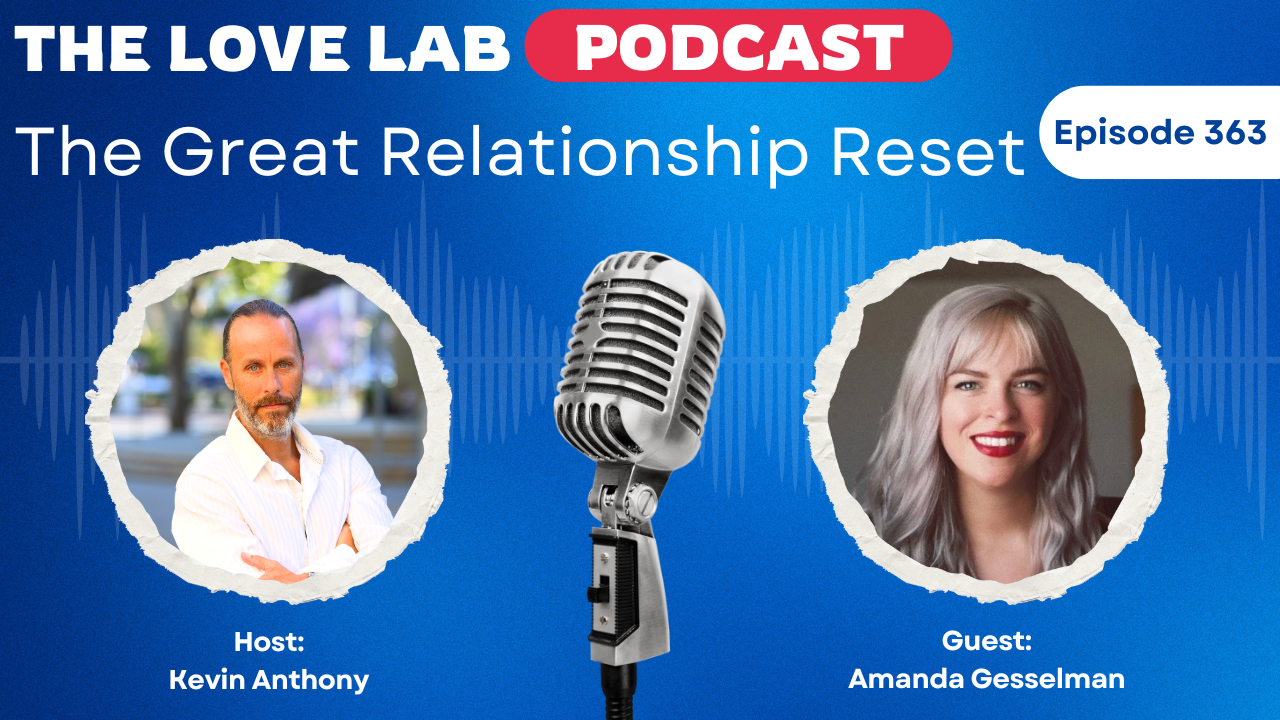
All right, welcome back to the Love Lab podcast. This is episode 363, and it is titled The Great Relationship Reset. What does that even mean? What are we going to be talking about today? We are going to be talking about data, specifically around relationships. And you know, what people are looking for, what they want. I got I got papers. I got papers. All over here about data, right? If you’ve been listening to any of the recent episodes, I’ve done a couple of shows where I’ve gone into data. I did one on a research report that was done on oral sex. I did another one, which was a ton of stats on orgasms. You should be noticing by now that I am basically a stat geek, and I like to know, I like to know the data behind the things that I am teaching and sharing every day on this show, because I think it helps us get a better understanding of what’s really happening out there when it comes to sex and relationships.
Kevin Anthony 1:35
So we’re going to be covering a report that was put out called Singles in America, and it is a lot of data. It’s not all just about singles, per se. It’s basically, it’s a lot of relationship data. So what you learn when you hear what singles are doing or what they’re looking for, some of this does apply to people who are already in relationships, also. So, don’t think you can just do it now because I’m already in a relationship, you’re still going to learn something here. And what I think is going to be also very interesting today is that I have the actual researcher with me today to talk about this. So in the past, when I’ve done these, I have not had that opportunity. So I read the stats. I’ll give you what my take is, as somebody who’s been working in this profession for a long time. I tell you what I see and how that compares to the stats this time, I have the actual researcher who works, not only with match.com who sponsors this, but also with the Kinsey Institute. And I’ll be reading her bio in just a second, but she’s the real deal. So we’re gonna, we’re gonna learn some really interesting things, I think, in today’s episode. And even if you’re like, Whatever, I’m in a relationship, everything’s great entertainment value. I think it will even be good with this. So please hang in there before we do that.
Kevin Anthony 2:58
A short word from my sponsor. Ladies, are you tired of always picking the wrong guy? Does it seem like there just aren’t any good men out there? Are you struggling with your sexuality? Or do successful relationships seem like a mystery you can’t quite crack the code on, then it’s time to get help. Check out my women’s relationship and sex coach coaching program at https://www.kevinanthonycoaching.com/women/. In this program, we will work on removing sexual shame, becoming confident in your body, learning the sexual secrets that drive him wild, what to really look for in a man when dating, how to break old patterns like always choosing the wrong guy, and so much more. This is your opportunity to learn everything you have ever wanted to know about men, while also creating real, lasting change in your life. So please go to https://www.kevinanthonycoaching.com/women/.
Kevin Anthony 3:46
Okay, my guest today is Amanda Gesselman, and she is a psychologist and research scientist at the Kinsey Institute at Indiana University, where she studies how people form connections and maintain intimacy. She also works with match.com as a sex and relationship scientist, where she leads the survey development and data analysis for the Singles in America Project. So welcome to the show. Amanda.
Amanda Gesselman 4:14
Hi. Thank you so much for having me. I’m so excited.
Kevin Anthony 4:17
Me too. I got lots of questions. There’s a lot of data here before we dive into the data itself. Could you explain a little bit about this study? So you do this research every year. What is it that you’re really hoping to learn when you do this?
Amanda Gesselman 4:39
So we do this survey every year, and every year, some of the topics change, but our real goal is to understand the single experience. You know, lots of people out there are single. They’re on the dating market, or they’re thinking about what they want, a partner. Some of them, you know, maybe don’t ever want a partner. They don’t ever want to. To enter into a relationship again. But the point of the survey is to just understand what singles want, what they’re looking for, how they’re thinking about their relationships, and what their strategies are going forward.
Kevin Anthony 5:11
And you do this research in a partnership between the Kinsey Institute and Match, correct?
Amanda Gesselman 5:17
Yes. So this was the 14th year that we’ve done this. It’s always a partnership between researchers here at the Kinsey Institute and Match. And my job in this project is to lead development of the big survey that we have people fill out to understand what they want and what they’re doing, and I also do all of the data analysis on the back end. So I am a fellow stats geek.
Kevin Anthony 5:42
Well, it’s obvious why match.com would do something like this, right? Because, you know, you just said Your goal is to understand the experience of singles. So from a business perspective, the better they can understand that, right? The better they can tell their product to help people, you know, not be single anymore, basically. But I’m curious, what does the Kinsey Institute why are they doing this research?
Amanda Gesselman 6:08
Well, every year, this research gives us a nationally representative look at what Americans want, what they’re doing, what they’re doing, specifically romantically and sexually. And the Kinsey Institute is the world’s leading scientific Institute into the study of sex, relationships, gender, and reproduction, or conception, having children, etc. So this product perfectly aligns with the Kinsey mission. It helps us see what’s going on, what people want and are doing in today’s sort of modern age.
Kevin Anthony 6:44
Yeah, and I have quoted Kinsey studies many, many, many times. I don’t actually always necessarily say, and this was the Kinsey study, but I’ll throw the stats out, you know. And people at this point realize that I think, as I’ve said it so many times, one of the main studies that I quote often is about, you know, how long men last before they ejaculate, versus how long it takes women to achieve orgasm. I have quoted that more times than I can possibly count, because they’re really to be honest. I don’t know. Maybe it’s changing in the landscape today, but there aren’t that many people out there really doing that research?
Amanda Gesselman 7:23
Yeah, we’re definitely, you know, a small group working at Kinsey was my dream job when I started here 11 years ago, because I was really passionate. You know, I’m a psychologist. So, from a psychological standpoint, how do people find a partner? What makes someone attractive? What makes someone, you know, a lifelong partner for you? How can we help people enter into those relationships, find those partners, keep them going, and if they end, how can we help them recover quickly, and, you know, get back in a good space? And Kinsey, the Kinsey Institute, is one of the only places where you can go as a researcher, and do that kind of work and have it reach a global audience. So I think the work that I do is important, obviously a very biased perspective, maybe, but I also think the work that my colleagues are doing is incredibly important, and hopefully, you know, hopefully, we have decades and decades in front of us of doing that work.
Kevin Anthony 8:23
Well, I hope so too. I mean, if you really want to understand a problem, you’ve got to really take the time to research it, right? You’ve got to find out. I mean, there’s a certain amount of stuff that we can figure out by trial and error, you know, like, Oh, if we, if we tell people to do this, it seems to work, and that’s good. You know, there’s nothing wrong with that. In fact, I think if we only had data, that would be a problem, and if we only had trial and error, that’s also a problem. So I love the fact that you guys are out there doing this, so that we can bring those two together, right? People who are out there in the field, working with people. We know what tends to work, but it’s so much easier for us to figure out how to help them when we’ve got the data behind it also. So one last question about the study, which is, could you just briefly explain how the study was conducted so people understand a little bit about that?
Amanda Gesselman 9:20
So every year, I lead the survey development. We come up with topics that we want to ask and also questions that we want to repeat each year to have a sort of trending look at what’s going on in this sort of American single experience. And what we do is we collect a nationally representative panel of about 5000 single adults in the US, people who are 18 and older, and we make sure that the sample distribution matches what’s in the most recent US census in terms of age range, gender identity, sexual orientation, region of the US that they live in. And race, income, all those sorts of demographic things that you might see in the census. We want to make sure that our sample matches that, so that we can when we get our results, we can go forward and say, you know, using this representative sample, we know that 19% of American single adults are doing XYZ to, you know to find a partner, or are doing you know XYZ to fulfill their own needs without having to find a partner or what have you. So it’s all nationally representative data, and at the end, we do put out a big sort of release of those findings that you can find at singlesinamerica.com. It’s updated every year as we do this, and this is the 14th year of our study.
Kevin Anthony 10:46
Yeah, I wanted people to know pretty much exactly what you just said, because sometimes, and I admit this, I’ve shared studies, you know, studies on this show before where, you know, basically they just go out and they randomly ask, you know, a certain sample size of people a bunch of questions. There’s nothing wrong with that. But you know, when you really want to get geeky and scientific about it, you have to approach it from a little bit more of a scientific approach, which is what you guys have done by matching your samples to what the actual census data says. So I think that this is probably about as representative as you can really get, which I think is important to know as we dive into the stats themselves.
Amanda Gesselman 11:31
Yeah, I’ve done those studies myself, those smaller studies. You know, when you’re studying a niche population or a group of people, that’s just not very large you sometimes you don’t have any other way to get a study of them. You have to just go out and hope that you get a large enough sample size to do statistics on. But in the US, about one in three adults is single. So that’s actually a pretty huge proportion of our population, of our adult population in particular. So doing this nationally representative study of them is a bit easier. They’re a bit easier to find because there are so many of them. And you know, they are all demographics, people who are black or white, people who are old or young, people who are gay, lesbian, bisexual, heterosexual, etc. There are lots and lots and lots of people in every group who are single, so it makes it a bit easier for us to collect this nationally representative data.
Kevin Anthony 12:28
Well, that is a great segue into the first data point that I want to talk about, because you just said one in three people are single in the US, and the stats are saying that 46% of people are ready for long-term relationships. So I’m curious, have you been doing this for 14 years? Has that number changed? And if so, has it gone up or down? That’s the first question I have in regards to this.
Amanda Gesselman 12:58
So we do ask this question every year whether or not people are ready for a relationship, and there hasn’t been that much change over time, at least not in the last you know, I think we started, I think we introduced this question maybe six or seven years ago, definitely before the pandemic, which changed a lot of things for a lot of people. And the number of people who feel that they’re ready for a relationship is generally around one or two, and that stayed relatively consistent across time, so we’re not seeing any big changes there. It still seems that you know about one and two are still holdouts. They don’t feel ready, whereas the other half does.
Kevin Anthony 13:36
Do you have any insight into why such a large percentage of people don’t feel that they’re ready?
Amanda Gesselman 13:42
Yeah, that was something that was very interesting to me after the first time that we asked this question, and I saw that only about one in two feel that they’re ready for a relationship. That was pretty surprising to me. I felt like that number should be a lot higher, especially because there’s research out there on people who are intentionally single and want to stay single forever, and that number of people is not 50% so what is it that’s keeping people from not feeling ready? And so I started incorporating questions, you know, year after year to dig into this. And truly, what I think the reason is for the about 50% of people not being ready is ready is that they just have other priorities right now, there are other things that are taking their mental and physical energy. There are only so many hours in a day.
Amanda Gesselman 14:31
So in particular, what we found is that people who feel that they have a lot of career goals, people who are in debt financially, people who feel like they would really like to improve their mental or physical health, and people who just really want to concentrate on family relationships or friend relationships, those are the people who tend to be not ready for a relationship, so they’re prioritizing other stuff. And we. Particularly see this in Gen Z singles, people who are between 18 and 26 or 27, they’re really prioritizing their higher education, finding a career, moving up the career ladder, and paying off those student loans. They might want a relationship. They might tell us, you know, yes, I want a relationship, but I’m just not ready for it. I need to do these other things first, or, you know, I’m prioritizing taking these off of my to-do list first.
Kevin Anthony 15:26
Yeah, I’m not surprised to hear that at all. And I have to say, as a coach, and you’re free to disagree with me if you want to, but I have to tell anybody who’s listening to this, who’s sitting there and going, Yeah, that’s me. Those are all the reasons why I’m not ready for it. I really have to ask you to reevaluate your priorities. There are certain things in life that truly make the experience of life better, and it’s really easy for a decade or two or three to just slip on by while you’re in the pursuit of your career or trying to be more financially ready, or whatever it is. And then one day, you wake up and you go, I’m 40 years old and I’m single, and not only that, but I’ve never really had any solid relationships, so I have very little experience, and I see this, I work with people.
Kevin Anthony 16:25
I’m working with a couple right now who’s gotten together, and they’re doing pretty good, but one of the things you know, he’s admitted to me is that he’s no experience whatsoever in the bedroom or in or really much in relationship, and he’s in his 40s, and now they’re trying to figure out, like, how do they blend her family in with him and like, and they just have nothing, nowhere to even start. So it’s like, those young years are the years when you’re supposed to be learning. You’re supposed to be gaining skills. How do I relate to other humans, right? How do I have a successful relationship? How do I, you know, have a healthy love life, you know, as far as like in the bedroom and sex, and so I think when people put off these things too long because they’re pursuing other things, I think that they really set themselves up for a more challenging future later on. And you know what they say, nobody ever feels truly ready to get married, nobody ever feels really ready to have a child. Nobody ever feels really ready for any of the big things in life.
Kevin Anthony 17:29
At a certain point, you just have to jump in and say, I’m going to do this, even though I don’t feel ready. That’s my personal take on it. When I saw this number, 46% say they’re not ready for a relationship, I just go, Oh, my God, this is bad. This is not good, right? Because then what’s going to happen is you’re going to end up with a whole bunch of lonely, unhappy people later on down the road, because they’re not prioritizing this.
Amanda Gesselman 17:55
Yeah, I agree. I think that a good quality relationship adds a lot of value in the research out there, not just singles in America, but, you know, there’s a wealth of relationships research out there that shows that having a good partner provides a lot of stress reduction, a lot of just value in all aspects of life. They can help you navigate those, you know, relationships with family, where you might be having to care, give, or, you know, help someone out. They can help you get out of debt. They can help you, you know, build up your emotional coping mechanism, your emotional store, so to speak, to be able to navigate all of these stressful situations in life. And so I’m definitely pro relationships. My study singles out a lot. I think that. I think that finding that relationship is a great thing no matter where you are in life, no matter what your situation is.
Amanda Gesselman 18:51
One thing I will say is that we do find that about half of our singles don’t feel ready for a relationship, but a lot of them are actually still trying. So a lot of them are still using dating apps or trying to find people in person. They’re actually still going about, you know, they’re still trying to engage in that, they just don’t. Maybe they don’t emotionally feel ready, but I think meeting the right person or the right people, I think can can shift that for a lot of people and make them feel like they’re more prepared than they thought they were.
Kevin Anthony 19:26
were. Well, I’m glad to hear that they’re still trying. But I will say this also, you know, if you don’t feel like you’re ready for something and you’re trying, are you really trying as hard as you could? Right? It’s kind of like a half-hearted try. And then if you want to get into like, woo, woo, spiritual land about manifesting. It’s like, what is your energy of telling yourself you’re not ready, going to do when it comes to dating, right? So then they’re in the dating apps, and they’re sitting there going, Oh, this, this dating app doesn’t work, and this is pointless, and I’m just scrolling all day long, and it’s like, hold on, is it really that the dating app doesn’t work or. Or is it really that you’re not really committed to actually finding somebody?
Amanda Gesselman 20:04
I definitely agree. Yeah, I think those. I think the other thing is that if you don’t feel ready, you’re not necessarily opening yourself up to have clear communication with people that you might encounter on dating apps or in real life that you’re interested in. And that is a huge problem, because one of the big issues that we found over and over and over again when we’ve done this survey is that people aren’t communicating the type of relationship that they’re looking for. And so what happens is everyone on the apps assumes everyone else is looking for something casual, that they’re not looking for anything serious or committed or long term or real, and those expectations really become a barrier. They make people feel disappointed. They make people feel discouraged. And this year in particular, we asked, you know, do you feel like those misconceptions are causing issues?
Amanda Gesselman 20:56
And I think over, I think around 84% a bit over 80% said yes. These are definitely causing issues. And my ability to even find a partner, you know, because people aren’t able to engage in that. They’re not able to say what they want. Maybe because they don’t feel ready, so they haven’t spent a lot of time thinking about it. Maybe they just feel scared that they’re gonna, you know, run someone away or scare someone off. But I think that sense of readiness and what you want can really be an asset when you come to the dating table.
Kevin Anthony 21:29
Yeah, another great segue into my next question, because you just mentioned that people were saying that there are a lot of misconceptions, one of which is that most of the people out there in the dating space don’t want anything serious. But the stats here that I read say that 62% of those actively seeking a romantic partner want a committed, exclusive relationship. So that actually says the opposite.
Amanda Gesselman 21:59
Yeah, absolutely. Again, it’s that there’s this sort of mismatch where this is what people want. People, most people want a long-term, committed, authentic relationship that feels real, feels like it has future potential. But when we get when we see them get on those dating apps, they feel a little nervous about saying that, about telling people what they want, even if someone asks, they feel a little, you know, like, like, it’s not acceptable to say that that’s what you’re looking for, because maybe that person will think that you’re like, immediately looking for a husband or immediately looking for your wife, and, you know, trying to jump too quickly into something.
Amanda Gesselman 22:37
But over and over again, what we’ve seen in this data, in surveying singles in the US, is that the majority of them are looking for that kind of relationship. That doesn’t mean that they’re not open to something casual. If they, you know, find someone they really click with, and it ends up being more casual than they had expected. Okay, fine, you know, I had a good time. I learned some things about myself. I learned some things about dating, but what they would really prefer is commitment.
Kevin Anthony 23:06
Yeah, and I’m happy to hear that because, you know, I have all of my friends who are in the dating space, especially because of the work I do, they always want to, like, ask me questions and, like, tell me about their experience. And I can tell you, I hear from a lot of them that that’s how they feel, that they’re on the apps, and everybody just wants a hookup. So I think it’s really important for us to say that that’s not what the data says, even if the people themselves aren’t actually saying that. And you know, I understand that some of them may be a little shy to state that upfront, but you know, I’m a big proponent of you’re not going to get what you want if you don’t make it clear what it is that you want, right?
Kevin Anthony 23:51
So you have to speak up and tell people. And I tell people all the time, look, if you in the beginning of dating, tell somebody ultimately what I want is a long-term, committed relationship. If you do that upfront, right, and they say, oh, okay, I’m out good. That’s a good thing. That’s a good thing, because otherwise you’re going to waste how much time, you’re going to get frustrated, you’re going to get angry, because eventually this person isn’t going to give you what it is that you want. So, like people, they won’t speak up and say what they want, because they’re afraid that the person is not going to want to go out with them. But you realize that you don’t actually want to go out with people who don’t want the same thing that you want. So, being upfront about it, can we get those people out? And yes, you might have fewer dates, but the ones that you get are going to be better quality, because you’re going to know already that there is at least a desire to get to the same type of relationship that you’re looking for.
Amanda Gesselman 24:52
Yeah, absolutely. And I think one thing that people worry about is, you know, if I say that I’m looking for a commitment or a long-term. Relationship, they’re going to think that I want to, you know, immediately become committed after the first day, immediately, you know, jump into an engagement and marriage and having kids. Just because you’re looking for that, really, that kind of relationship doesn’t mean that you have to move fast or move quickly. It just means that you’re, you’re being upfront with the things that you want, the things that you don’t want, and what our data shows that more often than not, you’re going to be talking to someone who also wants that, because again, more than half of the people that we’ve surveyed over and over and over again say that they’re looking for a committed relationship.
Amanda Gesselman 25:36
So I think it’s in everyone’s best interest to be a little more upfront about that a little bit more clear. And again, even if you say, you know, this is, this is the kind of relationship I’m looking for. I’m looking for something long-term, and that person says, Oh, well, that’s not what I’m looking for. Okay, well, you saved yourself some frustration. You saved yourself a little heartache. On to the next.
Kevin Anthony 25:58
That’s fine, exactly. Okay, so we talked about, you know, how many people are ready for a long-term relationship? We talked about how many people are actively seeking a committed, exclusive relationship. Let’s talk now a little bit about the qualities that people are looking for, because you asked a bunch of questions about the qualities that they’re looking for, and then, of course, also deal breakers, which we’ll we’ll get to in a minute. But what are some of the qualities that people say that they’re looking for in a partner?
Amanda Gesselman 26:32
So we asked a similar question like this in a lot of years of singles in America, so we’ve been able to sort of track the consistency and what pops up each year and over and over and over again, the top qualities that people are seeking in a partner. Regardless of what kind of relationship that they’re looking for, they’re looking for a partner who is kind and empathetic. So kindness and empathy are the number one traits that people are looking for. There’s also physical attraction, or physical attractiveness in the mix, that’s always relatively high each year. It’s not 100% so it’s not something that everyone is saying, you know, is the most important quality, but it’s in their top five. I would say they want someone that they’re personally physically attracted to. Doesn’t mean that you need to be, you know, the Adonis of the world.
Amanda Gesselman 27:21
But you know, there’s something about you that they find to be especially cute, or, you know, attractive in that way. And we also always find that a good sense of humor, or a compatible sense of humor, is in the top sort of priority for people. So they really want someone that they feel, you know, will have their back, will take care of them. So that’s where the kindness and empathy come in. They want someone that they can feel, you know, physically attracted to, that they can look at across the room and feel a little flutter for. And they want someone who they feel can mentally understand them and make them laugh.
Kevin Anthony 28:00
Yeah, this is a moment where I have to draw some parallels between the dating scene and people who are already in a relationship because so kindness and empathy. Yes, that makes a lot of sense. Also, you had basically as the second one is physical attraction. So I want to make the comparison like, when you get into a relationship, there are things that people are looking for in the beginning, and that’s kind of what we’re talking about here. People are dating. These are some of the things that they’re looking for. But if you let those things slide over the course of your relationship, right? And those qualities don’t exist anymore, or maybe not in the way that they did, which can have a negative effect on your relationship over time.
Kevin Anthony 28:48
So, because I know a lot of my audience are people who are already in couples, I want to make a few parallels throughout this so it’s not all just about people who are dating. And I just want you to know that you know your partner, no matter how long you’ve been together, is still going to want you to be kind and empathetic, is still going to want to be physically attracted to you, which is a big one that people, well, I’m married now. What I don’t gotta I don’t have to worry about that, right? It’s like, no, no, no, no. I don’t care if you’ve been married for 50 years, you should look at your partner and go, Yeah, I want some of that right, like you should be doing that. And then obviously somebody who can make you laugh is great. Another one that you didn’t mention that was also on the list was shared core values.
Kevin Anthony 29:38
So these are, these are things that are important, whether you’re just out there looking for somebody now you’re dating, or whether you’ve been in a relationship for a long time, so it’s important to nurture those things throughout your entire life. I just I think it’s important for people to UN. Understand what it is others are looking for, right? Because let’s go back to dating again. If you’re out there on the dating scene, right? You want to make yourself as attractive to whoever it is you’re looking for as possible. It’s like if you want to sell your house, what does everybody do these days when they want to sell their house? They go fix all the stuff that’s been broken for the last five years, right?
Kevin Anthony 30:24
They hire somebody to come in and stage their house and make it look like a home magazine, you know, because they want to increase the chances that somebody is actually going to want to buy it. Well, here you are out there in the dating scene, and if you know what it is most people are looking for, take a look at yourself and say, am I capable of providing those things? Have I treated my partners kindly in the past? If not, how can I learn to be more empathetic, right? What? How do I look physically? Am I doing the best I can with what I’ve been given in this meat suit, right? Not saying everybody has to strive to look like some certain model or whatever, but just do the best you can with what you’ve got, right, and that that’s a very difficult thing for a lot of people to do, is to look at their selves and go, You know what? This is, this is, this is as good as this meat suits gonna gonna get right? Like, that’s something we’ve all struggled with. I’ve had to come to terms with that too, you know, like, I train hard in the gym all the time, and I see other people whose bodies are far more defined or more muscle mass or whatever it is.
Kevin Anthony 31:35
And I just had to come to terms with I have a lean body. I’m never going to have that muscle mass, unless, of course, I get on steroids or something, right? But I like who I am, and I’m doing the best I can with what I got, right so that’s, so that’s what I think that people should strive for. So all of those things, look at yourself, do an assessment, see where you’re at. See, you know, what are you actually bringing to the table here? And I think this data can help you kind of pinpoint maybe some areas you need to work on a little bit.
Amanda Gesselman 32:07
Yeah, I think everyone is hoping to meet someone who’s, you know, bringing their best self to the table, whatever that looks like for you individually. You know what we found, in terms of, like I talked about earlier, the priorities that people have. A lot of people really are trying to prioritize their mental and physical wellness. And I think that also ties to what people are looking for in a partner. You know, if I’m working on bettering myself, if I’m working on bringing my best self to the table, then I really hope that you are too. And I think that, I think that that makes a lot of sense. We want someone who’s willing to put in the work and willing to show that they can be a good partner for us.
Kevin Anthony 32:50
Agreed. Let’s talk about deal breakers now, because we just talked about what people are looking for. What are the things that people say are absolute deal breakers?
Amanda Gesselman 33:02
So the biggest deal breaker is dishonesty. People want to feel like their partner, or their date, their potential partner, is telling them the truth, is presenting their authentic self. You know, no one wants to be lied to. So dishonesty is a huge red flag for singles in our study; for singles in America, it’s a huge deal breaker, and not something that they want to have to put up with. They want to deal with. So lying will get you dumped, for sure, run all of your partners away. People are looking for honesty. Some other deal breakers that we found in the survey were a history of cheating.
Amanda Gesselman 33:45
So singles would prefer that their partner be honest with them, be upfront with them, if that’s something that you have done in the past, but they are really looking for someone who if you’ve had those experiences in the past where you have been cheating, that you are actively working on yourself and that you can show the progress that you’ve made. Otherwise, they, you know, consider that to be a red flag. They want, they want partners who’ve been honest, who’ve stayed honest and stayed true to the commitments that they’ve made. Some other deal breakers. I don’t quite remember what else is on that list.
Kevin Anthony 34:22
I got a couple more. I can help you fill in with some of those. We talked, for those listening in the pre-interview, she’s like, Oh my God, there’s a lot of stats here. Please don’t make me remember all of them. I said, don’t worry about it. Said, I will have it all in front of us, so we’ll be good. It is a lot to remember. Nobody could remember all of this. So, a couple of the deal breakers that I wrote down here from the list were things like dishonesty, which you mentioned, by the way, 83% of people said that was a deal breaker for them. That should not be surprising at all. Emotional unavailability, 67% of people said that. That was a deal breaker? Yes, lack of physical attraction, 61% and non-monogamy. 60% of people said that non-monogamy was a deal breaker. That is not surprising, given the fact that we said 62% of those actively seeking a romantic partner want a committed relationship.
Kevin Anthony 35:19
So yeah, I’m not at all surprised to hear that non-monogamy is a deal breaker for a similar percentage of people, because they want a committed, exclusive relationship. So again, I think deal breakers are important to understand, and I’m going to go draw a little parallel over to the people who are already in relationships again, but they still want these same things, even once you’ve been in a relationship for a while, right? Dishonesty, whether it creeps in 10 years later or whether it’s there from the start, is a deal breaker for people. Emotional unavailability is another deal breaker. It doesn’t matter if you’ve been in a relationship for 25 years, if you can’t, you know, access your emotions and be able to communicate them in a mature way? That’s going to be a problem in your relationship.
Kevin Anthony 36:09
Obviously, I mentioned the idea of a lack of physical attraction. You know, you get into a relationship because physical attraction is part of that mix of things that attracts you to somebody, and then all of a sudden, you’re like, Oh, well, we’re married now. I can just let myself go eat whatever I want. Don’t need to get up and go to the gym anymore, because whatever, right? But that is still a problem in your relationship down the line. And of course, non-monogamy. You often hear, you know, people, they, they, they go through that, you know, some people call it the seven-year itch or midlife crisis, or, you know, these terms that we have to describe moments in relationships where suddenly something changes and somebody wants something different. One of the things that you will often see is, you know, somebody’s around, I don’t know, 30 to 40-ish, they’re going through that midlife crisis, and they suddenly decide they want to have an open relationship.
Amanda Gesselman 37:05
I will say, yeah, non-monogamy is different from cheating, and we defined it in the survey to make sure people understood that we didn’t mean cheating. So we have asked a lot about non-monogamy in the survey and in past surveys. And interestingly, what we found is consistently, there’s about 20 to 25% of American adults who’ve had a non monogamous relationship in the past. A non monogamous relationship is where you have more than one partner, and you can be committed to these people, but just not exclusive. So we found that around 20% of US adults have had an open relationship, where you have a main partner, but then you might also have sex with other people, and a little bit less than that, have had a polyamorous relationship, where you have committed, really committed, romantic relationships with more than one partner.
Amanda Gesselman 38:01
So it’s actually not as niche or uncommon as people might expect, but it is a deal breaker for a little more than half of our singles. When we asked, you know, what they’re looking for in a partner and what would be a red flag. So you know, again, I was surprised that the number was that low. I expected that to be a deal worker for more people. Considering the number of people I know have had this past experience, is not typically not more than around 25% in a given year. So to me, that says that more people are potentially open to at least talking about it, if that’s something that their partner comes to them and wants to do, or they meet people that they’re attracted to, and that’s the type of relationship structure that that person likes. It’s also been more represented in the media in past years, and some studies on Google trends have shown that people are searching it more often now than in past years. So that could be an area that we see more of in the coming years. And I know from you know, anecdotes from my friends that they are seeing a bit of an increase in people saying that that’s what they’re looking for in their online dating bio. So they’re looking for something non monogamous.
Kevin Anthony 39:14
Well, I’m glad that you did specify that there is a difference between cheating and non monogamous, because that is absolutely true, and that’s why, when I was giving my example of, you know, going through the midlife crisis and suddenly deciding they want an open relationship, I chose my words very carefully to make sure that I wasn’t saying that they necessarily want to cheat, but they come to their partner, and then they’re like, Honey, I think we should have an open relationship. And since I was drawing parallels to, you know, people who are already in a relationship. The point I really wanted to get across there was that for many people, that’s going to be a deal breaker for them, right? So you it’s like, it’s like, know your audience, read the room, right? So that’s kind of important to know.
Kevin Anthony 39:58
But I also, I agree with your point about the fact that you would expect that number to be higher, but I will say that I think you’re also right on with the idea that in media and in just the general atmosphere, that non monogamy has really gotten a lot more attention over the years, and I think that that has opened more people’s perspectives to possibilities that are out there. People who’ve listened to this show know that I’m not against it. They know that my wife, when we met, we were in an open relationship for a while before we decided not to be in one. We’ve done whole episodes on this show about open relating and polyamory and all that kind of stuff. So not against it, but the thing is, you again, you got to know, right when you’re out there, what are deal breakers for people, or if you’re already in a relationship, to suddenly decide you’re going to let yourself go, or you know you’re going to be dishonest about certain things, or you suddenly decide you want to open the relationship. Just know the majority of people are going to be a no to that. So that’s important to know.
Kevin Anthony 41:16
Okay, I need to take a short break. Got a new sponsor on the show today, and then I want to come back in and talk about, we’ve got age gap stuff. We’ve got the gap between men and women that I really want to talk about, what generation is having the most sex, and I’ve got a bunch more. I mean, there’s, there’s a section I have. I don’t think you guys, oh, you did title it this. I thought I wrote this down in my notes, but I got a section in here about fucking in your 40s. Like, we got to talk about this stuff. We’re already running out of time. So let’s do a quick pause for a break, and then when we come back, I want to talk about as much of this as we possibly can.
Kevin Anthony 42:02
Your relationship isn’t broken, your sex life just needs a reboot, and that’s where Beducated comes in. Beducated is where toe-curling pleasure meets expert-backed education. Dive into 150-plus courses that’ll help you enjoy sex more, master new spicy techniques, and radiate confidence in the bedroom. Beducated was created by top experts and has a huge variety of courses to choose from, everything from self-pleasure to kink, all in one space. Courses include video tutorials, practice exercises and reliable information you know. When they wanted to come on as a sponsor, they gave me access to their full library of courses. So I’ve had an opportunity to go in and go through some of these courses. And from what I’ve seen, it is really well done. There is some great stuff in there. It’s not weird or pony in any way. It’s educational, but it’s just, I think it’s just well done. And I think the goal here, really, is to educate you. And if you know anything about my show and my work, you know that that is a huge goal of mine. I often have people on the show that do similar things to I do, and I have them on because I want you to have the resources that you need to fix your relationship and your sex life. And I think that being educated is one of those. So if you are interested, and if you are in a relationship and want to enhance intimacy and spice up your sex life. Then check out beducated today by going to the link in the description, and make sure to use the code Love Lab to get 50% off the yearly pass. There is a risk-free 14-day money-back guarantee so there is nothing to lose. Sign up, get access, and see all of the content for yourself. Remember, use the code Love Lab to get 50% off the yearly pass. The link is in the description.
Kevin Anthony 44:14
All right, so we got a lot more to cover here. Let’s talk a little bit about what the stats say about age gap dating. So what I have here is that 34% have dated somebody 10 plus years or older. And of course, that broke down to 30% men versus 38% women, when that’s not typically surprising, 25% have dated somebody 10 plus years younger, what? First of all, I don’t know if you’ve been asking this particular set of questions for a long time, but if you have, have you seen that change at all? That’s the first question I have.
Amanda Gesselman 44:56
So we have asked this question. We don’t ask it every year, but we have asked it. It in the past. I think the last time that we asked it was around 2014, or so. And I did compare the statistics, because I personally thought that this might increase based on, you know, the movies that we have out now, like baby girl and other things. It just seems to be, like, very popular in the medium. And there actually wasn’t much of an increase, just like a few percentage points. So it doesn’t seem to be something that we’re seeing, you know, a rapid rise in the dating scene. But the numbers, you know, around one in three people have dated someone 10 or more years older than themselves. I think that’s a pretty large statistic in terms of what people are doing and looking for, especially when you think about the online dating app settings that you have to make. You know, typically it comes with, you know, some kind of age setting that’s around your age, maybe five years up or down.
Amanda Gesselman 45:59
But apparently, you know, one in three people are maxing it out. They’re open to any age range, regardless of how young or old it is. So I think that’s really interesting. And this year we, in addition to asking people whether or not they’ve had this experience, we asked them, you know, what are, what drew you to that? What are, what are the benefits or the good things that came out of that? And on the flip side, what made that relationship rough or made it challenging? You have to remember, these are single people, so they’re not still in those relationships. Obviously, those relationships did not work out, because they’re now single again. So we were really interested to see, you know, retrospectively, looking back, what was it that was appealing, or what was it that made it not so great?
Kevin Anthony 46:44
And what did they share with you?
Amanda Gesselman 46:48
Interestingly, regardless of if they dated someone older or younger, some of the benefits that they reported were quite similar. So for specifically for people who were dating someone 10 or more years older than themselves. What they particularly liked was this feeling of being cared for that they felt that people their own age couldn’t quite provide in the same way. So they liked the idea that someone you know had a bit more experience, they could give them a more emotional care and also, in some cases, more financial support.
Amanda Gesselman 47:24
In both cases, we found that people who are dating older and people who are dating younger felt that they had a bit more of a sex drive match, whether that was higher or lower, regardless, they felt that they were they were more sexually matched people who are dating down in age, people who dated someone 10 or more years younger than themselves, they liked that that person again, you know, matched their sex drive. Maybe that was a bit more frequent than people their own age. They also felt that the partner was more physically attractive at the time than people in their particular age range or dating market, and they tended to like that the younger partner was a bit more spontaneous, a bit more open to adventure, a bit more fun.
Kevin Anthony 48:11
Yeah, I can tell you what I’ve been hearing a lot of lately from older women who are dating. A lot of them are dating younger men these days, and the two most common reasons they tell me that they’re dating younger men are that the men in their own age group cannot keep up with them sexually, and that the men in their age group have really let themselves go and are not particularly attractive. I coach a weekly women’s group. I hear this from them frequently, because usually what happens is they come to me with some challenge, you know, in the relationship. And so I start probing for details, trying to figure out, Okay, what’s going on here. And then it comes out that this person is 10 years, 15 years younger than they are, right?
Kevin Anthony 49:06
So then we have to go into, okay, well, you know, what made you, you know, decide to date this person. Then we start kind of digging into some of the, you know, we get a little deeper into what their motivation is, and what some of the potential, you know, blocks might be and and so this kind of information comes out when we have those discussions. So that’s something that I’m seeing a lot with, you know, women who are still wanting to be sexually active and vibrant, and they’re just saying, you know, people in their own age group just can’t keep up. And so they keep going younger and younger. The other thing that I hear, and I hear this a little bit on both sides, is that people say that they’re just having difficulty finding people in that narrower age range.
Kevin Anthony 49:59
So just like. You’ll see them do with, you know, distance, where they keep expanding, you know, the distance in which they’re willing to date. That’s another one. I see a lot where people like, well, we’re in this long-distance relationship. Like, years ago, I didn’t get so much of that. Now I get tons of it, because people just keep expanding their range. And I see that with the age gap, too. People just keep expanding the possibilities of who they’re willing to date, because they say they’re having difficulty finding somebody in their own age group. Have you seen similar things to that?
Amanda Gesselman 50:32
Yeah, I think that as people sort of encounter barriers or challenges to finding a partner, they start to think about, you know. Well, okay, what standards could I potentially relax? Or, you know, what could I do to make my dating pool a bit denser, a bit more populated? And so I think that sometimes people end up in these age gap relationships, specifically because of that, because they couldn’t find a suitable partner, their own age, within a certain, you know, mile range, who had X, Y and Z, qualities that they were looking for. And I think you know, to some extent, that makes a lot of sense, especially if you are someone in your, you know, 40s and up. A lot of your friends are married. A lot of your extended social network is partnered up. There aren’t a lot of single people around that you haven’t already met, and so you know you have to strategize, to think about where you could look for suitable partners. So that in particular, makes a lot of sense to me.
Kevin Anthony 51:39
Yeah, and you shared some of the we’ll call them positives that people shared with you when it comes to dating, you know, somebody with a significant age gap. What were some of the negative things, the things that they thought didn’t work out so well?
Amanda Gesselman 51:55
For people on both sides of the coin, people dating younger and people dating older. One of the biggest challenges that they pointed out was having a hard time with each other’s social circles, so having a hard time fitting into their partner’s social circle, or vice versa, having a hard time getting their friends and family to accept their partner. And I think that, in particular, is really interesting as a relationship scientist, because there’s so much research showing that your social network, your social support system, is critical to your relationship’s longevity, or your ability to maintain that relationship over time.
Amanda Gesselman 52:33
The way that our friends and family treat our relationship and our partner, the way that they might help us keep it going, they might provide advice or provide some sort of resources. Those are crucial for us, for, you know, for having these successful long term relationships, and if you don’t have that support, or if you have some actual like adversity, where your friends or their friends, or either one of your families is actually, like, pretty hostile towards your relationship, they don’t understand it. They don’t think it’s a good relationship. They think you should break up. That can cause a lot of issues that stress that we experience from those people can spill over into our relationship and create more conflict, more dissatisfaction, and ultimately, you know, lead us to break up. So I thought that those were pretty substantial challenges that people, that people reported and that they have to face.
Kevin Anthony 53:23
Yeah, for sure, my wife, before we were together, her previous relationship had almost, I would think it was like 2530 year age difference. It was a pretty big gap. And so I, you know, I got to hear from her what her challenges were. One of them was exactly what you said, like they would go to functions together, and she would be the youngest by a huge margin. And so she often felt like she didn’t have a lot in common with the people in the social circle, which was a challenge for her. The biggest thing for her, though, in that age gap, difference, and I’ve heard this from others too, is that, you know, she said that even though it wasn’t something she was consciously doing, she always knew that somehow, you know, this wasn’t going to be the last relationship, right?
Kevin Anthony 54:25
Because just biologically, that’s just the way it is. In other words, she always viewed the relationship as a for-now kind of thing, as opposed to a forever kind of thing, because forever just isn’t in the cards when you have that big of an age difference, right? You know, so she could be 50, still relatively in her prime, right? I think anyway, that’s because I’m in my 50s, but still, you know, still a lot of life left, still a lot of vibrancy, and her partner might be gone. I. At that point, right? You know. So that was a big struggle for her, and really, like when she started thinking long term, you know, years down the road, it was hard for her to imagine staying in that relationship because of that, that challenge.
Amanda Gesselman 55:14
Yeah, that’s really hard, the ability to future plan, to think about our extended timeline with a partner, to think about all the things that we might do together and how we’ll spend our, you know, older years together, that’s a huge contributor to people’s sense of satisfaction with a relationship, that ability to think forward and, you know, look forward to different things that you might do together that is very predictive of having a long, lasting, fulfilling, satisfying relationship. And if, for whatever reason, you can’t do that, you know, if, if you’re seeing these barriers to having that long term future, you know, a lot of studies do show that that can lead to a sense of feeling not so great in this relationship, of feeling like it’s not fulfilling, it’s not satisfying, you know, and eventually those feelings build up. So I can see how that might not last for her.
Kevin Anthony 56:18
So obviously, for people who are dating, think about those things when you are considering dating somebody with a big age difference. These are things you should think about in the beginning, and if you’re in an established relationship already, I think it’s important to understand that these are things that could be, even if they’re subtle, underneath the current of the relationship, so to speak. And I think it’s important for you to speak to them, to bring them to the forefront in the relationship, and say, let’s talk about this, right? Let’s see if there’s a way that we can, you know, make this work, or make this better, or not, just sort of let it sit there underneath the surface and suddenly, you know, erode the relationship?
Amanda Gesselman 57:03
Yeah, absolutely, being upfront is always key.
Kevin Anthony 57:06
Yeah. All right, let’s talk about this. This, I thought, was interesting, and I really wanted to talk about it. It says that 70% of singles and 80% of Gen Zs see the gap between men and women widening. First of all, can you please explain what that means, the gap between men and women widening? And then I’m curious if you have any thoughts on why they’re perceiving it as widening.
Amanda Gesselman 57:34
Yes. So this is a set of questions that we specifically asked to people who said that they were heterosexual, so people who are looking for a different gendered partner, and we asked whether or not they perceive differences between men and women’s expectations on the dating market behaviors, the sort of ways that they’re going about dating, whether or not they see that as getting progressively different, or that gap getting progressively wider. And the reason that we asked about this is because there is just a lot of media, a lot of news stories, a lot of TV shows, a lot of movies that sort of depict this, you know, ever-growing misunderstanding between heterosexual men and women.
Amanda Gesselman 58:21
There are a lot of stories about online dating in particular, and how men are looking for one thing, but women are looking for the other. Sort of, going back to those, like, those classic sort of, like, men are from Mars, Women are from Venus. Kind of things where we’re seeing this sort of influx again, in this, this sort of narrative about heterosexual men and women and what they want. So we asked our participants who are heterosexual if they see this gap widening, and 70% of them said yes. And then if they said yes, we asked them a whole sort of list of different expectations that they’ve encountered from the opposite gender, or things that they’ve noticed that the opposite gender has expected of them, or sort of had, like preconceived notions about them. So, for instance, we asked men who are on the market for women who are looking for a partner.
Amanda Gesselman 59:18
We asked them, you know, what kind of misconceptions are you encountering on the dating market? What are you seeing that women are doing or thinking or believing about you, that are causing issues, and for men in particular, the number one thing is that all women think that they are just there to have sex, that they’re just looking for sex and not a committed relationship. And interestingly, when we asked women, okay, what are men misperceiving about you or, like, where do you think that the issues lie there? They said the same thing, that men are thinking that they’re looking for something casual, that they’re looking just for sex, and that they’re not, you know, looking for a long-term, real serious relationship. Good. So both genders feel that they are encountering this over and over and over again, and that it’s gotten worse over time for them in the last few years. And then there are some, some, you know, differences by gender.
Amanda Gesselman 1:00:14
So women really feel that a lot of men think that they are looking for a partner for sort of materialistic reasons, that they’re sort of, for lack of a better phrase, that they’re like gold diggers, that they’re looking for a man who brings, you know, a lot of money to the table and will take care of them so they don’t have to work. And, you know, the man will show up and pay for all the dates, etc. And they feel that that’s absolutely not true for them, but that’s something that they are repeatedly encountering on the dating market. And then on the flip side for men, in addition to women believing that they’re only looking for sex, they’re also experiencing women just assuming that they lack emotional intelligence or that they’re not willing to have these emotionally deep conversations or connections, you know, basically expecting a level of emotional immaturity from them, whereas they feel that they actually do have that asset. They could bring that to the table, but they’re not really given the chance to do so.
Kevin Anthony 1:01:14
You know what’s interesting? As I listen to you talk about that, 70% of singles say they’re seeing the gap between men and women widening. But what you’re telling me here is it’s not that the gap is actually widening. It’s that there’s a perception that the gap is actually widening. In other words, you know, if it were true that both of them really just wanted sex, right? Then, okay, there’s, there’s, there’s a gap there, right? And if that percentage goes up, that gap is widening. But what the stats apparently are saying is that, you know, that’s actually not true. Most of them aren’t just looking for sex, but they’re perceiving that they are, and that was just one example. Like you gave a couple in there where it was like they feel that they’re only this or they’re only that. But when you ask the person, is that the truth, is that what you were actually looking for, they’re saying, No, it’s not so it seems to me that it’s more about a perception than it is a reality. What do you think about that?
Amanda Gesselman 1:02:24
I think that’s exactly correct. And that was something that I was trying to dig out when I was developing this survey. You know, we are just so inundated with all of these stories about what’s happening, what people want, what online dating is like, how terrible it is, how frustrating it is because people are just on there for hookups, et cetera, et cetera, et cetera. And so I just really wanted to dig in and see, okay, is it objectively true? Are these things objectively there is an objectively bad experience, or are we sort of being influenced into thinking that these things are there, but in actuality, the people who are participating aren’t, aren’t, you know, looking for sex only, or, you know, they’re not behaving these ways.
Amanda Gesselman 1:03:09
And so, yes, I think exactly what you I think what you said is exactly true in that people really feel like this is something, this dating experience, is something that has gotten progressively worse or lower in quality over time, and it’s because there’s all these expectations on them and and you know, they’re not, they’re all experienced, you know, they’re not living up to these expectations, or they don’t actually have these qualities that people think that they Do, but when we look at what they do want, or what they are pursuing, or the type of person that they really are, that data is different. You know, people have this expectation that everyone they meet on this dating on dating apps in general is looking for hookups. They’re looking for one-night stands. They’re just looking for sex, and then, you know, they’ll never call you again. They’ll ghost you.
Amanda Gesselman 1:04:02
But when we narrow the pool down to people who, in our sample, are using dating apps, what we’re finding is that they’re looking for a long-term relationship, and they really hope that no one ghosts them, and they don’t want to ghost anybody else, right? Like they want to make these long-term connections, they want to meet someone who provides them with something authentic that they can connect with and feel good about. And, yeah, it’s a lot of it is perception, but not quite reality.
Kevin Anthony 1:04:34
Yeah, and I think that’s important to understand, because you made a point too about how some of this stuff is coming from society, and I completely agree. I think, unfortunately, a lot of what’s perpetuated out there in society keeps perpetuating these, you know, basically falsehoods, right? Like this isn’t really the reality, so that’s part of it. So, the advice would be to. A lot of that stuff is out, right? Just don’t, don’t pay attention to it. The second thing is, is, because it’s a perception, it basically means that the two sides aren’t really communicating their realities to each other, at least not in an effective way. So the second piece of advice is to talk about this stuff, right? You can bridge a lot of that gap simply by saying, Here’s what I want, here’s what I’m looking for. And if, oh, I’m looking for the same thing, I actually want the same thing, right? So you can actually bridge a lot of that gap simply by talking about it, tuning out the noise, and talking about the reality. And I think that could bring us both a whole lot closer together. We are technically over time. But I want to keep going a little bit, because there are two more things for sure. I want to make sure we talk about the next one is which generation is having the most sex?
Amanda Gesselman 1:05:54
Ooh, well, I think a lot of people would think that it was Gen Z, but it’s actually millennials.
Kevin Anthony 1:06:00
So just to read the stats, so you don’t have to try to remember what they are, Gen Z, 56% so it was, you know, who’s the horniest generation? So Gen Z, 56% millennial, 62% Gen X, 49% and Boomers, 32% obviously, like the boomer generation. This is my parents’ generation. They’re getting pretty old at this point, so we understand why theirs is lower. In fact, you know what? 32% overall from a generation that’s like in their late 70s into their 80s? That’s pretty good, actually.
Amanda Gesselman 1:06:39
Don’t rule them out, you know, they might have a little spice left.
Kevin Anthony 1:06:44
Yeah, believe it or not, I actually work with a fair number of older people, and yeah, I would say for sure they still have a desire. Sometimes they have physical challenges, or they’re, you know, they’re widows, and they haven’t dated in forever, and they just don’t know, but, but there is still a desire there. So definitely don’t, don’t count them out. Gen X. Man, this is my generation. I’m a little disappointed with y’all, to be honest. Only 49% Come on, we’re not that old yet. Not only are we not that old yet, but we’ve got the experience, man, we should know what we’re doing at this point.
Amanda Gesselman 1:07:27
Yeah? Well, I think so. First, I’ll say the question that you’re referring to with these statistics is, we ask people if they frequently feel aroused or horny or turned on, you know? So it’s sort of like a sex drive question, and Gen X in particular, I just feel like they get ignored so often, all of the media around Gen Z and Millennials and Boomers, I just feel like they’re always left out. There’s not a lot of attention paid to Gen X and what’s going on with them and what their experiences are. And so I really wanted to capitalize on that in this particular survey. And, you know, I agree. I would love for them to feel, you know, to have a higher sex drive, if that’s what they want to feel, you know, around more often.
Amanda Gesselman 1:08:15
But the other thing about Gen X is that they are right in the middle of life as a caretaker. Basically, they’re they’re more likely to be taking care of aging parents. They’re more likely to be taking care of their children. They just have a lot of expectations placed on them right now that are competing for their brain space. You know, you can only do so many things in a day, and sometimes you’re just exhausted. So I totally get why many of them might, might feel that they’re, you know, a little sexually dormant right now, that stress definitely spills over into all areas of your life. But you know, in other areas of our survey, we definitely found that Gen X is still open to, you know, to getting out there, to having a little fun to exploring their sexuality. And you know, they have enough experience to have perfected, perfected the sexual, you know, interaction. They know what they like. They know what gets them off. And many of them are open to it, even if they’re not necessarily able to actively pursue it every day, like Gen Z might be able to.
Kevin Anthony 1:09:24
I will say it is hilarious that you just said that, you know, you feel like Gen X, uh, doesn’t get a lot of attention when it comes to these things. Because honestly, this is true about Gen X. It doesn’t matter if you’re surveying them about sex, anything that generation. And it’s a joke within the Gen X population, like we all talk about it, I see it. I’m actually in a Gen X group on social media. And people talk about this all the time, how we’re constantly left out of everything. But I’ll tell you why I think that is, at least anyway. We were really the first generation.
Kevin Anthony 1:10:01
And people talk about this all the time, we were really the first generation that just had to survive on their own, like we were the last key kids, you know, the first generation, primarily where, you know, a lot of mothers went back to work because they had to, and we were left alone a lot. So we just learned how to take care of ourselves. We learned to just be quiet and just get on with it, getting on right, which has been different from pretty much every generation that came after us, is they’re, they’re absolutely the whiny squeaky wheels. And so, you know, the squeaky wheel gets the oil, so to speak. We just go about our own thing quietly. So we get left out a lot, which is kind of funny.
Kevin Anthony 1:10:40
You also made a really good point, too, because somebody was actually just telling me this exact thing that you said before. They were telling me they’re like, Okay, I got my wife’s parents, who are aging right now, and they’re having health challenges, memory challenges. It’s hard for them to take care of themselves. We’re like, worried about them taking care of them. I got two daughters in college, both whom still need a ton of help and support and money and all that. And then I got my own parents. Same problem that’s happening with my wife’s parents, right? So he was sharing all of this with me about just, he was just, like, feeling super stressed about he’s like, I got basically, like six children that I got to take care of all the same time, not to mention still working full time and all of that. So, so that’s a very good point that you made. It’s something that somebody literally just shared with me, like, two weeks ago.
Amanda Gesselman 1:11:35
So yeah, it would be hard not to feel exhausted in that, you know, in that situation, I think, and that stress and exhaustion definitely bleeds over into the way that we feel sexually. It can make us, you know, uninterested in that, in that area of life. So I totally get it for Gen X, what millennial? And when I was growing up, there was so much news about us, about millennials. They just constantly talked about all the things that we were doing wrong and the things that were affecting us. And I always wondered, why are you so concentrated on us? I’ve never heard anything else about any generation. You know, there’s nothing about Gen X. Why? Why us? Why so much concentration? So I was really excited to be able to talk about other people.
Kevin Anthony 1:12:18
Well, you know, I think one of the reasons why they talked so much about millennials is just because what they were seeing in the millennial generation was just such a big shift from the previous generations that everybody wanted to understand what was going on. What do you think? Because there’s, there’s a fairly good difference between the millennials and Gen Z’s. What do you think’s going on there?
Amanda Gesselman 1:12:44
I think that millennials are still in this area of life where it’s sort of expected that they pursue these sorts of traditional goals. So you know, over time, the age of marriage and the age that you have children for the first time has gotten progressively older, where people are are, on average, you know, marrying for the first time in their early 30s now, and they’re having children after that, you know, because that’s a traditionally, marriage comes first and then children. So millennials are still sort of in this age where there are these expectations around forming relationships and, you know, and having sex that goes along with that.
Amanda Gesselman 1:13:28
And so Millennials are still trying to figure out whether or not those things should come true for them, whether or not they should be aiming for those milestones. They’re still actively engaged in the sort of dating scene. And there’s all of this, all this sort of like popular culture or popular media around that for millennials, around you know, dating in your 30s, or getting married in your late 30s, etc. Whereas for Gen X, I next. You know, those expectations aren’t necessarily there for them anymore. They’re a bit freer, and so they can set their own pace, and they can live by their own rules. And then, on the flip side, for Gen Z, who are the younger generation from 18 to 26 or 27, they are still pursuing a sort of higher education. They’re trying to figure out their careers and that sort of stuff. And so interestingly, they are pursuing Sex and Relationships less than older generations, or at least less than millennials.
Amanda Gesselman 1:14:37
Whereas, if you were to do this survey back, you know, when I was in college, back when millennials were 18 to 26, we didn’t really have that same trend where Millennials weren’t, they weren’t, you know, engaging in less sex than prior generations. They weren’t engaging in dating less than prior generations. And I think that’s just because of the way that society has evolved, where we now treat you. Gen Z, who are going to college, and whatever, we treat them as sort of extended children, or extended, extended teenagers, where we’re still, you know, parents are still expected to take care of them for much longer into their adult lives. You know, they’re, they’re seen as sort of less independent, in a sense, than older generations, and so they are quite different than older generations.
Kevin Anthony 1:15:26
Yeah, that for sure is going on, you know, if you look at especially if you go all the way back to the boomer generation, an 18-year-old Boomer was like a full-on adult with a job, married, kids, you know, whereas an 18-year-old. Gen Z is still like, you know, a 13-year-old. You know, as far as you know, how they have to be taken care of and where they’re at, sort of maturity level-wise, there is a big difference. I mean, even as Gen X, you know, we were pursuing higher education too, but when we weren’t forced to sit in class and do homework, the rest of the time. Was, how do we get laid? Like that was literally the truth of it, like, you know. So it’s interesting to see the big shift in some of the younger generations. I know I have seen in Gen Z’s a lot that, you know, a lot of them just feel like they don’t have any prospects, and they just kind of give up, and so they just are just shutting that part of themselves down. I think there’s probably also something in there. We’ve seen testosterone levels just cratering in men.
Kevin Anthony 1:16:35
So we all know testosterone is a big part of driving that sex drive. So I think there are a lot of factors in there, you know? I hope that Gen Z can step it up a little bit, but only time will tell. Okay, just one last thing that I want to talk about, just because it was fun, and I love the way it was titled. It was fucking in your 40s. I wanted to just read a few statistics in here from this, and it was 73% frequently feel horny or turned on. 47% are interested in having casual sex. 64% get bored with vanilla sex. 72% watch porn. 75% say their partner having a low sex drive would be an issue. Let’s see. One in three would consider opening up their marriage to other romantic or sexual partners. 93% say it’s important that sexual chemistry is important in their romantic relationships. I just kind of wanted to throw all that out there, because people to know that, granted, it’s shifted. And, you know, now they say that 50 is the new 40, but there was this perception that, like, oh, 40 is over the hill. That’s it. Your sex life is over, you know? And that’s not what the stats are saying here. Can you, can you maybe just talk about that just a little bit?
Amanda Gesselman 1:18:04
Yeah. I mean, I think there’s a lot of, a bit of a narrative out there about your 40s being your second puberty, or second second coming, so to speak, where there’s this, you know, hormonal fluctuation as women get close to menopause, and men have these sort of testosterone fluctuations, and also, when you think about these people specifically being single, they are exposed to new people more often than than their peers who are partnered, they are encountering new, attractive strangers at work and that, you know, a local coffee shop or local bar, what have you, they just have a lot more opportunity for spontaneous attraction. And they’re also surfing these hormonal waves.
Amanda Gesselman 1:18:57
And I think that there are just a lot of things happening there that we wouldn’t necessarily expect. I think that people in their 40s are experiencing these waves of arousal that aren’t necessarily studied very often or talked about very often, but are definitely there. And you know, interestingly, I think that this also relates back to that that work on age gap relationships we talked about earlier, where, you know, we haven’t seen necessarily a rise in the prevalence of these but people in their 40s and people in their 50s are the ones who are most often saying that they’re attracted to or have dated someone who were 10 years younger than them, and again, that one of the top benefits of those relationships was this match in sex drive. So I think that people in their 40s, especially single people in their 40s, are, you know, a lot more sexual than we give them credit for.
Kevin Anthony 1:20:00
Yes, good for them. I highly approve of that. You know? I mean, I talk about this all the time on my show, but you know, it’s not just for dating, and it’s not just because, oh, great, you’re having fun. But we know statistics will show us that people who have fulfilling and active sex lives tend to have longer, more successful relationships. It is just that the data is clear if you’re if you’re in a relationship and you’re having sex and you feel fulfilled in the area of your sex life, the chances of you having a long-term successful relationship are greater than that’s just what the data shows us. So I am a big proponent. So much of the work that I do is around helping people have healthy and fulfilling sex lives. So to see data like that, I’m like, big thumbs up to you all in your 40s. And by the way, as you get older, there’s no reason why that has to change. I’m in my 50s now, I can tell you it hasn’t changed. Sex is actually getting better.
Kevin Anthony 1:21:07
I have some friends who are now in their early 60s who keep telling me that it seems for them, each decade, it’s getting better and better. So no reason why that has to change. And you know that those are some stats that I saw. I was like, yes, okay, positive stats here when it comes to sex, all right, there’s so there’s so much more. I did not even print out the whole thing. I’ve got pages here of stats people, and there’s no way that we have enough time to go through all of this. So, you know, go check out the singles in America. There’ll be a link for that in the description, and then also, Amanda, please tell people where they can find out more about you and your work.
Amanda Gesselman 1:21:52
Well, I have a personal website. It’s amandagesselman.com, hopefully you can see how to spell my last name in the show notes and and visit me there. You can also find me on the Kinseyinstitute.org website, where I spend the majority of my time doing research on people’s romantic and sexual lives.
Kevin Anthony 1:22:12
And those links are, of course, in the description. So check those out. Amanda, I want to thank you. I want to thank you for a couple of things. I want to thank you for doing this research so that we have this data and this information. And then, of course, I want to thank you for coming on the show and sharing all of that.
Amanda Gesselman 1:22:27
Absolutely. Thank you for letting me be a stats geek with you anytime.
Kevin Anthony 1:22:32
Man, I was like, Man, I don’t know if the listeners would like it, but, like, I could do two more shows on all of this stuff. Listeners might get a little bored, but I would totally geek out over it.
Amanda Gesselman 1:22:43
I love talking about this stuff, so always happy to come on and talk with you about it.
Kevin Anthony 1:22:49
All right, everybody, that’s all the time I have for this episode, and I will see you next week.
Kevin Anthony 1:23:00
I hope you like this episode of the Love Lab podcast. If you enjoy this show, subscribe, leave me a review and share it with your friends, and for more free exclusive content, join me in the passion vault at https://www.kevinanthonycoaching.com/vault/. That’s https://www.kevinanthonycoaching.com/vault/. Thanks for listening and remember, as Celine used to say, you’re amazing!
Transcribed by https://otter.ai
Kevin Anthony is a Certified Sexologist, Tantra Counselor, NLP Practitioner and a Sex, Love & Relationship coach. For over 10 years he has worked with men, women, and couples to have the relationships of their dreams, and the best sex of their lives! He is also the host of “The Love Lab Podcast”, creator of the popular YouTube channel Kevin Anthony Coaching, and creator of the popular online course series “Power and Mastery” as well as other online courses for both men and women.