Kevin Anthony 0:05
Welcome to the Love Lab podcast, the place to be for honest and real talk about relationships and sex, whether you’re a man or woman, single or a couple, this is the show for you. I am your host, Kevin Anthony, and I am here to help you have the relationship of your dreams and the best sex of your life.
Kevin Anthony 0:23
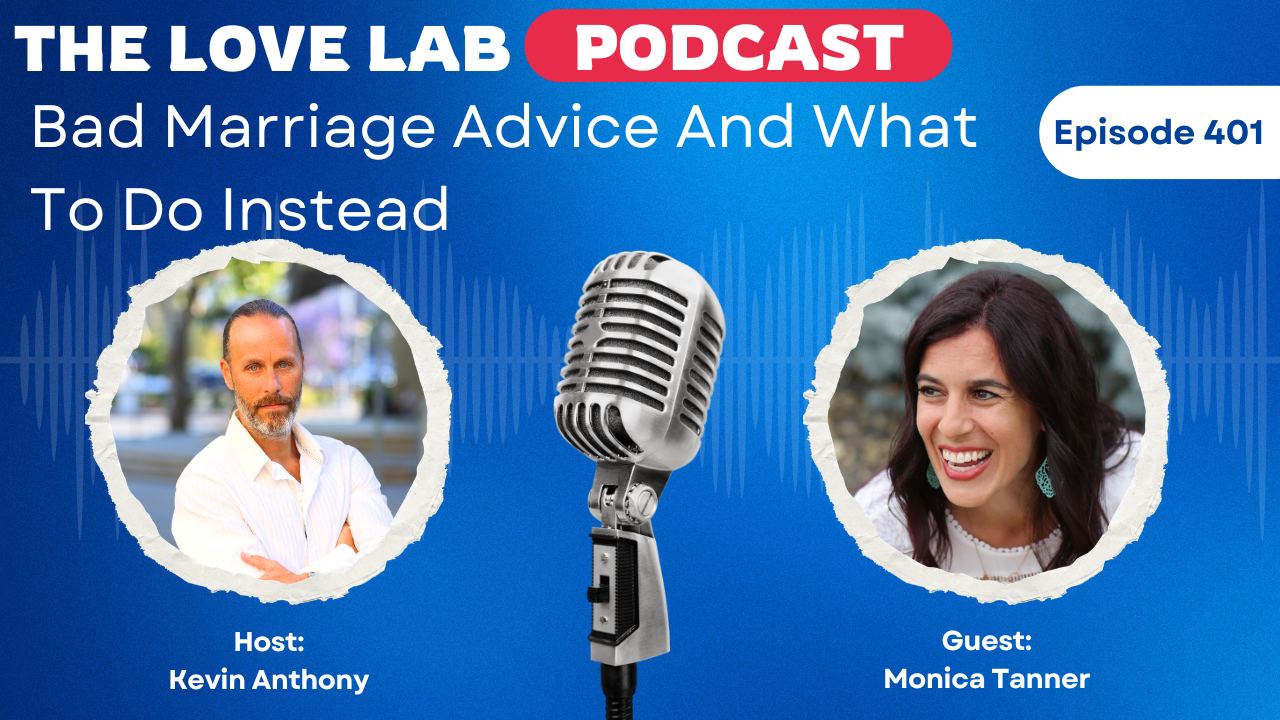
All right, welcome back to the Love Lab podcast. This is episode 401, and it is titled, Bad Marriage Advice and What to Do Instead. So when the opportunity to have my guest on today came up, as soon as I read that she had written a book called Bad Marriage Advice. I’m like, oh, I want her on this show, because having done coaching work for quite a long time now, I have heard a lot of bad marriage advice, and I hear it because, you know, people will come to me, and they’ll say, Well, what do you think? Right?
Kevin Anthony 1:03
And then, and then I’ll tell them what I think, you know, they should do, or what would be appropriate in the situation, or, you know, how they might be able to resolve whatever’s happening. And then inevitably, I get, well, my friend said, blah blah blah blah blah blah blah. Or now here’s one. I hear a lot. Well, ChatGPT said, blah, blah, blah, blah, blah. And I’m just like, Oh, God. So I’ve heard a lot of it. Now, I will say it’s not all horrible, but, but a lot of it is not particularly good, and I think, and we will dive into this and explore it as we go through the show, but I think a lot of it is simply because, you know, people are giving advice, even though they’re coming from their heart, they’re giving their advice based on their own traumas, their own triggers, their own experiences, and because they haven’t really taken the time to study how this all works, you know, the stuff they give ain’t that great? I’m really curious to hear what my guests take on that is, and we will absolutely get into that.
Kevin Anthony 2:08
But beforehand, of course, we got to pay the bills here, and you’ve heard me mention this once or twice in past episodes, because it’s basically brand new, but I have a brand new coaching app out there that I’m really excited about. So are you ready to build deeper intimacy in a more passionate relationship? I hope so, introducing intimacy mastery, the sex, love, and intimacy app for singles and couples, your personal guide to mastering love, sex, and connection. Get a personalized plan tailored to your unique relationship goals. Enjoy daily lessons, real-world challenges, and guided reflections, all designed by me, Kevin Anthony, your trusted guide and coach. Track your growth, celebrate your wins, and get expert feedback every step of the way. Access exclusive resources, videos, and proven tools right at your fingertips. Whether you’re single or partnered, this app will help you create the love life you truly desire, and it is available right now at https://www.kevinanthonycoaching.com/go/app. That’s https://www.kevinanthonycoaching.com/go/app.
Kevin Anthony 3:14
You know, when I was approached to create this app by the company that owns the technology. I was a little skeptical about it. One of the things that actually pushed me over the sort of edge and made me decide to want to do it is somebody literally coming to me and saying, Well, ChatGPT said I should blah blah, blah, blah, blah, blah, blah. And I was just like, so one of the things that this app has in it is an AI coach, but I got to train it on all of my content specifically, so it answers things very similarly to the way I would answer them, as opposed to just generic stuff that chat GPT is just trying to find on The Internet from a random batch of who knows what. So I thought if people were going to do it anyway, they might as well do it in a better environment. So check that out. And that’s only part of it, by the way, you heard me read the ad for all the rest of it, like there’s a whole customized program in there for you.
Kevin Anthony 4:18
Okay, my guest today is Monica Tanner. She is a relational life therapy certified relationship coach and host of the Secrets of happily ever after podcast, which transforms marriages with simple communication, connection, conflict resolution, and commitment strategies. Her mission is to lower the divorce rate and improve marital satisfaction through her engaging podcast, new Amazon best-selling book, bad marriage advice, vibrant social media, community, and couples coaching practice. Monica’s expert guidance has impacted 1000s of couples by helping them ditch resentment and roommate syndrome and get back to living their. Happily ever after love story. Welcome to the show, Monica.
Monica Tanner 5:04
Thank you so much for having me.
Kevin Anthony 5:07
I love that you have your mission on here is to lower the divorce rate and improve marital satisfaction. That is a very noble and worthy goal.
Monica Tanner 5:20
It’s a lot of my childhood trauma as well. My parents divorced when I was 12, and I remember at that very young age, I started observing all the couples around me, and I was pretty discouraged to find that they didn’t seem like they were having a lot of fun. The ones who were married, they seemed like they were just busy doing the work of life together, but not really enjoying one another. And so I thought, This is my mission in life. I want to lower the divorce rate, but I don’t want people to just tolerate each other. I want people to really, really love being married. And so that’s what I’ve made my mission.
Kevin Anthony 5:56
Yes, yes. We need more people out there doing exactly what you do. I completely agree with it. You know, I think maybe in past generations, marriage happened for a lot of different reasons, practical reasons, financial reasons, you know, passing wealth down reasons, and who knows what. But we don’t really need to do that anymore. We don’t need to have marriages arranged just for practical reasons. And even if there are some practical reasons behind it, it doesn’t mean that it has to be boring or uncomfortable, or a roommate situation, as it can also be fun, and it should be. And you know this is funny, right?
Kevin Anthony 6:40
Because you mentioned that part of your goal comes from, you know, having your parents divorced and watching, you know, couples and your parents and, you know, not having great marriages. And, you know, I think one of the best things that you can do for your kids is to be an example of what a healthy relationship looks like. I’m sure you will agree with this. I’m sure you will agree with this, because I know you know from all the years of coaching, I’ve done so much of the unraveling that we have to do with people when they come in with all of their patterns that are sabotaging their relationships in sex life, come from when they were a child and they were observing these dysfunctional relationships, and we spend years sometimes, you know, they come to you. They’re 40, they’re 50 years old, they’re still operating from patterns running behind the scenes, right? And their subconscious that they learn by observing their dysfunctional parents.
Monica Tanner 7:38
Absolutely.
Kevin Anthony 7:40
So that’s a lot to unravel sometimes.
Monica Tanner 7:44
It is, it is because, you know, we respond to our upbringing in one of two ways. We either model it, or we, you know, actively fight against it. And so either way, you have to kind of recognize why you do the things that you do, what was modeled for you, and then what is a better way?
Kevin Anthony 8:07
Here’s an interesting question for you, because you’re right. People will either model it generally, subconsciously, or they’ll rebel against it. Now, in the context of you know, relationships like modeling, it means simply repeating the same dysfunctional patterns. Now you would tend to think, and this is where, this is where my question comes in, because I’m curious what your take is. So you would tend to think the opposite of that, rebelling against it would be doing all of the opposite things. But I’m not sure that’s necessarily true. What is your take on that? Do people who rebel against dysfunctional families go out and put all of their time and energy and effort into having great, healthy relationships, or are there other ways that that rebellion shows up?
Monica Tanner 8:49
Well, I think, you know, it’s more nuanced than that. I mean, you know, I think there are no perfect families, right? And so even when we say, you know, even when we look back on our own childhoods, and there was probably a point in time, and most people can remember it, I’m never going to do such and such like my dad did, or I’ll never, you know, do this thing that my mom did. Even when we do that, there’s still some modeling, there’s still some patterning, there’s still, you know, what we actually took in, and we don’t recognize that we’re actually doing the same thing we said we would never do. So I definitely think it’s more nuanced than that. I mean, it’s on a spectrum. You know, we’re either modeling it or we’re rebelling against it, but it never looks that black and white.
Kevin Anthony 9:47
Well, I agree, which is kind of why I asked the question. Because I wanted people to understand that even if you’re one of those people who you know had a dysfunctional family growing up, and you say, I’m never going to be like that. That doesn’t necessarily mean you’re doing all the right things, right? Just because you recognize that as being dysfunctional doesn’t mean you’ve actually learned the right things to do. You could just be doing something different than what your family did, but just as dysfunctional, right?
Monica Tanner 10:18
And you know, to add a little bit to the dynamic that is in play, we have our adaptations. So we all, as children, created our adaptations, which is what helped us survive the family we grew up in. And those adaptations, while perfectly adaptive, then you know, we never want to dishonor the exquisite wisdom of the adaptive child. But now, oftentimes, in our current relationships, they are not there. We say adaptive, then maladaptive. Now, because you’re not married to your mother or your father. You know, we marry our unfinished business. So there are characteristics of those people that we did, you know, typically were attracted to, however they’re different. And so when we use those adaptations for a lot of us, so much growth happens when those adaptations no longer work for us, and we have to find a different way.
Kevin Anthony 11:21
Yeah, well, it’s a very valid point to make, too, and this is actually something I always tell whenever I come up against one of those patterns with a client, I always make sure to tell the client this. And, you know, sometimes they get it, sometimes it takes them a while to get it. But the point that you just made is that you said something about the wisdom of the adaptation of the child. And the point I wanted to reiterate here was that, you know, when people are adults, and they’re trying to unwind these things and solve them, they will often feel shame and guilt around the fact that, oh, my god, I can’t believe I’ve been doing this all this time. And the point I always try to make to them is that, you were a child, you did the best you could in that moment. This was just a strategy to help you survive, right?
Monica Tanner 12:05
And you’re here, so you did it perfectly well.
Kevin Anthony 12:08
Yeah, exactly. So that’s an important point to reiterate. Okay, man, I haven’t even asked you the first question, but that was a great start, a great warm-up to some of the things that we’re going to talk about. So my first question has to do with, you know, why you wrote a book called ” Bad Marriage Advice “? I kind of shared in the beginning, like, you know, my thoughts around that, and like, you know, the things, the feedback that I hear from clients that sometimes just makes me want to, like, cringe first of all, and sometimes I’m like, Oh God, I wish that myth would stop being perpetuated, you know. But what really inspired you to write a book called ” Bad Marriage Advice “?
Monica Tanner 12:50
Yeah, thank you for asking this question, because it is such a cool story. I have four children, the oldest of whom is now married, and when he called me and said, Mom, I’ve met the girl I want to marry. I’m going to propose next month. I panicked a little bit, like, Oh my gosh. Have I taught you all the things you need to know, like, you’re so young, not that I can I have much room to stand on. He got married about six months earlier than his father, and I married so but anyways, I just kind of panicked, and so I sat down to write him a letter, just kind of from my mama heart to him, just, you know, wanting to make sure that I had taught him some of the things that were most important.
Monica Tanner 13:31
And what happened was I started thinking about all of the things people told my husband and me when we were getting married 23 years prior, and it just quickly turned into this book, because I thought all of these really well-meaning, well-intentioned adults are going to, you know, want to give their advice. And not that it’s never been good advice, but my husband, over 24 years, and I have learned some things, not to mention the decade that I have been working with couples. And so there are some very specific pieces of advice or beliefs or ideas that keep people stuck and miserable. And so as I started writing, it just really flowed, the things that have not been helpful, and why, and what works better?
Kevin Anthony 14:25
Yeah, that’s a beautiful story, and I think such a great motivation, because writing a book is hard. Writing a book is not an easy thing to do, right?
Monica Tanner 14:32
And to have a great deadline, they didn’t give me very long to write it.
Kevin Anthony 14:36
Right? It’s just great inspiration, right? Because you’re really writing from your heart. You’re not, and there’s nothing wrong with writing from your expertise. Lots of people do it, and there’s so much value from that as well. But this one, I think, really came from your heart and wanting to help your son have a great marriage. So that’s a beautiful origin story for your book.
Monica Tanner 14:59
Ah, thank you.
Kevin Anthony 15:01
So of course, we’re going to get into the pieces of, you know, bad advice. But before we do that, I want to talk a little bit about what some of the consequences are, right? Because this bad advice is out there. And the crazy thing to me is like, I mean, I’ve been doing coaching work for about a little over 15 years now, so I’ve been doing it for a fair amount of time, and I often will see the same pieces of bad advice just keep coming around over and over again, right? And I know that they are having consequences for people who don’t know any better, and they think that this is decent advice. What are some of the negative consequences that you have seen from this bad advice?
Monica Tanner 15:48
Yeah, well, I’ll give you like the cheat sheet, Cliff Notes, like through line of the book is honestly, if it engenders lazy communication, it’s bad advice. So, as far as consequences, I see it’s that couples don’t communicate well. And so you can probably, you know, just as well as I can, most couples, when they come to see us, will start with we don’t communicate well, or we need help communicating, right? And so a lot of these pieces of bad advice are just kind of shortcuts or ways to not communicate well. And so throughout the book, I basically, I’ll point out a piece of bad marriage advice, why it’s not good marriage advice, and then I’ll teach a strategy or an elevated way of communicating that you know kind of helps fight against that piece of bad marriage advice.
Kevin Anthony 16:42
You know, I love that you kind of boil it all down to communication, because, you know, I obviously, in the work that I do, I didn’t take the same path that most people do. Like you, you went, and you got formally educated, and you trained in all of this stuff. And like, you know, you learn most of what I’ve learned, I’ve learned through experience, right, either through my own relationships or through working with people over time and early on in my coaching career. I mean, I always understood the importance of communication, and it was always part of what I taught, but I started noticing over time that I was spending more and more and more time with people just on communication stuff.
Kevin Anthony 17:25
And I started having a little bit of like, Am I doing the right thing? Like, am I being a good coach? I’m spending so much time focusing on just helping them communicate better. Like, I feel like I’m supposed to have all these other tools and things that I’m supposed to be doing with them, but for some reason, I just said, I don’t know. It just seems like it’s the right thing that I should be doing right, so after a while, I got over that bit, because I came to realize exactly what you just said, which is how important the communication piece is. And sometimes when clients come to me, I hear it in the words that they say, it’s like, Wait a minute. What we’re really going to work on is communication. I thought you had this thing or that thing, or this magic pill, or whatever it is, you know, going on. And I’m like, No, the foundation of it is really dialing in that communication. And a lot of times people still, they’re kind of like, really, that’s, that’s the thing, you know?
Kevin Anthony 18:33
And I’m like, Yes, that’s the thing. And so I’m really happy to hear you share that as such a foundational piece. And of course, now I’m on episode 401, I’ve interviewed. I counted the other day for my 400th episode. You are the 189th person I have interviewed on this show. And so many of them have similar backgrounds, and so many of them have echoed a similar idea that this communication piece is so key and crucial to a successful relationship, and so I’m really glad that that is, you know, one of the main things that you just brought up. So that, of course, leads me to, let’s just on this communication bit, what are some of the key areas where you see that couples are really struggling with this communication?
Monica Tanner 19:28
Yeah, I’ll take it one step further for you, because, yes, communication is so important, and oftentimes when couples are struggling to communicate, it’s not necessarily because they don’t have the skills. A lot of couples don’t have the skills, but skills are easy to come by. We can listen to podcasts, read books, you know, ask chat. GPT can give us communication skills. But the modality of work that I do with couples is called relational life therapy. You read that at the beginning, and what we actually say in relational life therapy, we say that. Lots of different therapies teach skills. We deal with the parts of you that don’t want to use these skills, and you’ve probably seen this in your work and in your own experience, that in the moment of conflict, it’s much harder to access those skills that you have.
Monica Tanner 20:17
Most people are really good communicators on the outside, you know, in their professions and things like that. They’re, they’re very skilled at communication. They get what they you know, they know how to negotiate and get the things that they want. But when it comes to their interpersonal relationships, there’s a lot standing in the way. And so these couples that come who are really struggling to communicate, it’s not because they don’t know how to communicate. It’s that there’s so much conflict, or they’ve tried to talk about difficult topics, and it hasn’t gone well in the past. And so it’s not that they can’t communicate, it’s that they’ve stopped communicating.
Kevin Anthony 20:53
Yeah, that is definitely a big piece. You know, I find, I actually do find that a lot of the people I work with don’t really have the communication skills, to be honest. And I don’t know, I don’t know how they necessarily communicate, you know, in their job, in their career, or with their friends, but I can tell you, when the two of them are sitting in front of me, I’m like, let’s start with some foundational skills. Having said that, though, you are absolutely correct in that once those triggers come up, right? Even the ones that do have the skills, the skills fly right out the window because the emotional trigger overrides it.
Monica Tanner 21:31
Right. Yep, and that’s it, right? It’s dealing with that part of you that does not want to use the skills. They’re only concerned about one thing, and that’s survival and protection, and that’s what breaks down communication faster than anything else.
Kevin Anthony 21:46
Yeah, I was actually, I was actually out on a mountain bike ride this weekend with a good friend of mine, and this was the entire communicate, the entire conversation that we were having about, you know how when he and his partner start communicating, he gets triggered, and then he says all these things that, you know, he’s like, I know I shouldn’t say this and and I know that was not the right thing to say, or that was mean, or that was hurtful, or whatever. But then I, you know, I’m in this state, and then I can’t help it, right?
Monica Tanner 22:17
Yeah, that happens more often than not, I think.
Kevin Anthony 22:21
Yeah, yeah. So it’s a really good point, because, as you said, you see that there are a fair number of people who do have decent enough communication skills, but then they sit there and go, Well, why can’t I do this in the moment? This is reminding me of a couple I was working with a few months back, and, you know, I had worked with them before, and we were able to make some good progress, working on some skills. And then one time, they come in and like, nothing is working at all. It seemed all the progress we made was gone, and in the middle of it, I realized, oh, okay, there’s a trauma response happening here. Something happened before they came into the office, that there’s this major trauma response that’s going on.
Kevin Anthony 23:14
And so I said, Okay, we can’t deal with any of these skills that I teach you are going to work, right? We need to literally just spend the entire session dealing with this trauma response and calming your nervous system down before we can do anything else. So that’s an excellent point that you bring up, and I’m really glad that you mentioned it. About yeah, there’s the skills part, but then there’s also, can you use the skills when you need to?
Monica Tanner 23:44
Yeah, yep. And a lot of times, going back to the book, because we have these crazy false beliefs and myths that get in the way. We also, you know, have these ideas about communication, like, also get in the way.
Kevin Anthony 23:59
Ooh, give me a couple of those ideas about communication that get in the way.
Monica Tanner 24:04
Absolutely, so like, like the one, if they loved me enough, they would just know I see this, get this, get people in trouble. So, so, so often, because we have this kind of fairy tale idea that if we married the right person, if they love us enough, if they cared about us, they would know what we need, or what we want, or how to make us happy, or, you know, they would be able to follow these breadcrumb hints that we like to leave. And they always say, husbands and wives, they don’t take hints. People don’t read minds. They follow instructions. And so the communication of being able to make requests about what you need, like being able to share with your partner. This is what I want. This is what I need. This is what I desire. People think that they shouldn’t have to do that if they married the right person, and that really, really gets in the way.
Kevin Anthony 24:56
Oh, yeah. So this is one of our big, you know, big. Add marriage advice pieces right here. Well, if he really, or if she really loved you, they would just know. I would say I don’t. I don’t know if you’ll agree with this or not, but I would say that I think women are a little bit more guilty of this one than men are. You know, it’s the whole, he should just know. As a man, I have heard this from past partners many times. You know, when you start like, you know, something happens, there’s a disagreement, or whatever, you can tell she’s angry with you about something. You sit down to have a talk about it, you start working through it, and then eventually it comes out. Well, you should have just known, and it’s just like, whoa, okay, stop right there, right? This is, this is really a big one that comes in, and men will do it too, not to, not to single out women, but I think I just see a little bit more from the female side, where they just feel like the man should just know what they need and what they want and what to do, right? And as men were over here, going, man, we have no clue, and please help us.
Monica Tanner 26:08
Well, and here’s the thing, men and women, they come by it honestly. I mean, a lot of us were raised as women. We were kind of inculturated to think that a good woman doesn’t have needs, that we put our own needs aside for the sake of others, right? And so we’ve got to sift through a lot of that, whereas men are enculturated to think that, you know, I’m strong, I’m powerful, I don’t have needs, right? Like, so both of us have to, both sexes have to understand that we do have needs. We’re human, and it’s okay to have these needs. It’s okay to express these needs to our partner, and it’s okay to ask for what we want and what we need.
Monica Tanner 26:48
And so like, once you sift through all of that, it’s amazing. I will have couples come and be like, the difference is remarkable when I just say what I want and need, for example, I always give this example. When I really want my husband to say something, I just tell him exactly what I want him to say. I don’t have any pretense that he’s going to be able to guess or know. Like, sometimes I’ll be like, I’m going to tell you a story, and then at the end, I want you to say this. And it’s like the most loving thing I can do for both of us, because I get the support that I needed, and he doesn’t have to, like, guess or wonder, like he knows exactly what I want him to say. And it works great. It doesn’t mean any less because I gave it to him. It actually means more because then he can just relax and listen to my story. He doesn’t have to guess what I want him to say at the end; he just knows.
Kevin Anthony 27:41
Yeah, this is, this is really important. So my wife was great at this, and I’ve learned, obviously, from her, how effective this can be. And she would do the same thing. Like, one of the things that, you know, I often try to explain one of the differences between men and women is this idea of, like, the concept of time, right? So in man world, the concept of time is a little different than it is in the female world, in the sense that, like, you know, for us, we’ll be like, Oh yeah, I tell her I love her all the time, right? But all the time might be like, I don’t know, maybe I said it, like, two weeks ago, or something like that, you know. But to us, it’s like, oh yeah, I say it all the time, like, of course, she knows that, right? But in female land, that’s an eternity. He hasn’t said it in forever. I don’t even know if he still loves me anymore, right, you know? And so there are these, these differences, right? And so one of the things that my wife used to do, to bring it back to the strategy that you just mentioned, is if she was feeling like I hadn’t verbalized something to her in a certain amount of time, she would just come out to me and say, Tell me three things you love about me, right?
Kevin Anthony 28:51
And so, it worked amazingly in our relationship. And so obviously, you know, incorporate that into my coaching. I tell people, just ask for what you want, and I would almost always get pushback from I shouldn’t have to ask. He should know these things. And if I have to ask, it doesn’t mean anything, and all that, I’m like, would you just try it? I have lived this personally. Trust me, it works, right?
Monica Tanner 29:18
Yeah, absolutely. I mean, we want our partners to win, because when they win, we win, and we win, they win, right?
Kevin Anthony 29:25
Yes.
Monica Tanner 29:25
It’s easier for everyone. And I can totally relate to that. Tell me three things you know you love about me, like, like, if I’m feeling like, Man, I just need a little bit of appreciation or encouragement, or I just asked for it. And here’s the beautiful thing, you know, yesterday was Mother’s Day, and my husband, who is very accustomed to it, it’s kind of an inside joke that, you know, I always ask him to tell him reasons why he loves me. Of course, at dinner, he’s like kids, let’s all tell Mom, let’s go around and tell Mom, you know, reasons why we love her. And the kids were horrible at it. It, you know, my husband’s trying to prompt them, you know. And I have teenagers, so like, every time they would, like, tell me, say a reason they love me with some sort of, like, backhand, like, like, when you actually do make dinner, it’s really yummy, right? Like, it’s like, there was always, like, a little bit of, you know, schmutz to it. But I can take it with a grain of salt, as I can, I can laugh about it, because if I really, really did need that acknowledgement, I would just ask my husband for it, right? Like I, I have a partner who is really good at fulfilling these requests for me.
Kevin Anthony 30:35
Yeah? Well, we can completely excuse the teenagers. In fact, I was reading a book from another guest that I had on this show. So I generally like to read the books when people send them to me, and he had a whole section on, like, you know, parenting teenagers in it. And basically, like, If I could sum it up, he’s just, like, basically, your job as a parent, you know, with with teenagers is, you know, to to, you know, obviously, do the right thing for them, but, like, make them not hate you so much, so that when they’re done being insane teenagers, they’ll come back to you and actually like you. That was a very funny way of saying it.
Monica Tanner 31:14
I think about it all the time. Eventually, they’re going to appreciate this, but eventually they’ll appreciate it.
Kevin Anthony 31:20
Exactly, so we can discount the teenager, but that was a beautiful thing, actually, for your husband to do is to try to encourage it, because he’s role modeling to them, right? Hopefully, maybe at some point later on in life, they will remember that and start doing it for their girlfriends and eventually, their partners. But one thing out of that whole discussion that we just had, if there’s anything that I hope people would get out of it, is that it’s perfectly okay to ask for what you need, and if what you need is some words of encouragement or to hear, I love you, or whatever it is, it’s okay. It doesn’t mean any less, and especially from a guy’s point of view, like I was mentioning this idea of time being sort of different when she asked for that, I don’t get annoyed and go, like, I can’t believe she, I’ll like, pause for a minute and go, when was the last time I said that? Yeah, I’m better. I’d better do that again, right? Because it has probably been a while, even though, in my mind, I feel like maybe it was yesterday, it probably wasn’t. It was probably last week.
Monica Tanner 32:27
Yeah, yeah. I mean, we just, we can just make it easier for our partners to do the things we want and need, and that is communication, right? But there are all these things that get in the way of being able to just ask.
Kevin Anthony 32:41
You know, the other point that you made, that I want to reiterate, is you said, Well, I want to set us up for success, which is something I am always telling my clients. You are not competing against each other, right? This isn’t like an I win, you lose. You know, a zero-sum game. You’re supposed to be working together as a team and as a team. You want to set each other up for success, right? And too often, what I see as couples is like laying little traps for each other all the time. Let me see if he actually says that. I’m just going to wait. I’m not going to express my name, right?
Monica Tanner 33:18
Stop testing and start teaching. Right? We teach each other how to treat each other well. I think that’s the most loving thing we can do for one another, is teach each other how to love us well, because we’re all so different. That’s why marriage doesn’t come with a manual. Like there’s no manual on me. I have the manual. And so, you know, that’s one of the biggest pitfalls we fall into, is that we think everybody else can see our manual, but they can’t, and so the most loving thing we can do for our partners is show them the manual we have for them and then teach them how to treat us well.
Kevin Anthony 33:54
Yeah, I love that. Stop testing and start teaching. You know, for last week’s episode, which was my 400th episode. I did 40 lessons learned from 400 episodes. And so I went back to previous episodes, and I pulled out, you know, important little things like that. I don’t know when I’m going to do the next one, but stop testing and start teaching is going to be one of those lessons. I will have to remember that when I’m going to write it down when we get off this show, because it is a great, simple way to really state something that’s important. Okay, I need to take a short break here, and when we come back, there are, I mean, we only covered really one main piece of bad marriage advice, so I want to at least cover a couple more and then talk about maybe some things that people should be doing instead of these bad pieces of advice before we wrap up.
Kevin Anthony 34:52
Okay, men, life is too short to fall short in the bedroom. In today’s day and age, it is no longer acceptable to be mediocre. At best, or even worse, if you are struggling with erectile dysfunction, premature ejaculation, ejaculation control, or poor skills in the bedroom, then power and mastery is for you. This three-course program will have you rise to the occasion every time, last as long as you want, and wow her with your skills in and out of the bedroom. Join the exclusive club of men who have taken charge of their sex lives by going to https://www.powerandmastery.com/sexual-mastery, that is https://www.powerandmastery.com/sexual-mastery.
Kevin Anthony 35:27
Okay, so we covered one piece of bad marriage advice, which is that if they love you, they would just know.
Monica Tanner 35:40
And what to do instead.
Kevin Anthony 35:40
That’s true.
Monica Tanner 35:42
We did give a really good piece of advice, which is to stop testing and start teaching.
Kevin Anthony 35:47
That is correct. So that’s good. We covered both of those in that one. Maybe that’s kind of what we’ll do as we go through the rest of them, too. So I got a couple more on here, but let me ask you first, if there’s, if there’s, I don’t know if the one that you covered is one of the biggest ones, but like, if there’s one on this list, because I had five that I wrote down from our pre interview call, if there’s one on here that you’re like, we absolutely have to talk about, because it’s just needs to be corrected. Let’s start with that one.
Monica Tanner 36:19
Oh man, I think all of them need to be corrected. But I think maybe the most relevant in our day and age is this idea of compromise. You hear that all the time. Whenever I ask couples, you know, like, what’s your secret, they’ll always say, Oh, you’ve got to learn how to compromise. And to me, compromise is just super lazy. To me, compromise is I give a little, you give a little, and we meet in the middle. And I just think, I mean, what do you think of when you hear the word compromise?
Kevin Anthony 36:47
Well, I think that the word, you know, if anybody’s talking about compromising in a relationship, you can’t just say you need to learn to compromise, like if you’re actually going to give that advice, you know, it’s like you said before. It’s way more nuanced than that, which means you have to get into the details of what that actually means, because the way that you just stated it, now, right? It’s like, I give a little, you give a little. Basically, that means nobody’s really happy.
Monica Tanner 37:14
Right.
Kevin Anthony 37:15
Nobody actually gets what they want.
Monica Tanner 37:17
Like, people think about the word compromise, you know, it’s, there’s a lot of score keeping, a lot of resentment, like we’re not, nobody’s really getting what they want. So why do it?
Kevin Anthony 37:28
Yeah, no, having said that, that doesn’t mean you always, you know, put your flagpole in the ground and refuse to budge. It doesn’t mean that either, right? So, right, tell, tell the listeners you know, when it comes to, you know, compromise, like, what is a better way to do it?
Monica Tanner 37:47
Yeah, I like to teach a different word entirely, and that is collaborate. I think, when I think of marriage, I think of it as a collaboration. So when I teach collaboration over compromise, what I teach is that you get really curious and clear. This is the most important aspect of how to collaborate is to get curious and clear. So I’m going to ask myself, Where do I fall on this particular issue? What do I feel most strongly about? What do I definitely not want to budge on, because there are some things that maybe we don’t want to give up, right?
Monica Tanner 38:21
And why do I feel so strongly about these things? That’s what’s important to get clear about. Then I get curious about my partner and their position. Where do they fall on this issue? Why do they feel so strongly about this? What is it that they really don’t want to budge on either? And then we get real resources, we start thinking about our options. So if you think about whether it’s where to eat dinner or how to educate our children, decisions Big or small, once you have a basic understanding of each other’s positions and values and where they fall on this issue, you can start to get resources.
Monica Tanner 39:00
And then you take the best of what both people value, and you come up with something better than either one of you could have on your own. That’s collaboration, that’s collaborate, collaborative, that’s co-creating the scenario that you really, really want. Man, takes a little more work than just compromise. So, you know, to give an example, give me an issue that you and your wife would have fallen on different ends on?
Kevin Anthony 39:33
Oh, that’s actually a tough question for me, because we were generally in agreement on everything.
Monica Tanner 39:38
I can use an example from my own marriage, then.
Kevin Anthony 39:42
Okay.
Monica Tanner 39:43
All right, so one of the biggest things I think, well, my husband and I actually disagree about most things, to be honest, and I think it’s a real strength for us, but one of the things we disagree on is social media. As I said, we have a lot of teenagers and young adults, and so we’ve had to. Really navigate. When do we give them certain technologies? When do we give them access to certain apps and social media platforms and things like that? And to my husband, he feels very, very strongly that. So there is no good, nothing valuable about social media. The kids should not have access to it ever.
Monica Tanner 40:18
And to me, I’m like, so I work on social media. I do a lot of there’s a lot to me value in social media, but nonetheless, my children need to learn how to navigate it before they leave my home, because I want to be able to guide them and support them, and, you know, witness them and be able to teach them certain things that I feel are very important. So my husband understands some of the shortcomings or downfalls of his view. In my view, if we keep them from social media completely, then they’re going to leave the house and then just have unfettered access and not have any knowledge of it, or I’m telling you the weaknesses in his position, because I think those things are important to explore, too. They’re going to go behind our backs and figure out how to do it anyway, right?
Monica Tanner 41:14
Some of the reasons, but it’s also very valuable for me to understand his position on what the dangers and downfalls of social media are. So now we have a very clear understanding, and even though we still have very different positions on the issue, we can respect and value those differences as we learn to navigate it. With each kid, it’s been different. Each child has been more interested in a different social media platform, some of them which I don’t even understand, right? And so, being able to take into consideration both our points of view, the strengths and the weaknesses of both of them, we’ve been able to get really resourced around. How do we really want to present social media to our kids and make it available for them, and so, you know, not only understanding each other’s positions helps us respect each other, but it also gives us a lot of compassion and a lot of leniency in what we do. I
Monica Tanner 42:13
know when I’m not around, my husband’s honoring my position, and when he’s not around, I’m very much taking into consideration when I’m working with my daughter on a, you know, Instagram post where she wants to say happy birthday to one of her friends or whatever, I know what my husband values and what’s important, and you know, I’m going to coach her through how many likes, and you know, all of these things or whatever are actually important. So it’s very valuable to have both of our perspectives taken into consideration when we decide how we’re going to handle social media with our kids.
Kevin Anthony 42:48
Yeah, that’s a great example. That’s a very contentious one these days, you know, you, by the way, are also a goldmine of taglines today, which is collaboration over compromise. That’s another really great one, because it’s absolutely true. So, you know, I mentioned earlier, I often will coach couples through the idea of your team, right? And teams have to work collaboratively together, right? And that’s, that’s the same thing that you’re talking about here, because, and I like the fact that you go, you know what? I don’t even want to use the word compromise at all. I want to use the word collaboration.
Kevin Anthony 43:25
Because when you think about it, when we’re talking about compromise, and we kind of said this earlier a little bit, but the idea is, well, I’m going to give up something that I really want, and you’ll give up something you really want, and we’ll meet in the middle in this sort of mediocre place where neither of us really feels happy or met or seen or whatever, whereas collaboratively, I think if you’re thinking in terms of collaboratively, it’s no longer, you know, I win, you lose, you win, I lose. You know, it’s not that sort of thing anymore, right? So it’s possible, from that point of view to look at something and say, like, if we take your social media example, it would be possible for your husbands to look at that situation and go, you know, I know that social media can be really bad, and it has a lot of potential downfalls and dangers, and I don’t want my kids in there, but I can also see how keeping them out of something that all of their peers are doing, right, that they’re probably going to figure out a way to do anyway behind my back with no supervision. Then, like, I can see how that could be a problem, right?
Kevin Anthony 44:33
And so what you’re ultimately doing by the two of you negotiating back and forth on how we’re going to, you know, present social media to our kids is figuring out what works best for the team as a whole. Now, the team as a whole is potentially, of course, the family, because what’s in the best interest of the family, but it’s also what’s in the best interest of you and your husband, so that you can get on the same page and you can parent. You know, basically the same way, rather than being on opposite sides of that issue, which, of course, kids are masters of exploiting, right? If they think there’s a little bit of a wedge between mom and dad, oh, man, they’re gonna, they’re gonna drive something between that wedge to try to get what they want, right? So it’s super important for you guys to be on that same team.
Monica Tanner 45:18
Right, and that’s why it’s so important to understand each other’s positions as well, because you’re right. Kids are masterful if they know, you know, if I ask, Daddy’s gonna say no, and if I ask Mom, she’s gonna say yes, they’re gonna exploit that every time. But I know what dad would say, and I can make my decision based on what I know is important to my husband as well. So it’s much harder for them to exploit that, because we’ve really discussed and collaborated on what our mutual position is, even though we don’t agree, I wouldn’t say we’re on the same page with social media, but we are very, very aware of how each other feels about social Media. So when I’m giving an answer or, you know, a curfew is another big one, right? We disagree on curfew, and my kids know that they’re going to oftentimes get an easier curfew if they talk to dad, but he’s very hyper aware of how I feel about kids being home by midnight. So it’s going to be a very rare, very rare occasion that he’s going to allow them to stay out past midnight, even though we have different ideas about curfew, right? Because he considers and understands my point of view. So it’s harder for our kids to exploit that, because he knows what I would say, and I know what he would say.
Kevin Anthony 46:37
Yeah, and that’s an interesting thing too, right? Because when I say on the same page, I don’t necessarily mean 100% agreement, but what’s written on that page you’re both aware of.
Monica Tanner 46:48
Exactly. We’ve both read that page. That’s 100% true, and I think that is with so much in marriage. All right, okay, so I’ll bring in a myth here, right? Like, happy couples don’t fight. It’s not that happy couples don’t fight. It’s that happy couples make understanding their goal, not agreement. It’s very, very different understanding your partner, and like how we get there is conflict. We gain more understanding and more compassion, more respect for a partner through understanding than we do through agreement.
Kevin Anthony 47:26
Yeah, absolutely. That’s an interesting one too, right? This idea that you have to always agree, right? And that you know you haven’t really resolved the situation until you’ve come to an agreement, there are some things you’ll just not agree about, and that’s okay.
Monica Tanner 47:44
Yes, and if you want to bring in the research, the the gottmans have have shown. The research says that 69% of conflicts in a marriage is unresolvable. You’re never going to agree on those things. So if we’re not going to agree, at least you should understand each other.
Kevin Anthony 48:03
Yeah, I, you know, I wasn’t aware of that statistic. That’s a much higher number than I would have guessed.
Monica Tanner 48:08
Yeah.
Kevin Anthony 48:08
That 69% as you’re just never gonna come to agreement. That is very interesting. That brings in a whole other range of questions in my mind, about partner selection and all that kind of stuff. We’re not going to go there today, but I think that is important to bring up for people to know, because I think too many people feel like they’re failures when they can’t come to some sort of an agreement on something right and or the other thing that they’ll do is they’ll go, Well, this is a big issue, and we simply don’t agree on it, so therefore we just shouldn’t be together.
Monica Tanner 48:45
And if agreement is your goal, you are going to run into that problem a lot. So if you change the goal to understanding, you’re going to have a lot better go of it, and you’re not going to start thinking there’s something wrong with my marriage all the time, because understanding comes through communication, and agreement is very different.
Kevin Anthony 49:05
Yeah, and I think it’s important for people to realize that, you know, yes, you’re married, yes, you’re a couple, you’re in a relationship, but you are two individuals as Well, right? You have your own experiences, your own upbringings, your own backgrounds, you know, and you’re not always going to agree on stuff. And generally speaking, that’s okay.
Monica Tanner 49:33
Oh, well, absolutely. The reality is, no two people can ever see the same thing from the exact same angle, and so a lot of times I talk about being in the butt of an elephant. So if you expect everyone to agree with you or have the same point of view as you, you could be stuck looking at the butt of an elephant for your entire life. Alternatively, if you have a partner who’s seeing a different part of the elephant, which. Is always the case, because the way our heads are created, like you can’t put your head, you cannot superimpose your eyes. So no matter what you’re looking at, your partner is always going to have at least a slightly different view than you are.
Monica Tanner 50:14
So just like you pointed out, our upbringings, our education, our values, our experiences, our opinions, they’re always going to be slightly different. And so if you will allow for that different point of view, you know your partner is probably looking at a diff at the elephant from a different angle. So, how cool, if you can both zoom out and see this magnificent animal from different angles. But if you’re not willing to accept anybody else’s point of view, if you think that the point of conflict is to agree, you’re going to be stuck looking at the butt of an elephant for a very long time.
Kevin Anthony 50:51
And there are definitely better angles to view an elephant from. That is, of course, fantastic advice, and I completely agree. And I think the biggest thing is really just trying to help each other understand that, Hey, I see this from a different angle. And, you know, I’ve been in situations like that where, you know, I’ve tried to do my best to see it from their angle, and I’ll kind of like, shift over and go, Okay, I can see it from your angle. I don’t, I still don’t necessarily agree with it, but at least I can see it from your angle, right? At least I have some understanding of why you see it that way.
Monica Tanner 51:29
Yeah, very important, right? That’s the value in the blessing of teamwork. Like, what a blessing that my partner sees it differently than I did, because I don’t want to just be looking at the butt of an elephant.
Kevin Anthony 51:43
Well, of course, then if you can get to the place where you can value the fact that you know different perspectives are potentially better for long-term success, then you know this. I mean, if you take it outside of a relationship, and you bring it, say, into the business world, right? And you say, Okay, here’s a team where everybody’s afraid to tell the lead of the team any other, anything other than what the lead thinks, right? So they’re all just a bunch of yes men and women, just like, yes, sir, yes. You know, blah, blah, blah, blah. How successful is that going to be, versus a team that says, ” Hey, what about this thing over here that we should be aware of? And you’re gonna have a much more robust picture of whatever problem you’re trying to solve if you have some different points of view in there, easy for people to understand when it comes to work stuff, not as easy to understand when it comes to relationships, right?
Monica Tanner 52:34
The default is like, it would be so much easier if they would just see it my way. But if you can, if you can stop yourself and go wait. What is the value of actually bringing in another perspective that’s so helpful? That’s why coaching, what you and I do, is so helpful for people, because they get caught in a dynamic and they can’t see what they can’t see. And so then you have a coach who’s trained on how to point out or hold up a mirror and show this couple the things that they aren’t seeing. So you take a two-person dynamic and add a third, it brings every new perspective. I don’t want to say every new perspective is valuable, but, but really honestly, if you can, if you can zoom out and bring in another perspective, it’s so valuable.
Kevin Anthony 53:20
Yeah, that is a large part of what we do as, you know, coaches or therapists. Fact, it’s about a year ago, I was working within a mastermind group, and we were all helping each other try to, like, dial in our little pitch of who we are and what we do, and the person who was reflecting back to me said almost those exact words, ” You help people see the patterns and behaviors that they can’t see, right? And I was like, Oh, that’s it, that’s it, right there.
Monica Tanner 53:47
How helpful to have somebody outside of your business looking in and giving you a better perspective, exactly.
Kevin Anthony 53:53
Exactly. And there’s nothing wrong with that. You know, sometimes people feel like, you know, a little bit of shame around having to hire somebody to help them do that. I’m like, Are you kidding me? It is always easier as a third person outside of the situation to see stuff take advantage of that.
Monica Tanner 54:11
Yeah, I think it takes a lot of courage and commitment to hire a coach for anything, right? If you want to be an elite athlete, all athletes have coaches, right? You want to learn how to play an instrument, you want to learn a new skill, you bring somebody in. If you want to have the best business, businesses, they hire consultants to see the things that they cannot see from inside, right? So why should marriage be any different? If you want to have a great marriage, hire someone to show you your blind spots.
Kevin Anthony 54:40
Absolutely, I completely agree, and I echo that sentiment on this show all the time. Sometimes I’m like, I know people probably think it’s just because I’m trying to pitch my services, but really it’s because I truly believe in it. That’s why I say it.
Monica Tanner 54:55
Me too. I have a great marriage coach whom I absolutely value. You. And I mean, I don’t think anyone is above having someone help in that respect.
Kevin Anthony 55:06
Yeah, I completely agree. You know, it’s funny too, because I don’t know that most people realize this, but pretty much, like every therapist has a therapist, like, I hear that all the time from therapists, well, my therapist, right? It’s like, yeah, of course.
Monica Tanner 55:20
I buy therapists, and it actually makes me, you know, used to make me super nervous because I was like, Oh my gosh, I’m helping a therapist. But, but, yeah, I mean, it actually therapists who are a little bit more difficult clients, I think sometimes, because they know their stuff, but it’s easier to point out the parts that they can’t see because they’re willing to see it.
Kevin Anthony 55:41
Yeah, yeah, yeah, that’s interesting. I’ve had, I’ve had numerous clients over the years who were actually licensed therapists, and in the beginning, it intimidated the academy, but then I just see that it, you know, okay, yeah, education, certifications, all that is valuable and important. Nothing wrong with any of that, but sometimes it just somebody on the outside that can see what you can’t see because you’re in it, right? You’re like, above your eyeballs in it, right? And it just takes somebody on the outside to see it a little bit more.
Monica Tanner 56:13
You can’t see the label from the inside of the bottle.
Kevin Anthony 56:15
That’s right. Okay, so we are. We’re almost out of time on the show, but I want to at least cover one more piece of bad marriage advice. And I’m like, Oh man, okay, we’ve got to don’t go to bed angry, oh man. I mean, or Happy wife, happy life. Don’t sweat the small stuff. I mean, like, all of these would be amazing to talk about. Is there one that you think we just we should wrap up on this one?
Monica Tanner 56:44
I mean, let’s, let’s go for Happy wife, happy life. Because this one keeps evolving for me, because how ridiculous is it to create a partnership of two people where only one person gets what they want, right? Happy wife, happy life. That’s absolutely ridiculous. So in the book, I changed it to happy spouse, happy house, which at least takes into consideration both partners. But since writing the book, I’m already ready to, like, you know, amend it, or what’s the word, have a new version of it, where the reality is, we are not responsible for each other’s happiness. So happiness is an inside job.
Monica Tanner 57:24
So if I were to rewrite that chapter or edit it, it would go so far as to say, your partner is not responsible for your happiness. That’s not happy wife, happy life or happy spouse, happy house. It’s literally happy individuals who share their happiness with their partners. Like, that’s it, right? Like, it’s not that I can’t ask for support if yoga makes me happy, and my partner can watch the kids on two evenings a week, so I can go to yoga. That’s great. That’s my partner supporting my happiness. But I’ve got to know what makes me happy. I’ve got to know what fills my cup, and then I have to ask, just like we talked about in the earlier myths, for what I want and need in that respect.
Kevin Anthony 58:12
Yeah, you’re absolutely correct. And this is, I think, one of those pieces of advice that I understand where it comes from, but it’s completely misinterpreted and used in a whole bunch of different ways that weren’t really the intention. So, like, from a man’s point of view, since I am a man, I will say that, you know, a lot of men feel that, like, if she’s not happy in the relationship or in the family unit, then that bleeds over into everything, right? So the idea is, if she’s not happy, then nobody’s going to be happy. Because, you know, she’ll be yelling at the kids or yelling at him, or criticizing, or like, that’s, I’m just saying, this is the way a lot of men would think about it, right?
Kevin Anthony 58:55
So when they hear Happy wife, happy life, they think, as long as she’s happy, there’s peace in the house. All should be good. That, of course, is not true, but that’s the way they tend to think about it. So this is where this starts, right? This idea starts, but then it gets taken into all these other realms. About, like, you said, you know, it’s all about her happiness, and I have to make her happy. And then, like, it just gets distorted in all these ways. So, a piece of advice that wasn’t even really very good to begin with, then gets distorted out into a whole bunch of ways that don’t make any sense and turn into really bad advice.
Monica Tanner 59:34
Not to mention that research shows that humans are only happy about 50% of the time. So if you’re, you know, gauging your effectiveness, or as a husband, or, you know, just your marriage in general, you’re going to be vastly disappointed if you’re gauging that on your partner’s happiness. Because as humans, we feel a whole range of human emotions. So to feel like we need to. Be happy all the time. It’s just already a lot of responsibility. But I also love movies. I love recommending movies. This is one that I really enjoyed. It’s called, is this on it’s about this, this couple that they’re separated, and he goes into, like stand up comedy to kind of figure out how to fill his own cup and process all of these emotions, but he realizes that he’s not unhappy with his marriage, that there are there were specific times in the marriage where he was unhappy in the marriage, or she was unhappy in the marriage, but that was part. In the end, he just says this line about, let’s be unhappy together, and that is what this marriage partnership is. It’s, let’s be happy together. Let’s be unhappy together, right? That’s just part of the human experience. So we don’t have to map that something’s wrong because someone’s unhappy. That’s just part of being a human?
Kevin Anthony 1:01:01
Oh, absolutely, it is definitely part of being a human, especially in today’s day and age, where it’s, it’s, you know, I mean, we’ve always had stuff going on in the world, right? And it’s always been, you know, it’s been there in a way that could affect us one way or another. But in today’s day and age, with the 24-hour news cycle. And the constant, you know, you know, threat level, this and that, and all the stuff that we’re exposed to, like, it takes a significant amount of work to stay balanced and happy and, you know, tune out all the negativity and all that kind of stuff. And so I just think, you know, it’s even more important today to realize what you said is that we’re human, and we have ups and downs, and it’s difficult sometimes, you know, to stay positive about, you know, whatever the you know, what’s happening in the world, what’s happening with your kids, or whatever stuff is going on, right?
Kevin Anthony 1:01:57
And so we definitely need to make space for that in the relationship. And if we’re judging the success of the relationship on Are we happy 75% of the time, or whatever it is, then we’re most likely going to be disappointed. And I think that is a really important point to make, and that’s true of both men and women in relationships. You know, we all have our ups and downs. My wife used to say, You’re the most moody man I’ve ever been with.
Monica Tanner 1:02:27
We both get to go crazy, just not at the same time, hopefully.
Kevin Anthony 1:02:31
Right exactly, exactly by that, she just meant that, you know, like I’ve always, my whole life, followed geopolitics very closely. And, you know, I just, I try not to let that kind of stuff bother me, but sometimes it does, you know, because the world is, well, I’m human, right? And if you, if you tune out sort of the mainstream media and the stories that you’re given, and learn what’s really going on beneath the surface, you realize it’s a really challenging world out there, and there’s some really, really bad people out there doing some really, really ugly stuff, and that’s hard sometimes to deal with, right? And so you have ups and downs and challenges, right? And then you work on getting back into, you know, a healthy space in relationship to it all. And as you said, that’s just part of being human.
Kevin Anthony 1:03:27
Whew, man, we covered a lot of ground here, and there’s still so much more that we could. I know I’ve heard a lot more than just what we covered, and I know that you’ve covered a lot more in the book as well. So I definitely recommend that people check out your book, because I am in agreement with everything that you shared today, and I really resonated with your message, and I’m glad that you’re out there sharing it, so I hope that people can find both you and your book, and that that can help them with some of these challenges. So now would be a great time to tell people where they can actually find you in your book.
Monica Tanner 1:04:03
Yeah. Thank you so much. You can learn all about me, the work that I do, the free resources that I provide, including my podcast, Secrets of happily ever after, which publishes every single week at my website, Monicatanner.com, so just my name spelled out, Monicatanner.com, and you can find my book on Amazon or anywhere where books are sold.
Kevin Anthony 1:04:24
Awesome. Well, again, I encourage everybody to check it out. I thought that everything that you shared today was really right on, and it’s absolutely in line with the things that I like to teach people. So obviously, I’m going to be a big proponent of it. Yes, go check out her stuff. I want to thank you also, Monica, for coming on the show and sharing your wisdom, and also for writing a book called Bad Marriage Advice. It also shows you have a bit of a sense of humor, too, right? Because most people would write like, here’s what you need to do in your relationship, and you’re. Like now we’re gonna flip that around and go, here’s all the bad marriage advice, which is great.
Monica Tanner 1:05:06
I do think a very healthy aspect of good relationships is to have a sense of humor, because life is hard. Like you mentioned, there are a lot of things to worry and fret about, and so being able to keep a good sense of humor is important.
Kevin Anthony 1:05:20
Absolutely, and it’s getting harder and harder to do, but it’s still possible, still possible, and we have to make that a goal in life. Stay positive and enjoy the good things in life, right? And family, your relationship should be one of them, and in my opinion, it should probably be your most important one, but at least should be up there in the top three of most important things in your life that you enjoy. So if it’s not that way, then do something about it, and that might mean going to Monicatanner.com and finding her services, or at least picking up a copy of her book. That’s at least a great start.
Monica Tanner 1:06:04
Well, thank you.
Kevin Anthony 1:06:05
You are welcome. All right, everybody, I hope you learned something today, and if not, I hope you at least had some fun talking about bad marriage advice. It made me laugh a bunch. So that’s good. All right, everybody, that’s all the time I have for this episode, and I will see you next week.
Kevin Anthony 1:06:31
I hope you liked this episode of the Love Lab podcast. If you enjoy this show, subscribe, leave me a review, and share it with your friends. For more free exclusive content, join me in the passion vault at https://www.kevinanthonycoaching.com/vault/. That’s https://www.kevinanthonycoaching.com/vault/. Thanks for listening, and remember, as Celine used to say, you’re amazing!
Kevin Anthony is a Certified Sexologist, Tantra Counselor, NLP Practitioner and a Sex, Love & Relationship coach. For over 10 years he has worked with men, women, and couples to have the relationships of their dreams, and the best sex of their lives! He is also the host of “The Love Lab Podcast”, creator of the popular YouTube channel Kevin Anthony Coaching, and creator of the popular online course series “Power and Mastery” as well as other online courses for both men and women.



Leave A Comment