Kevin Anthony 0:00
Welcome to the Love Lab podcast, the place to be for honest and real talk about relationships and sex, whether you’re a man or woman, single or a couple, this is the show for you. I am your host, Kevin Anthony, and I am here to help you have the relationship of your dreams and the best sex of your life.
Kevin Anthony 0:23
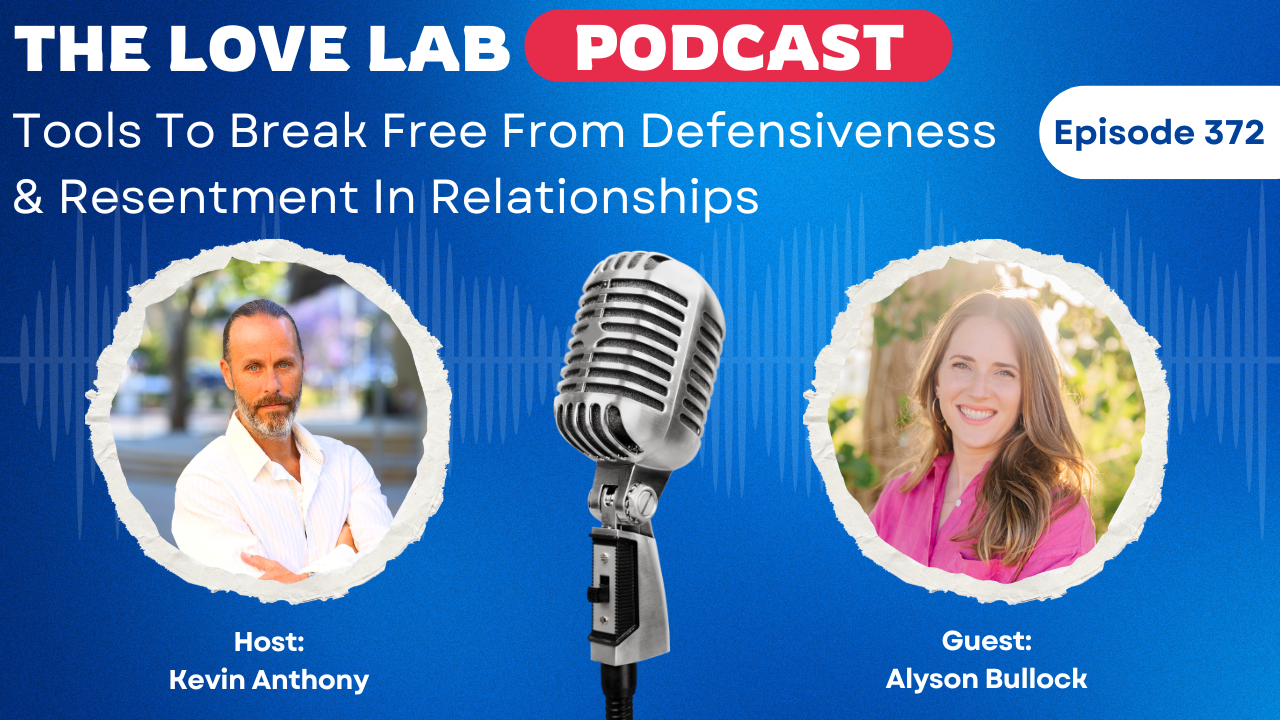
All right, welcome back to the Love Lab podcast. This is episode 372, titled ‘Tools to Break Free from Defensiveness and Resentment in Relationships.’ Defensiveness and resentment are two things that pop up a lot in relationships, and the way I see it is that defensiveness often leads to resentment, and then resentment, if it builds up over time, can really be something that ends up being toxic to your relationship. And so what we really want to talk about today is how we can avoid getting into defensiveness, first of all, and then, you know, how we can also avoid building up resentment over time? And then, you know, I mean, a little bit of resentment here and there is kind of inevitable in a relationship. So one of the other things we want to talk about is, like, what do we do when we start to notice that there is resentment building up, right? So we’re gonna, we’re gonna talk about all that, and probably a whole lot more will come up during the conversation as well. But that’s the basic idea that we’re gonna cover today, of course, before we do that short word from my sponsors.
Kevin Anthony 1:41
Ladies, did you know that the overwhelming majority of men consider receiving oral sex a must in their relationship? Of course you did, because they have been asking you for your whole life. But do you feel confident in your ability to give great oral sex if you tend to avoid it because you don’t feel you’re good at it, or if you feel that you’re pretty good at it, but want to get better, then my new blow job mastery course is for you. I have teamed up with the amazing coach, Ry Duong of Eterna Love, to bring you a practical and easy-to-follow course that is guaranteed to increase your confidence and skill when giving oral sex to your man. In this course, you will get all the secrets to mastering the art of oral sex with step-by-step instructions and multiple live demos. Go to https://www.sacredfemininearts.com/bjmastery. That’s https://www.sacredfemininearts.com/bjmastery.
Kevin Anthony 2:29
And just, just so people don’t think this is just about trying to get the ladies’ skills up to speed. If you’ve been listening to this show for any amount of time, you know, I always do an ad for power and mastery. That is the men’s sexual mastery course. That is where we get the men up to speed. So power and mastery, that is the latest version of the popular men’s sexual mastery course. If you are struggling with erectile dysfunction, premature ejaculation, or simply want to increase your skills in the bedroom, then power and mastery is for you join the exclusive club of men who have taken their sexual performance into their own hands and become sexual masters. Mastering your sexuality is a key component to becoming the man she has always dreamt of and craves. Don’t leave your sexual performance up to chance or the throw of the dice. Become a sexual master today by going to https://www.powerandmastery.com/sexual-mastery. That is https://www.powerandmastery.com/sexual-mastery.
Kevin Anthony 3:27
Okay, now that we’ve got the formalities out of the way, I would like to introduce my guest, Alyson Bullock. She is a licensed Marriage and Family Therapist and is head of relationships at paired, the number one couples app. She helps couples stay connected through healthy communication strategies. Welcome to the show.
Alyson Bullock 3:49
Allison, thank you so much, Kevin. I’m so excited to be here and dive into the dirty defensiveness talk that we’re gonna get into.
Kevin Anthony 4:00
I have to say that, you know, defensiveness is one of the most challenging things for me, personally, in a relationship, especially when you feel like your partner is coming at you with something that is just unreasonable. Doesn’t make any sense. And as a guy, it’s like, you know, we and I’m sure we’ll talk about this more, but you know, we have this, it’s just so natural for us to want to just go in and explain the details, right? Like, no, it’s like this because of a, b, and c, right? And so that itself often is viewed as defensiveness, even when we’re not necessarily meaning it to be defensive. So right, let’s just dive right in. My first question really is, what are the origins of defensiveness like? How does this usually show up? Where does it come from? Why do we get defensive?
Alyson Bullock 4:56
The most basic and also most obvious answer to this question. The question is whether it’s a natural protective response. We are instinctual human beings, and so if we feel that we are being threatened, whether that’s physically or emotionally, of course, we’re going to respond to that, right? We have the fight, flight freeze response, and all three of those can show up as defensiveness, but, but that’s that’s at its most basic, is that this is a natural response. Everyone, at some time or another, will get defensive about something, and then, when you take it a step further, there are other things in our lives that can exacerbate that defensiveness. So one really common one is the good kid identity, if you were the good kid growing up.
Alyson Bullock 5:47
For example, my partner has an older brother who was very rebellious, and so he was the good kid. My partner was the good kid. He was always making sure his mom was not going to cry about whatever he did, and he really internalized that identity. And so then later on in life, when he’s getting feedback from me, it’s almost like in his brain, it’s going, well, I can’t be getting it wrong. I’m the good one, like, I’m perfect. I don’t make mistakes. I always have good intentions. And so he’s interpreting any feedback as getting in trouble, rather than just as a healthy way to grow. That’s one origin. There are more. But I want to know if you have any thoughts on that.
Kevin Anthony 6:30
Yeah. I mean, I think that’s really interesting. Whenever working with a client, it doesn’t really matter what the behavior is that shows up. What you always want to do is try to the root of where that behavior comes from. And I think when we’re talking about defensiveness here, what is really interesting about what you just said is that this might be one of those areas where people don’t really think about that. In other words, you know, if you, if you’ve got, I don’t know, pick your you know, issue in your relationship. You know, like, we talk a ton about attachment styles here on this show, and it’s like people don’t really think anything of well, you know, I’m an avoidant attachment style. Let me see where that comes from. Like, but when it comes to defensive, nobody really thinks there might be an origin there, like you just shared with your partner you know about, you know, the good kid syndrome. So let’s explore those a little bit more, because I’m not sure that people really think about defensiveness that way.
Alyson Bullock 7:32
Yeah, and I shared this idea about the good kid syndrome on a video a while back, and someone commented and said, Well, my partner is the opposite. He was always the bad kid growing up, and he still gets defensive. And my response is, well, you know, that makes sense, because he’s so used to being interpreted and viewed as the bad kid, and you’re the one person in his life who’s supposed to see the good in him, right? Is supposed to see the best in him. And so when he senses any of that critical energy from you, it’s like, Screw it, you know, I can’t get it right for anyone, so I’m going to be defensive.
Alyson Bullock 8:06
So no matter what the origin is, it will make sense if you dive deeper, if you dive into it another, another reason someone might be defensive is a trauma response from a past betrayal, or maybe they were burned growing up, and they think, you know, I can’t be vulnerable. I can’t trust you, right? And so they put up those walls, or possibly it was modeled by your caregivers. I know plenty of parents who, you know, are parents of my adult friends, who can’t take feedback. They feel as if you give them feedback, it means they were a bad parent, and so they just say, I did my best. I did my best, right? If that’s what was modeled to you growing up, then it’s probably going to be hard for you to understand how to have a non-defensive response, because you’re so used to just seeing immediate walls go up.
Kevin Anthony 9:00
What happens if you were simultaneously the good kid and the bad kid? I say that because, honestly, I like that. That’s pretty much my childhood. In other words, I always excelled in school and did really well, and was, like, at the top of my class, and like, got all the others and stuff. So from that perspective, I was the good kid. Like, you know, I try really hard, and how could it? But I was also the one, technically, my brother really wasn’t, really, wasn’t necessarily the good kid. He just never, he was very good at not getting caught for things. Apparently, I was less good at that. Yeah, so, so I had a little bit of both. I’m joking, of course.
Alyson Bullock 9:43
Well, I’m curious, though, does that mean you were calculating, not in a bad way, but you were really thoughtful about what situations, what roles you played in, which situations, like, were you pretty self-aware from a young age? Oh. Oh yeah, absolutely, yeah. And so it’s possible that even that now you have this desire to want to, like you said earlier, explain exactly why you did something, explain exactly why that was your thought process, because you’re very good at making the right choice for the situation, and that maybe to a partner comes off as defensiveness, like you can’t you can’t listen, or you can’t take feedback, because you’re so so self aware.
Kevin Anthony 10:29
Oh, my partner’s really gonna have a field day with this one.
Alyson Bullock 10:34
Yeah, take it with a grain of salt. Like, right? I don’t know that much about you, so you can feel free to even cut this from the episode, right?
Kevin Anthony 10:41
Oh no, she will hear that she’s gonna go. Oh, that explains so much. Okay. So we, we talked a little bit about, you know, the origins of it, like, how where it comes from, which I think is always helpful to know, because, okay, one that might help us understand, you know, how to be less defensive, but I think it also will help our partners understand the behavior and maybe not see it as defensiveness as much, right?
Alyson Bullock 11:12
Totally, and I’m not sure if you have talked a lot about IFS or parts work in some prior episodes.
Kevin Anthony 11:19
Not a lot, so this would be a really good time to talk about it.
Alyson Bullock 11:23
Yeah. So I really like IFS. It stands for internal family systems. They talk about the different parts that we have as humans, you know, the protective parts and the not non neglect of what, of course, right now is the moment I’m forgetting the parts that we’re ashamed of, that we hide, the parts that are managers, you know, managing everything in our life anyway, the origins of defensiveness. When you really go deeper and understand them, you can realize, oh, you know, you’re not like you said, trying to be defensive. This is your manager part coming out.
Alyson Bullock 11:58
This is the part of you that’s just trying to make sure everyone’s okay, everyone has what they need, including you, and it becomes less personal to the person who’s receiving it, because they’re able to view that and think, oh, you know what? This is just a protective part of you. It’s not that you’re trying to dismiss me or invalidate me. It’s just a protective part, and once I can acknowledge that and see that, maybe I can be more patient with it and more kind to it.
Kevin Anthony 12:26
Yeah, absolutely. And I think really managing situations where there is a significant level of defensiveness really requires work on both ends. It’s like, How can I be less defensive? And then how can you know, if you’re on the other side, it’s like, how can I understand that not every one of these behaviors is, you know, defensiveness directed at me, right?
Alyson Bullock 12:49
Yeah, exactly, exactly.
Kevin Anthony 12:52
Okay, so let’s talk about some examples of how this shows up in relationships, just so we can make it easier for people to identify when defensiveness is coming up. What are some ways that it shows up?
Alyson Bullock 13:09
There are so many phrases that you might say that are very common. I’m just gonna go through a couple of them. Okay, I’m sorry you feel that way. That comes off as really, really defensive, or this one is super common, I guess I can’t do anything, right? Just immediately, okay, I’m the victim here. You’re overreacting to all of these things. So you said you talk a lot about anxious, avoidant or anxious or attachment styles here, and both attachment styles can be really defensive. Okay, the avoidant person might withdraw, and that withdrawal in itself is defensiveness, because they’re just not even willing to let you see behind their wall; they might also use humor as a form of defensiveness. They’re trying to deflect.
Alyson Bullock 14:02
And the thing with humor is that it’s not always a bad thing. Sometimes it can be really helpful, but when someone is constantly using it to deflect from going deeper, then it shows up as defensiveness versus a partner who’s more anxiously attached. Maybe their defensiveness is just repeating over and over? Well, no, I really didn’t mean it. Let me explain. I have to explain why I did it this way. And that can be more of an anxious defensiveness coming out. There are a few. I’m curious, what do you see most often in people that you’re working with?
Kevin Anthony 14:39
As far as the defensiveness goes, the manifestations. That’s a good question. I mean, obviously, some of the things that you shared for sure, I would say it really depends on where the couple is at. In other words, couples that I work with that are generally doing well and are just wanting to, I don’t know, improve their connection, or get the spark back that they had, or, you know, fix something in their sex life. They tend to show up when defensiveness comes up, in more subtle ways. You know, it might be like an I’m sorry you feel that way, kind of thing. However, the ones that are struggling more, the defensiveness shows up in a much more obvious way. You know, there’ll be things like their partner will say something, and immediately you get the eyes and, or the eye rolls, and, and, like, no, absolutely not. And like, it gets way harsher. You know, that’s not what I said at all.
Alyson Bullock 15:42
And, yeah, totally, totally. And it can show up differently for people who are conflict-avoidant as well, or people who are more comfortable with conflict, like my partner, is very conflict-avoidant, and so when he’s feeling defensive, you don’t always realize that’s what’s happening right away, because he just gets quiet. And someone from the outside might interpret that as, oh, he’s, you know, he’s taking space to process, but really, and he’s admitted this, he’s, he’s building a wall. He’s building an arsenal of things that he can say back when he’s ready that will refute the points that I’ve made, right? And so, versus someone who’s more confrontational, it might sound like I never said that you’re overreacting. That’s not true. It might be very blatant verbal defensiveness.
Kevin Anthony 16:35
So here’s a question, because I know people are thinking about this as they’re listening, which is, let’s just say your partner does say something that is really not true. Let’s just say that they’re having a reaction to a situation that is disproportionate to the situation itself. Right? So, how does somebody navigate that without a cue, without being accused of being defensive, right? So somebody, your partner, says something to you that’s just blatantly untrue. Your default response, especially as a guy, is like, No, that’s not true, right? So then how do we navigate that situation without them saying, Oh, you’re just being defensive.
Alyson Bullock 17:19
Totally, sometimes calling out that disproportion that you just mentioned is the way to go. So saying, Whoa, this response from you feels really big compared to what we were talking about, and I don’t want to dismiss it. I’m just confused because I wasn’t on the same page, like I’m not on the same page with this, this proportion of reaction, and that’s one way to highlight just the Yeah, the incongruency between what they’re saying and what you were just talking about, without necessarily saying You are crazy.
Kevin Anthony 18:01
Yeah. That doesn’t really ever work.
Alyson Bullock 18:04
No, never works, right? Another way to address it is you can say, this is what I just heard you say, and I’m feeling confused because what I said before that doesn’t feel related like I’m trying to think of an example, essentially, again, calling out that you’re just conf you’re just confused about their reaction, rather than telling them that their reaction is wrong. And sometimes, when you do that, they can take a step back and say, Okay, well, yes, you’re right. That was kind of a big reaction, and this is what I meant, and they can clarify, but I will say for smaller instances, if your partner is getting the facts wrong, fact-checking is usually not helpful. So if I’m expressing to my partner frustration that we only went on one date this month, and then you say, Actually, we went on two dates. That is not helpful in the moment, even if I’m factually wrong, you should understand that the sentiment of what I’m saying is that I’m feeling disconnected. I wish we were going on more dates. It’s not that I’m trying to get it wrong by getting the number off by one.
Kevin Anthony 19:26
You know, what you just shared is like, it is so challenging for us as men to navigate because we are such logical thinkers, you know, like, even if we’re not necessarily meaning to be defensive, in that we just have this innate desire to correct the record. And I would say that’s even more so true for those of us who’ve felt for a lot of our lives that we’re constantly misunderstood, right? So we’re just like, No, no. We’ve got to make sure there’s a clear understanding here, but I agree with you. It is like, especially in the example that you shared, which is a very black and white example, it doesn’t help. And the idea is to try to understand the overall sentiment. And I was just, I was just going to add to that in our minds as men, though, what happens for us is we think if we correct the record, the sentiment will change.
Alyson Bullock 20:31
Right, which is not true. How’s it working out for you?
Kevin Anthony 20:34
Oh, no, it doesn’t work well at all. I’m just, I’m just saying this is, this is this is the way we think. This is why we do that. Like, you know, with a difference, like, you know, one or two dates. It’s like, kind of a minor difference, right? So people may hear that, and maybe they don’t quite understand, but like, you know, let’s just say it were, you know, one day and four dates, right? You know, she’s like, Oh, we only went on one date, right? And he’s like, Well, wait a minute, yeah, maybe we only had one official date night, but we also went here, and we also did this, and we also did that, and we also did that right. So in his mind, he’s thinking like, if I could correct the record and get her to realize that those were actually four dates throughout the month, then her sentiment would shift. But that really never works totally.
Alyson Bullock 21:16
And this is also where it’s on the person communicating to communicate in a way that expresses the sentiment, rather than just what happened. Because if I’m going in saying, well, we only went on one date, it’s easy for you to then feel like you should correct that, versus if I’m going in saying, hey, you know, I know we went on one date this month, but I’m still feeling disconnected. I’d love to spend more time with you then you’re able to more easily understand the purpose of this conversation.
Kevin Anthony 21:44
Yes, and that’s exactly where I was going to go next. You totally beat me to it, and I’m glad that you did, which is this idea that it is not always obvious to us as men that there is that sentiment underneath. Yeah, right. And so the better job that you can do, you know, as a woman relating to us, is to make that really obvious for us. There’s a weekly group coaching call that I do is all women. And one of the things I tell them all the time, I’m like, I know, ladies, you are, you are masters at subtlety, but that subtlety is largely lost on us. I’m like, don’t like, sometimes you just need to hit us over the head with a sledgehammer, because then we go, oh, okay, right. Like, like, if you just come to us and say, you know, you know, we didn’t go out on enough dates or whatever, regardless of what the number is, right? We don’t necessarily make the connection in our brain that. What that actually means is I’m feeling disconnected from you.
Alyson Bullock 22:49
Yes, yes, absolutely. And one really easy tip for listeners to remember is just to think intention first and then content. So if I’m talking to you, and I want to let you know that I am feeling disconnected, and all I really need is a hug. Then I’m going to start with the intention. I’m going to say the intention of what I’m about to tell you is not to tell you you’ve done anything wrong. It’s just to let you know what I’ve been feeling, and I could really use some support after that. And then I say it’s been painful to me that we have been on our phones so much this month, and we haven’t had a chance to talk. If I start with that, then you’re able to say, Oh yeah, like, I get it, how can I? How can I be there for you better? Versus if I just go in saying, Hey, we’ve been on our phones so much this month, you don’t know if I’m bringing this up to criticize you, you don’t know if I’m bringing this up to have you fix it like and so you’re more likely to be defensive, because you’re just unsure of what the point of the conversation is.
Kevin Anthony 23:51
Not only are we unsure, but I can tell you, 99% of the time we will hear that as a criticism because the way we hear that is not; we’ve been on our phones a lot. The way we will hear that is, you’re always on your phone, and you’re not giving me enough attention. I’m not saying that’s what the intention is. I’m just telling you how, like, when it gets through the filters, that’s the way it’s often heard, right?
Alyson Bullock 24:18
And to be fair, that’s probably often the way it’s meant, right? It’s actually, at paired, we just came up with this new AI translator for couples called couple-ish. And you go on, you put in what your partner said, and it translates to what they meant. And it’s, it’s pretty funny to see the results. They’re very playful, but it’s to this point exactly of a lot of times, you know, women, especially stereotypically, are more subtle or maybe more passive-aggressive. And so you enter in the chat, you know, you’ve been on our phones a lot, and then it’ll spit out exactly what you just said. Yeah, people can try it now. It’s paired.com if you want to try to accomplish it, but it’s pretty funny.
Kevin Anthony 25:04
You know, I didn’t necessarily mean for this to go in the direction of, you know, this is how men operate. This is how women operate. I was really, you know, trying to talk more generically, but it was so good because these are very common things that people experience regularly when it comes to defensiveness. Now, women can get defensive as well, but, but you know, as I think any man listening to this, the first thing they’re going to think of, as we talk about these things, is all the times they’ve been accused of being defensive, because it happens to us a lot, right? So I think it was really good to shed some light on that and make it a little bit clearer, and we gave some action steps that both sides can take to try to clear that up. So it’s not so it’s not getting defensive, and so that’s not viewed as being defensive.
Alyson Bullock 25:53
Yeah, and one more came to mind, as you were talking earlier, is if you are the partner who wants to be fact-checked because you want to clear the record. What you can say to your partner in that moment is, I know what you’re sharing is important, and it’s hard for me to hear past this point right now. Can we clarify this point so that I can make sure I understand the sentiment of what you’re saying, essentially asking for permission to fact-check with the goal that it’s because you want to be able to hear them. You want to be able to meet their needs.
Kevin Anthony 26:29
Yeah, yeah. That’s really great, you know? Because what’s interesting, what you were sharing earlier is, you know, it’s the sentiment behind what she’s saying, right? So when you come in the here are the actual facts. They’re completely irrelevant to her, because she’s just like that. It doesn’t matter what the actual facts are. It’s the sentiment I’m trying to explain to you. And in our minds, we’re over here going, No, no, the facts are important. Because if we get the facts in there, the sentiment will change.
Alyson Bullock 26:55
Yeah, the way you’ve explained that is really helpful. Actually, I’m gonna, I’m gonna take that back with gonna take that back with me.
Kevin Anthony 27:03
Awesome, cool. Okay, so I still want to spend a significant amount of time talking about resentment, because that is a huge thing to deal with a lot in coaching. But before we wrap up this part on defensiveness, we talked about some tools, you know, to help with that. I’m wondering if there are any other tools that you could share with the listeners before we move on, that could help them navigate this, you know, challenge of either being defensive or experiencing defensiveness from their partner.
Alyson Bullock 27:41
Totally, my absolutely favorite tool is curiosity. So the antidote to defensiveness, from what I’ve seen with couples, is curiosity. And when your partner brings something to you, brings a complaint or a criticism, oftentimes people will respond with two types of questions that are unhelpful, and there’s one type of question that’s a curious type of question that is really helpful and reduces defensiveness. So, for example, if I’m coming to my partner and sharing that I’m feeling rejected sexually, one type of question they could respond with is a rhetorical question, What, so I’m just supposed to be in the mood all the time? That comes off as very defensive, right?
Alyson Bullock 28:31
Another type of question they might respond with is a solution-focused question, Okay, well, what do you want me to do if I’m not feeling in the mood? But the rhetoric is never helpful. The solution-focused question is often helpful later, after they feel understood, but people rush to it too soon, and the sweet spot for reducing defensiveness is instead of asking a solution question, it’s to ask what I call a deepening question. So this is when you’re trying to understand on a deeper level what your partner is feeling, what they’re sharing. It can be as simple as, Can you please tell me more? Or it can be okay when you say you feel rejected, I’m not I’m not sure what you mean. Can you explain that a little more deeply? Or, what about what I was doing felt like a rejection to you? All of those questions are going to soften them and also soften you, because you’ll be able to find more empathy and find space for validation, whereas if you rush to, if you rush to a rhetorical question or a solution-oriented question, you’re missing the opportunity to do that.
Kevin Anthony 29:46
Yes, that is great advice. I really like that.
Alyson Bullock 29:51
There are tons of deepening questions. If you search Gottman, the three skills of intimate conversations. I searched that on Google, there are a million PDFs, and the second page of it is just like 50 deepening question examples. And so those are really, really helpful for people who are trying to, trying to do this. So once you’ve asked your partner a deepening question, the next step for those who tend to get defensive is to find 1% of what they shared that you can agree with. You don’t have to agree with the whole thing, not even, not even 98% of it, but you can find 1% of what you agree with, or what you think is true, and then reflect that back to them. And this is going to reduce defensiveness a whole lot.
Kevin Anthony 30:44
Yeah, wonderful. I hope people really hurt that. Because, you know, the thing is, it comes across as being actually relatively simple the way that you explained it, but yet it can have a really profound impact and really shift the direction that the conversation is going.
Alyson Bullock 31:05
Exactly, and taking this example of rejection and sex again. You know, if I’m coming to my partner and sharing, I feel rejected because you haven’t wanted to have sex lately, the defensive partner is thinking, I’ve literally been stacked at work. We have two young kids. Why are you bringing this to me right now when we logistically can’t even have sex? That’s a defensive response. But if I’m finding one true part of what they said, I’m able to think, you know what? I understand that we haven’t had sex in a while, and that sucks. I didn’t agree with your reasoning for being mad about it. I didn’t agree that we should be having a lot of sex, but I can agree with the fact that you’re sad that we haven’t had it, right, and so that just allows the partner to feel heard, and then the conversation can be productive, rather than just a back and forth.
Kevin Anthony 31:58
Yeah, yeah. Excellent. Okay, before we move on to resentment, we need to pause for a short break from my sponsor, and then when we come back, we’re going to talk about, you know, what is resentment? Where does it come from? You know how it builds, how you can avoid it? Basically, a better language that you can use when it comes to conversations. So we got a lot to cover, much like we just did with the defensiveness. Just on the other side of this break.
Kevin Anthony 32:36
Today’s sponsor is Beducated. You know, it’s really funny. I’ve done a few ads for Beducated before, but I was on a podcast recently, somebody else’s podcast, and we were talking about skills that, you know, men need to have when it comes to sex. And the host of that podcast said, Oh, my God, this is why I love beducated so much. And I was like, Beducated, of course, you know, they’re a sponsor of mine too. Their stuff is amazing. So just thought it was really cool that, you know, another podcast host out there in the field of sexuality really appreciates the content at Beducated as well. So what is beducated? Well, your relationship isn’t broken; your sex life just needs a reboot. That’s one of their tag lines, and that is, of course, where Beducated comes in. Beducated is where toe-curling pleasure meets expert-backed education. You can dive into 150-plus courses that will help you enjoy sex more, master new spicy techniques, and radiate confidence in the bedroom. Beducated was created by top experts and has a huge variety of courses to choose from, everything from self-pleasure to kink, all in one place.
Kevin Anthony 33:54
The last time I did an ad for this, I was talking about how I was actually cruising through there, looking at their pretty extensive catalog of different courses, and was diving into some of them. And I found the production to be really, really good. And so when it comes to, you know, what sort of skills should men have in the bedroom? You know, beducky has got quite a lot of them. And it’s not just of course skills for men. They’ve got skills for everyone, women, couples, heterosexual, homosexual, it’s all in there. They cover a lot of ground. They have courses, video tutorials, and practical exercises. And from what I’ve seen, pretty reliable information. So if you are in a relationship and you want to enhance intimacy and spice up your sex life, then check out beducated today by going to the link below in the description. Make sure to use the code Love Lab to get 50% off your yearly pass. There is a risk-free 14-day money-back guarantee so there’s nothing to lose. Seven. Sign up to get access and see all of the content for yourself, and remember, use the code Love Lab to get 50% off your yearly pass. The link is in the description.
Kevin Anthony 35:12
Okay, so we covered defensiveness, and I think we did a pretty good job of sort of explaining where it comes from, how it shows up. We gave multiple examples and some tools for how people can manage conversations better, so that they don’t get into that defensiveness sort of loop. Let’s talk about resentment now. So we started with this idea when it came to defensiveness, about the origins of that. Let’s talk about where does resentment comes from. So if somebody’s been in a relationship for a while and they’ve got all this resentment built up, what are some of and I know there are lots of ways that this can but like, what are some common ways that we tend to end up with some, you know, amount of resentment underneath the surface?
Alyson Bullock 36:02
Oh my gosh. So many like you just said it’s such a problem. There’s a few, a few that come to mind first, though sometimes resentment forms when you feel that your partner is doing something that you do you yourself do not have permission to do so if your partner is sitting down on the couch resting, and you’re looking at them, and you just feel that resentment inside and you’re angry, sometimes it’s because you don’t feel like you have permission to sit down and rest, because if you sat down and rested, who would do the dishes or who would take out the trash or who would plan The vacation, right? And so you start resenting them, even though technically they’re not doing anything wrong. You just feel resentment because you can’t allow yourself to do that. That’s one way it forms.
Alyson Bullock 36:51
Another way it forms that I see all the time in couples therapy is that one partner has asked the other to change repeatedly. They’ve asked for behavior change 30 times, and it hasn’t happened, and they feel that they’ve tried everything in their toolkit. It hasn’t changed, and yet, now they feel stuck in a relationship where their partner doesn’t seem to value their needs and desires, so they start to feel resentment again. There are plenty of reasons why the partner may not have changed, and also, you can’t change anyone in a relationship. They have to do that has to come from within, but that is one of the reasons resentment forms for a lot of couples. Those are my top two that come to mind. I would love to hear some of yours.
Kevin Anthony 37:40
Yeah, well, so the second one that you shared was similar to one that I would have had in mind, although I have maybe a slightly different spin on that was One of the things that I see a lot in relationships is that resentment builds up when people basically don’t do what they say they’re going to do on a regular basis. Right? So that can, of course, show up in, like you said, where they’ve been asking for change for a long time, and they’re just repeatedly asking for and change isn’t coming. But you know, one of the things that I’m always telling men all the time, I was like, every time you tell her you’re gonna take the trash out, and you don’t take the trash out, and every time you say you’re gonna do this, and you don’t do that, you know, and in their minds, a lot of times, for the men, you know, they’re focusing more on the end result.
Kevin Anthony 38:26
So, for instance, if she’s like, I need you to take out the trash, you know, and he’s like, Yeah, okay. But then he doesn’t do it, right, because he gets distracted doing something else. But then he does make sure that the trash gets in the can before, you know, it’s trash day. In his mind, he’s like, Oh, good, I got it done before it needed to actually go out in the thing. But in her mind, he didn’t do it when she asked. And so therefore there’s like, just a little bit of resentment, you know, and then over time, a little more, a little more, a little more, a little more. This is why I tell men all the time you have to be impeccable with doing what you say you’re going to do, and then I, of course, always tell them, Then if you can’t do it, then don’t say that you will.
Alyson Bullock 39:11
Oh, I will. Thank you for teaching them this. Thank you.
Kevin Anthony 39:13
But the thing is, is that they don’t want to do that, right? Because they don’t want to either disappoint her in that moment, or they don’t want to end up in an argument right in that moment. So the thing I always tell them is, it’s going to be worse later on down the road than if you just set a boundary now.
Alyson Bullock 39:30
Yes, oh, thank you for being another person telling them, because as you’re talking, I’m like, You know what? You’re right. Resentment is so linked to trust. If I can’t trust that you will follow through, I’m going to start to feel resentful about that, especially if I’ve committed my life to you, and you’re supposed to be the person who has my back, and we’re supposed to be a team, and you’re repeatedly not following through on your commitments or what you say you’re going to do, that is breeding ground, a perfect breeding ground for resentment.
Kevin Anthony 40:02
Yeah? Another one that I see a lot is when somebody in the relationship, this can be either or, but when somebody in the relationship fails to speak up for their needs or wants, right? So they just have a need or want, whatever it is, but for whatever reason, they feel like they can’t speak it. They shouldn’t speak it. The person’s gonna get mad at me if I speak it, and so they just choke it down. And after a while, it’s again. It’s like, every time they do that, a little more resentment, a little more resentment, a little more resentment, until inevitably, what generally happens is it explodes out in some way.
Alyson Bullock 40:39
Totally. And this is kind of similar to the one I showed first, about not giving yourself permission. Sometimes you’re blaming your partner, thinking that your partner is not giving you permission to do this thing. But sometimes it comes from within. You don’t feel that you can say x, y, z, you’re not giving yourself permission to express this need or this desire, and whether it’s you or them who’s granting the permission, it still breeds resentment when you don’t feel that you have that.
Kevin Anthony 41:10
Yeah, and I, you know, I like the way that you stated yours. I would, I would make that a whole, its own, whole, separate thing, because, you know, when I was thinking about it, as far as you know, people are not expressing what they want to say. Okay, there’s the expressing part. I’m not speaking up for what I want or need. But yours was a nuance, I think that was important also, which is, it might just be something they’re not allowing themselves to do, right? Like, your example was great, like I would not allow myself to sit down on the couch and relax, because I feel like, you know, whatever, all the examples you get, who’s going to do the dishes, whatever. So I think that’s kind of a really important one to talk about. Because, again, I think it’s maybe one that people won’t, they don’t think about, you know, it’s maybe not as obvious as some of the others.
Alyson Bullock 41:59
Yeah, and it’s hard to it’s hard for partners to understand that, because let’s take the example of I’m sitting on the couch relaxing after a long day, and my partner is scrambling around the kitchen, and they are resenting me for sitting down on the couch as the partner who’s sitting down, I’m going to look at them and say, just relax. Come on. It’s no big deal. But that feels so dismissive to them in the kitchen, because they’re thinking in their head. You don’t see you don’t see everything that has to be done. You don’t get the mental load, you don’t support me, XYZ. And so it’s yeah, it’s just so it’s so complicated and so difficult to deal with, but when you’re able to recognize that, that’s what’s happening for you, and then express it, it makes a world of difference.
Alyson Bullock 42:50
For example, my husband and I run a small business together, and my brain takes a while to shut off. Whereas he can shut off at five o’clock, he can shut up, shut off, and be fine. And there have been times when I’ve started to feel resentful of that, and resentful that he can just relax. And I’m thinking about what we have to post? What do we have to email, XYZ? And he’s like, don’t worry about it. But once I’m able to express to him, Hey, I know that this isn’t your fault. You’re actually not doing anything wrong right now, but I have to tell you, when I see you able to relax and not stress, I start to feel a little resentful, and I need some support. And then he’s able to turn to me and give me a hug and say, I love you. Thank you for working so hard. That calms me down, and the resentment goes away.
Kevin Anthony 43:44
I’m like you. My brain doesn’t ever stop. It’s 24/7, and I go to sleep. It’s just working in dream mode instead of conscious mode. Exactly. Yes, there are some positives to that, but there are also some negatives.
Alyson Bullock 44:02
For sure, definitely.
Kevin Anthony 44:04
Okay. So those are, I think that gives people an idea of some of the ways that resentment can start to build. I mentioned something earlier about this idea that it often builds without people being aware of it. I’m wondering if you could just talk a little bit about that, this sort of, this tendency, that resentment seems to often be under the surface and sort of just growing and slowly metastasizing, you know, until something big happens.
Alyson Bullock 44:39
Yeah, I think resentment is one of those feelings that’s hard to express because we’re afraid of being misunderstood, and so a lot of times, instead of telling our partner how we’re feeling, we think, you know what, it’s not worth it right now. It’s not worth it to start an issue when there’s no issue. It’s not worth it. Start a fight, so I’m just gonna ignore this. And the visual I like to use is sweeping it under the rug, right? I’m just gonna sweep it under the rug for now, because I’m too tired to have a fight or they’re not gonna understand me. We kind of assume that our partner just won’t get it, and so we just put it under the rug.
Alyson Bullock 45:18
But then, over time, you’re walking on this rug and you’re like, Oh, what’s this lumpy thing under here? You know, you lift up the corner and you see nasty dirt, all this stuff, and you’re like, oh, I don’t want to, I don’t want to uncover this, because who knows what we’re going to find there. And so it’s easier to just keep sweeping stuff under and not look at it. But eventually, like you said, Something’s gonna pop. You’re gonna trip on something on that, on that rug, and the resentment is all gonna come out.
Kevin Anthony 45:47
Well, that, of course, then leads to the next question, which is, you know, how can couples avoid building this resentment?
Alyson Bullock 45:56
The number one tip that I give couples is to have a weekly, biweekly, or monthly relationship check-in. And I say those three timeframes, because depending on your relationship, you don’t need to have it every week, but having a safe space where you both know that you’re coming into this space to talk about the relationship and to talk about these, these issues, both both successes and challenges, helps so much, because then you can’t go three months without addressing it. You know, you can’t go a year without addressing it. And the relationship check in that I’m talking about is not some big, scary thing. It’s a very it’s a container, a safe container, where you talk about strengths, where you talk about goals, and where you talk about some challenges.
Alyson Bullock 46:49
And so you both know that coming into this conversation, you’re going to feel uplifted, you’re going to feel strengthened, and you’re going to get some feedback. And the reason this helps alleviate resentment is because one, you’re both expecting it, and so sometimes when you get feedback from your partner and you’re not expecting it, it’s easier to be defensive or get caught off guard or feel unprepared, and the conversation doesn’t go well. But if you have this relationship check in, you’re expecting it, and so the conversation can go better. And then the other reason is that I can’t even remember what I just said, that’s my first tidbit on relationship check-ins.
Kevin Anthony 47:29
I love that as a tool. In fact, you know, it’s something that I teach a lot to my clients, so much so that just this past week, I was like, Okay, I need to, like, basically create an entire document on, like, the different types of check-ins, the sort of method, you know, the steps, and then. So what I’ve been building for my clients is the first is the different types of check-ins, and when you might want to use them. So, you know, I have daily, weekly, monthly, and yearly, basically, and when it’s appropriate to use them. Because, like, like you said, if many healthy relationships don’t need a weekly, maybe they only need a monthly. But if there’s an ongoing situation, maybe you need, you know, a weekly. Or if there’s some emergency thing happening, you might need a daily, right?
Kevin Anthony 48:18
So there’s that, then there’s, like, you know, the steps for how you do a check-in, and then the last thing is literally just a giant list of questions that you can use to ask each other. So it’s great that you brought that up, because it’s something that I’ve been trying to put together recently, because I was noticing I’ve been teaching it a lot, and I didn’t have any, I mean, I had, I had in my head, you know, the steps in the framework and all of that, but I wanted something more formal that I could give to them, that they could take away and review in the future, six months or a year from now, when we’re not working together anymore and we’re like, wait a minute, we got to start doing those check in things again. How do we do that? Right? You know, so exactly.
Alyson Bullock 49:00
Yes, it’s so important that so many people find so much value. And the reason I love a guided check-in, like what you’re describing, you know, the check-in that I share with clients is a seven-step check-in. It has the questions, it has the guy is because when there’s a third party leading the conversation, then it doesn’t fall on one partner to be in charge of the relationship care. And so the check-in is almost like that third party, where it’s neutral. It’s not biased. It’s asking the questions. It’s not me asking you the questions. What are you gonna do better this month? Right?
Alyson Bullock 49:34
So having the neutral third-party check-in is so helpful when you said daily. I mean, it sparked my relationship with the paired app. The app is essentially a daily check-in it’s it asks you and your partner a question every day, and you can’t see your partner’s answer till you’ve answered. And the whole point is that it’s preventing resentment before it starts, because both partners are taking two minutes a day to show I care. About a relationship. I’m thinking about you. I want to grow with you, and that’s so important for sustaining long-term love without developing that resentment.
Kevin Anthony 50:11
Yeah, I think that’s pretty cool that somebody actually made a tool to do that. You know, I think, as somebody who used to work in technology before I did this, I used to joke all the time, you know? So I would like go to people’s offices and they’d have all the latest greatest tech, and they’re like, Well, you must have all of this stuff. And I’m like, nope. Like, I’ve worked in this stuff for too long, right? But having said that, I like it when we have really good uses of technology, like, in other words, there’s appropriate use of technology and inappropriate use. What I used to see a lot is people would just adopt every piece of technology out there and overcomplicate their lives, right? But there are places where you know things could really make a difference. And the idea that you know there is something out there that allows people to do that, and I think that was especially helpful for people, say, who are dating and aren’t living together, aren’t seeing each other every day,
Alyson Bullock 51:11
Yeah, long distance, it’s super helpful. And to your point, I am. I’m kind of anti-technology in that I think it causes so much disconnection. But at the same time, there’s part of me that, and it causes so much resentment in relationships. All the time, I’m hearing about partners who are mad because he’s on his phone or she’s on her phone or whatever. On the other hand, I’m like, let’s just swap out technology that’s disconnecting us for stuff that actually is helping us. And so that’s, that’s why I can get behind and promote something like this. Is because I think, you know, this is actually helping the thing that we care about most, which is our connection with the people we love.
Kevin Anthony 51:50
I mean, it sounds great, man. You know, I have a, not really a sponsor. They’re more of an affiliate. I’m drawing a blank on their exact name right now, but they’re basically a cycle tracking app. Nice, yeah, which I think is really great, too. So, you know, my wife and I, she was on the app, and then I had the same app on my phone, so I couldn’t input data, but I could look at data, right? So it was really helpful to know where she was at in her cycle, right? Because, oh, now I understand why she’s in this mood today, right? Versus that mood. I just thought of that because I was thinking to myself, Wow, maybe, maybe you need to just merge these types of things into one amazing app.
Alyson Bullock 52:43
To help manage things so many times, because I’m like, that information about the cycle is crucial to relationships.
Kevin Anthony 52:49
Yeah, it’s actually quite helpful. Let me just tell you where it gets tricky, though. Just because this is an ongoing real-life thing, which is that my listeners, of course, know that my wife passed away a few years ago, but I’m in, you know, a new relationship at the moment. And you know, my wife was significantly younger than I am, so my current partner is about this, roughly the same age I am, but it’s, it’s in that period of life where it’s basically going through menopause, right? And, it’s like, all that goes right out the window because the tracking app just doesn’t work anymore, because there isn’t a valid cycle, you know, there isn’t, like, a clearly defined cycle to track. So we were doing that, we were sharing the information on the app, but then it was just like, the app can’t track anything because it doesn’t have all the signals that you usually input to track. And I was like, damn it, I lost that valuable tool.
Alyson Bullock 53:53
Oh my gosh. I mean, we can go on a whole and a whole other podcast episode about, you know, perimenopause and menopause and how that impacts relationships, and it’s honestly just now becoming talked about, which I’m so glad it is, but I’m sad that so many people did not have the resources and knowledge about how this impacts us.
Kevin Anthony 54:12
If this is something you feel you have enough you know knowledge to talk about. I would love to have you come back on and talk about it. Because, like, just one example, I mean, I like to share stories from my own life, because, you know, the people know that, you know, we’re all going through stuff. And the thing that I noticed, you know, just with that story that I just shared, is that, even though there are no longer technically cycles, right? So you’re not programming in, you know, when you started bleeding, when you finished that sort of thing, because that’s not happening. There is still a hormonal cycle happening in the background, because I can observe the shifts, but I can’t track the shifts like I used to before. So it makes it more challenging for me to understand where she’s at and what. It’s happening. But I think that’s something that you know people may not be aware of, right?
Alyson Bullock 55:05
Totally. And thank you for being someone who is supportive of your partner in that way, and you know, understanding how their physical needs and anatomy is impacting their relationship. There are so many partners who are oblivious and don’t care and don’t want to know, but I appreciate that, you know, you take the time to be observant of this.
Kevin Anthony 55:25
Yeah, you know, I’ve always tried to be observant about that. It really was my wife who came in and brought the technology into it, because she was really big on tracking her cycle naturally as a form of birth control. And so one day, she was just like, you know, you should really, like, have access to this information, too. And it’s like a light bulb went off. And I was like, Yeah, I should have access to that takes the guesswork out of it. This is what I say about guys all the time. Like, if there were a playbook, a manual to women. We would love to have it. The problem is it doesn’t actually exist. They’d have to write a different manual for every day of the month. Pretty much. I joke about that, right?
Kevin Anthony 56:15
But I had some friends who started a company. This is actually called neuro hacker, and they were making, forgetting the name of the basically brain supplements, right there’s a term for it, drawing a blank on it right now, for the term that they use to describe this class of supplements. And early on in the development of it, they were giving us samples. And so my wife and I were both taking it, and they were asking for feedback. How did you feel, you know, that kind of stuff? So they were, they were doing their early testing and research. So one of the things my wife said was, well, you know, it really works, like, when I take it, I’m really sharp and I’m really on and I’m like, really on task and getting things done, she said.
Kevin Anthony 57:03
But the problem is, I don’t always want to be in that mode. She’s like, as a woman, I want to follow the natural cycle and rhythm, you know, that’s occurring in my body, and I feel like this is overriding it, right? And so, her feedback was, could you make a formula for women that took that into account? And you know, basically what they said was, well, we thought of that, but it was actually too complicated, because they’d have to make too many different formulas to go with all the different cycles. So their recommendation was for women to only take it when they were in a certain phase of their cycle, interesting, okay? Because they were just like, it’s too complicated to try to do, right?
Alyson Bullock 57:49
Oh, man, I gotta look up this company. If it’s still around.
Kevin Anthony 57:52
It is still around. They make all kinds of longevity and like neuro hacking type, you know, things, really good stuff. I actually really liked their supplement. When I was taking it, I was like, you want to get shit done. Your brain is, like, on fire. That’s awesome. Okay, cool. Okay, we are pretty much at the end of the show, and we talked a little bit about things that people could do to avoid resentment. I just want to, like I did with defensiveness, check in any other tools or advice you want to give people for avoiding resentment in relationships.
Alyson Bullock 58:41
The tool I’ll leave with the audience is to try and name it. And the reason I say that is because a lot of times, like we talked about, resentment is swept, swept under the rug. And I have found so often with couples and in my own life that as soon as I name it out loud, as soon as I lift up the rug and just say, Oh, this is there. And I’m honest about what I’m feeling. A lot of it goes away. And so if you’re feeling resentful, if a listener is feeling resentful of your partner, I want you to practice just telling them, Hey, I have been feeling off, or, you know, whatever it is you’ve been feeling, and I’ve realized, I think it’s because I’m feeling resentful. I don’t know what to do about it yet, but I do want to just name that so that it’s out there, and that way, sooner or later, we can tackle it. That is the first step towards making the change is just awareness and naming it. And sometimes that’s the hardest step to take. So that’s what I want to encourage listeners to do.
Kevin Anthony 59:48
Excellent, yeah, I think, I think that’s really good, you know, for me, you brought up the idea of check-ins, right? And then you’re also saying, you know, just name it, even if. Don’t necessarily both of those, to me, fall under the sort of category of communication, and I think that communication, especially paired with, you know, doing what you say you’re going to do, those two things alone, I think, could significantly reduce the amount of resentment that builds up. And, you know, I mean, I don’t know that you’ll ever get it to zero, but, you know, keep your words, do what you say you’re gonna do, and then just have really good communication. And if it does build, at least you have the opportunity to, you know, remove it, you know, before it builds to be something that’s just too big.
Alyson Bullock 1:00:37
Absolutely.
Kevin Anthony 1:00:41
All right, why don’t you go ahead and share with the audience where they can find more about your work? And also, I know you want to talk a little bit about paired as well. You’ve mentioned it a few times throughout the show, so tell people where they can find those things.
Alyson Bullock 1:00:54
Amazing. Okay, so I am head of relationships at Paired, like we talked about the couples app. You can go to paired.com, you can also go to at paired app on Instagram, TikTok social media. We also have a really awesome YouTube channel where I share long-form videos about all sorts of relationship talk topics, resentment, defensiveness, betrayal, sex, mental load, all those things, and that’s app-paired app on YouTube. And then my other account is at relationships with Aly on Instagram, and that’s where I share a lot of skits and role plays of how to communicate better in your relationship with your partner. So you’ll see a lot of me and my husband’s role-playing conversations and get some ideas for how you can improve your communication in your own relationship.
Kevin Anthony 1:01:45
Awesome, and those links, as always, will be in the description, so check those out. Ally, I want to thank you for coming on the show and sharing your knowledge and wisdom.
Alyson Bullock 1:01:56
Thank you, Kevin. It was so lovely. Thank you so much for having me. I appreciate it, and I hope listeners got something great out of this.
Kevin Anthony 1:02:02
Awesome, I hope so as well. All right, everybody, that’s all the time I have for this episode, and I will see you next week.
Kevin Anthony 1:02:16
I hope you liked this episode of the Love Lab podcast. If you enjoy this show, subscribe, leave me a review, and share it with your friends, and for more free exclusive content, join me in the passion vault at https://www.kevinanthonycoaching.com/vault/. That’s https://www.kevinanthonycoaching.com/vault/. Thanks for listening, and remember, as Celine used to say, you’re amazing!

Kevin Anthony is a Certified Sexologist, Tantra Counselor, NLP Practitioner and a Sex, Love & Relationship coach. For over 10 years he has worked with men, women, and couples to have the relationships of their dreams, and the best sex of their lives! He is also the host of “The Love Lab Podcast”, creator of the popular YouTube channel Kevin Anthony Coaching, and creator of the popular online course series “Power and Mastery” as well as other online courses for both men and women.