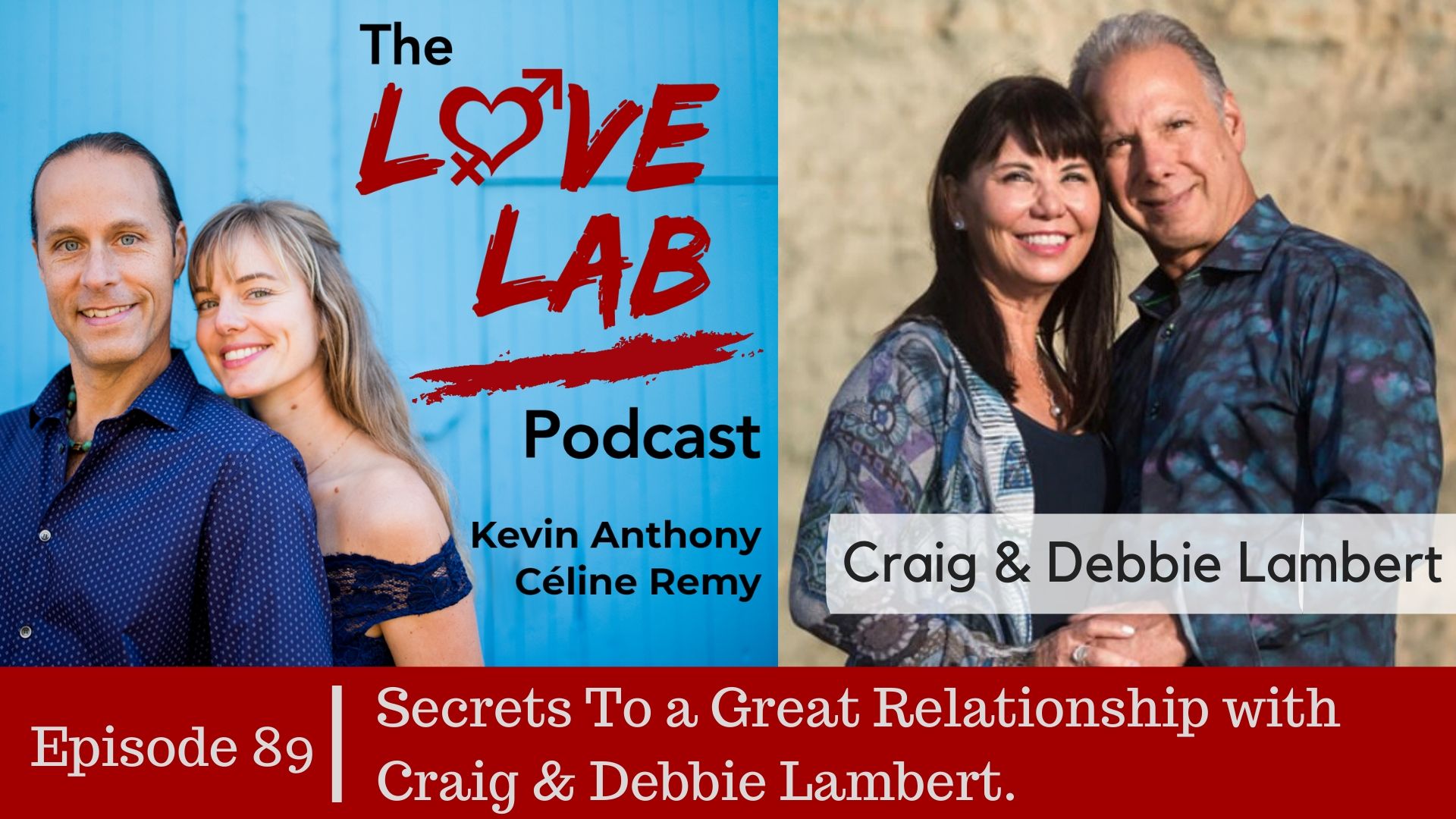
What You’ll Learn In Episode 89:
Everyone who’s in a relationship or wants to be in a relationship wants that relationship to be great. We certainly do. But how exactly do you create a great relationship? Is it all just luck or are there tools, strategies, and tips you can use? In this episode, Kevin & Céline talk with relationship experts Craig & Debbie Lambert who each have more than 30 years of experience in the areas of communication and relationships. Find out some of their best tools to make any relationship great.
Links From Today’s Show:

Craig and Debbie Lambert are relationship experts, each with more than thirty years of experience in the areas of communication and relationships. With a focus on strengthening relationships and improving communication, Craig and Debbie help frustrated, hurting couples gain new understanding of themselves, their partners, and even the world around them.
You can find more about the Mindful Couple book here.
Céline Remy 0:11
Welcome to the Love Lab Podcast, a safe place to get real about sex. Whether you’re a man, woman single or couple, this is the show for you. Because well, sex matters. We are your hosts Kevin Anthony and Céline Remy.
Kevin Anthony 0:28
All right. Welcome back to the love lab podcast. This is Episode 89. And it’s titled secrets to a great relationship with Craig and Debbie Lambert. So this is interesting because they do very similar work to what we do and having reviewed their book.
Kevin Anthony 0:46
I think there’s going to be a lot of alignment here with our guests. So I’m really interested in hearing what they have to say and digging into some of the tools and tips that they have for listeners.
Céline Remy 0:56
Yeah, right because who doesn’t want a happy healthy relationship? be connected and have just more love. So we’re like, well, let’s bring on some more expert. Let’s spread this word. That’s right.
Kevin Anthony 1:07
Don’t just hear it from us from other people too. Because, you know, sometimes people are like, they’re like, Well, yeah, that works great for you guys. But look at the relationship you guys have, like, so it’s good to hear from other people too, especially people who also work in the industry because, you know, it’s not just us. This is possible for lots of other people. Yes,
Céline Remy 1:27
We’re very excited, but before we introduce our guest, let’s give a big shout out to our sponsor power and mastery. So if you want to join the secret club of men who are great in bed, then check out power and mastery at power and mastery.com. It is the most complete sexual mastery training for men. You’ll find something if you want to last longer, have harder interactions or increase your sexual skills. So powerandmastery.com.
Céline Remy 1:53
So today, our guests are Craig and Debbie Lambert and they are relationship experts. And each with more than 30 years of experience in the areas of communication and relationships with a focus on strengthening relationships and improving communication, Craig and Debbie help frustrated hurting couples gain a new understanding of themselves, their partners and even the world around them. So we are very excited. Welcome, Greg and Debbie.
Craig Lambert 2:25
Hi. Thank you.
Debbie Lambert 2:27
Nice to be here.
Craig Lambert 2:28
Great.
Debbie Lambert 2:31
Great.
Kevin Anthony 2:32
Yes. Okay, so you know, before we dive into some of the specific things, I want us and our listeners to get to know you guys a little bit so we read your bio. Okay, that tells us a little something. But tell us a little bit more about what you actually do. You know, who do you work with specifically, what types of work do you do? Yeah.
Craig Lambert 2:55
Okay, so yeah, I got into working with couples about 10 years. years ago. And I would say that the main reason is that I was always curious about how to be present in a relationship, how to be fully present. And so I had studied yoga and meditation and I wasn’t really getting it. I was getting it from the perspective of sitting in front of a cushion and sitting on a cushion in front of a wall and meditating. But when it came down to being in a relationship, a lot of that just went by the wayside.
Craig Lambert 3:27
So I started my journey, which was about how to be present in a relationship. And I had been an individual therapist for many years and decided to change over about 10 years ago, and just work with couples. So during that time, I opened up a private practice. I’m a licensed clinical social worker. So I opened up a private practice in Carmel Valley and since that time, I’ve been working with couples in private practice and doing workshops.
Craig Lambert 3:59
My training has It’s been mostly with something called the imago relationship therapy, which was created by Harville and Helen Hendricks and to Johnson’s emotionally focused therapy as well as john Gottman his work. So you know, we’ve been studying the masters and trying to bring that into my practice.
Céline Remy 4:18
Awesome. How about you, Debbie? Did you already do this before you met Craig or like, tell us more?
Debbie Lambert 4:25
So my backgrounds a little bit different, actually quite a bit different. I was working in organizations for many, many years. My master is in industrial-organizational psychology, and my field was organization and leadership development. But what I learned when I met Craig and we start doing some work together is that when you’re dealing with individuals, the breakdowns and the needs for connection and everything, there’s just so much commonality between the work he was doing with couples and what I was doing team building and working with individuals.
Debbie Lambert 4:54
So I started getting more into work with couples and fell in love with it. I fell in love with it because when you work with individual acts as an executive, you’re just working with that person’s story. Their story about their boss, their peers, their employees. When you work with a couple, you have the unbelievable opportunity to have both people in the room present. The dynamics that you work with are phenomenal and so much. it leverages the potential for change. And so I just became addicted to it.
Kevin Anthony 5:30
There’s a couple of cool things in what you both said, one of which is, you know, I want to go back to something, Craig, that you said, which is that you were working a lot through spirituality and meditation, but then figuring out that you had to bring it really into the physical world. And this is something that I think is really interesting. In fact, we were just studying somebody who was talking about, you know, what he calls true spirituality.
Kevin Anthony 5:56
And he was basically saying something very similar to what you were saying. Which is that? You can meditate all you want. You can read all the scriptures you want, you can do all of that, you know, sitting in your room. But really, you got to bring it back here into the physical world because this is where we live. This is where we function. This is where the rubber hits the road, so to speak. And, yeah, so I love that aspect that you took all of that. And you said, I gotta bring this into the real world. So I thought that was pretty fascinating.
Kevin Anthony 6:25
Mm-hmm. The other thing that I thought was fascinating about what you shared was, Debbie. So from your point of view, I think what you If I could just sort of boil it down a little bit is like, what you were doing before, which was a more industrial organization, you realize it all comes down to relationships, and it all comes down to communication.
Debbie Lambert 6:45
Right? I had a teacher, my the teacher of my program, the main guy, his big organizational consultant that we all looked up to. And I remember one day in class, he said, okay, when you go out there in the real world, and you start consulting with executives, you’re going to find out that in any organization’s there’s one problem and it’s one word. I was like Dallas tell us what it is and he says it’s communication.
Debbie Lambert 7:07
As I got into organizations, and I started consulting, I’m like, Oh, he’s right, like, Oh, yeah, he’s right. Over and over. So it really helped me frame the problems that were going on. You’ve hit the nail on the head that that’s, that’s it, and, and human relationships. It’s couplehood.
Céline Remy 7:26
So I love also what you brought when we work with couples, too. And one of the things is, I always tell people, you can do the work on your own, and there’s a lot that can change. But what happens when you work the two of you together, the catalyst that happens, it changes so much faster.
Céline Remy 7:44
And something that I found is so funny, too, is when we work with couples, we always speak with them separately at some point. So we get her point of view and his point of view, and sometimes you’re thinking oh my gosh, I get it, I know what they want and then you speak to themselves.
Céline Remy 8:00
And you’re like, Oh, this is totally different than what I thought I heard, you know, because like his version and her version are different. And so what I’m curious about too is do you work together with couples? Like as a couple, do you have like it?
Debbie Lambert 8:17
Yes.
Kevin Anthony 8:18
Okay. So there’s four of you sitting in a room, right?
Debbie Lambert 8:21
Well, not all the time. So that’s something recent that we’ve kind of brought into the mix. And it’s just for like, maybe the more challenging couples. A majority of our work is Craig works with his couples, I work with my couples, but occasionally, we’ll be together and we’ve found that there’s a lot of benefits.
Kevin Anthony 8:43
Well, so that’s one of the things that I wanted to ask is kind of why we were going in that direction, which is if you were doing this work separately on your own, which you were, now you’re bringing it together and working as a couple. I’m wondering what you’ve noticed that that’s different when you work together as a couple versus when you’re just working by yourselves with other couples?
Craig Lambert 9:02
Well, for me, one of the main things I’ve noticed is the male person is really oftentimes connecting with me. So it’s a jet we’re connecting on our agenda. And, and also for Debbie, the female is often feeling more safe having a female presence in the room. So they’re connecting on that level as well. And it may not be something that we’re talking about.
Craig Lambert 9:30
But I think on a deeper level, there’s some feeling of commonality like you get me and as as a woman, you get me or as a male, you get me and so that, that is sort of unconscious, but I think it’s sitting in the space with us. The other thing is, Debbie comes from a very, very different perspective. And she sees things very differently than the oftentimes. And so we can kind of come together in that way, and kind And share different perspectives on the same issues that are coming up in therapy.
Debbie Lambert 10:06
I think in our individual practices, the thing that Craig and I do a lot of draws on our own experience. So a lot of times I’ll say, Well, you know, sometimes when Craig wakes up in the morning, and we draw upon our individual experience, so when we’re doing cold joint therapy, we do the same thing.
Debbie Lambert 10:21
But again, like he’s in the room, like, Well, you know, when he wakes up in the morning, one of the things that he does, and he’s just sitting there, right, and so I think that because he’s sitting there and he can react is even more powerful. Mm-hmm. And then he can disagree with me. And we’re interesting.
Craig Lambert 10:43
We certainly can model for the couple, how to interact on a conflictual issue in a very positive way. Mm-hmm.
Céline Remy 10:53
Oh, that’s awesome. So I want to dive into couples and what you’ve seen what do you think if to boil it down, and you might already have given the answer earlier when we were talking about communication, but we were curious about, from your perspective, what do you both see as most couples biggest struggle?
Craig Lambert 11:15
Well, you know, the one that I always tend to lean towards is that couples don’t often understand perhaps that multiple perspectives can coexist at the same time. So I have a perspective, you have a perspective and oftentimes, we’re fighting as to who’s right and who’s wrong. And you know, as Terry real, one of my mentors likes to say, you know, you can be right or you can be in a relationship.
Craig Lambert 11:48
I like to really point that out. And I do that visually, with props and we talk it through like, can you complete validate your partner’s perspective. And if you can, I think you’re you’ve come a long way. So that’s one of the keys, I think.
Kevin Anthony 12:11
I was just going to say that, that I think a lot of people tend to look at any conflict, whether it’s in the relationship or not as what we call a zero-sum game, right? Which means there’s always a winner and always a loser. So I think it’s great that what you’re pointing out is that is not necessarily the case in a relationship, you can actually hold multiple viewpoints or ideas simultaneously, and it doesn’t make one person wrong and one person, right.
Craig Lambert 12:34
Exactly, exactly.
Debbie Lambert 12:35
Yeah. And I think when I think what Craig is talking to, I would agree is probably the biggest not the only but certainly, the biggest breakdown in relationships is holding on to our stories. And then what happens is over time, we’re really good at making a bigger, you know, so it’s like, you know, and then we hear you always you never and in our minds when we’re interacting and even when we’re not and sometimes more when we’re not is we create this story that started here, and now it’s there.
Debbie Lambert 13:01
So the type, by the time they get into our office, the stories are so big, there’s absolutely no space for, Kevin, what you’re referring to is the two to coexist. And what I’ve observed in working with couples is that takes a lot of effort to maintain those stories, I’ve got to work really hard.
Debbie Lambert 13:21
So all my energy goes into maintaining and creating and validating my story. And what we’ve noticed is that when couples realize to your point that two can coexist, and they actually step into that space of recognizing somebody else’s story. It’s like a relief in a way.
Debbie Lambert 13:39
That’s where the magic really starts to happen. They realize that they can create a habit of doing that and it’s not easy, but once they do it, I think it open space for them to do it more and more. So we believe that just take little, little steps, like one step into that little story, mountain story and then we can step into a bigger Joy, but it’s um, it’s exciting for couples to take that step.
Craig Lambert 14:05
Yeah, absolutely. I think a key part of this for me that I learned from Harville Hendricks, and I think it was one of my biggest takeaways was this idea of being able to validate. And you know, I know that as couples therapists, I’m sure you guys spend quite a bit of time talking about the importance of being able to validate your partner’s perspective.
Craig Lambert 14:26
Simply put, it’s, you know, I’ve listened carefully to what you’ve had to say, and you make sense. You make sense, what you’re saying makes sense. You’re able to cross over on that bridge and be in your partner’s shoes. And that is so powerful. So that’s a big, big part of it. I think, for every,
Kevin Anthony 14:46
I completely agree. And here’s an interesting thing that I think about that, which is that in order to do that, you have to have really good communication skills. So and let’s be totally clear. When we say communication, I’m not just talking about the words coming out of my mouth because the other half of communication is listening. Right? So in order for you to sit there and say, Okay, what you’re saying makes sense to your partner, you have to have listened to properly and heard it, and then effectively communicated that back.
Kevin Anthony 15:19
So one of the things that we find almost every problem has a communication breakdown component to it. So they come to you with all these different problems, right? And really, if they had effective communication, they would have realized that most of those weren’t even problems. So what I was curious to ask you guys, is one if you see a similar thing, and two, what are some of your best strategies or tools or advice for couples who are struggling with that communication piece?
Debbie Lambert 15:54
Well, it’s probably one of the first skills that we teach couples when they come in, we call it mirroring basically just repeating back what the person’s saying. And what’s so fascinating and fun for me is that people say, I’m a good listener, I listen carefully. I really do and I get. I just don’t agree with what she’s saying, because she doesn’t listen to me. And it’s so fun because then I say, Okay, well, let’s just listen to each other.
Debbie Lambert 16:19
Right? So I’m just going to have you listen to her, and we describe how to mirror basically repeat back what she has to say. But do it like you’re in charge of the conversation. So when she said enough, you stop her and say, Okay, let me what basically what you’re saying is, and so when they go through this exercise, first of all, they let the person go on too long, right? And they can’t remember it. So they finally get it and checkable pieces, and when they go back to merit, they can’t you know, the person that thought they were like the best listener, they’re like, could you say that one more time
Debbie Lambert 16:58
and even after the second time they’re not quite getting it. And so what couples learn really quickly is they’re not good listeners. We’re just not good listeners as human beings.
Craig Lambert 17:08
There’s a reason for that.
Debbie Lambert 17:09
Right? Yeah. Because our minds are busy thinking about what we’re going to say or discounting what they’re saying. Um, there’s a lot of listening mistakes that people make, I
Craig Lambert 17:20
I think it’s interesting. Excuse me, I think it’s interesting that the mind tends to go right to opinion, judgment. And that’s what while our partner is speaking to us, I think it’s not quite conscious that what we’re doing is already in our minds. We’re not fully listening. We’re forming opinions and judgments of what the person is saying and as Stephen Covey would say, you know, we’re listening, not with the intent to listen but with the intent to respond. Not I’m sorry, yeah, with the intent to is Yeah,
Kevin Anthony 17:53
it’s the difference between listening to understand and listening to respond.
Craig Lambert 17:57
Exactly. So As Debbie pointed out, the mirroring is so powerful, it’s so effective because it slows everything down. And now all my whole job is just to hear what you have to say. And once I do that, once I am able to do that and you feel listened to, everything slows down, everything calms down. That’s just the first step. So we teach the mirroring. And then after they’ve learned that, and they feel pretty settled with that, then we will bring in the idea of summarizing, which is when the person is complete, and they’ve really shared everything they want to share.
Craig Lambert 18:37
We will ask them to summarize the key points of what you just shared with me. So what I hear you saying in summary is and then we go to validation, which is a huge step, right? We take we go to that part of, you know, I’ve listened to everything you’ve shared with me, and you make sense, that makes sense. But then there’s one more step, empathy. Empathy is probably the more difficult step for many. That’s not listening with your mind, but listening with your heart. At that moment you say, I can’t imagine you must be feeling fill in the blank.
Craig Lambert 19:18
So it’s broken up like that. And we teach that to our couples as a basic strategy for communication right when they come in the door. That’s usually one of the first things we teach. And a lot of our sessions use that process to help couples stay connected and feel safe. And that’s the key
Debbie Lambert 19:38
I am really impressed by how quickly they learn it like how bad they are when they come in, and then within a few sessions, they’ve got it nailed.
Céline Remy 19:46
Well, I think it’s all about habits, right? People are not taught these skills unless they’ve sought them out. And I had a funny story because I remembered at the beginning of our relationship I was talking to Kevin Somehow I was under the impression that he wasn’t listening to me and you know, you come into a new relationship from all the baggage of the previous relationships, right? So I’m kind of like, well, what did you hear me say, you know because we use nonviolent communication principles we apply all of that so I was like, What did you hear me say?
Céline Remy 20:16
Kevin just like literally like said every word back exactly the same words because I think it’s very important in the mirroring is not to like to be used for your filter, but literally mirror back the exact words, and I was floored. I think I did that about maybe two more times where I had him like, what did you hear me say like mirrored back at me is to use your terms. Then I noticed that he always listens even if he doesn’t seem to listen to the way our words he listens.
Céline Remy 20:47
So I had the proofs and then I haven’t had to ask him that like I trusted from then on after those three times. I was like, Okay, he’s proven himself. This is good, and I can trust that he’s a way of paying attention to me. He is gonna be like sitting down staring at me. But he’s still listening and really taking it in. And so that’s kind of what it brought to me is like, remember to when you are talking with your partner, they may not be mirroring exactly or acting the way you would when you give your full attention. But it doesn’t mean that they’re not really listening.
Debbie Lambert 21:19
Right? It’s such a great point. And Celine, I love that you proactively say, what did you hear me say, Oh, he’s a way to check out if they’re listening.
Céline Remy 21:28
Absolutely. And I think then we treat we really train each other. And so I want to say this again. So you’ve got your steps because this was huge. This was like a huge gem for all of our listeners here that I’m like, like, if that’s the only thing you get, there’s the mirroring part. So it’s really reflecting like what you heard. And then what was the second part see, like, here we go here. Yeah, this the mirroring. There’s
Craig Lambert 21:54
Summarizing,
Céline Remy 21:55
Summarizing, yes use you guys use the summarizing And then I was kind of lumping the empathy together, but you have kind of an in-between step right?
Craig Lambert 22:06
Yeah, validation and empathy come together, but we like one is kind of more cognitive, okay. I can imagine, I can understand your perspective. So it’s more of a cognitive, the empathy is much more on a feeling or emotional level.
Céline Remy 22:23
That makes sense. And I think that could help those who can relate more with their brain and then those who relate more with their heart so you can get both parts. Yeah, so I would love to get deeper into some topics of your book. But before we do that, we’re just going to give another shout out to our sponsor here.
Céline Remy 22:40
So if you are longing for more connection, deeper intimacy and red hot passion in your relationship, and you are a committed couple, who loves each other but has lost a spark and has fallen into a boring routine, we meaning Kevin and I have a special invite for you. We’ve created “Relationship Synergy” a cutting edge next level intimacy program. For the modern capital to help you fire up your love life, so give us 90 days and we will help you transform your love life forever. So you can find all about relationship synergy at CelineRemy.com/synergy.
Kevin Anthony 23:14
okay, I love doing live commercials and it’s even more fun when they’re commercials for our own products.
Céline Remy 23:25
So, um, you know, you have 52 topics in your book. So your book is called the mindful couple this, this 52 weekly strategy that on to real love and connection. And I see that you know, you could read it through all at once, maybe to get the concept or you can take your time and do it weekly and really like talk about the subjects and do the exercises because there are actually practices just like some of the things that you guys were sharing.
Céline Remy 23:51
And some of them I really liked and I wanted for you guys to maybe, like bring this to our audience, and our listener. So the very first topic that I love that you talked about was about trying generosity in your relationship. Oh, there was another one.
Kevin Anthony 24:11
Yeah. Oh, first one. The first one on our list is to forget fairness.
Céline Remy 24:15
Okay. Forget fairness. Okay, good. Okay, that’s sort of that one. So basically,
Kevin Anthony 24:18
we picked we cherry-picked a couple out of your book that we thought would be fun. And this one is one that we talked about a lot. And so we really actually wanted to get your opinion on it.
Céline Remy 24:28
Forget. So let’s start with forgetfulness. So give us more about your opinion and what that’s what does it look like for couples Really?
Craig Lambert 24:36
Sure. Want to start?
Debbie Lambert 24:38
Well, I think it’s, you know, it’s really easy to get into a fairness mentality. In fact, we often talk about the shift from fairness to generosity, hmm. So, you know, when I approach a relationship and my love relationship, if I can say, Well, you know, I did the dishes last night. You do them tonight. I’ve created culture fairness, which is really good sometimes because fairness can create guardrails and boundaries for the relationship.
Debbie Lambert 25:09
But as a mindset, it’s not great. If I approach my entire relationship in terms of what’s fair, then it doesn’t leave room for me to show up in a more generous way. So for example, when I see dishes and it’s not my turn, I might just do them because I know he’s busy. And he’ll really appreciate it. We share times for coffee. So it’s fair for us is that one day I do coffee in the morning, we drink it in bed together. And then the next day he does it, but sometimes he didn’t sleep so well. So I just do it, or vice versa. Right. So that’s being generous versus fair. And
Craig Lambert 25:48
I think I think a lot of couples come to their relationship with a tit for tat mentality. You know, I’ll do this for you if you do this for me. You know, I’ll if you come home early from work, I’ll give you sex. But you know, coming home early for work, because you want me to be home early and you want to spend more time with me, is something I may want to just consider doing because I care about you, and I love you.
Craig Lambert 26:16
And so having something connected to what you do, you know, on one level, I hear it a lot with couples about fairness, well, that’s only fair, I’m doing this for you, you can do that for me. But it frequently breaks down. And I think the more generous or the more loving place to come from, is I’m doing this because I love you. I care about you. I care about our happiness. So there’s no question about what I’m going to get in return. You know, it’s an old concept give without expecting anything in return.
Kevin Anthony 26:48
Yeah. And you know, one of the things that we see is that somebody will say, Well, I’m not going to do that, because they never do it right. So they’re waiting for it. Well, I’m not going to say that I love them because they never tell me that that they love me, right? So they sit there waiting to hear that from the other person. And then nobody ever says it. It’s like a self-fulfilling prophecy. And so one of the things that we tell people all the time is if you want your partner to tell you that they love you to tell them that you love them regularly, you might not get it back at the same frequency, but that’s gonna motivate them to return that action.
Debbie Lambert 27:23
Right? We were big believers of the law of attraction and that everything’s energy and you know, what we do has a vibrational quality to it. And so, you know, to your point, Kevin, you know, when you say I love you, you raise the vibration of the relationship, and when you raise the vibration of the relationship, I’m more drawn to do the same.
Debbie Lambert 27:44
So you know, we just kind of rise up together, or we can lower together a few say, Well, you know, you didn’t do it. I’m not gonna say I love you because you haven’t said I love you. Then I just sync it down. So the more high vibration actions and thoughts And feelings that I have in a relationship, the more I’m going to foster those with my partner. Mm-hmm.
Céline Remy 28:08
So you have another concept in your book give more to get more, which is kind of tied into what you guys were talking about. But I thought it was a really good point to bring because most people again will not hold back in their giving. And I’m going to share a story here also a personal story to illustrate before you get into that, at the beginning of our relationship, I was under the impression that I was loving Kevin more than he loved me.
Céline Remy 28:37
So I was having a problem with that. I was like, oh, that sucks. Then one day I just sat down and I thought, but who cares because the only love you get to keep is the one you give. I’m just gonna pour love on him. It doesn’t matter how much I get back because it’s all about how I feel when I give love and the moment I was able to shift that, that perspective, it never was an issue and he has the just as much and shows me the love like I was just probably stuck into something at that moment.
Céline Remy 29:13
But that was a very good story to illustrate, had I stopped giving my love, then I would not have gotten more or felt like I was having more. And so by being okay with giving more, because it was just my perception because he was giving just as much then we continue to elevate our relationship,
Kevin Anthony 29:31
you know, and I think to what happened in that situation was when you were able to sort of letting go of that belief, then you were able to see all the ways in which I was loving you that you hadn’t noticed before.
Céline Remy 29:44
That is true.
Debbie Lambert 29:45
That’s such a great point, Kevin, and I love the example because Céline what you’re talking about is just resistance to the notion of possibility that maybe you’re giving more and underlying that is this thing that he should be giving as much as I should it should be equal. And when you let go of that story and just a story, right, then you’re vibrationally were allowed to kind of float up.
Debbie Lambert 30:09
And that’s why you were able to see the quality and the beauty of what was really happening. You know, the fact that he was giving more, you couldn’t see it from that perspective where you’re living in that he should it should be more equal. Mm-hmm.
Céline Remy 30:23
Absolutely.
Craig Lambert 30:25
on another level, to that one of the things that have occurred to me over the years is that sometimes we want to get a little bit clearer about what it is that the other person wants to receive. So we call it in our practice caring behaviors, giving behaviors that actually land for another person. So this really doesn’t have so much to do with the fairness concept, but it kind of takes it to a level of, can I identify those things that make my partner feel loved and cared about?
Craig Lambert 30:57
And how do we go about doing that, so that when I am giving, giving love giving caring behaviors that its land and for the other person? So as Kevin was saying earlier, you know, with I love you, for example, one way to receive I love you is to tell your partner that I enjoy hearing you say, I love you to me. So we’re sharing with our partner, we’re getting out of it of this mind-reading idea that my partner should just know, what makes me feel loved and cared about, we move into an area where I tell my partner what makes me feel loved, and cared about and it’s very empowering.
Craig Lambert 31:36
When we do it with our couples, they just, they just love it. And there are so many things that make you so when you feel loved and cared about the Kevin does, I’m sure. And oh, yeah, probably by now. Now Kevin knows what those things are. You know, he’s been a quick study, and he’s observed and he’s asked, and he’s noticed. A lot of couples miss that, they don’t quite get it. If you can just kind of be really clear about together what makes you feel loved and cared about and do those things. Well, the fairness the whole idea kind of moves away, you know, isn’t what I want.
Céline Remy 32:11
And then you step into that great relationship that we are talking about. So we are coming close to the end of our show, but there is one more point I would like you to talk about, and it’s called the 15 seconds connection, so it’s not going to take too long apparently, it’s 15 seconds. All jokes aside, I thought it was a really good point. And maybe you could share that with our audience today. How to use like 15 seconds everyone can find 15 seconds to create a deeper connection. Really?
Craig Lambert 32:46
Yes. So you know, this has kind of a part one and part two. Part one is that there are I would say there are three times of the day they’re their most important for a couple. The first time is when you wake up in the middle The second time is when you meet each other if you go out to work, and you come back together at the end of the day, and then the third time is when you go to sleep at night, there’s got to be some connection going on, right during those times
Craig Lambert 33:14
A 15 second hug before you leave in the morning, before you when you first come home at night and see each other for the first time. Right before you go to bed. That’s all it takes to feel that deep connection. look in your eyes, look in each other’s eyes, touch each other, hold each other 15 seconds, it will transform your entire relationship. So that is one of the main practices. It’s just 15 seconds. And we have another practice that we do that takes 15 seconds that can also transform your relationship. That’s simply giving each other one appreciation.
Craig Lambert 33:53
And going hey, let’s do it. I’m sure
Debbie Lambert 34:00
Is it a nervous laugh?
Céline Remy 34:03
No, I’m laughing because we talk about it all the time on this show about the power of appreciation and its practice we give everyone who works with us to talk about like, we call it three things you love about each other, you know, and just kind of like share that or ask for it when you need it.
Céline Remy 34:20
So you can be like Craig is saying like doing it at a certain time like the morning when you wake up, which is a great way to wake up to when you come back home because it makes you like really happy to come back home and before falling asleep because it helps you to focus on what things that you’re grateful for. So it cultivates that mindset. Or you can do it as we teach it where anytime you feel a need for it just go and ask your partner and just get it field and feel really good about it.
Kevin Anthony 34:46
Yeah, so you often will say tell me three things you love about Yeah, I do and I just have fun with it. You know, like I think a lot of times you know if guys were being asked that on a regular basis. Wow, man, I could. Well, I gotta think of something that I just have fun with it. Like it Could be anything, the simplest little thing like, oh, I love the way you, you put that the extra spice in that meal that you made and made it so much better than the simple little stuff.
Kevin Anthony 35:11
The other thing that we do to that it sounds a lot like what you’re saying is, so we have a rule that if anybody goes out on their own when they come home, that the other person should greet them at the door. Right? And so it’s like what you’re saying when you come home, so I know pretty much every time I come home unless you’re indisposed. You’re going to come and greet me and say hello and welcome me back. And that really makes a difference. Mm-hmm. Absolutely. So we have one more question for you guys that we ask all of our guests. It’s the time when you get to blush because we want to know what your best sexual talent is.
Debbie Lambert 35:54
It’s all special. Yeah.
Craig Lambert 36:00
I actually think one of my special talents is consistency. I feel that you know, I’m 63 that’d be 62. Over time, you know, things change, your body changes, priorities, change, desires, desire changes. One thing that we’ve made a commitment to is to commit to being intimate with each other sexually intimate with each other, every single week, and I hold Debbie accountable to that. She holds me accountable for that.
Craig Lambert 36:37
And I so I think that consistency is one of my superpowers. I won’t let a week go by without making love. And I know it can. It can go from a week to two weeks to three weeks to a month, three months, if you’re not careful. It’s a slippery slope. So absolutely. believe that. That’s your superpower. One of them. That system
Debbie Lambert 37:00
No, I think he really places a priority on, you know, having that intimate connection and making sure that, you know, it’s, you know, sometimes it’s two or three times a week and but if it slips that we have that once a week, and we make it really special and romantic and so he’s kind of the keeper of that, which I really appreciate you.
Céline Remy 37:21
Yeah, Debbie, we want to know, what’s your best sexual talent?
Kevin Anthony 37:28
Remember, there are no restrictions on this show.
Debbie Lambert 37:31
So since there are no restrictions on this show, I would say that, you know, one of the things is as you get older, it changes sexually, right? I’m just gonna say without pointing fingers or without, you know, saying anything inappropriate. would be that I have a capacity to orgasm quickly and that comes in handy.
Kevin Anthony 37:53
Okay, yeah. So good control over that.
Céline Remy 37:58
Alright, well That was juicy. Thank you both for sharing.
Kevin Anthony 38:02
Yeah, we love that question because it really likes catches a lot of people off guard, but it’s real and that’s the thing is we want it to be real. We want the audience to feel like you’re real people that they can connect with. And that I think that question always helps do that. By the way, if you’ve, if you’ve listened to any of our past episodes, our entire sex life is sprinkled throughout every show that we do. Now.
Céline Remy 38:28
So, Debbie, and Greg, it’s been a pleasure having you please tell our listeners where they can find more of you. No pun intended. But why can they get your book and connect with you then?
Craig Lambert 38:40
Yeah, on the book, you can go to mindful couple calm, it’s on Amazon. And you’ll find it right there. As far as reaching out to Debbie and me, right now we’re redoing our website. So it’s still under the old name, but it’s Craig Lambert therapy.
Céline Remy 38:56
Okay, we’ll put the link in the description and people can Find that we highly recommend that you check out their book The mindful couples because it’s got really great strategies really easy things to put into practice to bring the level of connection to the next level in your relationship. I
Kevin Anthony 39:16
barely scratched the surface, we just cherry-picked a couple of little pieces out of it. So there’s a ton more information in there for people who are interested.
Céline Remy 39:23
Alright, everyone, thank you so much, Debbie and Craig for being here today,
Craig Lambert 39:28
Thank you.
Kevin Anthony 39:30
Yes. All right, everybody. That’s all the time we have for this episode, and we will see you next week. We hope you liked this episode of the love lab podcast. If you enjoyed this show, leave a comment and share it with your friends.
Céline Remy 39:48
And if you want more, we have an entire digital library with the best sex tips and Relationship Advice at Selena jaime.com. That’s c e li n e r e m dot com. So join us in the sex vault to continue this adventure.
Kevin Anthony 40:05
Thanks for listening
Céline Remy 40:06
and remember, you’re amazing
We hope you liked this episode of The Love Lab Podcast. If you enjoyed this show, leave a comment and share it with your friends.
RATE & REVIEW THE LOVE LAB PODCAST
—> LEAVE A 5-STAR REVIEW ON APPLE PODCAST
ASK A QUESTION FOR THE NEXT EPISODE
—> Click here to leave a message directly to Kevin and Céline to be answered on the air.
Thanks for listening and remember you are amazing.

Kevin Anthony and Céline Remy are an international husband and wife team who joined forces to create a worldwide movement of true sexual empowerment. Kevin, “The Truth Warrior,” is a Men’s Coach, Tantra Counselor, and Couples Relationship Coach. Céline, “The Intimacy Angel,” is a Holistic Sexologist, Certified Sexological Bodyworker, Relationship, and Intimacy Coach for men, women, and couples. Together, they are truly the ‘Power Couple.’ They host ‘The Love Lab Podcast,’ and are co-creators of ‘Power and Mastery,’ an online educational training system that teaches the exact process to any man who desires to bring his ‘A’ game consistently to the bedroom. They guide couples and men on how to go from ‘good’ to ‘AMAZING’ in the bedroom and beyond.