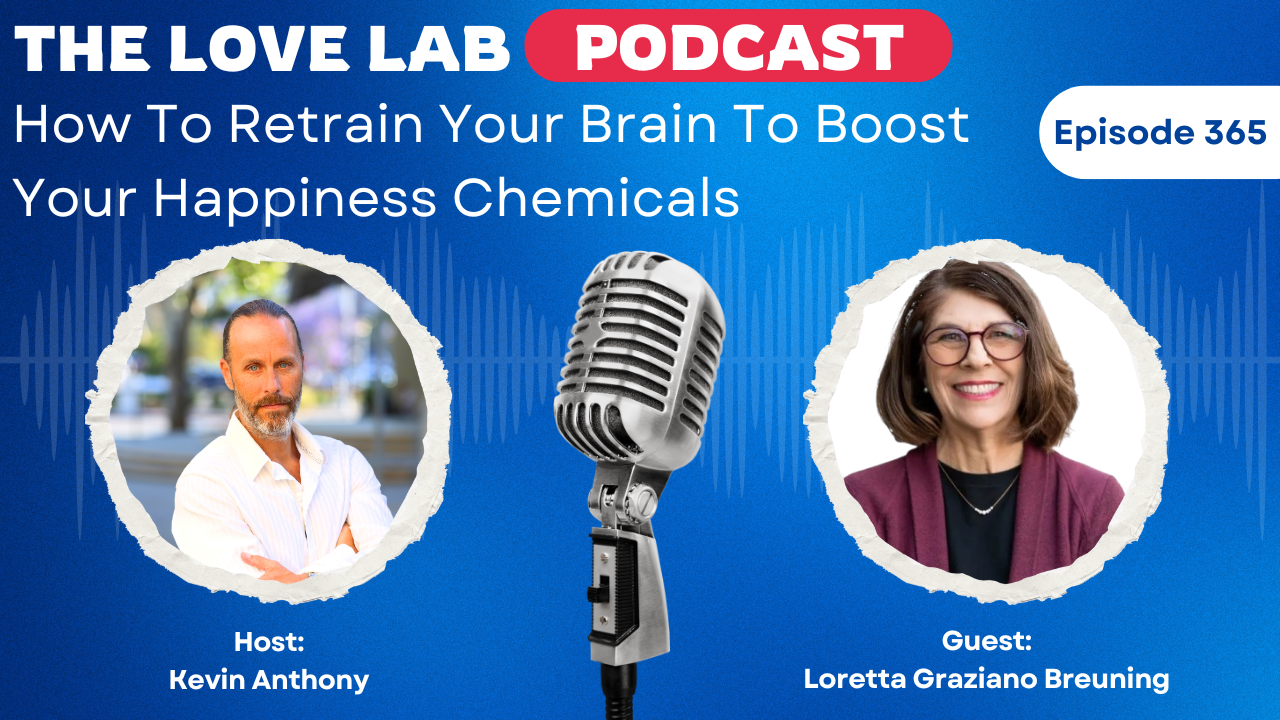
Kevin Anthony: Welcome to the Love Lab podcast. The place to be for honest and real talk about relationships and sex. Whether you’re a man or woman, single or a couple, this is the show for you. I am your host, Kevin Anthony, and I am here to help you have the relationship of your dreams and the best sex of your life.
Kevin Anthony: All right, welcome back to the Love Lab Podcast. This is episode 365. 365. That’s kind of a cool number, because I was noticing over the weekend when I was looking at this show, that you could listen to an episode of my podcast every single day for an entire year. How cool is that? That’s a lot of content. I also looked up how many hours total. That was because not all the shows are exactly an hour. It’s a lot of hours. So, uh, I thought that was pretty cool.
Kevin Anthony: Anyway, today’s episode is how to retrain your brain to boost your happiness chemicals. So if you’ve been listening to this show for a while, you know that we have talked to some extent about the different, uh, hormones or chemicals that sort of drive our behavior. And we’ve talked about how that influences different aspects of how we relate together as humans and also our sexuality. You can’t cover the topic of relationships and sexuality without talking about these chemicals because they are so influential in our behavior.
Kevin Anthony: So today I have somebody who I will introduce in a moment who is an absolute expert in, uh, these chemicals. She has made a career out of studying animals and their brains and how this all works. Uh, so we’re going to get even more detail and nuance on this subject than we have ever had before on this show, I think. And every time I was working on this or looking at this topic, uh, the thing that keeps popping into my head, and I’m sure you’re going to laugh, but, uh, you’ll realize as we go through the show how relevant it is. Do you remember that song? I believe it’s from the 90s. And the song was you and me, baby, Ain’t nothing but mammals. So let’s do it like they do on the Discovery Channel. Right? It was a very popular song in the 90s. And as we start to talk about this research and how it applies to us as humans, that will make a whole lot more sense.
Kevin Anthony: All right, before we do that, as always, a short pause for my sponsors. Ladies, did you know that the overwhelming majority of men consider receiving oral sex a must in their relationship? Well, of course you did, because men have been asking for it your entire life. But do you feel confident in your ability to give great oral sex. If you tend to avoid it because you don’t feel like you’re good at it, or if you feel that you are pretty good at it but want to be even better, then my new blow job mastery course is for you. I have teamed up with the amazing coach Ry Duong of Eterna Love to bring you a practical and easy-to-follow course that is guaranteed to increase your confidence and skill when giving oral sex to your man. In this course, you will get all the secrets to mastering the art of oral sex with step-by-step instructions and multiple live demos. Go to sacredfemininearts.com/bjmastery. That’s sacredfemininearts.com/bjmastery.
Kevin Anthony: You know, you’ve heard me talk about this a few times in the show. I did a video on YouTube about what men consider great oral sex. It kind of went viral. And the comments I got from women were all kinds of things like, oh, my God, I need to know how to do this, or I had no idea, blah, blah, blah. So I just decided to make a course for it. And, uh, the feedback so far has been amazing. What I was really hoping and what has been coming in is women saying, I feel so much more confident now. I feel more connected to my man. He’s so much happier now. He keeps praising me, all these things. So go check that out.
Kevin Anthony: All right. My guest today is Loretta Breuning. She is a, uh, PhD and founder of the Inner Mammal Institute and professor emerita of management at California State University. She is the author of the popular book Habits of a Happy Brain. Retrain your brain to boost your serotonin, dopamine, oxytocin, and endorphin levels, which has been translated into 18 languages. Welcome to the show, Loretta.
Loretta Breuning: Hi. Thanks for having me.
Kevin Anthony: All right, we’re going to dive deep today into happiness chemicals. I mean, who doesn’t want to be happier? If we could find a way to be happier, wouldn’t we all want to do it? So when we’re talking about happy chemicals, what are we actually talking about? Could you give the audience just a brief description? Because we’ll dive deeper into each one later on. What is it that we’re talking about when we say retrain your brain to increase happiness chemicals?
Loretta Breuning: Sure. So the chemicals I’m talking about are dopamine, serotonin, oxytocin, and endorphin. And when I say retrain your brain, I mean that our brain is born with billions of neurons, but they’re not connected to each Other at birth. And the big neural pathways in our brain are built in adulthood and youth, and it’s quite hard to deviate from them. And that’s why people end up repeating behaviors that they’re not enthusiastic about with their conscious mind. And so I explain, uh, the really quite difficult challenge of building new neural pathways. But the important thing to know is that our brain is not designed to make us happy all the time. It’s designed to motivate survival behavior. And so we have this misconception today that we should just be effortlessly happy all the time. And other people are. And if we’re not, something is wrong. And in the context of relationships, you blame your partner often if you’re not happy. So I really think, uh, that’s not good for relationships.
Kevin Anthony: Indeed. Something you said is perfect. Segue into my next question, which is I wanted to dive a little bit into, uh, in the animal kingdom, what drives the production of these chemicals? Because I think it’s important to understand what’s driving it. Where is it coming from? Why are they being produced in the ways that they are?
Loretta Breuning: Sure. So when I said survival behavior from an animal perspective, it means the survival of your genes. So, uh, you could think of like, animals are just trying to spread their genes. But animals, of course, are not aware of their genes. So what does this mean? Well, uh, they are looking for mates. And what I was amazed to find out is that animals are picky about who they mate with. They’re looking for a good mate because a good mate has a higher survival rate for the young. In addition, they’re looking for what in human language we would call support. Because that increases the survival prospects of the young. How this works out in monkeys and apes and cows and pigs has been intensively studied for the past, um, century. I was amazed that nobody taught me this. Uh, in fact, there’s, uh, an academic field called evolutionary biology. What I’m saying, you could find it in any introductory course, whether you prefer evolutionary biology or evolutionary psychology. But the irony is that this field didn’t come into existence until just when I left college. And then it suddenly became taboo because animals are not nice to each other. They will kill each other for a mating opportunity or for an extra bit of food that builds the strength they need to survive. To have a strong reproductive ability. And so that whole field has now disappeared in favor of what I call the warm fuzzy view, which gives people the idea that your brain is just designed to go around loving people. And then when life doesn’t work out that way, then people think, oh, ah, what’s gone wrong.
Kevin Anthony: Indeed. He made some really good points there. Uh, one of the things that I really wanted to pull out of that, which I think you did a good job of, was the main underlying sort of drive or motivation factor. Right. Which is to pass along those genes. You know, uh, as somebody who does relationship coaching, it’s not something I like to spend a lot of time on, like when coaching people. But every once in a while, there comes a point where we have to sort of get real about what’s happening. And people don’t really often want to hear that. Right. They don’t want to hear that there is some drive underneath that they don’t necessarily have control of. They want to think of themselves as so much more evolved modern-day humans who have complete control over the way they act. And they don’t want to hear that, you know, some behavior is being driven by an evolutionary force that’s existed for a million years. So what I was hoping was that you would bring that out and share that, because that is a reality, right? There is some reality. It doesn’t mean that we’re 100% bound by it, but it’s there. And we at least have to recognize that it’s there.
Loretta Breuning: Yes. And it’s there for everyone all the time. And this is what people don’t want to accept because they like to think that that’s somehow a failing or flaw and that you should have been able to rise above that. But even the person who’s telling you this they haven’t risen above it. And the reason is simple, is because that’s what’s connected to your happy brain chemicals and your stressed chemicals. So the simple way to explain this is that we humans have two different brains. So we have what I call the pink fluffy brain, which you see in pictures, which is able to produce abstractions like language and thoughts of the future. So I call it your internal public relations agency, because it’s always putting like a positive spin on everything you do. And then underneath that, you have the mammalian limbic system, which is like the amygdala, the hippocampus, the hypothalamus, all that stuff people hear about, which controls the chemicals that make you feel good and and the chemicals that make you feel bad. So what we really want is to feel good and to stop feeling bad. And then we do that with old neural pathways that are built from whatever triggered our chemicals in youth. And then when we do something to make ourselves happy, then we say, why did I do that? And then we try to come up with a good reason for it.
Kevin Anthony: Yeah. All right. Two things I want to talk about here. One goes back a little bit further, and then another one has to do with those pathways and how they get established. Uh, the first one is that you mentioned that animals don’t just mate with anyone. They’re actually selective and they choose right. And I wonder if you could just talk a little bit more about that, especially in terms of humans, because this behavior is obviously very present in humans. It shows up a little bit differently because, you know, for instance, you know, you’ll hear things like, oh, she’s just after his money, and blah, blah, blah. Okay, okay, maybe that’s true. But is there an underlying behavior? What does the money actually mean to her? Right. Yes. So. So talk a little bit more about that. And that’s the idea of selecting a partner and how this behavior drives it.
Loretta Breuning: Sure. So I have to use, um, an uncomfortable term. It’s called reproductive success. This is a term in the biology field. Any behavior that increases the survival rate of your offspring is what triggers happy chemicals and relieves stress chemicals. So even if you don’t want to have children, even if you had children years ago and now you’re a grandparent, whatever it is, this is the underlying wiring of your happy chemicals and stress chemicals. So a simple way of looking at it is to create a safe environment improves reproductive success, because that prevents the young. So anything that I connect in my mind with a safe environment triggers my happy chemicals. So for one person, it could be money. For another person, it could be fine food, because they’ve associated that with safety and protection. So in my books, I explain how each of the chemicals. Dopamine, serotonin, oxytocin, link to this, uh, reproductive success. And that helps each person understand these behaviors because nobody is consciously saying, oh, I’m going to go around and spread my genes. Of course, I’m not saying that we’re thinking that.
Kevin Anthony: Right. But see, that’s the challenge that I have sometimes when having this conversation, which is nobody is going around thinking that, and yet it’s there. And then when you try to point it out to them, like, no, no, no, no, no.
Loretta Breuning: Exactly. That is not at all what’s happening. I am so much more evolved than that.
Kevin Anthony: Exactly. I run into the same problem all the time. And, uh, you know, this is why I love having people like yourself on, because you have the knowledge and experience. You have studied this extensively. And it’s like, I need people to hear it coming from other than just me. Right? And I need my audience to hear it from someone else, too. I love that. That’s a win-win. Um, okay, so we kind of covered that part about, uh, you know, what’s really under there, driving it in the mate selection. The other thing that you said that I wanted to talk about is this idea that these sorts of habitual patterns, sort of, for lack of a better term, create sort of grooves that we then tend to follow. Right. Like, talk about how when these behaviors manifest, they create these patterns that we unconsciously repeat over and over.
Loretta Breuning: Sure. So I said that we’re born with a lot of neurons, a lot more than animals, for example, but almost no connections between them. So you probably see, like, an animal can sort of run with the herd as soon as it’s born and find its own food when it’s born, because it’s born hardwired. So we are born with the ability to build wiring, but not with the connections themselves. So, how do we build our wiring is from early experience? So if we have, like, 20 years to wire ourselves up, that’s a really long time, because, like, animals only have, like, two months or two years before they’re a reproductive adult. So 20 years is a long time. And yet the average person thinks, oh, I ignore all of my early stuff and I figured out everything for myself. I thought it through when I left home. But no, each of us is acting on early experience more than we realize. And it’s so uncomfortable to see in yourself that it’s sort of fun to start with other people. And the way I’ve done this is by reading a lot of biographies. And when you know a person who’s famous for a certain thing, then you see their childhood and you say, wow, they were just repeating their childhood. And every one of us is repeating our childhood. And it’s real physical pathways in the brain. And you could think of it as the highway system in the brain. And we have more of this highway-building material when we’re young, called myelin, and that builds neural pathways that are super efficient. It’s like the difference between fiber optics and copper wire, uninsulated copper wire. So the neural pathways we built when we were young are so efficient that when you do things that are your usual, you feel like, oh, they’re just right, they’re easy, they’re obvious. Whereas if you tried something new, it’s so hard to get the electricity in your brain to flow down a new pathway that it feels wrong or confusing, and hard to sustain that thought. And that’s why we all default to old Patterns, even when, uh, we consciously reject that.
Kevin Anthony: Yeah, this is such an important point to make because we as humans will understand a concept in one context, but humans seem to have a really difficult time applying that same concept to other contexts. So what I mean by that is, you know I, I’ve been a teacher my entire life in many different ways. I even taught high school for a little while, which is a little-known fact I don’t think I’ve ever shared on this show. I taught for the American Heart Association, and I taught for the American Red Cross. I have taught guitar. I’ve taught drums. I’ve taught a lot of things in my life aside from relationships and sex. And one of the things that you learn as a teacher when you’re teaching somebody something new is that the new thing always feels awkward or difficult or challenging or whatever. And I like to use really the example of me, you know, teaching somebody a musical instrument because it always feels weird. And in fact, like, you know, one of the things I was just teaching this past weekend, uh, I don’t do it professionally at all anymore. I just do it for fun when people ask. But I was teaching some West African drumming and in that there are patterns, sort of, and they get more complicated as you as you get to it. And even when you start and you learn something and you get it down in the beginning, then you switch it up and you go, okay, here’s a new pattern. And it’s complicated, right? It’s different than the pattern that you’ve practiced a lot already. It just feels so awkward, so awkward. And they’re like, I’m doing it wrong. But as the teacher you’re watching, you’re like, no, you’re doing it right. It just feels awkward and wrong until the repetition comes in and makes it feel right. And the reason why I’m, I’m talking about that, which is, seems to have nothing to do with what we’re talking about, is that people get it in that context. You know, when I teach them a musical instrument, like, they understand it and they’re like, yeah, I get it. It’s, it’s going to feel awkward until I practice. I just need to keep doing it. But then, when it comes to, say, learning a new skill in their relationship, they don’t seem to apply that same concept. They’re like, this is just too hard or this is whatever, and therefore it must not be right, and therefore it must not be good, or he’s wrong or I’m wrong or whatever it is. Like they, they don’t seem to apply the concept, uh, what I would hope people would get from what you just said is that in the context of relating, if you have grown up your entire childhood and into your early adult life, behaving a certain way, relating to people a certain way, and now you’re trying to do it differently than before, it’s going to feel awkward, it’s going to feel weird, it’s going to feel hard. And that doesn’t necessarily mean it’s wrong. It just means you need more practice at it.
Loretta Breuning: Yes, very good explanation. Yes. And so now we can move on to talk about what is the way we want the practice it. Ah, and also, um, how do you get yourself, how do you make the practice fun, I guess, in order for people to do it?
Kevin Anthony: Yeah, and we definitely want to talk about those things for sure. Before we do that, though, I would like maybe to just talk a little bit about those main chemicals so people can get a little bit better idea of what they are and how they’re influencing their behavior. So let’s start with the first one, dopamine. What is it doing in our. In our brains and in our bodies?
Loretta Breuning: Sure. So dopamine is the brain signal that you’ve met a need. So let’s say you have a newborn baby and it doesn’t consciously know what its needs are, but it’s born hungry and cold, and it cries. And then when it gets warmth and food, it’s like, ah, now I’m better. So a need, an unmet, uh, need, is a stress chemical, cortisol, that people have heard about. And then when the need is met, dopamine is like, Ah. Now, the baby’s brain links dopamine to everything going on in that moment when the need was met. So the mother’s footsteps came just before, or the mother’s voice came just before the need was met. So the baby connects the sound of the mother’s footsteps, the mother’s voice, before it even knows what a person is. And that triggers their dopamine. So this is basically Pavlov’s dog, right?
Kevin Anthony: Yeah, yeah, exactly.
Loretta Breuning: And so the bottom line is that our brain is designed to predict what it takes to meet our needs. And in the modern world and in, uh, adult life, because our physical needs are basically met, we use this same operating system to meet other needs, like social needs, which we’ll talk about with the other chemicals. And it’s all about prediction, like, what do I have to do to meet that need? Um, a lot of negativity around dopamine. Is popular today. It’s all being blamed on social media. People are going to social media for dopamine, and therefore, you should put away your phone. So we could talk about that later if you want. But the way I think is very useful to think about it is if you have an unmet need for romance, let’s say, when you find an opportunity to meet that need, you get a huge dopamine spike. It’s like, oh, I’m so excited. Whatever the opportunity, however that individual defines it in their brain, once the need is met, the dopamine stops because it’s already done its job. It’s sort of like when a monkey wakes up in the morning, it’s hungry, nobody’s going to feed it, it has to find food. When it sees fruit in a tree, it’s so excited, it takes action. Dopamine releases the energy, motivates the action. You can go get. You go meet the goal, meet the need, and then the dopamine stops. Because it’s designed to stop. And then to motivate you, you got to meet some other goal in order to spark more dopamine. And this is why when your partner excites you in the beginning, and then once the need is met, however, that individual defines their need. Men, the need is met. You don’t spark my dopamine anymore. It must be your fault if you don’t understand dopamine.
Kevin Anthony: Ooh, that was big. That was big. Uh, you know, there’s a. There’s several things that you said in there that I thought were kind of big. One of which I hope people caught, which is that it’s not just the thing. So you were using the example of a baby in food. It’s not just the food. It’s the other things, the footsteps and all that, that get associated with it. Right. So we need to understand that there are a whole bunch of other things that we start to associate with whatever’s going to.
Loretta Breuning: And those associations are wired in during your early years because that’s when you have a lot of myelin. So basically, your teen associations with meeting your relationship needs, however you define them. And, uh, another really uncomfortable thing is it’s called mirror neurons. Mirror neurons is we notice when other people get rewards and meet needs. So when you’re a teenager, you’re looking around for what works for other people, and then you wire that in, and it’s like, oh, so this is the way to get rewards.
Kevin Anthony: Oh, yeah. So you know how they always say, like, uh, you’re. You’re. I forget the exact wording of it, but it’s something along the lines of, like, you’re sort of the product of, like, you know, the five closest people that you spend time with or whatever. Right. That’s basically what. What they’re saying here. Right. Is like, when you’re looking out at other people and saying, Oh, okay, this is how I do this. So in those, especially in those early years, although I think it’s true throughout the rest of your life, too, the company you keep is actually important because you are learning, you are mirroring, you are creating pathways based on what you’re observing. That’s another, I think, important point for those who feel like maybe the people in their lives are not the healthiest people. Okay, uh, man, I could just literally keep talking about dopamine itself, but we got a lot more to talk about in this show. Let’s move on to the next one, which is oxytocin. Another one that people hear a lot about.
Loretta Breuning: Sure. So, um, in the public discourse, oxytocin is often referred to as the love chemical or the bonding hormone. And this is, I think, based on the false idea I call the warm fuzzy view that animals, like, you see a group of animals and they’re just loving each other and cooperating and empathizing all the time, which is not at all how it works in the animal world. And so to get right to the point, our animal brain is always looking for protection. So, um, if an animal smells a predator, they run to the herd because they want protection. And they even push their way to the center of the herd, where they get more protection. So we humans we want protection from others. And when you trust someone to give you that protection, oxytocin is released, and you lower your guard. It’s like, ah, now I feel safe. And of course, we want that feeling all the time, but we’re not designed to have that feeling all the time. I’ll give you a simple example. Let’s say you’re a zebra. And zebras, animals, they need to eat all day in order to, um, meet their survival needs. If you are eating grass, you can’t be looking out for a predator. So you’d rather have other animals around you because they’re protecting you from a predator. And then you could relax and then you can selfishly fill your stomach. So when we have these, um, collaborative, cooperative, like all these nice words, but we’re really thinking, yeah, I want you to protect me. And the other guy is thinking, yeah, I want you to protect me. And like, we feel like, well, something’s wrong, because they should be unselfishly devoted to me, just like I’m unselfishly devoted to them. And that’s just not what sparks our oxytocin. And one more thing. This is why the cliche example you hear is that a person has to go to a bar every night to spark their oxytocin. And it’s the bar where everybody knows their name. And that people, when they have a habitual way of getting that feeling, then they have to keep doing that, maybe an unhealthy behavior, because that’s the only way to know they know to spark their oxytocin. But the bottom line is, are those people at the pub really protecting you? What they’re protecting you from is that everyone else in your life is criticizing your drinking habit, and the people at the pub are protecting you from that.
Kevin Anthony: Yeah. That’s interesting. I like how you gave that example, because it actually did. It was answering a question that I was going to follow up on, which is the idea of protection. Because one of the things I was curious about as you were talking was, like, do you see a difference in the way this sort of behavior manifests in men versus women? Because, you know, from my point of view as a man, I look at it as it’s my job to provide the protection. And I’m not saying that I wouldn’t like protection necessarily, but as a man, I just basically don’t expect it. Like, I pretty much don’t expect anybody ever really to provide that for me.
Loretta Breuning: Well, so let me give you male examples of protection. So, number one is if you have a boss who will, uh, protect you when there’s potentially criticism for something you do. So that’s really important if you have friends that will side with you when some, let’s say, friends or relatives that will side with you in an uncomfortable situation. And the most important thing is if you have a responsible partner who protects your children in a responsible way, that protects the survival of your genes more than a flaky partner who may be hot and produce more offspring, but doesn’t succeed at keeping them alive. And in the state of nature, the survival rate of children is low. And that’s why we evolved to care about not just, uh, quantity, but quality.
Kevin Anthony: Yeah. So. And that’s why I was glad you included that, because the first thing I thought of when thinking about protection was, well, you know, as a guy, like, it’s like, ain’t nobody coming to savior. Like, that’s. That’s kind of how we feel and operate in the world. But I like that you redefined that, because, you know, protection can show up in lots of other ways that we might not necessarily think of traditionally as protection, which is what you explained by, uh, your boss protecting you from criticism or, you know, your partner, you know, protecting your genes and that sort of thing. So.
Loretta Breuning: But do you mind if I add, um, so from a female perspective, there’s been a lot of unrealistic messages in our culture, I think, which is that if you have the right partner that you should feel protected all the time, or if you have the right girlfriends that you would feel protected all the time or the right boss, then you would feel, and this is just ridiculous because we have a very alarmist brain that is constantly hatching disaster scenarios. And so women tend to look for that, like what is called support or nurturing in our culture. And, like, I should be able to relax my concerns because other people help me feel protected. But if I’m constantly hatching disaster scenarios, then no matter how good a partner I have, I’m not going to feel safe, and it’s not right to blame the partner.
Kevin Anthony: This is a really big truth, uh, about life itself that you just shared. It really is. Because so many of us have a tendency to go through life thinking, once I get this, then I’ll be that. And once I get this, then I’ll feel that. Right? So it might be, once I make this much money, then finally I can relax and not have money stress, or, you know, once I find this partner, then I can relax and not have to worry about that. And the reality is, is you’re right. Our brains are wired to look for danger and what could possibly go wrong. It’s a protection mechanism, but it can sometimes drive us a little crazy. And so I think the important point to take away from that is to not get caught in that loop of, well, once I get here, then I can do that other thing. Right? And, uh, you know, people say all the time, well, this person’s got so much money, like, why? What drives them to keep making money? They’ve got more than they could ever spend, right?
Loretta Breuning: Yes. And you know what, what if I lose it?
Kevin Anthony: Yes, exactly. Exactly.
Loretta Breuning: Yeah. But you know what? Money is always blamed. But let’s think of some other examples. A common one is, once I lose 20 pounds, then I will have the perfect relationship. So another one is, you know, once I get an official marriage contract, then I will feel safe all the time. Another one, you know, familiar, is, like, political. Once a certain, um, political, whatever you have defined in your mind as some idealized political outcome, then you’ll be happy all the time. None of them are going to work. And so that’s why we talk about happy chemicals, but we also need to talk about stress chemicals. Uh, and that’s why I have eight different books, because I have a whole one on stress chemicals.
Kevin Anthony: Yeah, that’s so funny you mentioned the political one, because I literally just had that conversation with a very longtime friend of mine who, uh, admittedly, unfortunately, has a little bit of a drinking problem. And, you know, he. He said to me over the weekend that, you know, he had stopped drinking and he was feeling so much better. I said, this is amazing. But in that he had mentioned it had been several years since he had had a period of time. But I remember he used to do a period of time every year where he would take off from that. And I said, well, what about your usual yearly thing? And he’s like, well, I haven’t done it in the last five years because of all this political stress. And I was. And I was. I was hoping that, you know, once things started to turn around, then finally I could stop. And I was just like, wow. And I actually, uh, my response to him exactly was, you know, things are constantly, uh, changing. They’re going to be better, they’re going to be worse. They’re always going to be in flux. Like, just take care of yourself now and don’t worry about, you know, who’s in power and what’s happening.
Loretta Breuning: And, you know what, if you’re not taking care of yourself and you find it hard to change, you will always find a way to blame it on politics or any other potential sources of blame. And you will always find people trying to sell that theory to you and trying to recruit you to. Because instead of being your own herd leader, you join their herd and they’ll, um. This is the important thing. Animals only go to a herd when there’s a predator, so they will alarm you about predators in order to get you to follow their herd. And you will do it because that gives you a nice sense of protection, of like, oh, it’s not my fault, I have this drinking problem or whatever other dozens of problems a person might use. This mentality with.
Kevin Anthony: Man, we are hitting, uh, on so many powerful truths that go far outside the scope of relationships. But it’s awesome. I am absolutely loving it, because you’re right. This is what they do. They scare you into the herd mentality. The last five years have been the greatest example of that we have ever seen in modern human history. But we don’t need to go there right now. Okay. And just by the way, if I may just add, as frustrating as it is to. If you follow the narrative, let’s call it, um, for much of human history, there was a lot more violence. And if you watch movies, let’s say from the 30s or the 50s, you know, two people would get into an argument in a bar and they would start punching each other. And that was not so unusual today. You’d be defined as having a mental health problem if you got into an argument in a bar and punched people. So I always tell myself, war of words is unpleasant, but it’s much better than real war.
Loretta Breuning: Oh, for sure. Yeah. You know, on that topic, a thing that I think is interesting about our modern society versus the way things were in the past is that, you know, back in those days, yeah, they might be quicker to jump to throwing fists at a bar, but they throw fists, somebody gets a black eye and a bloody lip, and then they go home, and that’s it. Whereas today, things tend to escalate so much further, and then you end up with shootings and stabbings and, you know, all kinds of much more violent. You know, I think the violence goes further today, um, than it did back then. At least that’s my observation anyway. But then again, it’s an aside. So we really need to talk about serotonin. So this is the missing piece to everything. And this is why I started the Inner Mammal Institute. Because when I learned this about serotonin, I was shocked. Like, why did no one tell me that? So in the 70s and 80s, there were monkey studies that showed that, uh, when a monkey gains the position of dominance over the monkey next to it, then its brain releases a little bit of serotonin. For example, if there’s, uh, a banana between you and I, and if I see that you’re stronger than me, I know that if I grab for the banana, you’re going to bite me. And that bite can create a permanent disability in the natural world and cause starvation. So I am not going to grab, um, for that banana whenever I see that the guy next to me is bigger. So first social comparison and then a stress chemical when you’re bigger than me, but I still need to eat. So I go looking around for a banana that’s near someone smaller than me, and then my brain releases serotonin. And then it’s like, okay, I’m the man, M. This is my banana. And so this is what we’re all looking for. And in the modern world where we all have enough bananas, then we still look for that good feeling of I’m in the position of strength. And nice people don’t like to admit that they want this feeling and like this feeling. So I use a simple example that imagine we’re playing poker and I need a certain card to win, and then I draw that card and it’s like, I’m really excited because I want to win. So there’s certain tabooness to admitting that we want this one-up feeling, but our brain evolved to seek it all the time. And this is not at all what is ever said about serotonin in the public discourse and in the medical world. But there was a whole century of research in biology that showed that all mammals have social hierarchies in their group. And every farmer knows this. If you try to manage animals, anyone in the animal world, they know that animals have a social hierarchy. And that’s why we all have such strong feelings about social comparison.
Kevin Anthony: Yeah, that’s a great point. In fact, you, whether realizing it or not, I think, just described the rise of the Karen. Right. In our modern society, we use that term, the Karen, she’s like the busybody who’s going to go tell everybody all the things they’re doing wrong. Right. And it’s taking on the responsibility to enforce something that is not her responsibility whatsoever. Right.
Loretta Breuning: Uh, it’s moral superiority. So this is what everyone wants. And like I say, it’s better than getting superiority by being stronger and punching out someone. But it has its own downside. And one of the downsides is that if you get your one up feeling by being morally superior rather than taking responsibility for what’s going on in your own life, then, you know, you could be that, yeah, like you said, the expert in what’s going wrong with other people and not take care of business at home.
Kevin Anthony: Yes, indeed. Okay, we, uh, have just a little bit of time left in the show. I want to take a break, uh, for an ad. And then we come back, uh, if there’s anything else we need to cover to make sure we’ve really covered the, um, chemicals properly. We can do that. And then I want to get into how do we change these grooves? Right? So that’s. I always want to leave people with, like, things they can do to make their lives better. So that’s what I want to do when we come back. All right. Are you a couple? Are your relationship and sex life where you want them to be? Are there changes that you would like to make? But just don’t know how. Maybe you think there is nothing that can be done. If you’re not 100% happy, uh, with where your relationship or sex life is, then get help today and change your Life. Go to kevinanthonycoaching.com/couples and schedule a strategy call with me today so we can map out a strategy to get you where you want to be so you can have it all your way. That’s KevinAthonyCoaching.com/couples and book your strategy call today. Obviously, that is an ad for my couples coaching program. I love working with couples. I love when I get to work with both halves of the couple because that’s where we get to make the most change and we get to cover so so many different things, uh, throughout that. So go check that out. Kevinanthonycoaching.com/couples okay. Uh, is there anything else? I mean, I know there are some other chemicals other than the ones that we covered. Anything else that’s really important that we need to into this conversation?
Loretta Breuning: Well, why don’t I quickly explain about stress chemicals, which people hear about? Um, cortisol. I call it the threat chemical because its natural role is to warn you of potential threats. And, um, in the natural world, disappointment is a threat because, like you, if you watch nature videos, the lion may hunt for a whole week without catching any food. So when you run and you fail, that disappointment is a real survival threat. And it plays an important function because it tells the lion that you better stop running when the gazelle got away or you won’t have any energy left for a better opportunity. So in our daily lives, we get plenty of disappointments because we are encouraged to have these high expectations. So then we get stress and cortisol, and it lasts in our body for about an hour, whereas happy chemicals only last, let’s say, five minutes. So, in addition, the disappointments of your childhood built the big neural pathways that make you hypersensitive today. Turn on your stress chemicals more easily today. So you just wanted a short explanation, so I’ll just start with that.
Kevin Anthony: Yeah, I thought something you said there was really interesting, too, that the happiness chemicals only last a few minutes, but the other ones last a whole lot longer. Man, sometimes it feels like we are. We are set up for some difficult lives, huh?
Loretta Breuning: We’re set up to survive in a harsh environment where there was a real threat of, um, um, not only starving, but watching your kids get eaten alive.
Kevin Anthony: Yeah. You know, way back at the beginning of this episode, you were mentioning one of the Main differences between animals and humans is that animals are born with a lot of connections, whereas we’re born with, you know, a lot of neurons but basically no connections in there. I always thought, would be amazing if we as humans could have both. Wouldn’t it be super cool if we were born with a certain level of rewiring for the basics in life? Right. But then still had the ability to create massive amounts of new connections? I always thought that would be the best of both worlds.
Loretta Breuning: Well, the problem is that when you’re hardwired, you’re hardwired with the survival skills of your great, great, great, great grandparents. And so that would be quite limiting.
Kevin Anthony: That’s, uh, a good point. Yeah.
Loretta Breuning: So that’s how it works. So, for example, a squirrel finds nuts in the way that its ancestors found nuts. And if there are new kind of trees with a different kind of nuts, that squirrel is going to starve to death.
Kevin Anthony: That is a great point. You know, when I was saying that, like, I, Maya always thought was like, man, we spend so much time and energy as children just learning the basics, like how do we walk? Right. You know, how like, uh, uh, that’s why I always thought it’d be cool if we just knew how to do that stuff already and then we could focus all of our energy and learning more stuff. But, but you make a very good point because, yeah, you know, maybe how you walked, uh, in the forest without shoes is different than how you walk, you know, with, you know, shoes on hard surfaces. Right. So that is a very good point. I hadn’t thought of. Great. Now I don’t feel bad about not having pre-programming.
Loretta Breuning: Yeah. Yeah. Well, I have a bunch of toddler grandchildren, so I’m really aware of how much effort goes into, you know, the basics of learning basic skills. But you have to remind yourself that in a hunter gatherer world, which is not too long ago, that kid not only needed to learn to walk and dress themselves, but they needed to find food and, and learn how to crack open nuts and make a fire so that if they got lost in the woods, they wouldn’t starve today. Death indeed.
Kevin Anthony: Okay, so with the remaining time that we have left, let’s talk about how people can potentially rewire their brains. So you, you, I think, did a really good job of explaining how our brains get wired and how early on in life they get wired. And I think we also made the point that, you know, people tend to repeat these patterns throughout much of their lives. If we do want to rewire our brains, change these patterns, from the perspective that we’re talking today, how would one go about doing that? What’s necessary?
Loretta Breuning: Sure. So it’s quite hard because in later life we don’t have a lot of myelin. Again, I said myelin is that highway-building material. And the simple example of this is that a, uh, child learns languages easily. But if you try to learn a new language in adulthood, it takes a tremendous amount of repetition, and most people give up. Even though we know it’s possible to learn a foreign language in adulthood, most people give up because they don’t want to do all the repetition. That’s what it takes to rewire your emotions and your emotion-related behavior. To me, the solution is to make it fun. So how could we make it fun? I look to animal training for this. So how do they teach an animal to do a flip? Animals don’t know what a flip is, but they teach an animal that, like if you spin to the left, I’m going to give you a cookie. And then the animal keeps spinning to the left to get another cookie, and pretty soon it’s spinning all around, and then you only have to give it one cookie. Uh, you know, it’ll do a, a lot of spins because it knows it’s going to get a cookie. That’s a very simple example. So if you only motivate yourself with cookies, then that will hurt your health. And so the art of life is to find a variety of, um, rewards and then to find concrete goals where I’m going to design this new behavior that I want and I’m going to reward myself for repeating it in a way, certain, certain schedule.
Kevin Anthony: Yeah. And what’s funny about that is it is so simple, and yet it’s so difficult. Right. Because you’re right. The basic idea behind it is to do this new behavior that you want and give yourself, give your brain a reward for doing that thing. And if you do it often enough, you recreate the connection in a more positive way.
Loretta Breuning: Yeah. And your brain will associate the cookie, the good feeling of the cookie, with the new behavior. And that’s the idea, is that the joy of the cookie is a myelinated pathway. So you’re building on the foundation, the platform of the big highway system you already have. And again, I’m, uh, not advocating only food rewards, but we all need to experiment. And, for example, I use comedy, so I use um, I enjoy um, comedy. Ah. So when I do something I don’t like, then I listen to comedy after. And now I’m motivated to do that thing I don’t like, and I end up with a positive feeling about it.
Kevin Anthony: So if people are getting a positive response for this thing that they’re doing, right, whether it’s the cookie or the comedy or whatever, that theoretically should motivate them to keep going. But we see, you know, with humans at least anyway, uh, that they’ll do these. It’s just like you said, learning a foreign language, right? You know, like, people will do it for a while, right? And they might even get some positive stimulation from it. Meaning, like, they get to have their first, you know, basic conversation with somebody or whatever. They’re like, oh, my God, this is so cool. Right? But then they don’t keep up with it. Like, uh, is there. Is there something going on chemically in the brain that’s responsible for that? Or, like, why do you think that? Even when people start to try to change their behaviors and do get some reward, they still tend to often not follow through.
Loretta Breuning: So in the modern world, it’s often easy to get the reward without doing the behavior. In fact, we often reward bad behavior. A simple, simple example would be if you get angry at your partner, they suddenly do what you want, whereas if you ask nicely, they ignore you. And therefore, without intending to, they’re rewarding you for, uh, getting angry. So we have to really be conscious of our own reward structure. Whether you’re, um, enabling bad behavior in another person or in yourself, you have to look at, well, what am I really rewarding? And how can I really make a habit of only rewarding the behaviors I want? Uh, and let’s think of an example of how people do this to themselves rather than just to others. You come home and you say, I had such a bad day. I’m going to open a bottle of wine. So you reward yourself when you have a bad day, but then when you have a good day, you think it’s, like, shameful to reward yourself. So then your brain is always coming up with reasons why you had a bad day, so it can get you to open the bottle of wine.
Kevin Anthony: Ah. Uh, so that. That is a really fascinating answer. Basically, it’s the way we create our reward structures.
Loretta Breuning: Exactly.
Kevin Anthony: So, you know, obviously, if we understand that, then we have to actually pay more attention to how we create those reward structures. Because, like, if we’re talking, if we bring it back to relationships, which is primarily what this show is about, the example that you gave is you want a certain behavior from your partner, and rather than doing the work that it takes, whether it’s the own Interpersonal work, or it’s the work together in the relationship to be able to shift that behavior. You just go straight into anger, which then gets them to do the behavior, which, of course, on their part, is like, I’m only doing it because I want to get away from the anger. Right. Um, but you’re not actually putting in the work. So people never really want to hear. It’s like we started the show talking about things people don’t really want to hear, but. Sorry. Unfortunately, the truth generally is somewhat difficult to hear, which is that if you really want the behavior to stick, you’ve got to create better reward structures, which is going to require you to do some work. Like, there is no simple, easy way around doing the work. Right. In other words, uh, I think what was popping into my head when you were describing this was what we’ve created in our culture these days is everybody gets a ribbon, everybody gets a trophy. Right? You get the reward, but you never put in the work. You didn’t put in the hours of practicing your sport. You just showed up, and it didn’t really matter if you sat in the field picking dandelions; you still got the trophy. Whereas when I was growing up as a kid, like, you were disappointed a lot. You didn’t get the trophy. Somebody else was better than you, and you were like, I’m gonna have to do more work. Right. Or maybe not do more work. And then you focus your work on something else. Uh, so that’s another thing is, for example, uh, I always use this example that, um, when your partner is not stimulating your dopamine, take up a hobby, stimulate your dopamine another way. That’s what. You know, I have this thing where I thought my husband and I should have a shared hobby, and he didn’t want to have a shared hobby. And I thought, well, why do I need to force him to do that? I should be grateful, forgetting to choose my own hobby.
Loretta Breuning: Yeah, I love how you brought that up as well. Because, you know, it is something that I talk about a lot when it comes to relationships and people, because a lot of people think that they should have shared hobbies. And that’s great if you do, and it’s okay if you don’t. One of the things I tell people all the time is one of the things that’s really important is that you each give each other the space to have your own things. You know? So, for instance, in. In, uh, in my world, I. I love to do a lot of extreme sports. And, you know, my wife, when she was alive, she would do a little bit of it, you know, like, she would go climbing with me and things like that. But like downhill mountain biking, she’s like, absolutely not. That’s all you. Right. My current partner is the same way right now. She’s like, I know you love, you know, going out and bombing down mountains on a bicycle. She’s like, I have no desire to do that, but she gives me all the space I need to go out and do that on the weekend when I, um, need to do that. And so I think that’s such a healthy way. And, you know, you can tell people that and they go, sure, that sounds like a good idea. But what I like about when you just brought it up is now we’re not just saying that’s a good idea, that’s helpful. We’re saying that’s actually going to stimulate these chemicals such as dopamine that you can then bring back to the relationship.
Kevin Anthony: Exactly. Yes, exactly. Yeah. So it’s just super important for people to understand that there are other ways to navigate this. Right. And it’s that idea. This is, I mean, it’s like relationship 101. Never expect your partner to be able to meet all of your needs because you’re creating expectations that they’ll never be able to live up to. Right? M hm. But that doesn’t mean they’re not the right person for you. So you can find other ways. And disappointed expectations trigger cortisol. And you don’t realize that you’re triggering it yourself by having the expectation. And then your friends often feed the unrealistic expectation. So then you have a sense of righteousness.
Loretta Breuning: Oh, yes. You know, one of the things that I’ve loved about this conversation, and there have been several, but one of them is, is that, you know, the, what you’re sharing is really the science behind, you know, a lot of the behaviors that we as relationship, uh, coaches talk about. And I think it’s just so helpful for people to hear that. Now some people are gonna, you know, hear the science bit and it’s gonna click for them because they’re more, you know, science-oriented in the way they think. Other people might hear more of the softer psychological, you know, way, and that will work for them. But the idea that we can have both perspectives and bring them together, I think really helps regardless of where you’re at as far as, am, uh, I right brain, left brain? Like what, what is easier for me to understand, it brings both of those together in a way that really makes a lot of sense.
Kevin Anthony: Great. Well, we’re pretty much out of time. Even though I did have a couple of other things I thought we might want to talk about today. But I knew, I knew this is going to be a deep conversation, uh, and we probably wouldn’t get to them. And that’s okay. We covered the, the main points that I wanted to get to, which is talking about the science and the chemicals behind our behaviors and how that relates to how we relate to each other in relationships so that they can bring more understanding, uh, about not only our partners, but about ourselves. Right. And then how we interact together. And I think we did a fairly good job of that. So please tell the listeners where they can find more about you and your work and the many books that you have written on this.
Loretta Breuning: Thank you. Uh, inner mammalinstitute.org inner mammalinstitute.org and there’s lots of free resources, videos, podcasts, infographics, a free 5 day happy chemical Jumpstart. And I also have a couple, uh, an online course, eight books and coaching. And uh, I hope you’ll uh, put in your email at the bottom of the page and get the free five-day Happy Chemical Jumpstart.
Kevin Anthony: Yes, please do that. The link is in the description. And you know, my listeners all know that we do a pre-interview call. I always speak to my guests beforehand and you know, we get to establish some rapport there. And I just want the listeners to know that in that conversation that we had, other than talking about, uh, you know, the topic and you know, the details of, you know, making a podcast, I really got a sense for the fact that, um, you really have a well rounded picture of the whole of life and society. So like you mentioned, you have coaching and courses and all of that. I want people to know that you’re not one of those sort of scientists or researchers that’s just limited to there. Here’s the part that I studied. I really felt like you had, you really were able to bring that into what it’s like to live life. Like there’s an understanding of bridging the science and life and that’s the sense that I got by speaking with you. So I hope that people, uh, will realize that as well.
Loretta Breuning: Thank you so much. Can I add one more, um, little tiny topic that we didn’t get to that I think is really helpful?
Kevin Anthony: Sure.
Loretta Breuning: So social comparison is an actual, um, automatic animal behavior. So like I said, when you and I are looking at the same banana and I’m comparing my strength to your strength, so this social comparison is going on all the time. And people need to learn to notice their own social comparison dance, because otherwise you feel like you’re being judged by society or your partner or whatever. And then you’re doing your own social comparison and you’re thinking whether it’s a negative, like, my friends have a better life, or whether it’s a positive, like, look how hot my partner is. Whatever the social comparison dance that you’re doing, to notice that it’s going on inside you and it’s triggering your own chemicals, and then you have more control over it.
Kevin Anthony: Yeah. Oh, uh, I wish we had more time to dive into that a little deeper because the social comparison thing, you mentioned social media earlier and. Oh, man, social media has really enabled the social comparison aspect to just go crazy. And it’s a big topic in modern society. Unfortunately, we don’t have enough time in this episode to talk about it, but I do appreciate you bringing it up and at least mentioning it to people. Uh, and, uh, you know, again, if they want to know more about that, I’m sure they can go dive into your work. That was the Inner Mammalian Institute. Inner mammal. Inner mammal. Sorry, it’s all one word as I’m looking at it here. So I’m like mammalian. Okay. Inner mammal institute.org and that link is in the description. Well, Loretta, thank you for coming on the show and, uh, talking about your research and this topic and sharing your knowledge with the audience. Thank you. Keep in touch. All right, everybody, that’s all the time I have for this episode, and I will see you next time week. I hope you like this episode of the Love Lab podcast. If you enjoy this show, subscribe, leave me a review and share it with your friends. And for more free exclusive content, join me in the passion vault at kevinanthonycoaching.com/vault that’s kevinanthonycoaching.com/vault. Thanks for listening and remember, as Celine used to say, you’re amazing!
Kevin Anthony is a Certified Sexologist, Tantra Counselor, NLP Practitioner and a Sex, Love & Relationship coach. For over 10 years he has worked with men, women, and couples to have the relationships of their dreams, and the best sex of their lives! He is also the host of “The Love Lab Podcast”, creator of the popular YouTube channel Kevin Anthony Coaching, and creator of the popular online course series “Power and Mastery” as well as other online courses for both men and women.