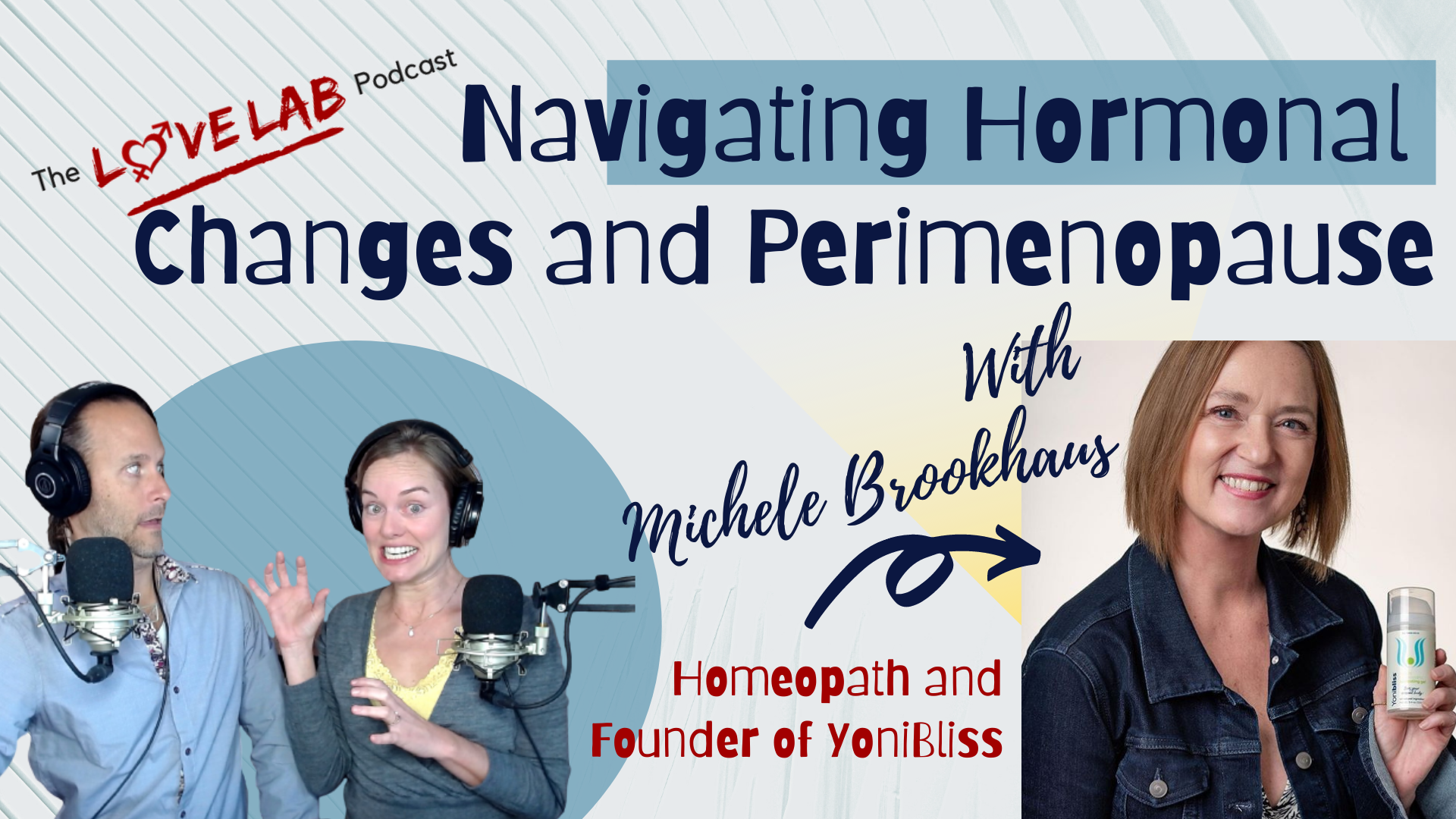
What You’ll Learn In Episode 131:
Do you know the difference between perimenopause and menopause? What are the signs to look for? What can women do to ease the transition? How can men help during this time? And what do both men and women have to look forward to after menopause (hint: awesome sex)?
All of these questions and more are discussed in this episode with Homeopath Michele Brookhaus. Even if you think you are too young to worry about this now, you should listen and make sure you are ahead of this life curveball.
Links From Today’s Show:
Michele Brookhaus is a Classical Homeopath, in practice for over 20 years. Her passion is women’s sexual health and healing. She created a homeopathic lubricating gel for women from this passion.
To find out more about Michele and purchase your Yoni Bliss natural homeopathic lube click the link below.
Don’t forget to use the coupon code LOVELAB for 15% off!!
Céline Remy 0:11
Welcome to the love lab podcast a safe place to get real about sex. Whether you’re a man, woman, single, or a couple, this is the show for you.
Céline Remy 0:20
We are your hosts, Kevin Anthony and Celine Remy. And we are here to guide you to go from good to amazing in the bedroom and beyond.
Céline Remy 0:28
Alright, welcome back to the love lab podcast. This is Episode 131. And it is titled navigating hormonal changes and perimenopause. All right, before anybody tunes out, because they’re thinking that they’re under 55 years old and not a woman, hang in there with us because this is a very important subject.
Kevin Anthony 0:52
One of the reasons we really wanted to do this show is because we have personally experienced multiple friends, who were very clear to us going through perimenopause, they had all the classic symptoms, which we’re going to talk about, and they were in 100% denial of it, we have a friend, we were telling her this for about three years before she finally realized that something indeed was going on and that she needed to address it.
Kevin Anthony 1:18
And as soon as she addressed it, she had major changes in her life. So this is one of those things that sneaks up on people. They’re not even aware that it’s happening. And it can have major impacts on the people going through it. their spouses, their relationships, their family life with their children, their physical body. I mean, it’s just the changes and the and the potential repercussions really ripple out through everything.
Kevin Anthony 1:47
So this is so important. Please stay with us, we have a special guest, we’re going to really dive into some really interesting things. And I’m willing to bet that most of the people listening to this do not know any of this.
Kevin Anthony 2:00
So just to give you some numbers, approximately 40 million American women are going through perimenopause, or transition right now, about to turn 38. And I consider myself going through this change already. Just to give you some indication markers of time. Again, it’s not something that happens when you like super much later in your 50s. It can happen early and it does happen sometimes 10 years before menopause really happens. And so it can be confusing for women, for men.
Céline Remy 2:34
And so today we have a special guest who is going to help to bring some light into the subject. Before we introduce our guests, let’s give a big shout out to our sponsor power and mastery. So if you want to join the secret club of men who are great in bed, then check out power and mastery at power in mastery.com. It is the most complete sexual mastery training for men.
Céline Remy 2:55
Whether you want to have harder erections last longer or increase your sexual skill, you will find something for you at power and mastery.com.
Céline Remy 3:04
Today we have Michelle Brookhaus. And she is a classical homeopath in practice for over 20 years. Her passion is women’s sexual health and healing. She created a homeopathic lubricating gel for women from this passion. So welcome, Michelle, to the love lab.
Michele Brookhaus 3:23
Thank you so much. I’m so happy to be here with you today.
Céline Remy 3:27
Awesome.
Céline Remy 3:29
Okay, so I just want to jump right into the questions because this is super fascinating to me. I made it.
Unknown Speaker 3:35
Yeah, it really is.
Céline Remy 3:40
Well, I made a statement at the beginning of the show that probably most people don’t know this information. And the reason why I say that is not to belittle the audience in any way. But it’s just an observation that we have from working with clients. And just from being in that age group.
Kevin Anthony 3:54
And watching our friends go through a lot of these changes in seeing that they really don’t have any idea what’s happening. So. So our first question is, most women don’t pay attention to the changes. They wait until it’s too late. So the question is, when should women start to pay attention? And what should they look for?
Michele Brookhaus 4:14
Yeah, I mean, that’s a really, really great question. And I think what makes it most difficult for women and men or anybody is that we don’t always know the soup we’re swimming in, you know, so we’re in this soup of hormones. And we’re, I mean, we’re in it. So it’s hard for us as individuals to sort of even notice the subtle shifts and changes in our bodies, and hormones affect our emotions. So much. It’s just amazing.
Michele Brookhaus 4:48
We have this sort of cocktail of hormones that you know, come up and actually can, like, navigate the waters of our emotions. So I think just being aware of emotions, maybe like you were saying, listen to other people, I think it’s hard for men because a lot of men often just sort of say to their woman or whatever, you know, you’re so hormonal, and that’s not helpful.
Kevin Anthony 5:18
You know, advice to men never say that to your woman. So hormonal, you’re likely to get something thrown at you.
Michele Brookhaus 5:31
Just never do that, because we are all hormones, I mean, and that’s just the long and short of it. And for women, it can start early, just like you guys were saying, it can start the mid-30s, it can start after the birth of a child. Because our hormones are so sensitive. And shifts can happen so subtly and be up and down. And there are so many things that can contribute to hormonal changes.
Michele Brookhaus 6:00
So I don’t know, it just takes some self-awareness. You know, when people start when women I mostly work with women start coming to me, I think we’re not always aware of our own bodies, our own emotions, even the waves that we’re on. So even to just begin tracking within yourself, whether you need to journal or whether you go, what’s my energy like today? What are my emotions like today, and then you can at least start to spot some of the potential shifts?
Céline Remy 6:32
So so one of your recommendations is to start kind of tracking what your emotions are like. So the first thing that women should be looking at is, are they seeing real changes in their emotions? Yeah,
Michele Brookhaus 6:45
I think they’re, you know, it’s funny, I was just talking to a man, I don’t know, last weekend, he was saying that his relationship broke up during perimenopause. And I think it’s possible that we women, when we get to this place, and things have shifted and changed and hormones make a difference in terms of pheromones, and how we’re attracted.
Michele Brookhaus 7:09
And then we can just cut things off. But, you know, tomorrow could be different. And the next day could be different, you know. So, yeah, I think there is really something about tracking emotions, for sure.
Kevin Anthony 7:22
So I’ve never taken any pills. My contraception method has always been to track my cycles with the temperature and checking my cervical mucus. And this is for a whole entire show that one day I’d like to bring on. But the gist of it is that I’ve been tracking myself for nearly 20 years now. So I think that’s why it’s literally like the day I turned 35 I started to feel a difference. And they were subtle. So some of the things that started to happen, I was noticing that I used to be very, very regular with my cycle.
Céline Remy 7:55
But then my cycle started to be either two days shorter, or two or three days longer. So it can kind of like shifting, it wasn’t just as consistent since I had been so consistent. And little things like the size of my breasts that started to be a little bit bigger. I noticed that now I started to put on some weight before I did anything I wanted and never show it.
Céline Remy 8:21
And suddenly I started to see that if I ate more than really was needed. It started to show especially on my mid area, I started noticing things like my chin and those lovely hair growing in places I did not walk them while the hair on my head started to slow down the growth of the ones I wanted, while the one on my face was like all over the place. And I was like what the heck yeah. And then just also noticing some, some little bit and this is like since I’m about to turn 38. So that’s three years in now.
Céline Remy 8:58
I notice all of this happened over these three years. Another thing I noticed was a difficulty with my emotions. While I’ve always been very balanced. I’ve never been somebody who’s been what you would qualify as hormonal or that I was PMS sing or anything like that. For me, it’s always been really good. But I noticed that there was a time where I had some brain fog, or I had a more difficult time dealing with anger or like stronger emotion, I felt more overwhelmed maybe faster.
Céline Remy 9:30
And so this for me was some of the little signs and then different again, changes in the breast where I started having some fibrocystic breasts. So all of this was telling me too much estrogen probably too low progesterone, I’m about to get all my hormones checked all the levels to have all the numbers confirmed in a couple of weeks. So I have all the answers. But this is like the journey of the where I’m on and this is what set me to say that I’m going through perimenopause, and I’m 38 and people think, Oh, this is like so early, it’s impossible.
Céline Remy 10:03
But this is a very slow, gradual little changes that people may not notice. They might just think, Oh, well, I’m getting closer to 40. And especially if you have kids you like it’s normal. I’m just more tired. And I’m like, No, this is all the different hormones. And then once I started taking some herbal remedies because I’m so early on, it still is a good time to do that. Things started to rebalance, like my moods, and the fogginess, all of this disappeared.
Céline Remy 10:31
So that’s how I knew I was on track. So I wanted to share all of this, because I’m hoping that whoever is listening is like, Oh, my gosh, I have that too. Oh, and I forgot the night sweats too. If you have night sweats, like crazy things with your temperature, these are happening a lot here. So this was my experience.
Céline Remy 10:49
And now I’d love for you, Michelle, maybe to share, of course, if you have anything to share with what I just shared, but also, why don’t you tell us a little bit about your journey, some of the signs and what it was like so those other women can understand and relate?
Michele Brookhaus 11:03
Yes, thank you. Thank you. And I mean, it’s amazing, I don’t think a lot of women like you have tracked everything quite so precisely. I mean, you are so in tune with your body, because you’ve been tracking for so long. And part of that is that whole fertility journey and the choices that you made with that. And, and that’s, that’s amazing, you know, a lot of women, and I did this too, in my early 20s just took the pill, you know, to sort of taking care of that.
Michele Brookhaus 11:32
But it didn’t take long before I realized it was that was not good for me, too, that messes with hormones, crazy, crazily, you know. And so, I was before I was a homeopath. And I sort of know better now, I mean, that’s a whole other conversation to let you know, we can really play with cocktails and hormones, and it can really mess us up, you know, so we have to be careful about how we actually supplement.
Michele Brookhaus 12:01
My journey was interesting, too, I don’t think I really recognized what the journey was going to be like, you know, even though By that time, I had been working with homeopathy and had had some amazing changes, even with other hormonal kinds of things, because I used to have Hashimoto’s thyroiditis, you know, so another hormone in the body that was not performing well. And with homeopathy shifted it.
Michele Brookhaus 12:31
So I think you can shift hormones in many different ways, herbal homeopathy, I think when you start supplementing with actual estrogen, actual progesterone, it’s, it’s such a direct hit, that it can be kind of crazy to navigate that. And so a little bit more observation needs to happen. And I think it can be done if it’s done early enough. Postmenopause, probably less so.
Michele Brookhaus 13:00
But my journey was, I mean, I noticed my I didn’t take anything, I just did whatever, you know, I just went through the whole process on my own with some help with homeopathy with a little bit of help with some herbs and things like that. I was blown away, just blown away by the experience of going through, you know, the perimenopause and menopause process. Initially, it was like you said a little bit. My periods weren’t as regular there was a little bit more pain, and I never really had any pain. So that was an interesting thing.
Michele Brookhaus 13:41
When I had hot flashes I used to do I can’t do this anymore, because we’re none of us are doing this during COVID times I used to do Bikram yoga. So sweating, you know and I did it for 10 years and I was an efficient sweater. So when through perimenopause and menopause, when I had a hot flash, I could put my arm on the counter and leave a pool of water. After he was just like, amazing, it’s just amazing, but it was to just see what the body can do. And luckily, I didn’t have night sweats, you know?
Michele Brookhaus 14:22
So again, we’re all different and I think that’s the other thing about going through this process is it every woman is different. Every woman is different. We’re gonna have slightly different symptoms that come up. I actually had a frozen shoulder too, which I now believe was part of that whole process. First I used to dance to another thing I can’t do anymore.
Michele Brookhaus 14:47
And I thought it was being yanked I thought my shoulder just got yanked by you know, particularly aggressive partner something and something got to hold but this frozen shoulder Then moves to the other shoulder. And I’ve heard since that other women have had this too seems like a weird symptom, but it could be part of the whole parent perimenopause, menopause experience as you’re making those shifts and changes. So I actually quit leading when I was 51.
Michele Brookhaus 15:21
And I actually, I kind of grieve to the whole process. I know a lot of women are, can hardly wait till they’re done bleeding. But there’s just a whole other shift that happens with hormones when you’re done bleeding, you know, it’s, there’s less estrogen, less progesterone. So you have to find a balance in your emotions in a different way, in a way, is kind of what I believe. And I think it can be done.
Michele Brookhaus 15:55
For sure, because I, I now, almost 60. And so I’m 10 years beyond so my birthday is this month, and now I’m 60. So 10 years, no, you know, no period, no bleeding, it’s been blessed in so many ways, and have gotten through all of those symptoms. So it’s almost like, we have this. It’s like a rite of passage, you know, we talk about young girls, you know, when they start having their period, that’s a rite of passage.
Michele Brookhaus 16:26
And maybe we don’t celebrate or recognize that enough, but we certainly recognize that there are lots of shifts and changes. For girls emotionally, it’s the same for us. We’re going through another shift rite of passage. And it’s almost like, you know, it’s, it’s like going through something hard to the light at the end of the tunnel.
Michele Brookhaus 16:52
I don’t think we have a great appreciation for women postmenopausal and that wisdom, or crone energy, but I have a feeling that we’re because we’re all living longer. This is the next step. Because there’s a lot of freedom and fun and everything once that hormonal shift balances out again, on the other side,
Céline Remy 17:13
we’re gonna get to that because that’s one of our questions later on because we want to leave people on a high note.
Michele Brookhaus 17:20
But we won’t get here too soon, right.
Céline Remy 17:24
Slow down. Now, I wanted to come back to one thing that you were saying. That became very evident when both of you told your stories, which is that you didn’t have the exact same symptoms, right. As you need, like you accurately said, it’s gonna be different for everybody. Your first piece of advice was to, you know, journal or keep track of those things.
Kevin Anthony 17:49
And I think it’s really important that advice becomes more important when you understand that it’s not just a set of 123, like, oh, here I met the requirements, boom, that’s it when you realize that it’s a different journey for everybody. And that there is a collection of symptoms that you may or may not experience to different varying degrees. It’s not all that clear cut.
Kevin Anthony 18:12
Because of that, I think that tracking that journaling and, and being more aware of these things will be so much more helpful, because you can’t just say, Oh, I got a cough and a runny nose, I must have a call, right? It’s not that clear.
Kevin Anthony 18:27
Right. And I also think about establishing the connection with yourself and trusting yourself because I think you know, as a woman when something’s off, and don’t let other people tell you that it’s all in your head if you know something’s off, find support find other women find a homeopath like Michelle, like whatever your path is, find somebody who can support you and help you find a balance of what feels good and normal to you. Because you know, that something is off. So trust yourself on that.
Michele Brookhaus 18:59
Yeah, I agree.
Kevin Anthony 19:01
I want to take this now to the sex life because, you know, that’s what we love to talk about a lot. And so, how all of this like crazy hormonal changes is affecting people’s sex life. What do you see going on for the women going to seek help from you? Yeah,
Michele Brookhaus 19:22
I mean, that absolutely is a big shift and a change for a woman to and ups and downs with it, you know, and there’s definitely some vaginal changes. For sure as a woman goes through perimenopause and menopause. I mean, the actual labia start to look different. And I don’t even know if women are aware of that, you know, or men either.
Michele Brookhaus 19:50
But, you know, it’s like there are actual physical changes that happened down there. Then, the lining of the vagina canal can spin It’s a little bit more delicate, it actually invites, like slow sacks. And there is this place where it’s important to really slow down at times. And because it’s not like women can’t get lubricated, they still can.
Michele Brookhaus 20:20
It just may require a different approach for a while, maybe always, but I think there’s this place of, of heart connection, maybe that we begin to appreciate more. And I think even as men get older, they can start to appreciate that too. But there are a lot of changes that happen in that area. But I don’t think it means that sex is over by any means.
Kevin Anthony 20:46
How about libido? Like, what do you say, and again, because in my research, I see that some women will lubricate more, some women will lubricate less, some women will experience pain during intercourse, some women will be totally fine. Some women as soon as they go through menopause, have the best sex ever because they don’t have the fear of being pregnant anymore. Some women find that they have high libido hours, like super low libido.
Céline Remy 21:10
So I feel like again, it’s all over the spectrum. And there’s not like one recipe for everyone. But would you say also that there is a change in libido that you see kind of like, either way, that it can go up or down? But there’s something shifting? Have you seen that as well?
Michele Brookhaus 21:28
Absolutely, absolutely. I do really feel like women have those changes? I mean, some women start with low libido. And so going through this shift, I mean, I guess it depends on what the low libido is about. You know, it’s like, sometimes it’s purely hormones, that’s driving a libido. Sorry, um, sometimes it’s actually the connection that you have with someone I mean, I actually do really feel like we can stimulate libido.
Michele Brookhaus 22:00
You know, it’s just a matter of like, how, what’s my connection like, with this person with my partner? What kind of communication? Do we how are we able to articulate what’s actually going on without fear of judgment? Because I think anytime you get some of that clashing judgment about what’s going on, it’s like, oh, you’re not the same as you used to be? Well, you know, we’re either growing or dying. So we’re never going to need a thing. So let’s navigate all of those changes.
Céline Remy 22:34
Yeah, absolutely not. That’s a really interesting point that, yes, there are hormonal changes going on. But there are other things happening that maybe are contributing more to it. Right. So you, you mentioned earlier, somebody that you knew that actually ended up getting divorced during perimenopause. And that is not an unusual thing.
Kevin Anthony 22:55
Now, is it? Because, oh, I’m not getting as much sex as I used to? Or is it because you know, any of the physical changes maybe but most likely not, my guess is most likely what’s happening is they’re not relating well, anymore, right. She maybe is having a lot of different emotional changes due to the hormonal changes. Maybe she doesn’t know how to deal with those. So she’s not acting in a way towards her partner.
Kevin Anthony 23:21
That’s, that’s, you know, very loving and kind. He’s on the other side, taking offense to everything that’s happening and not understanding that she’s going through these hormonal changes. And then he’s firing back, right. And so now you’ve got this constant. How you gonna, how you gonna get any sort of libido going in that type of a situation.
Kevin Anthony 23:41
You also forgot the scenario, Kevin, where finally the woman is finding her voice, and she’s no longer willing to put up with the crap that she’s put out all this time. And she’s putting her foot down and she’s saying, I don’t want this crappy sex anymore. You haven’t loved me, adored me. And like, do these things that really make me feel like the beautiful queen that I am or I’m going to get a man who does?
Céline Remy 24:09
Yes, that is well, that that is another thing where it may be If a woman has been repressed, she’s finally like, Alright, I’m done with this shit. Yeah,
Kevin Anthony 24:16
I think physiologically speaking, you can’t hold it back anymore. Because it’s like, that’s what perimenopause does,
Michele Brookhaus 24:22
actually, because there’s more testosterone. Women, we actually can feel I mean, if we’re gonna keep on with this whole chemistry, place of it, there is more testosterone because we’re not being ruled so much by the estrogen and progesterone. And if you think about it, testosterone is that masculine, go for it, and I’m going to tell it straight like it is. You know, they’re getting a dose of their own medicine and maybe not like
Céline Remy 24:50
Yeah, but here’s the interesting thing about that. I’m really glad that you brought that up because as men get older, their testosterone levels are going down. So now women are getting Older their estrogen levels are going down, their testosterone levels are going up. So we talk a lot on this show about polarity, about how you need to have that polarity in a relationship.
Kevin Anthony 25:11
So what you’re actually seeing here now is you’re seeing that polarity becoming unpolarized. As he becomes less testosterone dominant, and she becomes more, and they start moving more towards the middle, and now you’ve got clashes. Right? Exactly, exactly.
Michele Brookhaus 25:27
And I don’t think that’s the end of the world. But it’s great to know that that may be hormonal II, that’s exactly what’s happening. But I agree with you, I do believe there needs to be a polarity. So how do you create that polarity? in other ways, you know,
Céline Remy 25:41
for sure. And you know, I would, I would suggest because this is the stuff that we teach all the time when it comes to polarity. But if you notice that that’s happening, as a woman, you try to do your best to relax into your feminine and as a man, you have to do your best to step up your game and be that strong masculine that she wants and needs. Mm-hmm.
Kevin Anthony 26:00
So now that we’re talking about the men, it’s a perfect segue into the question about how do you think a man can help a woman going through the hormonal changes?
Michele Brookhaus 26:11
Oh, that’s a great question. I mean, really, wouldn’t it be nice to have someone to help you go through that rather than be combative with you,
Céline Remy 26:21
I told them when they needed to listen to this show, this is guys, this is gold right here, turn everything off and listen to this.
Michele Brookhaus 26:31
It’s a dance, I think there is this maybe just remembering that you’re in a dance with your partner. And, and maybe she is trying to lead a little bit at times. And so either I like what you said, like coming up more strongly, you know, holding that masculine in a stronger way. So that you can invite her to sort of relax a little bit, or maybe allowing that sort of that testosterone or that masculine in her to come up and then just move with her with it.
Michele Brookhaus 27:09
And I think I mean, this is, okay, this is a, there’s a fine line here with this. So just take some of this with a grain of salt. But giving some feedback, I mean, but I think you negotiate that ahead of time that it’s okay, I just want to give you some feedback about what I’m experiencing about your emotions right now.
Michele Brookhaus 27:29
So maybe just actually create a partnership, and she’s navigating all these hormonal changes, like go into partnership with her. If she’s keeping track of her emotions and things like that, you can, you know, invite, you know, ask her to invite your feedback about that, Oh, this is how I’m experiencing you right now. How are you feeling? You know, so I do think that there’s a way to support a woman through this.
Michele Brookhaus 27:59
Then we can feel held, you know, there’s something about being held in all of that, because it’s kind of crazy-making at times, really, really, it can be. I think that men actually recognize that all the time. When a blanket statement that I don’t think men really recognize that they have an expectation of how they have been with their woman experienced their woman, they, man, I think generally, if this is general, broad strokes don’t always like change. This is actually an invitation to change, you
Céline Remy 28:38
know, so absolutely, you know, as as a man, because we are generally very stable in our hormones. And the changes that we do experience are slow and subtle, generally. So it’s, it is really hard for us to understand what it is that you as women are going through. And so yeah, that piece of advice really is to try to be more compassionate and understanding. And that’s a challenge for a lot of guys.
Kevin Anthony 29:11
Because like, what, what the hell, I mean, just yeah, doesn’t make any sense to us. We want to pull our hair out and be like, what the hell is going on? Right? But you really, yeah, you really have to take a step back and have some compassion and realize that this isn’t just because she’s a bitch, or, you know, she wants to be that way. In fact, a lot of times women are like, I know, I’m being this way and I don’t want to be this way, and I can’t fucking change it. Like that’s the feedback that a lot of women have.
Kevin Anthony 29:43
And I also wanted to add the piece about the sexuality that if your woman is asking for something different, like please pay attention, like the slowing down in the lovemaking, maybe more foreplay, maybe some more gentle, maybe less genital focused intimacy and More hard focus, give her if you want your sex life to stay thriving, give her the kind of sex she wants and needs so that she’ll seek it and wanted.
Céline Remy 30:11
Otherwise, if you keep doing the old way, she’s gonna stop, and you’re not going to get any. And then the relationships going to take a big nosedive, not in a rush in the right direction. So remember that it’s really important, and just to be willing to try new things. And it doesn’t mean you’re a bad lover.
Céline Remy 30:30
As Michelle said, sometimes we do have the defending of the tissues that make it that we more, we have more pain or discomfort during the lovemaking, but doesn’t mean we’re not attracted to you, we’re not loving you, we’re not wanting sex, it’s just the body’s working differently. So we’re not working against that we’re working together towards that common goal of that connection and that intimacy.
Michele Brookhaus 30:54
You know, it’s a, it’s an amazing invitation. Actually, if you think about it, because we have so many erogenous zones, a woman’s body is full of them. And if you’re used to sorting of doing the same thing over and over, especially when you’re younger, and you start this relationship, like this becomes an invitation to go, Well, what happens if I just caress her neck? For a little while?
Michele Brookhaus 31:19
I mean, there is, I mean, there could be such fun in this exploration in this new phase, you may find some things out about each other that you don’t know, at all, some things about her and her body. See, I mean, I think the best advice is just to be curious, you know, we can keep our curiosity up about our partner, whether it’s about what’s going on in their body, and always this spot, a great spot.
Michele Brookhaus 31:48
I mean, whatever that is, it is an open invitation for the relationship to actually grow and intensify and maybe sex becomes better than ever.
Céline Remy 31:59
Oh, we’re going to get to it. That’s our next question. So first of all, I want to tell the men listening, pause the show, rewind, listen to that, again, maybe two or three times if you have to. And then we do want to jump in because that really is like, Okay, what do you have to look forward to. But before we do that, I know we have one last sponsor we need to get
Kevin Anthony 32:21
Yes, we want to thank Onnit for sponsoring today’s show. And on it has a lot of different product. But today we want to talk to you about alpha brain. And alpha brain helps you to get into the zone into that flow state.
Céline Remy 32:38
You know, those days when you’ve closed the big deal, won the game made love for hours checked everything off your to-do list, and it was effortless, and it just flowed. That’s what it feels like. And this is when you have optimal levels of consciousness where you can perform at your best. Now you can use things like alpha brain to help you achieve that flow, state, and support other aspects of cognitive function for better memory focus and mental processing.
Céline Remy 33:04
So if you go to onnit.com, and use our coupon code love lab, you will get a 10% off any product that you order. But check out alpha brain to help you remember names, focus on a complex task, reduce stress, react more quickly, and protect your brain and mental clarity. So go to annie.com and make sure to use our coupon love lab at the checkout.
Céline Remy 33:28
Alright, let’s talk about what people can look forward to. So I can men and women look forward to post-menopause. So we’ve talked about the apocalypse, we’ve talked about this crazy ride that you’re going through. Now, what can you look forward to afterward?
Michele Brookhaus 33:49
Well, I do think that we can look forward to an amazing and fantastic sex. I mean, that’s what this is about rage. And really what Yoni bliss was about to, you know, it’s like we can there are tools that we can use because there is something about our connection with the other sexually that actually Bond’s us. I mean, we can talk about those hormones, the oxytocin, you know, that, that comes from connecting in that way.
Michele Brookhaus 34:21
And yeah, and maybe it just allows us to be more creative too. And I know, you know, there’s, there’s the science around the cervix. I don’t know if you guys talked about the cervix, or even, you know, energetically the tip of the penis and the tip of the cervix. I mean, that is heart-opening places, you know, and if you slow down, so the surface cervix requires a lot of slowness.
Michele Brookhaus 34:49
So I mean, slowing down, then becomes this incredible invitation to whole-body orgasms, you know, so I think there’s something About post-menopause. in that zone, men have maybe a little less testosterone, they can slow down. I think this is an amazing invitation for couples for men for women to actually have the best sex of their life.
Céline Remy 35:19
So if you had to compare your pre-menopause sex with your post-menopause sex, what would you say is the biggest difference?
Michele Brookhaus 35:29
Um, post Yeah, post-menopause sex. I got some amazing, amazing post-menopause sex. But it’s, I think it’s less fear of getting pregnant because I think we didn’t even really talk about that. But for women, pre-menopause in perimenopause, you know, there’s always this, do I want to tell do I not want a child I mean, there’s all of that kind of thing going on too.
Michele Brookhaus 35:57
There’s a lot more chaos, I’ll just say chaos and you know, Perry, postmenopausal the chaos is gone, you know, there’s, there’s, it’s just like, let’s get clear about what I want here. And then being courageous enough to ask for it, and have a partner that you can communicate with about that.
Kevin Anthony 36:22
All the great recipe for great sex, the communication, the confidence, and just taking the time to be in your body, I’m going
Céline Remy 36:31
to write a new blues song instead of the thrill is gone, it’s gonna be the chaos is gone. That’s gonna be a happy blues. The Chaos is gone.
Kevin Anthony 36:43
So I know that you’ve created a product called the uni bliss loop that can help women and men and couples with their sex life. So how does the Yoni blaze loop fit into all of this? Maybe if you could tell our listeners a little bit more about this and why it’s a good time to bring it into their lives? Yeah,
Michele Brookhaus 37:07
Yoni bliss kind of came from both my own experience and work with women. And of course, I’m a homeopath. It’s water-based. It’s so it’s and the idea behind it when I first created it is I wanted something very simple. That had some slide to it for women, because because of that dry tissue, we like we need a little bit of that. And so the seaweed is part of that. But the remedies are also really helpful. And this is probably the only lubricant on the market that has homeopathic remedies in it.
Michele Brookhaus 37:44
And nature muriaticum emotionally energetically is about holding on, and letting go so that we’ve got this and women, as you probably know, have this tendency to hold on, we can hold on and not let go. It’s about water tissue balance to nature. muriaticum is actually simply salt, the energy of salt, not salt in the lubricant. I want to be clear about that because that’s not how homeopathy works. But it’s also so it’s about holding in tears, too.
Michele Brookhaus 38:16
So nature muriaticum is this grief remedy. And I think women whole have a tendency to hold on to a lot of grief in this pelvic floor, that general issue for a variety of reasons, whether it’s sexual trauma, whether it’s traumatic births, I mean, there’s all sorts of reasons it could be what we’re carrying on from our generations, but to be able to let go of the grief.
Michele Brookhaus 38:41
Because when we can let go and open up, then we’re more receptive to the masculine, and then that that camomile is just soothing because we can be often irritated. And if you think about drinking chamomile tea, it’s just soothing. It’s calming. And so there is this sense of just allowing a little bit more calm, less irritability, some ease. So it’s a simple water-based lubricant with a couple of homeopathic ingredients. Yeah.
Céline Remy 39:11
Yeah, I would love to point out to you know, the discussion that we’ve been having is really around perimenopause and menopause. But as I’m listening to you describe the ingredients that are in this. And I know you of course, already knew this. I hadn’t really thought about it just because of the subject matter of the show.
Kevin Anthony 39:28
But there are a lot of other potential applications for this not just women in perimenopause or menopause because you’re saying trauma, you know, whether they’ve been abused physically, or they’ve had childbirth or whatever it is like there’s a lot of other possible uses for this that could be incredibly healing for women of all ages.
Kevin Anthony 39:47
Yes. So I’d say for any woman who finds that she’s not lubricating the way that she wants to or experiences a little bit of discomfort, trying to just add some lube and knowing that this is like a bomb. For your vagina, because it’s got the medicines, and it’s got natural ingredients, it doesn’t have all the junk that so many other lubes have, because you got to remember whatever you put on your skin, and especially inside your vagina gets absorbed, her body’s absorbed everything.
Céline Remy 40:16
And you don’t want to be absorbing like petroleum and all the stuff that’s in all the ever junky things. So think about this as like, it helps you feel good at the moment, but he’ll you also on a different level. So I think it’s really a beautiful product that you have for all the women and couples out there to make sex more enjoyable again, and, and again, if once you take the pain away, it makes it so much better.
Céline Remy 40:46
Sometimes in our relationship when I was younger, I was in another relationship where we had certain things that weren’t always compatible. I wasn’t always listening, but my person you and I weren’t lubricating the way I needed to. And I was so young, and I was thinking what’s wrong with me, it shouldn’t be. But really, it was a symptom of something more that was happening in the relationship because you know, our bodies know.
Céline Remy 41:10
But what I want to say is, even though I was in my 20s, like, I used lube, and it worked really well. And it still helped us to be able to keep having sex with taking the pain away, which was amazing because nobody wants to associate pain and sex together. Absolutely.
Michele Brookhaus 41:27
And you know, you may need loot today and not need it tomorrow. And I think that’s the only thing. I think we have resistance to using tools and even lube. And I’ve heard it many times and actually a lot from men. It’s like, Oh, she doesn’t need lube. If I’m doing my job. And it’s like, Well, not really true, you know?
Céline Remy 41:47
Correct,
Michele Brookhaus 41:48
necessarily. And besides, why not inform it can be a lot of fun. It can actually extend lovemaking if you can utilize it. I think there’s less stigma about using lubricants now than even 10 years ago. But, you know, then there’s a lot more of them to choose from
Kevin Anthony 42:06
you. Absolutely. So you have we have a coupon also love lab, it’s always our coupon for all of you listeners who want to get a bottle of the unit blaze lube. And Michelle will tell you later like where to go get this we’ll have the link in the description too. But remember, if you get a user coupon love lab, you’ll get a 15% off your purchase of a Yoni bliss lube. And before Michelle tells you where you can get it, we have to ask you our very last favorite question. We all want to know what is your best sexual talents
Michele Brookhaus 42:43
I love it. I wasn’t expecting that.
Michele Brookhaus 42:52
what’s my best challenge? My best sexual? My best sexual?
Céline Remy 42:58
Yes, it is.
Michele Brookhaus 43:06
Wow.Wow.That’s a great question. You know, I’m gonna say for myself the best talent for me. The benefit for me is that I’m quite sexually I have easy orgasms, I’ll just say that. And so I have favorite ways to get there. But it’s really nice to sort of get the juices going quite quickly. And so I’ll say that’s my challenge
Céline Remy 43:38
comes easily and quickly on demand
Michele Brookhaus 43:43
It can be over quickly or long.
Céline Remy 43:48
There’s multiple of those you know,
Céline Remy 43:50
that’s the beauty of being a woman right is you have as many as you want. Keep going till you don’t feel like going anymore. Man,
Kevin Anthony 43:57
this loop is working. You cleared out all the trauma from your pelvic floor and now you’re rocking those orgasms. tell our listeners where they can hear and where they can find more about you where they can follow you and of course your website where they can get their uni bliss.
Michele Brookhaus 44:13
Beautiful. Yes, my website’s Yoni bliss.com yonlss.com that’s where you can find the lubricant you can find different articles about why does my lube burn or you know different things like that. Instagram is my Yoni bliss, so you can follow me there and then YoniBliss on Facebook as well. And if you want to talk if you want to just connect with me, you can just do Michelle at Yoni bliss and Ellie, wonderful. Thank
Kevin Anthony 44:43
you so much, Michelle. We highly recommend that you all check her out get a uni blue slip for yourself. Yeah, just it’s good to have somebody like Michelle in your back pocket whenever you need some support and some help in going through hormonal changes. Thank you for being here today with us for the conversation.
Céline Remy 45:04
There were a lot of gems in here and hopefully all of you listening were inspired. Remember, there are lots to look forward to after the chaos.
Céline Remy 45:19
All right, thank you again for being on the show. You’re welcome. All right, everybody. That’s all the time we have for this episode. And we will see you next week.
Céline Remy 45:34
We hope you liked this episode of the love lab podcast. If you enjoy this show, subscribe. leave us a review and share it with your friends.
Kevin Anthony 45:42
And for more free exclusive content. Join us in the passion vault at kevinanthonycoaching.com/vault.
Kevin Anthony 45:56
Thanks for listening.
Céline Remy 45:57
And remember, you’re amazing
We hope you liked this episode of The Love Lab Podcast. If you enjoyed this show, leave a comment and share it with your friends.
RATE & REVIEW THE LOVE LAB PODCAST
—> LEAVE A 5-STAR REVIEW ON APPLE PODCAST
ASK A QUESTION FOR THE NEXT EPISODE
—> Click here to leave a message directly to Kevin and Céline to be answered on the air.
Thanks for listening and remember you are amazing.

Kevin Anthony and Céline Remy are an international husband and wife team who joined forces to create a worldwide movement of true sexual empowerment. Kevin, “The Truth Warrior,” is a Men’s Coach, Tantra Counselor, and Couples Relationship Coach. Céline, “The Intimacy Angel,” is a Holistic Sexologist, Certified Sexological Bodyworker, Relationship, and Intimacy Coach for men, women, and couples. Together, they are truly the ‘Power Couple.’ They host ‘The Love Lab Podcast,’ and are co-creators of ‘Power and Mastery,’ an online educational training system that teaches the exact process to any man who desires to bring his ‘A’ game consistently to the bedroom. They guide couples and men on how to go from ‘good’ to ‘AMAZING’ in the bedroom and beyond.