Kevin Anthony 0:00
Welcome to the Love Lab podcast, the place to be for honest and real talk about relationships and sex, whether you’re a man or woman, single or a couple, this is the show for you. I am your host, Kevin Anthony, and I am here to help you have the relationship of your dreams and the best sex of your life.
Kevin Anthony 0:26
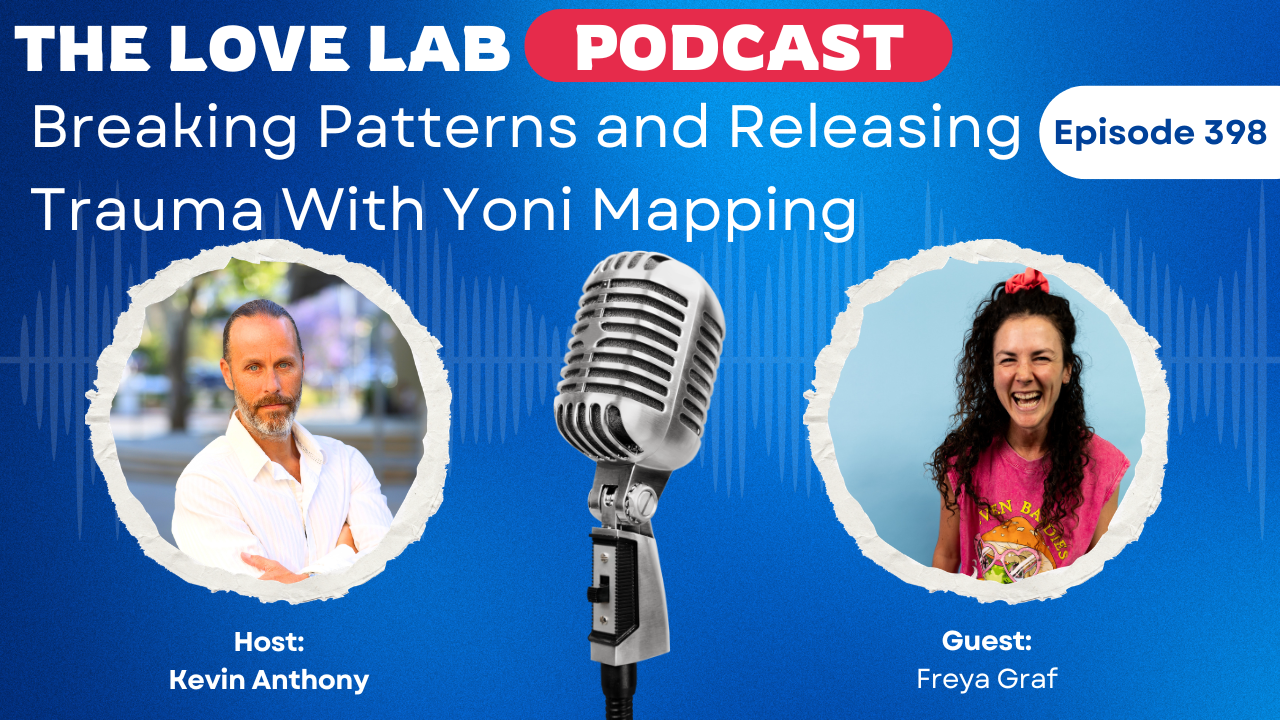
All right, welcome back to the Love Lab podcast. This is episode 398, and it is titled, Breaking Patterns and Releasing Trauma with Yoni Mapping. So we’re going to talk a little bit about Yoni mapping today. If you’ve never heard that term, don’t worry, we will explain it to you. We’re going to talk about what it is, what it isn’t, why it might be helpful. If you’re watching this on YouTube, you can see that I have a guest today, and she’s going to tell a little bit about her own personal story of how she came into doing this work, and you know how it has really changed her life as well, which I think is kind of, you know, important, like, you know, if you’re gonna, if we’re explaining to you a new modality that might be able to help you heal something, it’s kind of good to know that other people have used it successfully to heal. So we’ll hear about that story, I think you will find it very interesting.
Kevin Anthony 1:24
If you’ve been listening to this show for a long time, if you’re like one of the old school listeners when Celine, my wife, was here with us, you probably remember that she did some of this work as well, and she used to talk about it every once in a while, but it’s been a long time since we’ve covered this on the show. So if you haven’t heard it before, for sure, stick around. And if you have heard it before, you’re gonna hear a little bit of a different take on it, I think, today.
Kevin Anthony 1:49
But before we do that, as always, we’ve got a couple of ads to read here. Men. Life is too short to fall short in the bedroom. In today’s day and age, it is no longer acceptable to be mediocre at best, or even worse, if you’re struggling with erectile dysfunction, premature ejaculation, ejaculation control, or poor skills in the bedroom, then power and mastery is for you. This three-course program will have you rise to the occasion every time, last as long as you want, and wow her with your skills in and out of the bedroom. Join the exclusive club of men who have taken charge of their sex lives by going to https://www.powerandmastery.com/sexual-mastery. That’s https://www.powerandmastery.com/sexual-mastery.
Kevin Anthony 2:35
And ladies, I have something for you as well. You know, after so many women commented on my viral video titled What men consider a good blow job saying they didn’t know that’s what men really wanted, I created the blow job Mastery program. I teamed up with Coach Ry Duong of Eternal Love to create a program designed to teach you exactly what will drive your man wild and make him look at you like the goddess you are. This program gives you step-by-step guidance and includes multiple live demos to show you how to master the techniques. He will never look at you the same way again. Go to https://www.sacredfemininearts.com/bjmastery. That’s https://www.sacredfemininearts.com/bjmastery.
Kevin Anthony 3:19
And since they’re sitting right here on my desk, I wanted to show you my T-shirts. More orgasms, less wars. That’s the men’s version we got. We got softer colors for the ladies as well. Come on. There we go. More orgasms, less wars. Who can argue with that message? You can find those on my website, KevinAnthonyCoaching.com
Kevin Anthony 3:47
All right. My guest today is Freya Graff, and she is a holistic sex educator, coach, and Yoni mapping therapist with a passion for dismantling shame, stigma, and taboo. She keeps it real, raw, and relatable when it comes to talking about sex, relating, and bodies, and is on a mission to educate, empower, and normalize these important topics by having open and vulnerable conversations about them. Across her work with clients, her online courses, and on her hilarious podcast, the labia lounge. Welcome to the show. Freya.
Freya Graf 4:24
Thank you so much. Awesome to be here.
Kevin Anthony 4:27
All right, so I mentioned in the intro that you had sort of a personal story around this work, and I thought it might be nice to start there, because we’re going to be talking about something that, depending on how women view it, might feel like really vulnerable having somebody do this kind of work, like, Would I really want to open myself to that? And so maybe starting with your story about how you came to be doing this and the effect that this work had on your life, might. Kind of start us off by sort of setting people at ease a little bit. So tell us a little bit about your story.
Freya Graf 5:07
Yeah, totally. If you are one of those people who hears about journey mapping therapy or genital based massage and sort of thinks, God, I could never do that 100%, that was me. I would never have, in a million years, predicted that I would wind up doing this work as a professional, let alone trying it personally. I was very, very shut down sexually. I was riddled with shame and self-consciousness. I couldn’t be naked in front of, you know, partners that I’d been with for years, it was a really crippling state to be in with regards to my body and my sexuality, and so eventually, when I started getting into personal development work and working on my my sort of beliefs and things that were limiting me and holding me back in my life that gave me such a sense of, you know, progress and empowerment and liberation that I got on this, you know, self development tip, and started going to all the workshops and all the trainings and getting really addicted to personal development, right?
Freya Graf 6:19
It’s a little bit of a common trajectory, once you get a taste for how powerful that can be and the fact that you can take matters into your own hands. And so after a couple of years of that, I was really noticing so many positive changes in my life and feeling quite, quite a boost in my confidence, because I’d tackled a fair bit of limiting stuff that had been impacting me a lot, you know, my mental health, my relationships, things like that. And so I thought, Okay, final frontier, this whole sex thing, this whole nudity thing, this whole body pleasure, genitals thing. I’ve really got to have a look at this, because I can’t keep living like this. It’s a bit of a nightmare in my relationships. It’s impacting my confidence. It means that, you know, whenever sex comes up in conversation, in a room, I just go quiet. I get read. I can’t say the word sex or pussy or cock, like I’m so shut down and crippled by this, and I’m terrified everybody’s noticing. I know in my partnerships, it’s just really, you know, negatively impacting me. I’ve got to do something about it.
Freya Graf 7:30
So I got up the courage to start exploring sacred sexuality and Tantra, and going to sort of sex education events, talks, and workshops, and working on that for myself. And then after a couple of years of that, just really smashing through so many, so many obstacles and hang-ups that I had, I got really passionate about studying it and helping other people do that too. And that’s when I found just when I was thinking, okay, how can I make this something that I actually do professionally, like, what training can I seek out? What can I sort of find? And I’d done some sessions in different practitioner trainings around Yoni massage, and then I found Yoni mapping therapy, which is a specific modality, with a very similar name to a lot of other modalities that are not specifically the same. There’s some overlap, but, yeah, just want to differentiate this particular modality journey mapping therapy, because it’s a lot more, not that, not that.
Freya Graf 8:38
Other ways of practicing aren’t always credible, but I was drawn to this because it was, you know, I was able to be accredited as a practitioner and to get insurance and to be registered by boards and things like that, which for modalities that involve Yoni massage or internal vaginal massage. That’s quite rare, and there’s a lot of cowboys out there, a lot of pretty poorly trained and unqualified people saying that they do this modality. So I sought out this training. I ended up obviously receiving a lot of this type of body work and doing a lot of these sessions throughout my training with other practitioners, and the rest is kind of history.
Freya Graf 9:18
But I just remember being so blown away that it was even accessible to me, impossible for me to overcome the shame and the fear and, you know, the tremors that would come through my body. I would have trauma responses, basically around things like genital touch, and so when I think back to where I was and how far I’ve come now, what a large role this type of work played in it, it’s quite amazing, and that sort of is what fuels me to pursue this type of work, because it just had a completely life changing impact on me.
Kevin Anthony 9:59
Yeah. And that’s why I really wanted you to talk about it, because, you know, you can hear when you’re describing the impact that it had on you, like you can feel that shift and that change, right? And I think that was just such a great place to start, because as we start to get into what this work is a little deeper, you know, I think people now can look at it from a different point of view, right to see that? Oh, wow, this, as you said, this isn’t just some weird, crazy thing that some poorly trained person is doing, and how is this really going to help me? And isn’t this just about somebody wanting to touch my genitals?
Kevin Anthony 10:33
And, you know, like, here, here you are with your real life story about, wow, I was really shut down, like I couldn’t even talk about it, like people would talk about sex, and I’d start sweating, you know, like, literally, and then to find this, go through it and completely shift that. Now, not only are you doing this work, but you’re here on a podcast that lots of people will hear talking about. I mean, they think, I think, I don’t know how many times you’ve already said the word sex, like, think about what a drastic shift that is from where you were. So I think that’s really beautiful, first of all, and I think it’s great that you’re modeling that to people, that you can actually make that shift in that change. Because I think there are a lot of people who are exactly where you were, who are really stuck with that, and they’re not sure what to do about it.
Kevin Anthony 11:26
And you know, you mentioned something else that I think was really interesting. You’re like, I’m doing all this personal development work, and then after like, all this other work that you’ve done, you finally were like crap. Now I have no chance, no choice but to confront this thing that I’m avoiding. And I think a lot of people do the exact same thing. They don’t want to look at the sex stuff, and they think they can just compartmentalize it, put it over there by itself, and not worry about it. And if I just read another Tony Robbins book, everything will be fixed. No. Dig on Tony. Tony’s great, but, you know,
Freya Graf 12:04
No, I totally agree, and it was pretty essential for me to follow that trajectory in terms of what I focused on when I did start working on this stuff, because I just needed to, I needed to build my confidence up, and I needed to tackle the low-hanging fruit before I approached the sexuality stuff, because it’s big, you know. And some people will say that they’ve found my podcast or my website years ago, and it’s taken them this long to build up the courage to send me an email, you know, and then it might be another six months before they’re ready to actually book in and have a session.
Freya Graf 12:36
And it is really big stuff. It’s very confronting. It takes a shit ton of courage to actually start looking at this, let alone come and have a session with a body worker like me that does that sort of work. Or, you know, even I do online sex coaching and education packages and like, for some people, just talking about this stuff with another human that might be the first time they’ve ever done that. And so it’s, you know, it’s not for the faint-hearted. It’s so worth it, but it might take a bit of a run-up, and that’s so okay, because for most of us, we put this in the too-hard basket for as long as humanly possible.
Freya Graf 13:12
But I think, you know, it gets to that point for a lot of people, as it did for me, where the discomfort of staying where I was was actually larger than the discomfort of actually rolling up my sleeves and tackling it. And it just became, you know, it wasn’t an option for me anymore to keep living the way I was living, because it was fucked. You know, it’s really rough, and so many people are in that place. So yeah, very inspired and very passionate about helping people, because now I know it’s actually possible, and I don’t, I don’t want to sort of be like, Oh, if I can do it, you can too, because I think that that’s a little bit too, like, there’s no nuance in that, and that’s obviously not taking into account so much of the intersectionality and the different factors that everybody is facing that’s unique to them.
Freya Graf 14:04
However, I do feel like I’m in a unique position to help clients who have been where I am, because I get it and I actually know what worked for me and what’s worked with lots of other clients. So yeah, it’s a real privilege to be doing this work, because I know what a big deal it is for people.
Kevin Anthony 14:22
It is a big deal. And, you know, it’s interesting that you said that, you know, people often tell you that you know they’ve been following you for a year before they actually end up hiring you. I get the exact same thing. People will tell me they’ve listened to me for years, and they’ve just finally gotten the nerve to, you know, book a strategy call. I mean, that is a very common thing I learned early on in this business that, like, you know, the promotion I’m doing today probably isn’t going to pay off for another year, right? Because it takes that long for people to either hit the rock bottom breaking point, right, or to do so. Open up the courage, or both, really,
Freya Graf 15:02
Right, and to trust you, you know, like it’s a really, really personal, delicate topic to delve into with someone. So, you know, people are doing their research. They’re really, they’re forming a parasocial relationship with you that’s robust enough that they do feel like they can trust you when they book in, you know. So I totally understand that it’s a pretty hard business model.
Kevin Anthony 15:23
It’s a very challenging business model, especially when you realize that pretty much everywhere you want to promote your work, you’re just completely banned from doing so. But we don’t do this work because, you know, we’re trying to become millionaires, although I have no problem with that at all. We really do it because we love the work and we understand the massive impact that it has on people and how it changes their lives. So, we persevere. But it’s not really about our struggles. Let’s talk about other people’s struggles. You started to mention exactly what Yoni mapping is, and you started to go into some of the differences. Let’s go into that a little bit deeper. First, start by explaining what exactly Yoni mapping is, and then from there, we can move into how that might be different from some of the other internal work modalities that are out there.
Freya Graf 16:17
Yeah, no worries. So the modality I practice. It’s called Yoni mapping therapy. There are other things called similar, if not the same names. It’s not a protected name. However, what I do involves a combination of talk therapy, sex coaching, and education. So you know, people will initially come. We have a pot of tea, and we have a chat for a good hour, hour and a half. The sessions last between three and four hours. And so we start with a chat, and I’m gathering information, obviously, where we’re building trust and rapport. I’m just sort of finding out where they’re at, why they’ve come, what their goals are, what their challenges are, and giving them some sort of talky pieces in there before we get to the bodywork.
Freya Graf 17:03
And I’ll also send a follow-up email after the session with some home play practices tailored to them and what we’ve spoken about, based on what I think will be the most helpful next step for them. But it’s important to kind of have that portion of the session just to ease into it and have a chat and get the lay of the land with them, and then I’ll pre-frame what we do with the bodywork so they know exactly what to expect, and we’ll move into that and all throughout the session. You know, there are a lot of reminders that I’m giving them, that this is all on their terms. We go at their pace. If they need to pause or stop, or if they change their mind about anything, that’s perfectly okay, then no will be celebrated.
Freya Graf 17:43
Because, you know, it’s a big ask to expect someone to come into my office and, within a three-hour period be comfortable with me having my finger inside their vagina. You know, like, it’s quite a it’s quite an in-depth session, because I don’t want to just have it be very wham bam. Thank you, ma’am. Like, you know, clinical shove a speculum up there, or maybe even, you know, with pelvic floor physios, no shade, but they only have really short sessions, and they’ve kind of got to go straight up and in, you know, there’s, there’s not a whole lot of easing into it or warming up. And so my sessions are very slow. They’re very easy. We’re really gradually moving towards the genital work.
Freya Graf 18:27
So before we even do any genital touch, I do a full body massage to just relax the whole body. Honor the whole body. Help them start to drop into the sympathetic, the parasympathetic nervous system, because it’s really important for the pelvic floor muscles. If I’m going to be working on those tissues and ideally releasing some tension and bringing about better circulation and things like that, we need them to be in a relaxed state. We can’t just be going straight into the vagina and expecting everyone to be able to totally relax and allow their muscles to lengthen. So the whole session is basically building to getting to the genital work in a way that’s honoring how our bodies actually operate and how you would like to be approached in the bedroom as well, you know, with respect and tenderness and slowness and no kind of rushing to the finish line.
Freya Graf 19:18
So I do a full-body Kahuna massage. I do some chest and breast massage, some abdominal massage to start getting the pelvis ready, and then some inner thigh and hip massage. So all of this kind of abdominal and pelvic massage is beginning to bring blood flow into the area and help soften the muscles, so that when I do go internally, those tissues are more receptive. And then if the client is ready, I’ll do some external vulva massage, and I’ll check in for permission at each step of the way. No, no sudden movements. I’m not doing anything to them, you know, it’s a co-creation. And so I’m communicating as I go. I’ll start the mapping process as I’m doing the external vulva massage, and begin to kind of name where I’m massaging and what I’m doing, and check in with them what they’re noticing, because there might be a different sensation on the right outer labia compared to the left, or there might be numbness in a place, or there could be some emotions that are arising.
Freya Graf 20:16
And so this isn’t for diagnostic purposes, but it’s just to get us into the habit of being very present and observing what they’re experiencing, whether it’s, you know, a color or a sensation or an emotion or a memory that’s surfacing, and we’re starting to kind of map that before we do anything internal. And then finally, if they’re feeling up for it and their body feels receptive, I do some internal vaginal massage, and that’s involving some tension release, you know, some actual massage and palpation of the tissues to kind of help with their health and circulation. And there’s a physiological component. And then what usually comes with that is some level of emotional or energetic component as well.
Freya Graf 21:01
So people might have a bit of an emotional release. They may have some shift energetically. There can be, you know, moments where we can hold space for some emotional and trauma release with regards to things that have been just locked away and stored in the body that they haven’t been able to deal with. You know how we deal with trauma, and we sort of bottle it up and we shove it, shove it back down, and until we’ve got the resources at a later date to actually process it, these sessions are one of those times where often people finally feel like they can just drop their bundle and they’re safe enough, and they’re, you know, being facilitated and having space held for them in a way that they can actually allow some of those emotions or memories to surface and be felt and acknowledged and then let go of and so every session looks really different. In some sessions, there are tears, and releases are happening. We’re not trying to push for catharsis, like I don’t want to really traumatize or trigger them. It’s all very much within the window of tolerance.
Freya Graf 22:07
And some sessions might just be very educational, because I’m also doing a guided tour. I’m showing them where their spot is. I’m showing them where their G spot is. I’m saying hello to the cervix. I’m kind of talking them through what I’m doing in there and where I’m massaging so that we’re creating neural pathways to all of those areas internally. And that’s obviously going to, as well, build up a little bit more awareness and sensation with an increased, you know, mind-body connection. And so it’s quite holistic. There are all sorts of things that can come up in a session that we deal with and work on together. You know, some people learn about their anatomy. Some people actually just learn what it feels like to be touched in a way in those areas where there’s nothing expected of them. It’s not medical, it’s not sexual. We’re not trying to get to a goal. I’m not trying to bring them to orgasm or anything like that. It’s purely to be nurturing and educational and give them a space to be massaged and cared for in this area, when there’s actually like nothing else going on, it’s a very neutral, professional sort of therapeutic space, rather than erotic or something medical or clinical, where they’re just kind of gritting their teeth and trying to dissociate until it’s over.
Freya Graf 23:23
So it’s unique in that way, and that can be quite healing, just having an unrushed, unhurried, very gentle, slow experience of their genitals being explored. And so then we wrap up the session. We have a little debrief. I send an email afterwards with some next steps that they can do to carry on the work at home, and that’s sort of the general flow of a session. So let’s, and I can’t remember what, what else you asked.
Kevin Anthony 23:48
That’s okay, let’s pause here for a moment because that was a lot. So I want to give people a moment to sort of integrate everything that you just shared. And while they’re doing that, I just wanted to talk about a couple of the things that you shared. So you know, you mentioned that it’s not nearly as you know, cold and clinical as you know, a typical exam at your gynecologist, but it’s also not as erotic as you know, a session that’s built purely around pleasure.
Kevin Anthony 24:18
And so when we talked about in the pre-interview was this idea that it’s sort of this middle ground between the two, right, where you’re not specifically going for straight clinical, and you’re also not going for straight erotic. You’re going for basically just allowing what happens to be in the moment. And I can say I have been a witness to this on more than one occasion, and I have witnessed some really big breakthroughs that women have had. And sometimes they’ll just break down in tears. And you know, if you were to ask them even afterwards, maybe not so much in the moment, you know what was going on for them.
Kevin Anthony 25:00
And a lot of times they’ll say, I don’t really know, I just all this emotion just suddenly came to the surface, and I just felt like I needed to let it out, right? And so that’s, that’s a very common experience, not that it would happen for everybody, but now that’s how powerful this particular modality can be. The second half of the question was, how is it different? So we talked about it to middle ground. We know it’s not necessarily, you know, clinical, like a gynecological exam. We also know that it’s not erotic, like, you know, specifically for enjoyment or release or anything like that. But it’s sort of this middle ground. And so the question then is, how is that different from other types of internal modalities?
Freya Graf 25:52
Well, I’m also trained in a modality called internal pelvic release work, and I’ll often utilize that in uni mapping sessions as well. I’ve sort of amalgamated them and brought in the best of both worlds. But, for example, internal pelvic release work is another type of internal vaginal massage. It’s a little bit more clinical, and there’s no talk therapy, really, at the start, a little bit of educational stuff. There’s no full-body massage. There’s no vulva massage. It’s just straight internal, and so the reason that I don’t practice that as often is just because, yeah, it doesn’t really allow that easefulness and that gradual working towards internal work.
Freya Graf 26:40
And I feel like it’s quite jarring for a body to be penetrated just out of the blue quite quickly. Some of the other modalities around differ, I mean, every practitioner differs, but I find some other modalities really focus on the sort of more energetic and spiritual and erotic side of it. So, you know, tantric body work and your massage little bit more focused on pleasure. The risk of that, I find, is that a lot of people who seek this work have a lot of sexual trauma, and it’s actually, you know, can be re-triggering and not helpful at all. And I’ve heard of people going into a fawn response, where they can feel that the practitioner is trying to elicit pleasure and get them to have an orgasm. And so they go into a foreign response and actually, like, fake an orgasm, or end up having one, but feeling really icky about it.
Freya Graf 27:36
And then there isn’t really a lot of kind of aftercare, because they’ve gone into this, this, you know, nervous system response, this trauma response. So I feel like, even though it can be so beautiful, there’s, there’s obviously incredible practitioners everywhere doing cool stuff, I find it, it’s, I’m hesitant to kind of recommend Yoni massage, actually, like, mostly, unless I know the practitioner, and probably know the client too, and know that they’re compatible and ready for that, because so much damage and re triggering of trauma can actually happen. And so a lot of the Yoni massage modalities are a very gray, unregulated area. Most of them don’t have to do much training, and there’s no you know, board that they’re certified with, there’s no code of ethics. There are no real kind of regulations in place to protect the clients. Anyone can kind of put on their website after doing a weekend workshop that they’re a uni massage practitioner.
Freya Graf 28:34
And so I’m very, very wary of it, because there are a lot of cowboys in the space, and I’ve heard a lot of horror stories. And yeah, I think, you know, you need to be really trauma-informed, at the very least, if you’re doing genital touch and this sort of work, which is why I really like the modality that I practice. And yeah, it’s not, there’s no goal, I guess, like some other sessions, that does sound like they’re either trying for orgasm or pleasure, or they’re trying for some sort of catharsis. They want you to have a big, big emotional release and scream and cry and basically have this exorcism. I’ve seen that in so many Tantra trainings and workshops, and that seems to be the kind of marker of success and what they’re sort of aiming for as a practitioner or a facilitator. And I’m very, very cautious of that as well, because that’s really not very trauma-informed and not great for people’s nervous systems to be kind of pushing them into a space of catharsis and huge release, if they’re not, you know, ready for that or able to handle that. So I guess, like those are a couple of ways that this differs from those types of practitioners, but it’s very varied out there.
Kevin Anthony 29:57
Yeah, indeed it is. And as you said, it’s. You know, I have a challenge in the sense that, like in this case, regulation is good, but in a lot of cases, I think regulation just gets in the way of people being able to, you know, do good stuff. So, yeah, you know, I feel a little bit torn about saying the fact that, you know, you know, it’s sad that there isn’t more sort of regulation. But maybe it’s not necessarily regulation that we need. It’s more standardization, you know, in the field.
Freya Graf 30:28
Yeah, of training and stuff.
Kevin Anthony 30:29
Yeah, exactly. I think maybe, maybe that would make this work more accessible to more people, where they wouldn’t have maybe as many fears about it if it were more standardized across the board. But be that as it may. This is why we like to talk about these things in the show, so that people can make informed decisions. Because after listening to this, they should be able to go, oh, oh, okay, there should be more to it than just this, or Oh, I realized that, you know, it shouldn’t be just about trying to give me an orgasm or make me have some. You know, massive, cathartic, you know, moment or something like that, like, maybe they’ll know what questions to ask when they’re, you know, potentially seeking out this work, which would be hugely beneficial. One, because hopefully, they get the care that they need. And two, because it would hopefully help them avoid choosing the wrong practitioner, right?
Kevin Anthony 31:20
All right, all right, we’re just about halfway through the show, so I need to pause for a break for the show’s sponsor, and when we come back, I want to talk about some of the reasons people would seek this out. So what types of things might this be really helpful for? What are some of the underlying reasons that, you know, women would come to you with the challenges they face, and after that, maybe get into some of the misconceptions, although I think we kind of covered some of those already. And then obviously talk about, you know, if somebody were interested in potentially pursuing this, how they might be able to find that, so that’s what we’re going to talk about on the other side of the break.
Kevin Anthony 32:07
All right. My sponsor today is Beducated. Did you know that May is officially international masturbation month, and the only acceptable way to celebrate is by taking matters into your own hands. You know, today my guest is talking about Yoni mapping, and, you know, doing this work professionally as a practitioner, but one of the things that practitioners will often recommend to clients afterwards is some home exploration, some home play, so that you can explore your own body on your own. And so, hey, May is masturbation month, perfect time to do it, whether you’re a man or a woman, masturbation is healthy. It’s good. And you know, nobody really taught you how to do it correctly. And that is an interesting thing, because a lot of people think, well, of course, I know how to masturbate. I’ve been doing it ever since I was whatever age.
Kevin Anthony 33:08
But you know, I did a video on my YouTube channel. It was a video specifically for men about masturbation techniques, and it is one of my highest-rated videos of all time. That shows me that there are a lot of people who need education on this. Now, in that video, I could only talk about a few things. I couldn’t really teach you a class, but Beducated can teach you a class, right? So self-pleasure is natural, and let’s face it, we pretty much all do it, and if we’re not doing it, we probably should be doing it, because there are so many benefits to it.
Kevin Anthony 33:50
Yet talking about it is still taboo, which means a lot of people have questions. And that video that I just mentioned shows you, you know, the how, how much there is a need for learning how to do this. How is it, quote, unquote, properly, or just better, how to maximize your pleasure, how to maximize the enjoyment of it, how to use it to train your body? There are so many things that you could be doing through your masturbation practice that you’re probably not, because you simply weren’t ever taught how to do it. So that is why this month Beducated is going back to basics. Celebrate Masturbation May by indulging in shame-free solo pleasure, dive into 150 plus courses that’ll help you enjoy sex more, master new spicy techniques and radiate confidence in the bedroom, discover what you like and learn new techniques for out of this world pleasure. I think, you know, I’ve always said this. I think that masturbation is an essential tool when it comes to learning what it is you like. So how can you go to your partner and say, here’s what I like when you don’t even know what you like with yourself, right?
Kevin Anthony 35:08
So the idea is to use this as a tool to get to know your body more. What types of touch do you like, where you like to be touched, and how much warm-up do you need? You know, what order do you like these things to go in, like, oh, I would like some touch on the outside, then maybe on the like, you get to learn all of that stuff through your self pleasure practice. And if you’re not sure exactly where to start, well, here are some ideas. These are some courses for inspiration on the beducated platform: hand job mastery, sex toys for vulva owners, squirting male multiple orgasms, self pleasure, journey, and guided masturbation. So get your personalized roadmap to sexual happiness by clicking the link in the description. Trust me, you will have fun. How could you not have fun? So click the link below in the description.
Kevin Anthony 36:04
All right, so let’s talk about some of the things that you know women might choose to come to you for, like, when women are coming to you, because, like, I know I do this whenever somebody comes to me, obviously, ask them, How did you find me? Right? That’s where we usually hear. Well, I’ve been following you for a year, and then I finally decided, you know. And then the next thing is, okay, why are you here? Like, what are you seeking? You know, what kind of, you know, challenges are you having? What kind of change are you hoping to get in your world? And so we always get to, you know, get that stuff on the table right away. So I’m assuming that you know you do something similar in your intake, which means you probably have a pretty good idea of the common reasons why you know women would come to see you. So could you share what some of those are?
Freya Graf 36:54
Yeah, of course, there are really varied reasons, but there are a lot of common ones that crop up almost every time. So there’s, you know, struggling to have an orgasm, either at all or with a partner, very, very common. Probably one of the most common is that women are looking for some help getting to know their body, figuring out how to actually experience pleasure. Maybe they have an over-reliance on vibrator use, or clitoral orgasms, and they really want to learn how to enjoy penetration a bit more, or maybe they’ve just never experienced an orgasm before. But usually they can have one on their own with a vibrator, but then they struggle to have one with a partner. So that’s really common.
Freya Graf 37:43
Also, just lack of confidence and body image issues, communication in the bedroom, you know, people want to improve on that. Dating pain, pain, and numbness in the pelvis is a really common one, and that obviously impacts pleasure and relaxation. So you know, the extreme sort of manifestation of that that I do see is things like vaginismus, where the pelvic floor muscles are contracting so intensely that they can’t even have penetration, or it’s incredibly painful, or just they’ve got a numbness and they can’t really feel a whole lot. Chronic pelvic floor tension is often at the bottom of a lot of this.
Freya Graf 38:21
And so things like really high stress and trauma obviously contribute to that. And then there are things like prenatal preparation, if someone’s preparing to give birth and they want to start working on the pelvic floor muscles and teaching them how to lengthen, and doing some perineal massage and things like that, postnatal rehabilitation of the pelvic floor. You know, if they have given birth, and they may have birth trauma, or they have some damage that’s occurred to the pelvic floor, some tearing, some scar tissue, some prolapse, all these different things, they might come for some support, and people might also come because they just want to know their body better. They just don’t really know much about their arousal processes, much about their anatomy. It’s always been a little bit murky, too hard basket, a bit mysterious. And they just want some education and some direction.
Freya Graf 39:14
So people often not have you know anything too major hindering them, but they just want, they just want more information and direction with regards to knowing how to self-pleasure or knowing how to play their body like an instrument in the bedroom. So those are probably the most common ones. Often, people have intersecting challenges. You know, if someone’s coming and they can’t orgasm, and maybe they’re feeling really shut down or a lack of confidence in the bedroom, often they come and also have a few layers of either conditioning or sexual trauma.
Freya Graf 39:58
And so, you know, the way I work is quite holistic. Because, you know, someone will come with a physical thing that they want to quote, unquote, fix, or a challenge they want to overcome, or a goal that they want to get to, and then when we start looking at what’s contributing to that, there are so many intersecting factors. There are so many layers. And so we really have to kind of be holistic in our approach to it, because it’s usually not just a physical issue, you know.
Kevin Anthony 40:25
Oh, yes, I do. You know, this is something. It’s funny, right? Because obviously, you’ve been doing this work for quite some time now. Yeah, I can tell by, you know, the way that you describe it, the professionalism, you know, that you approach it with, I can tell you’ve been doing it for a while, and so, you know, much like myself, I’ve been doing this for a while, too. And you know, you start to see, like, nine times out of 10 when somebody shows up for a strategy call with me, they come up, you know, saying, here’s the thing that is my problem, and here’s what I want to work on. And in that very first call, I already know that’s not really the thing, right?
Kevin Anthony 41:03
I already know that there’s, I’d say, more often than not, I know what the thing is, the other half of the time, or slightly less, I go, I don’t know what the other thing is, but I know there’s another thing. It’s like, I know it’s not that thing, you know. So, which is sort of a great segue into talking about, you know, so they might show up for, you know, painful sex, or inability to orgasm, or inability to orgasm with a partner, or all those things that you shared. But there’s often something underneath those, you know, sort of surface-level challenges. I wonder if you could speak to what some of the things that often lie underneath are.
Freya Graf 41:47
Totally so. I mean, I like to just remind, well, maybe not even remind people, but point out to people that it’s no wonder we struggle with these things. We live in a sex negative society. We’ve had a lifetime and generations of negative conditioning and narratives and messages around sex, but in particular, when I’m working with female body people, we’ve got a very feminine negative culture that we’re steeped in, where female pleasure is de-prioritized and seen as a luxury. We’re seen as selfish if we want to chase pleasure, we live in a very kind of Phallocentric world where we’re taught from a really young age that our pleasure doesn’t matter and that it’s all about the penis in the equation and making sure the penis is pleased and ejaculates, and all of these things, you know, mean something about us as well as women.
Freya Graf 42:47
And so there are often all of these stories and these sorts of sexual scripts that are playing out that have been handed down to us that don’t work with female arousal processes. Don’t work with female pleasure anatomy, and so I kind of like to just educate and point this stuff out to people, because it’s like, we’re really up against it. You know, we’ve got so much shame and stigma around sex in general, but in particular around vaginas and periods and female pleasure. You know, we’ve got insane levels of ridicul, judgmental, objectifying, you know, like attitudes. When it comes to women’s bodies, like we’re battling against the tides here, and so that’s, of course, going to affect our ability to allow ourselves pleasure.
Freya Graf 43:42
So a lot of the time, there are themes such as feeling like they don’t deserve pleasure. They’re not worthy of it. Their pleasure is an added bonus that’s non-essential, and it’s a bit of a luxury or an indulgence, or they’re selfish. They’re too needy. You know, there are a lot of emotional barriers to women actually allowing themselves pleasure and feeling like they deserve it and that it’s their birthright. We don’t have the same level of entitlement to pleasure and sexual gratification as men are socialized to have. So that’s a really common theme. There’s also hang on. Can you remind me? Can you phrase the question again? I just like, got me, yes, that’s okay. There were a couple more things.
Kevin Anthony 44:31
We were talking about, sort of, the underlying issues that, you know, create all those other things, like the painful Sex and the inability to orgasm and all that. Because we were basically having a conversation about how, you know, we often know that the thing that you come in saying is not necessarily the real issue, and that there are deeper ones that lie.
Freya Graf 44:49
Yeah, yeah. So also in, you know, a similar realm to what I was just speaking about, because we’re, you. In this kind of Phallocentric, patriarchal world, we’re measuring ourselves up to a blueprint of sexuality that’s based on a man’s body. So often, we will feel like we’re broken. Clients will describe feeling like, you know, I need to be fixed. There’s something wrong with me. My body’s not working properly, and when we dig into it, it’s like they’re measuring themselves up to a male blueprint, like the default, the baseline that we’ve all been handed down, is all based on male pleasure, male sexuality, and male arousal.
Freya Graf 45:31
So we’re often feeling like we’re broken and not operating correctly, but we’re trying to function in a really broken system and play by a male body’s rules. So, you know, we require a different approach to allow our arousal processes to take place and sort of cascade in the body. And for our, you know, erectile tissue to engorge after our parasympathetic nervous system has been relaxed, like there’s all of these sorts of things that need to take place in our body that take, just, realistically, just take more time than it does for a man to get an erection or feel aroused or pleasure. And so we feel like, Oh, my God, I can’t come, or I’m not getting wet, or all these like, you know, things that we use to measure arousal, which, you know, don’t even get me started on arousal, non concordance, and so the women that come to me end up feeling like they’re the ones that are dysfunctional.
Freya Graf 46:29
And so often they’re not. They’re just, you know, not understanding that they don’t have a penis, they don’t have a male body, they don’t have the same kind of operating systems as men. But if they’ve slept with men their whole lives, and we’re steeped in a culture that focuses on the male blueprint for everything, then of course, they’re going to be thinking, oh shit. Well, that’s not my experience. I don’t, I don’t look like that. Or that doesn’t happen for me. So yeah, I think underlying a lot of the challenges, definitely trauma is the massive one, but a lot of the like sex negative and Phallocentric messaging around sex is making women feel like they’re broken, and so then we beat ourselves up. We turn it on ourselves, you know, like we’re very self-reflective, we’re very quick to be self-effacing or deprecative, and we’ve been conditioned to do that, right? So the automatic response is like, Oh, well, I’m the problem, and I need to be fixed.
Freya Graf 47:30
And then that is obviously really not great for our pleasure, our relaxation, and our confidence in the bedroom. And so I feel like some of those are those kinds of norms or expectations around sex that are based on men and patriarchy underpin a lot of the things that we struggle with. And then stress like, oh my god, stress is just such a massive one, and that can also be related back to like, being a woman living in a patriarchal system that’s oppressing and subjugating us like there’s, there’s so many interlinked things, but it kind of often comes back to living in really unfair conditions that aren’t designed for us and that make us feel like we’re wrong.
Kevin Anthony 48:17
Yeah, you know, I in last week’s show, I had a woman on, and we were talking about, you know, women basically reclaiming their sexual selves, right? And a lot of this topic of patriarchy and stuff came up as well. So, you know, it’s obvious that there is a thing there, right? As far as you know, what women are feeling. But I think, you know, one of the things that I see a lot is you’re absolutely right when you say, like, you know, women are expected to perform sexually the way that men do.
Kevin Anthony 48:46
But what I see in most couples today is I don’t necessarily see the guys you know, coming from the well, you know, it’s got to be a man’s way or else. What I see is a lot of guys who just don’t understand that women are different, right? Like they don’t understand the difference in arousal between men and women, and they think, Well, yeah, I can get aroused right away. I don’t understand why she can’t. Because they don’t understand that the female body just works differently. It’s wired differently. It’s physically different, but it’s energetically different too. It works differently. So, you know, when I’m coaching men all the time, I go, look, it’s just about understanding who they are and how they work. Once you understand how it works, then you can figure out how to work with it, right?
Kevin Anthony 49:34
And that’s kind of one of the biggest pieces that I see these days, is that there’s just so much misunderstanding between men and women. And unfortunately, because the men have this expectation, because they think sex is supposed to work the same for everybody. You know, I think a lot of times women think sex is supposed to work the same for everybody, right? And so they just kind of take that on, and they’re like, Well, it ain’t working that way for me, so therefore I must be broken, right? It’s that that’s, that’s where I see it like, in other words, I know it’s out there. I do. I’m not, I’m not downplaying and saying that there isn’t, you know, suppression out there of the feminine by the masculine. But what I am saying is that in most cases, like regular people, I think they just don’t understand each other, and if they could just get on the same page and understand how each other’s bodies and minds worked, it would eliminate so much of that disconnection.
Freya Graf 50:30
Oh, my God, absolutely, absolutely, yeah, and I love that you brought this in, because there’s no way I’m saying like, Oh, men are the ones doing like, no, it’s way bigger than that. It’s like these rules were put in place so long ago that we’re not even consciously playing them out, and it’s no one’s fault, necessarily. Like, men are so well-meaning, like, often the partners of the client, and I work with men as well, like in coaching, like they really want to pledge to their partner, they really want to understand, we just don’t have the education. We just don’t have the awareness. It’s like the blind leading the blind.
Freya Graf 51:01
And so often I’ll have, like, a woman as a client who’s, like, my partner’s always like, trying so hard and asking me, like, what, what he could do better or more of or what I need, and trying to take heaps of time and slow down, and he’s not focusing on the penetration and like, doing all the right things, right but the woman has such internalized misogyny and internalized like, pressure that she puts on herself just because of like, this sort of culture that is broader than that individual relationship. So often it’s like the women beating themselves up and rushing themselves and putting pressure on themselves to adhere to these sexual scripts based on male bodies, without them even realizing they’re doing it. The male partner doesn’t need to apply any pressure. We do it to ourselves.
Freya Graf 51:45
So, yeah, there’s, there’s this stuff playing out that if there was more education on and more awareness and, like, normalization of, like, the fact that there are differences and we have different needs, and it’s okay, like, I think it’s tough, because we’ve been taught not to take up space, not to be too needy, not to be too bossy, basically, not to have needs. As women, there are these kinds of messages really subtly and overtly, like our whole lives, so that, like we’re policing ourselves in the moment, like even if no one’s rushing us or putting pressure on us, we still feel like, Oh, I’m taking too long. I’m taking up too much space. He’s probably getting bored. He’s probably getting tired. I need to hurry up. Oh, it’s not going to happen. I’m just going to pretend and fake an orgasm, or just, I’ll just make him come, and then that’ll be fine. Like, we, we already, like, police ourselves so much because of our conditioning. And that, I think, underpins everything.
Kevin Anthony 52:40
And I think if we’re going to have this discussion, it’s important that we share that piece of it too, right? Because this is a part of the discussion I had in the last episode last week, too. Was like, you know, I know that there are, you know, bad actors out there, because there are in every you know sector of the world, right? But, you know, the average guy has no idea that she’s doing this right, but he feels the effects of it, and he doesn’t understand, right? And then sometimes he’ll feel sort of unfairly blamed for it, right?
Kevin Anthony 53:13
Because he’s like, I’m like, you said with your client, I’m doing everything like I’m supposed to be, like, I’m being the good boy, right? And it’s still not working, right? So I just think it’s important to sort of have that conversation. I think if women can understand that, oh yeah, I have this conditioning, and I am self policing, and if men could understand that, oh, it’s not all about me, it’s about something deeper than that, then that makes it so much easier for both of them to work through that. Totally, yeah, great. Okay, we are running out of time, but I just wanted to cover one last thing before we wrap up. I wonder if you could talk a little bit about maybe some common misconceptions that you’ve heard about when it comes to the work that you do. I imagine doing this for a living. You’ve probably heard them all. Oh, you do that thing, that’s a this, or that’s a that, or isn’t that that other thing you know. Like, what types of misconceptions have you heard about this type of work? And let’s bust them.
Freya Graf 54:17
We sort of touched on them a bit already, but yeah, really common ones that I get. People assume that because there’s genital touch involved, it’s erotic, or it’s for pleasure, and so they put it into the category of sex work. And so you know, my family, for instance, you know, people might hear about what I do, and they automatically think, Oh, my God, she’s doing sex work. They think, ” Oh, it’s a happy ending for women. You know, this sort of assumption that if I’m touching genitals, and, you know, doing vaginal massage, why else would I be doing that, other than for pleasure, especially since I’m doing a full body massage for.
Freya Graf 54:59
And then genital massage, it’s like, they just think, oh, it’s like, it’s like a glorified rubber and tug for chick, you know, so, and there’s absolutely nothing wrong with sex work, like, there’s such a place for it awesome, but like, I’m that’s not what I’m doing, that’s not what this modality is. And so I kind of want to bust some of those myths, just because I want the right, you know, clients to find me that are seeking what I actually offer. And I don’t offer any sort of sex work services. It’s a little bit more therapeutic in nature and educational. Not that sex work can’t be therapeutic, but, yeah, it’s not erotic, and it’s not a happy ending, and it’s not about giving an orgasm. That’s like, probably the most common misconception or assumption that people make.
Freya Graf 55:54
I think there’s a there’s a lack of education, and then there’s a lot of, you know, ignorance, and so often, if I’m meeting new people or at a party or a social thing, and, you know, they asked me what I do and and then I have got to pick my battles, basically, because sometimes I just think, Oh, I’m just not even gonna, I’m not even going to try to explain this, because it’s such a foreign concept to people, and the only thing they have to relate to is, like, a happy ending type of massage. But, yeah, I guess, like, that’s all I can think. Like, that’s probably the main one, other than everything we sort of covered around the differences in modalities and things like that, myths and misconceptions.
Kevin Anthony 56:43
You know, doing the work that I do, I love it when I go out, and somebody, like just totally innocently, doesn’t know me, and then goes, ” So, what do you do for a living? I get a big smile on my face. I’m like, oh, here we go. This is gonna be great. It’s generally fun. I have no qualms about it. I don’t get embarrassed about it at all. I’m just like, Okay, let’s see how far we can push your comfort level here.
Freya Graf 57:11
Totally. Well, I struggle a little bit sometimes, especially if it’s sort of a man asking, and he’s like, I don’t know, like a really conservative Boomer, or he’s just like, you know, he instantly sexualizes me. He’s like, Oh. Like, what you massage your vagina is like, oh. And then he gets all like, creepy. And, you know, I think people assume that I do sex work, and therefore they sort of start sexualizing me. And I don’t love that, so sometimes I just will choose my words carefully, and maybe I won’t even tell them what I do exactly, or I’ll say I’m a sex educator or a sex coach.
Freya Graf 57:50
And you know, everyone here is a sex coach, and they think I’ve got a whistle by the side of the bed, and I’m like, coaching people through actual sexual sessions. So there are, you know, misconceptions around that, but I think there’s more awareness around it nowadays. You know, a misconception I don’t love is when I get lumped in with, you know, the really pseudo-spiritual kind of Neo Tantra world, where those practitioners sometimes can be pretty unethical and not trauma-informed, and very, very much kind of pushing for catharsis and quite ego-driven.
Freya Graf 58:27
So I don’t love, you know, just because the name Yoni mapping therapy is sharing that Sanskrit word Yoni, which comes from Sanskrit, you know, it’s, it’s sort of in that Tantra realm. I don’t love it when people make the assumption and just sort of lump me in with those, those practitioners, because they’re so varied, and there’s some incredible ones, but as I said, there’s some real cowboys that are quite irresponsible and unethical. So yeah, I don’t love it when people think, Oh, I just do this, like, woo, woo, kind of pseudo Sperry modality, yeah. But I can’t think of any others at the moment.
Kevin Anthony 59:05
Well, I mean, those are kind of the two big ones, right? That it’s, it’s, you know, somehow sex work, that’s a big one, which it’s not, and that it’s somehow, potentially, just some sort of, you know, esoteric, you know, airy fairy kind of thing that you’ve heard about the woman who went to the guy who had the bad experience, because, you know, like, so Exactly, those are pretty big ones. So, yeah, lastly, if a woman is listening to this episode and she’s thinking, Hmm, maybe this is something that could be helpful or beneficial to me. What’s your advice for somebody as far as whether or not they should seek this out or shouldn’t, or maybe, what are the steps that they should take, like, what do they do if they think this might be beneficial for them?
Freya Graf 59:57
Well, firstly, finding. Practitioner is a whole thing, just depending on where you live as well. It’s quite a niche modality. There aren’t a lot of us, and there are a lot of people I probably wouldn’t recommend. So if you are going to look for a practitioner in your area, ideally, if you can find some personal recommendations from someone who’s actually been to that person, you know. Have a look at their website. Check out their qualifications. Read the testimonials. See how credible and professional it all seems, whether they use language that lands for you or whether it feels too Woo. Woo. I’ve actually got a blog post on my website and a YouTube video on all of the sort of factors to consider when choosing a uni mapping practitioner.
Freya Graf 1:00:45
So, you know, I can link that to you and put it in the show notes, and people can kind of run themselves through that checklist, because I think choosing the right practitioner and a safe practitioner is, like, the most important thing. And yeah, as I said earlier, I wouldn’t just be recommending anyone or thinking, oh, oh, that’s that modality that Freya was talking about. You only have mapping therapy that’ll be good because, like, it isn’t a protected name. And so there are lots of people saying they do this, and they might do something a bit different. Doesn’t mean it wouldn’t be great, but I think really vetting someone before you hire them is important, especially if you do have, you know, sexual trauma or this feels like a really confronting and vulnerable area for you to tackle.
Freya Graf 1:01:31
You really want to feel safe and confident in the practitioner that’s going to be holding space for you and opening up that can of worms, like they have to be trauma-informed or trauma specialists. They really have to have a lot of integrity and, ideally, a lot of experience and training, because it’s really big stuff. You know, it’s a type of sex therapy. And then the other thing is, like, you could also work with someone, because it’s not accessible for everyone. You know, there aren’t many of us, and depending on where you live, I get people from the states contacting me asking if I could recommend someone in their state, and usually I don’t know of anyone where they live. So there are actually ways you can kind of dip your toe into this work.
Freya Graf 1:02:18
You know, prior to having a session, or if you can’t access an in-person session, you can do online sessions. You know, I do coaching and things like that, and I teach people how to do their own journey, mapping on themselves or with a partner. I’ve also got an online course that teaches women how to do this type of work for themselves, and among a lot of other things in there, but I created that in lockdown for the people who weren’t able to have an in-person session. So there are resources like that. You know, you can also work with sex therapists or coaches. You can listen to podcasts. You can kind of just start dipping your toe in and familiarizing yourself with the work and the language and the topics, and doing that work from home, you know, in the safety of your space, before you take the leap, so you don’t have to go gung ho all at once.
Freya Graf 1:03:08
But I think once you start thinking about seeking this work out, you know, part of the on ramp and part of the work is actually doing the research, you know, vetting a practitioner, following a few different accounts or podcasts or reading some books, like there’s preliminary work you can be doing to equip yourself, and also to start making it feel like less of a less intense, less of a big deal when you do actually have a session with someone, if you’ve already been reading up and listening to stuff and doing some online courses and beginning that work yourself, then you’ll have a really good foundation for when you do wind up in a session room with a practitioner.
Kevin Anthony 1:03:52
Well, that is all excellent advice. And you know, one of the things I like to do on the show is I like to expose people to different modalities and different ways that they could potentially, you know, heal or gain new skills or learn something new. And so that’s, you know, part of why I wanted to have you on the show today to talk about this modality and to share with people what it really is and what it really isn’t right, so that people could make good choices, and they could decide, hey, you know, this is something that might actually be really beneficial for me. At the end of the day, we want as many whole, healed, highly functional people out there as possible, and so the more options we can give them for ways to do that, I think the better off we all are. So having said that, I want to thank you for coming on today’s show and sharing with people about this work that you do.
Freya Graf 1:04:51
My absolute pleasure. Thank you for having me. It’s been really fun.
Kevin Anthony 1:04:56
Well, I really enjoyed it as well. I hope that the audience learned. Learned something from it. And if there’s anybody you’re based in Australia, I believe, right?
Freya Graf 1:05:07
Yeah, Melbourne in Australia, yeah.
Kevin Anthony 1:05:09
So if there’s anybody who wants to physically do sessions with you, that are there or potentially do remote sessions with you, tell them how they can find you.
Freya Graf 1:05:21
So my website is freyagraf.com, my podcast is the labia lounge podcast. You know, Instagram, Freya graph. Underscore the labia lounge. I’m sure we can pop it in the show notes, but you can find all of my offerings and things on my website, like the online course I mentioned, and yeah, we’d absolutely welcome any questions or inquiries, and we’re super happy to help you set off on this journey. If it’s something that’s, you know, sparking some curiosity or interest, my drawers open, awesome.
Kevin Anthony 1:05:55
And of course, the link to your website will be in the show notes, so they can find it there easily. And of course, we’ll be sharing clips of this across social media as I always do with my show, so people can find you all right one last time. And just want to thank you for coming on the show and sharing your knowledge and expertise.
Freya Graf 1:06:15
Thanks so much, Kevin.
Kevin Anthony 1:06:17
All right, everybody, that’s all the time I have for this episode, and I will see you next week.
Kevin Anthony 1:06:28
I hope you like this episode of the Love Lab podcast. If you enjoy this show, subscribe, leave me a review, and share it with your friends, and for more free exclusive content, join me in the passion vault at https://www.kevinanthonycoaching.com/vault/. That’s https://www.kevinanthonycoaching.com/vault/. Thanks for listening, and remember, as Celine used to say, you’re amazing!
Kevin Anthony is a Certified Sexologist, Tantra Counselor, NLP Practitioner and a Sex, Love & Relationship coach. For over 10 years he has worked with men, women, and couples to have the relationships of their dreams, and the best sex of their lives! He is also the host of “The Love Lab Podcast”, creator of the popular YouTube channel Kevin Anthony Coaching, and creator of the popular online course series “Power and Mastery” as well as other online courses for both men and women.

Leave A Comment