Kevin Anthony 0:00
Welcome to the Love Lab podcast, the place to be for honest and real talk about relationships and sex, whether you’re a man or woman, single or a couple, this is the show for you. I am your host, Kevin Anthony, and I am here to help you have the relationship of your dreams and the best sex of your life.
Kevin Anthony 0:23
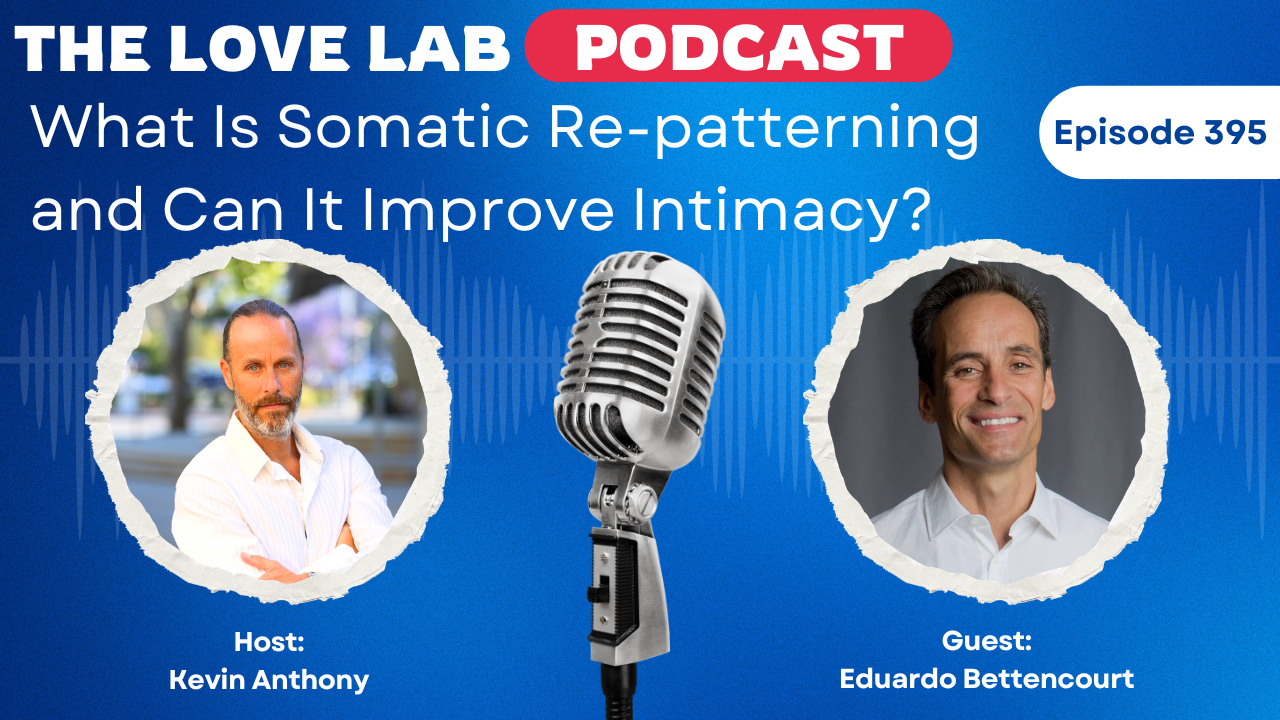
All right, welcome back to the Love Lab podcast. This is episode 395, and it is titled, What is somatic repatterning, and can it improve intimacy? So you’ve probably heard the term somatic a lot lately. It’s kind of a buzzword these days. You hear a lot of people talking about somatic practices and somatic work and somatic this, and somatic therapy, and somatic, but what does it really mean? It can actually mean several different things, depending on who’s using it. So we’re going to talk today about, you know, what it is in the context of the modality we’re going to talk about today, which my guest is calling somatic repatterning. I’m going to talk about what that is. We’re going to talk about why it may be helpful and the types of issues that it might be able to help.
Kevin Anthony 1:19
We’re also going to talk about choosing practitioners today, because that’s going to be an important thing when it comes to somatic and it’ll make more sense once we define it and we talk about what the work is, but making sure that you’re working with somebody that you can trust, that has high standards, high ethics, high morals, is critically important in this area. So those are some of the things that we’re going to talk about today. If you’re watching on YouTube, you can obviously see that I have a guest with me. He’s going to help us break all of this down in just a moment.
Kevin Anthony 1:53
But before we do that, a couple of quick ads. Got to pay the bills. You know how that goes. Ladies, did you know that the overwhelming majority of men consider receiving oral sex a must in their relationship? Well, of course you did, because men have been asking you for your whole life. But do you feel confident in your ability to give great oral sex if you tend to avoid it because you don’t feel like you’re good at it, or if you feel that you are pretty good at it, but want to get even better, then my new blow job mastery courses for you, I have teamed up with the amazing coach, Ry Duong of eternal love to bring you a practical and easy to follow course that is guaranteed to increase your confidence and skill when giving oral sex to your man. In this course, you will get all the secrets to mastering the art of oral sex with step-by-step instructions and multiple live demos. Go to https://www.sacredfemininearts.com/bjmastery. That is https://www.sacredfemininearts.com/bjmastery. And as I always say, when I read that ad, I made that course because I did a video on what men think is a good blow job. And the comments were overwhelmingly from women, saying, I had no idea that’s what men wanted. I had no idea that’s what men liked, and I thought, ” Wow, okay. You know, my goal is always to help people have better sex. So if you can understand what men like, and that’s something that you’re willing to provide, then everybody will be happier.
Kevin Anthony 3:15
Now, I always have to also say, we’re not just here to help the ladies improve their sex skills. We are also here to help the men improve their sex skills. And since 2016, I have been talking about power and mastery. Power and mastery, which is now at version 3.0, is my men’s sexual mastery course. And so if you’re struggling with erectile dysfunction, premature ejaculation, or simply want to increase your skills in the bedroom, then power and mastery is for you. Join the exclusive club of men who have taken their sexual performance into their own hands and become sexual masters. Mastering your sexuality is a key component to becoming the man she has always dreamt of and craves. Don’t leave your sexual performance up to chance or the throw of the dice. Become a sexual master today by going to powerandmastery.com. Forward slash sexual dash mastery. That’s power and mastery.com. Forward slash sexual dash mastery. So guys, it’s 2026, there is no reason for you not to show up in the bedroom as a master, right? You’ve got to show up. You’ve got to take care of her, too, just like you want her to take care of you; you’ve got to take care of her.
Kevin Anthony 4:28
All right. My guest today is Eduardo Bettencourt, and he is a Sausalito-based somatic therapist specializing in somatic sexual repatterning, a body-centered approach designed to release deep, emotional, and physical armoring. With over 30 years of experience, he combines breath work, sound, and movement to help clients move beyond talk therapy and heal trauma stored within the nervous system. His work focuses on expanding a person’s capacity for intimacy and vitality. By reprogramming the body’s subconscious responses to stress and pleasure. Welcome to the show, Eduardo.
Eduardo Bettencourt 5:07
Thank you. Kevin, so nice to be here. All right, I have to chuckle. I was just thinking of my mom watching this, and it’s starting out with a blow job course. And I thought, Okay, gonna be fun?
Kevin Anthony 5:23
Well, maybe Mom knows somebody who could use that. All right, let’s just dive right in. Because, you know, we’re using some terms here that you know are sort of like buzzwords these days, I kind of mentioned in the intro. So we’re talking about somatic repatterning. And I’m pretty sure most people listening to this don’t actually know what that means. So let’s start by explaining when you say somatic repatterning, what are we talking about?
Eduardo Bettencourt 5:56
Sure, yeah, thank you for that. So many of us are caught in thinking about how we are, how we exist in the world, how we relate to our partners, our lives, and we’re very seldom connected to how we feel in the world. At least, this is my experience with clients. They’re not really connected to their bodies. So somatic is this sort of bottom-up approach, if you will, where you’re going into the body, noticing what you feel and having what you feel and form, how you’re showing up, how you’re behaving, so how your brain, your mind, is ultimately conducting your life.
Eduardo Bettencourt 6:30
And oftentimes we’re not as connected to that as you know we might want to be. The term I use is congruent. Which congruence are the tools that we use to show up authentically in the world, and specifically around sexuality, which is where my focus is? Many of us aren’t showing up where we’d like to. We don’t even really know where that is. So this is about reeducating or repatterning. What you enjoy, if you really ever knew that, or maybe discovering it for the first time, is that you have had what many people call a peak experience, something that happened at some point in the trajectory of their lives where they recall it.
Eduardo Bettencourt 7:09
Now on my intake form, you know, 20, 30, 40, 50 years later, what was the magic sauce that happened on that occasion? Right? What made that a peak erotic experience for you, so we can recapture that and bring that into your current reality. If you don’t have one, which, sadly, many people don’t have, even a good erotic experience might peak. Then it’s about. How do we figure out what you like, what turns you on, you know, lights up your experience, your reality?
Kevin Anthony 7:39
So what is the somatic portion of this? Because, you know, I know I keep coming back to that word, but only because, and maybe it, maybe it’s because, you know, I work in this field, but I hear that term so often, and I’ve heard it used in different ways. I understand you did a great job of explaining what sort of repatterning means. How does the somatic part figure into that?
Eduardo Bettencourt 8:01
Yeah, the somatic part. So if you can just take a moment, even for your listeners, and see what they’re noticing in their body, right? Is there holding anywhere? Is there numbness anywhere? Is this sensation that they’re unaware of, and how is that sensation holding them in space? So are you feeling at ease and comfortable? In other words, are you feeling regulated? Is your nervous system resilient and able to respond to what’s coming to you in real time? Are you feeling somehow disconnected, completely disassociated, shut down?
Eduardo Bettencourt 8:31
And if so, where do you notice that? Where do you notice that you’re not connected to your physical reality, that you’re just in your head, thinking about the next thing, thinking about the last thing, thinking about how to get out of this thing, rather than being okay? Let me see. Well, what does my body want? Or do I even know? Can I feel my body? Is it terrifying to even think about acknowledging what the needs of my body is asking of me? So for most of us, we have a varying relationship with our body. If something feels safe and good, we’re really able to enjoy that something feels a little edgy. We might shy away from it entirely, rather than kind of leaning in and seeing, is there more information there is this really something to happen in the past, or something that I’m worried about in the future, something that I just don’t understand, that I don’t have any information or education around so the somatic piece is like, what do I notice in my body? What is the sensation? What is that sensation? Maybe trying to show me what it possibly means?
Kevin Anthony 9:30
You know, you brought up something interesting there, which is this idea of really being in your body, or feeling safe to be in your body, especially around certain experiences. And, you know, for a lot of my life, I found it kind of difficult to understand how some people really weren’t actually living in their bodies. Like, I know that sounds crazy, right? So some people listening to this are like, ” What are these guys talking about, right? Yeah, but there is a significant number of people now having. Done this work for a long time, like I get it now, it makes a lot of sense to me, but, but earlier on, when I was younger, it didn’t really, I couldn’t really grasp, how could somebody be physically here, living in the same world like the rest of us are, but not really be grounded in their body? And yet, you see it all the time. And so what I think is really interesting about this work is that it is something that can actually help those people who aren’t grounded in their physical body to get grounded in it.
Eduardo Bettencourt 10:35
Yeah, well, well said, and that made me remember just a training I did recently that was populated mostly by cognitive therapists, and they were seeking somatic tools for their clients. And I’d say there were maybe 10% of us that were somatic oriented, you know, that had experiences of working with the body, and whenever an exercise came up, we were just right on board and and these highly trained and skilled cognitive based therapists like fishes out of water, fish out of water, you know, they just didn’t even know where to begin. And it was really confusing to me, because, of course, with my clients on the table and in person, it’s easy to see one on one, to really empathize with their inaccessibility to the body, but you’re thinking that with professionals out there, well, of course, they know, and you realize that that’s actually not the case.
Eduardo Bettencourt 11:29
And of course, many of us are living with experiences of shame from the past that never let us access our body, right? So we move to whatever age we are, only even giving that part of our experienced life, if you will. I always think about when you go in for a traditional massage, let’s say, certain parts of the body and the anatomy are just off limits. And you know, What message are we giving to that part of the body by omitting it from the experience? You know? Why is my belly not as safe to touch as my back?
Kevin Anthony 12:03
Yeah, you know, that brings up another interesting question. And you mentioned a couple of them here, but I want to talk about it just a little bit more, which is, you know, I was just talking about this idea that there are quite a few people out there that aren’t really living fully in their physical body, right? They’re not really physically present in their body all the time. And there can be multiple reasons for that. So one of the ones that you mentioned was this idea that, you know, people who spend a ton of time in intellectual pursuits are always up here in their heads, right? And you know, you’ll see it. They’re amazingly intelligent, and they know a lot of stuff, right? But their bodies are a mess. They’re overweight, they’re sick, they’re all this stuff because they pay no attention to their physical, so that’s one way, sure, but then another way that you mentioned, and this is probably the area that I’d like you to talk about a little bit more. But when people have traumatic experiences, especially things like sexual abuse, where it involves the body, one of the ways that their mind copes with that and deals with that is to just shut that part down altogether.
Eduardo Bettencourt 13:14
So you want me to speak more to the fact that people are trapped in this experience from the past that they’re unable to sort of resolve or move through.
Kevin Anthony 13:25
So, yes, talking a little bit about, like, you know, why do people get disconnected from their physical body to begin with?
Eduardo Bettencourt 13:33
Yes, so the big T trauma is, you know, what often gets the largest finger pointed at in its supposed, which is not what I initially intended when I sought out doing this kind of work. But of course, that’s what those are, the people that came through the door. So, you know, it’s really common to have a big T trauma, you know, something that is sexual abuse, you know, classically defined, but equally common is just to have a dis, what I call a disempowering event, you know, where you’re at a tender age and someone who holds power over you, it’s a power dynamic, and might just be that they’re a couple of years older than you, like a cousin, or, of course, like a guardian figure, shames you in some way, or makes You feel less than adequate in some way around your physical expression.
Eduardo Bettencourt 14:24
That can be even just how you might show up on the dance floor as a little child and have, you know, someone make fun of you, and then you shut that part of your physical experience down. So it’s usually an external message. You know, another big factor, at least in my work, I like to be as specific as I can is it’s coming through the lens of religion. So a lot of people come in with distorted views of their own sexuality because of what they’ve learned at a young age, that they haven’t had enough resources as an adult, or time to go out and explore. And really understand better for themselves. Well, sure, this is what I was told, but this is not what my reality and my truth are, which is what the repaving work is all about. It’s like, how do we get to what’s joyful and pleasurable in your body? How do we get to what feels authentic, and how do you express that congruently without all these other voices in your head, or these experiences from, and this can be current.
Eduardo Bettencourt 15:24
You know, there are people who I see that have a fairly have had a fairly solid relationship with their bodies, and then there’s an impact, you know, as they get older and they’re less able, there’s an impact that comes from, like a big loss, like a divorce, let’s say, and then shut down happens again. And even though they had these peak experiences from the past, now shut down slowly, slowly, kind of forget, you know, the muscle memory of the body forgets. Oh, that’s also possible, because the body’s changing and the physiology is changing, and, I mean, it’s there. And it’s really easy to get back online once you commit to it, but I know it’s harder, because I tend to see people who are older, and predominantly women. By older, I mean kind of empty nesters, you know, mid-50s, and they think that, you know, their second life is all it’s done. You know, there’s just it was never that great anyway.
Eduardo Bettencourt 16:22
So when they recapture it’s such a joy, because it’s like, you know, having this thing that you’ve imagined, that you fantasize about, that you hear your friends either telling the truth about or exaggerating about, and now it’s true. I’ve had women well past 60. They’re like, Oh, I’m having the best sexual experiences of my life.
Kevin Anthony 16:43
Yeah, and thanks for sharing all of those different reasons why that can happen. I mean, I have my own experience. I mean, you know, when my wife got sick, I mean, sex was the last thing on our minds. Like, all we had to do was just like, try to get her well, get through life. And so I had to shut all that down, like, there’s no energy, there’s no time for sex, and it can be completely unreasonable to even ask her for that, right? And then obviously, after she passed, going through all the grieving and all of that, like, my ability to access that was just shut down.
Kevin Anthony 17:18
And I was fortunate that, you know, doing the work that I do, and knowing a lot of people, I had some close friends who do this type of work, you know, be able to show up and help me bring that back online, yeah, but had I not had that, I’m not really sure what would have happened. I’m not sure how long, even, even with my own knowledge and awareness and working in this industry, I’m not sure how that would have went if I didn’t have that type of help to and I remember, I remember, after one of them came over and we did a session, I remember literally saying the words, I feel like that just came back online. No, beautiful. So there are a lot of reasons why that can happen.
Eduardo Bettencourt 18:06
Sure, sure, yeah, I just want to take a moment to be present where I felt coming through from your you know, this loss, you know, I just want to acknowledge that. Yeah, your vulnerability and sharing as much as you did was touching to me, and I don’t know the story, but you have mentioned to me, and thanks for being open with that content, and you know, in this global presence.
Kevin Anthony 18:37
You’re welcome, and you know that, yeah, like, yeah, but part of that really is about letting people know that this can happen to anybody. Of course, yeah. And even with all the skills that you might have and all the knowledge that you might have, things happen in life, right? And these things can happen, and you do, yeah, everybody needs a little help from time to time.
Eduardo Bettencourt 19:02
Yeah, exactly. That’s a really good point that we do need a little help when we’re in these states, because we need someone who’s more regulated than us, you know, to help us regulate. And that’s where the help of someone who’s trained and qualified can really help you. Feel like, turn back on again. Don’t come back online, because hopefully they’re doing their own work. You know, mentioned earlier that a lot of the a lot of people with a lot of head knowledge and tools don’t necessarily take care of their bodies. And sure, I saw plenty of that and the workshops that I was mentioning earlier.
Eduardo Bettencourt 19:38
But yeah, the ability to keep yourself as a therapist, you know, or as a therapy practitioner in good standing, right? Like all the habits you know, all the basic habits of you know, diet and exercise and thought, but doing your own work, so that when people come in, you have something to give them that’s not just a tool that anyone can pull off the internet or out of a book or you. You have, you know, your own regulated nervous system that they can borrow to feel safe enough to come back online and get turned back on.
Kevin Anthony 20:09
Yeah, so let’s talk about some of the more typical issues that people will come to you with. What are some of the things that people you know, obviously, if they’re coming to you, they’ve already recognized that there’s something that needs work or help. But what are some of the typical issues that you see with clients? I know why.
Eduardo Bettencourt 20:31
This makes me chuckle, because this is probably my favorite question, because it’s so varied, and I always tell people this story, about what my most unusual client was looking for a dog groomer, and she wound up in my office. How did the internet wind? Most of my work is word of mouth. People who just read somatic sexually patterning. It’s very polarizing, right? So there’s something about their sexuality that they’re curious about, but when they actually get in the door after we’ve had an intake call and they still do a questionnaire, oftentimes it has nothing to do with their sexuality. You know? It’s this feel, oh, like I mentioned earlier, it’s kind of an empty nest situation, or like, what am I going to do in my life now? Kind of thing, if it is issues more connected to sexuality, usually they’re vague, like, I haven’t had, you know, the questionnaire opens people up to things they haven’t thought to ask themselves. Like, who? Not many people, I guess, come to see me spend time thinking about a peak erotic experience, for example.
Eduardo Bettencourt 21:43
So when you realize that that’s a question on a questionnaire and you don’t have even an erotic experience, never mind a peak one, you know that can really take the wind out of your sails in terms of feeling, well, okay, now there’s something else that’s wrong with me. So people come in feeling really confused about their sexuality and about what sex is, you know, because just this kind of old narrative that it’s just sort of like a Brazilian friend of mine used to say, it just doesn’t translate so well. But it’s just like a pole in a hole, pole in a hole, hole in a hole. And I’m like, God, that sounds awful. She’s like, yes, well, that’s the narrative that most men that she knows have presented to her, so broadening, just like the idea of, What does sex mean to you? Like, how does sex feel good to you?
Eduardo Bettencourt 22:31
I’ve had clients who say the most incredible orgasm that they’ve had is just staring into a man’s eyes and doing a particular practice, which is contradicting nature, but just that contact and that heart connection opened them up to these other states of pleasure that were non genital related, but still in their definition of orgasm. So people come in confused to me, I would say, is probably the main thing. There’s a curiosity around sexuality. Maybe they see that one of their friends benefited from working with me, and they want that, but they don’t really know what it is. Certainly, 90 plus percent of my clients, too, have a sexual history that is either traumatic or disempowering in some way, and then for men, almost exclusively, they get pulled in by their partners, unless, on occasion, I have men that come in to see me for issues of like the ED but that’s probably less than 1% usually women, usually empty nesters, usually curious about what their friend experienced as a result of working with me, or curious what in their own sexuality they haven’t thought to think what’s that? How does it go? They want answers to questions that they don’t yet know they have.
Kevin Anthony 24:02
Okay, so, yeah, a lot of people come in confused, but with curiosity. If you were going to describe, like, let’s say, if somebody said to you, who are the type of people who should come see you? Like, how would you describe that? Like, would you say, Okay, if you are experiencing this, or this, or this, you would be a candidate for from this, for this work. Like, how would you describe that?
Eduardo Bettencourt 24:29
Yeah, initially, I used to answer that years ago. Well, everybody, and most people would kind of chuckle and say, Well, yeah, I think for sure, my friend, but not me, people who are dissatisfied with their lives. Basically, you know, because sexual energy is creative energy. So if you’re dissatisfied with what you’re doing for a living at this stage, or if you’re dissatisfied with the relationships you’ve had or your current relationship, you’re just satisfied with the relationship that you have, even with your children, people come in, and they get more congruent, more authentic, and. Are able to articulate and set boundaries in such a way that they’re opened up to almost a whole new life. So if you’re feeling disconnected from like your authentic self, then it’s a great practice, because it’s not specific to sexuality. That’s why I brought in the name to somatic repatriating, because a lot of people, as I said, are polarized. Come in, we’ll start talking about sexuality. And people love that.
Eduardo Bettencourt 25:23
Because even in traditional, in my experience, again, most traditional talk therapy, my clients don’t feel comfortable talking to their therapists about sex. It’s not in their scope of practice. So, unless you go to a specific sex therapist, which usually is around some kind of problem or dysfunction, then this stuff just stays bottled up inside, and maybe your best friend is filling you with stories that may be partially true and making you feel worse about your own experience, rather than, Oh, wow. People feel like they can, and they do tell me anything they feel really safe and really comfortable. And that’s really where, like, the therapeutic process starts, if you don’t have that to start out, and then you’re throwing, you know, tools at a problem, but the problem really is not wanting to be addressed because they don’t trust that those tools are the right tools. But if you feel safe and you don’t need as many tools, right, just kind of drop into feeling safe, and from there, begin to express yourself. And this is all like, these are all behaviors that we’re born with, you know, knowing how to be ourselves, but then we get slowly conditioned out of being ourselves.
Kevin Anthony 26:27
Oh, isn’t that true? You know, another thing that you were just talking about is, you know, often when people are experiencing problems around their sexuality, a lot of times people will first go to their doctor, their doctor basically cannot help them at all. I mean, the only thing their Doc is going to say is like, Here, try some Viagra, or, you know, one of the other types of, you know, medications like that. They’re also developing that. They have that for women now, too. So it’s like, oh, you’re having this problem or that problem here. Just take that. That’s about as far as their doctor ever goes. And what’s interesting is when people come to work with me, depending on what type of issue they’re showing up for, but say, especially men with ED, because ED is a possible sign of cardiovascular issues in the body, I always tell them, Okay, you got to go see your doctor, get a full checkout, make sure all the physical stuff is working fine, right?
Kevin Anthony 27:23
But because of that, because we have that interaction a lot, and I hear from a lot of clients, and I’m sending some of them directly to their doctor, I hear what the responses from their doctors are, you’re fine here. Just take this all is good, right? You know, and then, and then, you know, if they take it the next step further, then they want to go to their therapist. And honestly, a lot, as you correctly pointed out, a lot of therapists don’t really want to go there. They don’t really want to talk about sex. They’re uncomfortable with it, and they don’t have the knowledge in the area. I mean, I’ve literally, and I think I applaud the ones who have done this, I have had therapists, actual licensed therapists, hire me to come in and talk to clients and do workshops and things on the sexuality piece, because they’re like, this ain’t my area of expertise, right?
Kevin Anthony 28:14
So I applaud them for doing that. But if you think that by going to your regular therapist, you’re necessarily going to get what you’re looking for when it comes to dealing with challenging issues around sex. You may, you might get a good one, and you may not, right, and that’s where people like myself and people like you fill that gap, because this is something that we specialize in, and it is something that we can help you with, and we have a lot of experience in.
Eduardo Bettencourt 28:41
Yeah, absolutely. And I think that when you go see your GP or general practitioner, and you don’t get what you need, or you know, you get a substitute for what you need, it can really be a waste of time, you know, sure you can meet a specific, you know, in terms of just Ed and a pill. Okay, we can check that off with the boss. Well, what about everything else that’s part of your sexuality that gets missed? You know, all the ways that you’re I have a funny story about that, but I won’t go into it now, I guess. But the ways that you can take a pill and perform a function, but still feel more and feel the same or even more disconnected from what you’re doing to your partner. It’s almost heartbreaking. You know, when you realize all that is possible, when you are fully open to the experience, and again, to use my own language, congruent and authentic with the exploration of sexuality. Sure, a pill can help with that, you know, you can prolong that experience.
Eduardo Bettencourt 29:47
But if that’s all that’s happening, and you’re missing everything else that’s part of like just a healthy sexual education, a healthy sexual awareness, then you know it feels like a band-aid that sooner or later. You’re gonna wind up eating life like, Whoa. Okay, now, even the pill is barely, you know, still. Now, now I’m so used to the pill that I’m still not getting that other thing, that other level of intimacy and connection and exploration. But I can do this, you know, I can do basically, you know, stick in the hole, yeah?
Kevin Anthony 30:20
Well, you know, the problem with most medications is that they’re addressing symptoms and not the root cause, right? So, I mean, in the case of an ED, if somebody goes to their doc and they they get one of those pills prescribed, it can help them get an erection, but it doesn’t solve the underlying problem that’s causing you to not be able to have an erection to begin with, which in many cases, in my experience, isn’t physical, it’s generally psychological, right? And so that’s where things like coaching and somatic-type practices can help remove those things that are in the way, and then you don’t need the pills anymore.
Eduardo Bettencourt 30:58
Yeah, it’s the psychological aspect that impacts the body is going to restrict, you know, breath, blood flow, pliability, so, you know, start here and then wind up, okay, well, now we do actually have a physical component also in the pelvic floor. But where, where did that originate, right? And still can help, like, yeah, push the blood where it needs to go, kind of find its way. But the hypertonicity of the pelvic floor is still going to be an issue, you know, and can lead to other problems, it probably already is, you know, in terms of ergonomics and maybe things like back pain and stiffness for sure.
Kevin Anthony 31:36
Okay, we’re about halfway through. I need to take a quick break, but when we come back, I want to talk about some of the benefits that people might be able to. We’ve alluded to them already, but I want to just make sure that we clearly like here are some of the potential benefits you could get from a modality like this. I also want to talk about some of the different modalities that you use when you’re working with people, okay? And then we need to address what I call the big pink elephant in the room, which is working when it comes to sexuality in intimate ways with a practitioner of the opposite sex, and what that could potentially mean. So those are all some things that I want to get into when we come back.
Kevin Anthony 32:23
Okay, all right. Are you a couple? Are your relationship and sex life where you want them to be? Are there changes you would like to make? But just don’t know how, maybe you think there is nothing that can be done if you’re not 100% happy with where your relationship or sex life is, then get help today and change your life. Go to https://www.kevinanthonycoaching.com/couples/ and schedule a strategy call with me today so we can map out a strategy to get you where you want to be, so you can have it all your way. Go to https://www.kevinanthonycoaching.com/couples/. That obviously is an ad for my couples coaching program. And look, life is way too short to be in a relationship where you’re not happy, if your relationship isn’t working the way it should, if it’s not flowing beautifully, if you’re not happy to be spending time with your partner, if your sex life doesn’t make you feel satisfied and fulfilled, if you’re not excited about being physical with your partner, then something really needs to shift. Something needs to change. And so one of the things that you can do to help that is, of course, going to Kevin at the coaching comm forward slash couples. Something else you could potentially do, of course, is work with somebody like Eduardo, and at the end, I’ll give him an opportunity to share where you can find out about him. But don’t, don’t get stuck in that just boring, you know, day-to-day routine where you’re not loving your relationship and your sex life, there’s just no need to be stuck in that place.
Kevin Anthony 33:55
Okay, so let’s talk now about some of the benefits we’ve been talking a little bit about, you know, what this work is, and what types of issues people would come in for, and sort of why they’re they are where they are. Let’s give them some hope. Like somebody comes to you, like, what might shift? What might they experience? What might they change? What are the benefits they might experience from doing this kind of work?
Eduardo Bettencourt 34:22
Yeah, thank you. I want to also applaud that. Adams, I feel it inspired me absolutely, yeah, if you’re not like in flow in your relationship and excited to be intimate with your partner, then that something needs to change. So thanks for making that accessible and available to people. You’re welcome, yeah, of course. Well, I can, I guess, just speak from what is rather than what might happen, what has happened right for clients, and it really varies wildly and widely. I mean, I’ve had such far-out experiences, but what comes. Mind immediately is really a change of like, life direction. I’ve had more than one.
Eduardo Bettencourt 35:06
Again, I’ve worked mostly with women, although as of late, more and more men are showing up, actually, but then just boom, big, pivot and go in a completely different direction to their lives with that thing that, like they’ve been thinking about, that they’ve been sort of dreaming about, and they go off in a new direction in their lives. Boom, take off. One that couples you might want to block their ears on isn’t as popular. Is that they leave these relationships, these disempowering relationships that aren’t working, and they finally have, you know, the courage and the support and the regulation to feel like they can do that, so that they go off and do that.
Eduardo Bettencourt 35:42
Of course, people are always surprised by what is possible as a result, in terms of their own orgasmic potential. You know, nowadays there’s either nine or a million different types of Female Orgasms, depending on who you listen to, but just the fact that there’s more than one, for a lot of women that are so accustomed to either, some cases, not having or only having had a number again, once upon a time, of orgasms, realizing that they can have both external and internal, realizing that they can broaden their own definition of what an external and an internal orgasm is, realizing like how and where to touch themselves in ways that do bring about states of like, conscious bliss that they didn’t know were accessible. What else happens? Let’s see what’s coming to mind. The main thing is that people feel more like themselves. They feel like, even though it’s talked about as somatic sexual re patterning, or somatic re patterning, what we’re doing is through the power of your sexual creative energy, informing who your authentic, congruent self is.
Eduardo Bettencourt 36:55
So people come out a lot healthier in terms of their boundaries. And what I hear a lot is people are speaking up for themselves a lot more. And you know, when you speak up for yourself, then the world changes, right? Because people actually start to listen, and you start to feel more confident, and then you speak up more, and it just builds. And next thing you know, you find yourself with new friends and new intimate relationships. And in case of some bolder individuals, actually new life directions with our previous partners or husbands? Yeah, won’t say wives, because I haven’t had any men leave their wives, but yeah, going in a new direction in life.
Kevin Anthony 37:35
Well, those are some pretty big and profound shifts. Now I can honestly say that you know, not only myself, but just having witnessed a lot of people over the years, there can be some pretty profound shifts, like one example that comes to mind, and this is funny, because it speaks to something that you were mentioning at the very beginning of this show. But you know, my wife, when she was alive, she was a certified sexological body worker, which is a form of somatic work, right? And so, you know, she had a client, many clients over the years, but she had one in particular that I remember, that was a licensed therapist, and he went through a package of sessions with her, and ended up giving up his license and and switching modalities because he was so blown away by what what he was able to personally accomplish through that modality that he’s like, What am I doing talking all day long. Now that’s an extreme example, right? That’s not going to happen for everybody, but it is an example of the sort of profound changes that people can go through sometimes when they unlock these things that are, you know, sort of bound up inside.
Eduardo Bettencourt 38:57
Yeah, and the body piece is so important, and I don’t think people really realize it until they feel it. I just had a client recently who had been through a number of cognitive therapists, and he knew what to do, but he wasn’t feeling well. And he came in to see him as his first somatic session, and he left feeling like at peace, like in his body, like now he could take what he knew, and he was feeling well enough and at peace to do something with it. And so this idea, like, you know, we all know something that we should do, or like to do, that makes our lives better in this way or that way, but we’re not actually doing it, knowing it doesn’t make it any better, right?
Eduardo Bettencourt 39:34
Doesn’t knowing you got to go to the gym as a basic example, doesn’t make you feel like you see when you go to the gym, but when you start to feel this at a somatic level, and you embodied, then it’s these, you know, bigger experiences of like life changes that seem radical, or just, you know, a safer term, a pivot, are as hard to to believe because you’re doing them because you’re body, the behavior, the repatterning piece. Now, what happens also is that people will see this, but then won’t necessarily go all the way, and that’s why I think coaching comes in. It’s something that I’ve started off with this year, as well as the accountability piece. So you have these breakthroughs, these ahas, and it’s feeling one way in the office, and we give you home play when you go home, and you’re doing it, you’re not doing it, you know, depending on the amount that you do it or don’t do it, then your life starts to be impacted and change.
Eduardo Bettencourt 40:26
So oftentimes people come up, they see, they make a little breakthrough, they make a little bit of progress. It’s good enough, and they stay there. But for people who have a strong enough experience and the follow-up, then it’s not a stretch to have a, you know, to go from your example or examples that I mentioned, where people left their lives and started something completely new.
Kevin Anthony 40:49
Yeah, and I do want to make the point that, you know, don’t be afraid to do this work, because suddenly your whole life is going to be upended. That’s not true for everybody. Absolutely, it’s a possibility. Point, good point. I don’t want, I don’t want to scare people off, like, oh my god, if I go see Eduardo, I’m going to end up divorced in a new career, and not necessarily.
Eduardo Bettencourt 41:11
Not necessarily. Absolutely, not necessarily. Yeah, you know people. One thing that’s also really true about my work is that people who come to see me, it’s usually like they’ve tried everything else, you know, it’s kind of come up and, you know, that’s the expression. They’ve tried many things, and they’re stuck, and most of the things have been cognitive, and they feel stuck, and they’ve kind of lost faith in the ability of their particular cognitive therapy to get them where they’d like to be. And so they come in they try something, like a guy off or something, more body-centered.
Kevin Anthony 41:43
Yeah, more body-centered. That is a good segue into my next question, which is, we’re talking about all the somatic stuff and body-centered approaches and all this stuff. But what does that really mean? In other words, what are some of the modalities that you use when working with people that help them be more embodied?
Eduardo Bettencourt 42:04
Yeah, thank you for asking. So in creating somatic sexual repatinity took roughly 30 years worth of practices and turned them into this modality, so they include things like traditional body work, you know, and most just traditional massage to be more specific, things like Swedish massage techniques and positional therapy techniques, which is another type of massage, deep tissue. In terms of, you know, the general public is more familiar with sports-type techniques, so that’s in the physical hands-on, there’s a lot of traditional massage, which is where I started out. Then, because of my yoga background, there’s a lot of emphasis on pranayama, which is now so common, which is all the different types of breath work, right? So we always start out with breath, if people have access to it, because for some people, going to the breath means going to the body means Whoa. Huge dysregulation, shutting down, disassociating. So the techniques and dog sitting, I don’t know if you can hear that dog 14 times. Can you hear the dog?
Kevin Anthony 43:11
Just a little bit, but that’s okay. Just keep going.
Eduardo Bettencourt 43:13
Okay, good, sorry. And then more from the somatic, so in yoga, also this assisted stretching. So pranayama and movement from yoga, then are more specifically like the somatic approach. A lot of it is based on Peter lein Somatic Experiencing work which is really big on being slow, being titrated, which means going back and forth between states of feeling safe and regulating Safe States of sealing and pushing the edge of you know what feels less safe or even reminds you of the traumatic experience, and that happens oftentimes, just with imagination, sometimes with different props. So I bring, really, I bring whatever I have at hand that the imagination feels would be useful, and that can be like holding on to a weight. This is the simple one. You know, you hold it on to even something as light as a pen all day long, but this is just in theory, and then you let it go, you can feel like all that was bound up attention-wise, and energy and musculature and holding, so we hold bigger weights, we hold different props. We do pushing and pulling.
Eduardo Bettencourt 44:31
And there’s a lot of catharsis that’s possible that can look big and wild and crazy, but not necessarily necessary. So what kind of separates the patenting work from other somatic modalities that will take one approach or another is that whatever kind of shows up, I hold space for so if it feels like you need to throw a raging fit, or if it feels like you just. Need to be held and weak, or feel like you need to be really small, whatever it feels like you need to do. The key is that then we integrate whatever that was so through the basic techniques that I mentioned, when people sign up for it, which isn’t always the piece of accountability that I hold people to practices. It can be just like mirror work, you know, which is another modality or practice that comes from the sexological school where you just gaze at yourself in the mirror and notice how it makes you feel.
Eduardo Bettencourt 45:35
And when you feel something that feels disconnected in a certain part of your body, you might take time with a specific practice we build around that, you might just journal around it, and then bring it into the next session to see how connected you are to all of you. Where do you feel now? Where do you feel alive? Where do you feel like, Oh, that looks kind of like really good. That looks sexy. That makes me feel so I’m not sure I feel like it went on a tangent. There, did I? Did I answer your question enough?
Kevin Anthony 46:02
Yes, well, you mentioned a number of different modalities, and that’s really what I wanted people to get a feel for. Was like, you know, if they’re going to come to you, what might they experience? And so you talked about breath work and movement. I know we also talked in the pre-interview about how you incorporate sound, and you’ve got all kinds of different things that you can potentially bring into the mix. And one of the things, obviously, that you mentioned was, you know, more hands-on type work. And one of the main reasons I wanted to ask that question was to bring out two things. Number one, just because you hear semantic repatterning doesn’t mean that it’s all hands on, right? Because there’s a bunch of other modalities and things that you do right that have nothing to do with hands-on, but there is potentially also some hands-on in certain situations. And so that would be something that somebody would want to be aware of, also.
Eduardo Bettencourt 47:00
Sure, yeah. So this modality actually works on zoom as well, where, in terms of hands on, we actually do hands on via zoom, they just so happen to be your hands on, you know, or, you know, sometimes a pets hands on, or, depending on, it’s a couple sessions so in person, and this all gets discussed beforehand, you know, intake, interview and the application as well. In person, hands-on, and anything that happens is always guided and directed by the client, you know, so whatever they’re feeling, it’s it just feels like they need a hand on their heart if they feel like they need, like, a really deep pressure point.
Eduardo Bettencourt 47:44
So hence more like the deep tissue type work. That’s what we’re going with, going with what’s happening for them in real time. And as soon as it feels iffy or they’re just curious or unsafe in any way, we stop immediately. So there’s a dialog that’s built up from the very first session on how to communicate their needs and making sure that they do that, you know, in a very safe way, before we actually begin the work of why they came that day. Look at anything that might be triggering.
Kevin Anthony 48:16
Yeah. And so you have an entire procedure for how you bring somebody into this work, as my wife did, too. And that procedure, at least in my wife’s case, and I imagine the same is true for you, but for her, it was about making sure not only the client felt safe, but that she herself was safe as well. And so there was an intake procedure. And I know you do similar things, like you mostly work with people who are referred to you. You get on the phone with them, right? And you know, my wife used to get on Zoom calls, where she could see them. What does this person look like? Who are they like? You can read facial expressions. You get a feel for that. There’s a questionnaire that you feel that you have clients fill out, right? You, I know, also do an intro session where there is no touching or genital, you know, anything happening, right? So there are all of these layers in there, first, where you get to know each other, and there’s a formal process, and you get to build trust and safety before you get into any sort of hands-on type stuff.
Eduardo Bettencourt 49:16
Absolutely and really from the first phone call, because, you know, I assume, anyway, that it’s more imperative with a woman in this field to make sure all those, you know, checks are checked off. But as a man, I don’t maybe feel as threatened as a woman might, just imagining that scenario. However, I want to make sure that it’s a good fit. So right from that first phone call, I tune people into their somatic experience and awareness right away to see if it feels like it is. Is this voice that you hear, or this face that you see, someone that you see that could help you, that you feel could help you, and I help people get into the biases. See, does this feel like a yes, you know, I’m doing that, of course, but I want to make sure that they are, so that, because otherwise it’s just a waste of time and money, you know. And if people aren’t sure, then we work with that also on the intro phone call. But if people are definitely no, then, you know, we can tell ourselves a lot.
Kevin Anthony 50:21
Yeah, you know, I do something similar to when I talk to people in strategy calls. You know, there are a lot of people out there, like their whole goal is sales, and at the end of the day, it’s just like I got to get somebody, you know, to sign on the dotted line and pay the money. But you know, my procedure when I’m talking to people is, I’m interviewing you as well, in the sense that I want it to be a fit, like you just said. I want you to feel good about signing up for coaching with me, because if you don’t, you’re probably not going to get the benefit that you’re looking for. And then you walk away, and you’re like, That guy didn’t help me at all. He sucks. He doesn’t know what that doesn’t do me any good, and it doesn’t do you any good, right? So I want people who are coming to me to feel good about working with me and be happy about it, and get the change that they’re actually looking for. And it sounds like it’s a very similar thing that you’re looking for as well.
Eduardo Bettencourt 51:13
Yeah, yeah, that’s a good point. You do want to know the best client outcome for the client? You know, because, as I mentioned, usually I’m at the end of the list of the things they’ve tried, and after me, there might not be anything else they’re going to try, right? So if they feel like they’re a full yes sometimes, you know, even if I’m unsure, I’ll move forward so that I can offer them, you know, the opportunity to have what whatever their yes is telling them, and that can just be in the intro session, like, okay, that yes was clear. And I do want to work with this person, and it informs me, you know, I don’t just get to work with everyone that’s the best Fitbit. Ideally, they’re the best fit. But if they feel like I’m a good fit and I can help them, then I’m going to make it fit, you know, because that’s what I’m a professional in that. So I think part of undertaking this as a profession is that you don’t only get to work with ideal clients, right? You have to work with people who have a need and feel like you’re ideal for them. So yeah, I definitely, yeah, definitely leave myself open.
Kevin Anthony 52:17
Okay, so now we only have a few minutes left, and I want to make sure that we address this before we leave. When we’re talking, anytime we’re talking about doing hands-on work in any capacity, you know, there is always the issue of power dynamics, right? So we were just talking about, you mentioned, you know, I imagine from the perspective of a woman doing this work, you know, she would feel more vulnerable. She’d want to put more safeguards in place to make sure that her safety is taken care of. Obviously, when it comes to a male practitioner, that power dynamic is flipped the other way a little bit.
Kevin Anthony 52:53
And so, you know, one of the big hesitations I had with having you on the show was I didn’t know you personally, even though you came recommended from somebody that I do know very well, and I’m very particular about who I would actually recommend somebody go see, because I have seen way too many just nightmare stories of big names, you know, who had reputations, who stepped over the line and did inappropriate things. And I would never, ever want to be in the position of promoting somebody or recommending somebody that then did that to somebody else, right? And so one of the things I mentioned to you is we’ve got to talk about this. We got to talk about the idea that, you know, there are, unfortunately, people out there who don’t have the same standards and ethics and morals and do cross lines. And how does somebody tell the difference between somebody who will respect boundaries and will show up as a professional versus somebody who says they will, but then doesn’t?
Eduardo Bettencourt 54:01
Yeah, good question. And unfortunately, I’ve had to learn that the hard way myself, with people that I had referred in the past, who I had studied with and turned out to be bad players. I don’t know if they were all along, but they were in this case, and then went on to prove that further afterwards, for me, part of it is that, you know, trust your gut like, okay, we’re in this, we’re having this dialog. You’re interviewing someone. Okay, go ahead and see what it’s feel, what it feels like. Ask lots of questions, unfortunately or fortunately. Many times, women seek me out specifically because, you know, their violation happened by the masculine by a male, and they feel that that aspect still needs to be addressed.
Eduardo Bettencourt 54:46
So they come to see a male practitioner. Look for reviews as I put myself on Yelp right away, which was kind of scary. So look for reviews to see what other people are saying. Ask the practitioner. Questioner, if you can talk. I have a number of clients who, without me even mentioning it, have over the years. If anyone is reluctant to do this work, as I was, let them know they can talk to me. So ask the practitioner as well. Who can I talk to whom you’ve worked with and get a few people, not just one or two? Of course, you can just, you know, now, you can just Google their name and see what comes up and do a deep dive on that. But first and foremost, just for me, it’s like you’re looking at their content. Whatever it is. I don’t know how much of it you know, but their website, their image, and like, okay, how does this person make me feel? Don’t go with the first thing. Whether it’s a yes or a no. Get more information. But like, how does that image come across? How does what they’re saying come across, and then, if you’re on the fence, ask to talk to someone that they’ve worked with. Look for, you know, review sources like Yelp or Google reviews.
Eduardo Bettencourt 55:54
Because unfortunately, it happens, and I don’t recommend anyone. It’s really sad. There are a few people in the field that I respect, but I still know the potency of this energy and how it can get out of hand. You know, people can project that one of the beauties is that it is around sexuality. So, when sexual feelings come up, you can talk about them right away, and usually that neutralizes the experience. And you can get back to doing the work, whereas, if you’re having those feelings with another type of therapy, and they don’t get talked about, they get buried, and then they can call it pastors. So I feel like it’s a beautiful aspect of work of a sexual nature that can just all be put on the table. And we can get back to why you’re there, not any kind of fantasy that you might have, any projection that might be happening consciously or semi consciously, semi unconsciously, I guess.
Kevin Anthony 56:48
Yeah, yeah. So you know what I really wanted people to get from that is I wanted them to be aware that they do need to do their due diligence. So if they’re thinking that this is something that might be helpful or beneficial to them. Do your due diligence. So like you said, ask for recommendations. Maybe you know somebody who saw a practitioner and they had a very positive experience. Look for reviews. Go to their website. Read everything that you can read on them. You know, look on the internet. See if any you know allegations come up about their past or whatever you know, like, because those things are out there, just do your due diligence to make sure that you’re going to work with somebody that is a professional. And some things that you can look for to find out whether or not they’re a professional.
Kevin Anthony 57:38
Of course, are all those things we just mentioned, but what is their process? Do they have a process that’s actually professional, or are they just winging it? Like, yeah, here’s my cell phone number, just, you know, call me whenever. We’ll figure something out, right? You know? Like, that’s, that’s a bit of a red flag right there? Like, there should be a process, right? There should be, if they’re asking you, you know, to sign any sort of, you know, contract or questionnaire or, like, coaching contract kind of thing, like, these are signs that this person treats what they’re doing as a professional right? You shouldn’t necessarily look like I have a coaching contract. Everybody who works with me signs a coaching contract, right?
Kevin Anthony 58:19
And I just lay out all of the rules about how the sessions work and what my job is, and what the client’s job is, and all of that, so that all of that is in writing. Everybody is clear on exactly how this process goes. So those are things that you would want to look for, you know, in a professional to make sure that they’re actually treating this as you know, a profession that they respect and they have boundaries.
Eduardo Bettencourt 58:46
Yeah, very important. I don’t know that there are many professions where the boundaries need to be as clear as they need to be with work of this nature.
Kevin Anthony 58:54
And they do, and that’s a really important point, like when you because sexual energy is so powerful, and because there has been so much abuse of it in the past, it is so important that we have really, really clearly defined and held boundaries when it comes to doing this work, even if, even if that work, I don’t do hands on work. I made a decision with my wife years ago when, you know, people were asking us to do it together, and I was like, as a male, I was just like, I don’t even want to go there. Like, she can handle that portion of it. I’ll handle the other portion. But even not doing hands-on work, I have to make sure that these boundaries are really clear, because sexual energy is so potent and powerful, as you said, we want to make sure that we have really clear professional boundaries.
Eduardo Bettencourt 59:50
Yep, couldn’t you agree more, absolutely.
Kevin Anthony 59:53
All right, well, we are pretty much at the end of the show. So two last things. One. You know, any last things you want to share about this work that you would like the audience to know, and then after that, let them know where they can find you if they’re interested in working with you.
Eduardo Bettencourt 1:00:09
Okay, yeah, this came out just while you were speaking, actually, that if you’re feeling like you go through this process of looking for someone, and it can be easy to find reasons not to do, right? Whatever that is, fill in the blank. So if you feel like this is something that is you’re curious about, or you have like a real calling for, lean into it. Lean into that. Even if it’s not 100% yes, find a practitioner who’s 100% yes. But even if it’s not 100% for you to do the work, lean into and explore it, because it is very rewarding. I know it’s scary. You know, I’ll get a phone call. It’ll be years before that person actually shows him, shows up through the door before they muster the courage, but they’re always happy that they did.
Eduardo Bettencourt 1:00:52
You know, people always get something out of these sessions, whether it’s just the introductory session, even just the application, just going through those questions on the questionnaire, people respond like, ” Whoa, not ready for this yet. Thank you so much. I learned a lot more myself. So just lean in, you know, but be safe and you know, do your due diligence. The best way to find me is that my name on my website, which is Eduardo veteran court.com it’s E, D, U, a, r, d, O, B, E, t, t, e n, t, o, u, r t.com, I am on Yelp, also under somatic sexual repatterning, and that comes up easiest if you search for Sausalito. I’m on Instagram, but it doesn’t do me any good, because I don’t really promote myself there, and also on Facebook and LinkedIn, but you can only get hold of me. My website is the simplest way.
Kevin Anthony 1:01:45
You know. Another green flag is that the person that you’re seeking is out there in the public and uses their real name, other than like, oh, look, a star, child, Moon, whatever wants to do a session? Sorry. I know I have people who go by names like that that I know and love and are good people, but we do have to, we do have to kind of point out that pink elephant that’s there. There are some people out there that…..yeah.
Eduardo Bettencourt 1:02:16
Yeah, and I guess, Lastly, if you have had a less-than-great experience with someone who’s working in the field of the realm of sexuality. Don’t let that shut you down to opening up to someone who’s qualified and can actually help you. You know, even if it hasn’t been re-traumatizing, if it just left a bad taste in your mouth, just wasn’t a very good experience. You know, don’t let that kind of shut the door on this modality. And even just doing a search on the sexological body work is a great way to find people who do this, do similar work.
Kevin Anthony 1:02:53
All right, I think we did a pretty good job today of explaining to people what this work is, why they might want to use it, what some of the benefits are, and what some of the things to look for are, if they’re interested in working with a practitioner. And so that’s the best that we can hope for in an hour segment, is to introduce somebody to something that maybe they never heard of before, or maybe they were slightly curious about but didn’t really know about. So I think we did a good job with that, and I want to thank you, Eduardo, for coming on the show and sharing your knowledge.
Eduardo Bettencourt 1:03:24
Thank you. Definitely a bit nervous being on a video. You know, all like this for a podcast, but I think I don’t think I put my foot in my mouth too many times.
Kevin Anthony 1:03:36
No, you did just fine.
Kevin Anthony 1:03:39
All right, everybody. That’s all the time I have for this episode, and I will see you next week.
Kevin Anthony 1:03:54
I hope you liked this episode of the Love Lab podcast. If you enjoy this show, subscribe, leave me a review, and share it with your friends, and for more free exclusive content, join me in the passion vault at https://www.kevinanthonycoaching.com/vault/. That’s https://www.kevinanthonycoaching.com/vault/. Thanks for listening, and remember, as Celine used to say, you’re amazing!
Kevin Anthony is a Certified Sexologist, Tantra Counselor, NLP Practitioner and a Sex, Love & Relationship coach. For over 10 years he has worked with men, women, and couples to have the relationships of their dreams, and the best sex of their lives! He is also the host of “The Love Lab Podcast”, creator of the popular YouTube channel Kevin Anthony Coaching, and creator of the popular online course series “Power and Mastery” as well as other online courses for both men and women.