Kevin Anthony 0:00
Welcome to the Love Lab podcast, the place to be for honest and real talk about relationships and sex, whether you’re a man or woman, single or a couple, this is the show for you. I am your host, Kevin Anthony, and I am here to help you have the relationship of your dreams and the best sex of your life.
Kevin Anthony 0:26
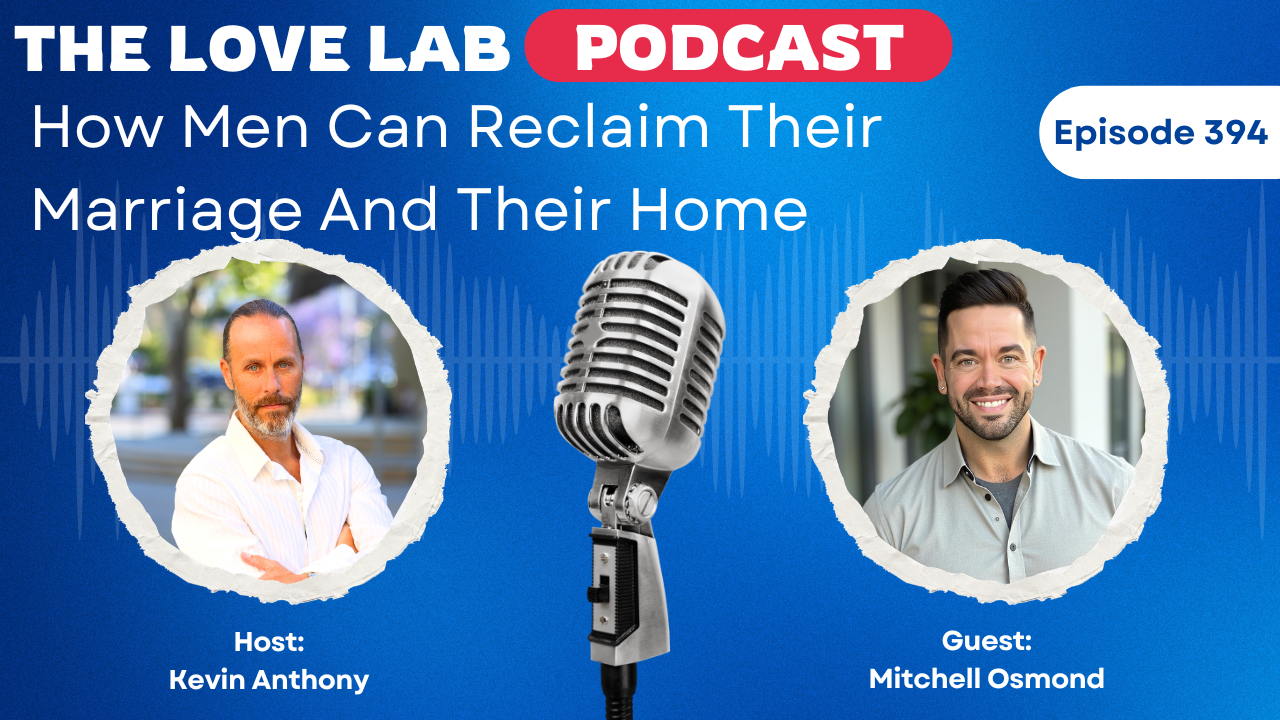
All right, welcome back to the Love Lab podcast. This is episode 394, and it is titled, How Men Can Reclaim Their Marriage and Their Home. Whoa, okay, hold on. Oh, we already got to stop, right? I can hear the screeching in the background already. I’m telling you, just with that title, I’ve already offended people, because I know some people are thinking, Oh, here we go. Here we go. We’re going to be talking about that toxic masculinity stuff and how men have to step up and take charge of their women. No, that is not what we’re talking about today. So if you were offended just by the title, I ask you to hang in there and actually listen to the conversation. Listen to what we are going to talk about. I would be surprised if, after listening to the whole show, you were still upset about the things that we’re talking about.
Kevin Anthony 1:18
But hey, you never know, there’s somebody upset about everything. So we’re really going to be talking today about what it means to be a modern, masculine man. How can he show up as the best version of himself? How can he show up and fulfill those roles that the masculine is supposed to fulfill? And we’ll define what those roles are. We’ll talk about what the masculine is supposed to do right, especially in the context of, you know, his relationship and his family, and how he shows up in the world. We have so much to talk about. I was telling my guest before the show that I wrote way more questions than I usually write. So we’re going to try to get through as many of them as we can. Therefore, I will keep this intro short. Let’s just go straight to the ads. Got to pay the bills, people.
Kevin Anthony 2:06
Ladies, did you know that the overwhelming majority of men consider receiving oral sex a must in their relationship? Well, of course you did, because men have been asking you for it your whole life. But do you feel confident in your ability to give great oral sex if you tend to avoid it because you don’t feel like you are good at it, or if you feel that you are pretty good at it, but want to get even better, then my new blow job mastery course is for you. I have teamed up with the amazing coach, Ry Duong of Eternal Love, to bring you a practical and easy-to-follow course that is guaranteed to increase your confidence and skill when giving oral sex to your man. In this course, you will get all the secrets to mastering the art of oral sex with step-by-step instructions and multiple live demos. Go to https://www.sacredfemininearts.com/bjmastery. That is https://www.sacredfemininearts.com/bjmastery. I made that course simply in response to all the ladies who commented on a video I did about how men like what men consider a great blow job. And so many of them were blown away that those were the things that men actually liked. It wanted. I said, Okay, well, let’s put it in a course. And so Ry helped me create that. Obviously, I needed a woman to help teach that. So check that out.
Kevin Anthony 2:45
And then, of course, power and mastery.com, which is my men’s sexual mastery course. If you’re struggling with erectile dysfunction, premature ejaculation, or simply want to increase your skills in the bedroom, then power and mastery is for you. Join the exclusive club of men who have taken their sexual performance into their own hands and become sexual masters. Mastering your sexuality is a key component to becoming the man she has always dreamt of and craves. Don’t leave your sexual performance up to chance or the throw of the dice. Become a sexual master today by going to https://www.powerandmastery.com/sexual-mastery. That’s https://www.powerandmastery.com/sexual-mastery. The links, of course, are in the description, and I don’t know that we’re really going to talk about this today, but when we talk about masculine roles and like how you show up in your relationship, showing up as a high quality man in the bedroom is an important piece to that whole picture, and that’s what I try to teach, empower mastery. I’m not teaching you tricks, or, you know, anything like that. It’s about how to be the best version of yourself when it comes to the bedroom.
Kevin Anthony 4:18
So, all right, enough of that stuff, let’s get right into it. My guest today is Mitchell Osmond. He’s a high-performance coach and the host of the Dad Nation podcast. He helps career-driven men reclaim their home, health, and happiness by teaching them to show up as powerful and present men, husbands, and fathers. Welcome to the show, Mitchell.
Mitchell Osmond 4:44
Kevin, it’s such a privilege and an honor to be here, my friend. I’m looking forward to having this conversation with you today.
Kevin Anthony 2:06
All right. All right. I love in your bio, you talk about teaching men how to show up as powerful present husbands and fathers. And that is absolutely one. What we want them to do. So let’s talk about, you know, what should Okay, we’re gonna get into what a modern man should be, right? Before we do that, though, let’s talk about where men have been, what have been the two primary sides of the masculine debate, right? Because that’s what we always hear it talked about from one side or the other. Men are either this or they’re that. What are your thoughts on that? And if you need more sort of clarification as to what I mean by that, I can provide it.
Mitchell Osmond 4:56
No, I know exactly what you mean. Yeah. So the reason why this is so polarizing is because I just want to acknowledge what’s going on behind the scenes. Because if you are listening like, for example, myself and you know Kevin yourself, you would understand this as a person who is a in a space, as a coach or whatever, as an influencer of any type, as a leader of any type in this space, the more polarizing you can be, the more clicks you will get, the more clicks you will get, the more money you will make, right? And so if we can be so polarizing and agitate people emotionally, they’re going to engage with our content. And so there are a lot of reasons why we people do this, but at the end of the day, it’s important to acknowledge that extremism makes people money, right?
Mitchell Osmond 4:56
And so why? Why would I talk about the middle if it’s not if it’s not really moving anyone, it’s not getting likes, if it’s not getting clicks, if it’s not getting follows, right? And so let’s acknowledge that, that a lot of big voices in the space are intentionally being very intense on one side or the other. The problem with that is it causes confusion for men who have grown up with mixed messages, or maybe didn’t have a, you know, strong father figure in the home, whatever, and then they grow up. That was me. I mean, I was confused about my role as a man, how to show up. But the problem with this, these two sides, is that it causes mass confusion and insecurity. You know, you don’t know how to show up, and your wife is frustrated. You feel like you don’t have a place in your own home.
Mitchell Osmond 4:56
You know, all those different things, but the two sides of the pendulum that we’re talking about are one side, which is like the ultra, what we would define as the toxic masculinity. It’s the alpha male, the red pill, the, you know, the new manosphere, you know, on Netflix. It’s that kind of, yeah, that mentality that’s like, you know, you have to be you have to have a six pack, you’ve got to be rich, you’ve got to possess women. You’ve got to, you know what I mean, like, that kind of mentality. The other side is, is the complete opposite. It’s like soft these guys are known to be, quote, unquote, nice guys who are pushed over to get mowed over who, you know, Simps, whatever you want to call it, and they’re so confused about relationships and how to show up that also, that’s not making their partners, if they have one, it’s not making them happy, right? And meaning that they’re also not happy. So that’s the kind of two sides of the pendulum, if you will. And so really, what I talk a lot about is that middle side. How do you, how do you swing to the middle?
Mitchell Osmond 4:56
Because this is not, this is not the 50s, you know, 60s anymore. Like, roles have changed, society has changed, expectations have changed. And so it’s really important to understand, Okay, what’s, what are the best things that we can take, actually, from both sides of the pendulum and bring them to the middle and be what I would call a healthy, present, powerful, you know, modern man. And there is an adjustment, an enormous amount of confusion about what that looks like, especially in Gen Z, for example. It’s, yeah, dude, I can’t even tell you how many men I talked to, men who were like, you know, 2324 25, and they’re like, What is a man? I’m so confused. And those are kind of the two sides.
Mitchell Osmond 4:56
We’re going to get into that, because that is a big piece of what I want to talk about today. Like, what? What is that middle way? But I want to come back to a few of the things that you just said. I definitely agree with you that you know, the sensationalism, the hyperbole, you know that gets clicks and makes people money, and we have to just be honest with the fact that there are people that don’t really care how much damage they’re doing. They just want to make money. It’s unfortunate, but it’s true. However, there are also a lot of people who’ve really bought into it, as they’ve really bought into all of that. There are legit people out there who are teaching this stuff, who actually think that you should be that extreme, or that extreme, you know, and I think that does a lot of damage, too.
Kevin Anthony 9:37
And so, you know, one of the reasons why I was excited to have you on the show is because your approach, and what you’re talking about, though, what you call the Middle Way, is very similar to what I’ve been teaching. And I just feel like we need more voices out there who are showing men that this is a possibility. And what I find is hilarious too, is, you know, and. Some of my videos, I’ll get comments. Like, the manosphere men will comment and say that, you know, Oh, you’re such a beta, such a soup, you know. Like, I get that stuff from that side, and then from the other side, right? You get the opposite stuff. Like, this is just a bunch of, you know, manosphere BS, you know, both of them make me laugh when I see both of those kinds of comments coming in on my stuff, I go, I’m obviously in the right spot, right? Yeah. So let’s talk, then a little bit about if men aren’t supposed to be the, you know, manosphere, and they shouldn’t be, you know, the super softy, you know, new agey guy either. What should men strive for? What is this middle way?
Mitchell Osmond 10:53
Yeah, yeah, that’s a great place to start. And actually, you know what? Just before I jump into that, I’ll just acknowledge kind of what we were just talking about. Because I think another reason why people get caught in this trap of one side or the other is that we’re tribal by nature, right? We all want to belong, you know, our ancestors, if you got kicked out of the tribe, you died, right? So it’s in our instincts, it’s in our DNA. It’s like we want to find a pack. We want to belong to some group with some, you know, ideology or whatever. And so it is. It has a it does feel, actually, kind of natural to pick a side. And secondly, you know, our brains are designed to look for things that are, you know, emotionally moving or jarring or potential threats or dangers.
Mitchell Osmond 11:40
Because, again, looking back at our our wiring, our ancestry, it’s like, you know, back then it’s like, if you missed a piece of good news, like, you know, the women came home with a great forage of berries, it wasn’t a big deal if you missed that piece of good news, but if you missed a piece of bad news, like a saber tooth ripped through the jungle and wiped out half your tribe, well, that was a big piece of information that you needed to know. And so for the beginning of from the beginning of time, the way our brains are wired is to look for the negative, is to look for the extreme, you know, dangerous, whatever. And so that’s why we can’t look away from, you know, a train wreck, or that’s why bad news, or, you know, CNL, CNN cells, or this is why we doomscroll, because we’re like drawn to like moths to a flame, right? And so there are a lot of reasons why that way of communicating works, right?
Mitchell Osmond 12:30
But it’s really important for us to have this conversation, Kevin, because once you have that awareness, then you can say, Okay, well now let’s talk about what it looks like to live in the middle, right? And I believe in the middle, as I said in the beginning, is a combination of both. I love the phrase, I am easy to love, but hard to kill. Or another way I would say it is, you know, strong like a line, Meek like a lamb. It’s like you have the ability to be fierce, to be courageous, to step in to protect your family, whatever way, physically, emotionally, psychologically, even your family, by setting up healthy boundaries, to protect your wife, to protect your children, digital boundaries, whatever that you are, uncompromising in your values. Know who you are, strong man, right, while simultaneously having the emotional intelligence and the emotional awareness to be able to convert from a strong line to a meek lamb and to say and to be able to hold space for your wife’s emotions, for her to come home and you to have a conversation, and her to say, talking about how she’s struggling with maybe the stuff around the house. There’s so much to do.
Mitchell Osmond 13:50
And if you’re confident in who you are as a man, you’re not going to get defensive. You’re going to hold space for her, and you’re going to let her express that, and you’re going to empathize, and you’re going to connect, you know, and then she’s going to feel seen and heard and emotionally safe. You can hold space for your children, and you can be gentle in those quiet moments when you’re putting them down, or you can put everything aside and be that person you know for your family as well. And so it’s this emotional strength, physical strength, right, psychological strength. It’s a beautiful combination, and in my experience, it’s rare to see a man who does well in both arenas. In my experience, a lot of my clients are high-performing business professionals, executives who are very assertive, confident, driven by logic, you know, all those different things.
Mitchell Osmond 14:43
And then they come home, and they continue to apply those strategies to their wife and kids. And then I’m treating them like employees, you know, they lead their living room like a boardroom, and I tell people all the time, I’m like, there’s a different set of rules for your family, right? You’ve got to take off that CEO hat. And maybe a different kind of CEO, instead of Chief, Chief, you know, executive officer, it’s chief encouragement officer. You know, I love that. It’s like, Hey, you’re a cheerleader. Come home. Build into your family. Hold space for them. Be there for them emotionally.
Kevin Anthony 15:17
I saw this cartoon years ago. I think it might have been a far side or something like that. And it was a man, he just retired from the business world, and so he’s home with his wife, and he’s walking around with a clipboard, and he says the caption is something along the lines, I figured out a whole bunch of ways to make this house run much more efficiently, or some, some version of that, right? And at the bottom, it said, and this is why men don’t live as long as women, because she killed him, because he comes home and he treats the house just like He treated work, which is exactly what you are saying with a lot of the high performing men.
Mitchell Osmond 15:55
And that’s, and that’s, that’s the middle ground, you know? And when you live in that way, there’s going to be people who say, man, you’re so soft, you’re such a beta. And there’s going to be other people who say, You’re too strong, you’re too assertive, right? You’re too alpha, or whatever. And it’s like, you know what I know for what I know, what works for me and my home and me and my family, and what works for the men that I’ve coached, and in my experience, that is that sort of beautiful combination. You know, there’s the gardener and the the gardener and the warrior analogy. And I can’t remember who said it, but basically the quote was like, I’d rather be a warrior in a garden than a gardener in war. Yeah, and it’s like, I want to be powerful and be prepared and ready to go to war if I need to, but I’m gonna be, I’m gonna live in this garden, and I’m good with that, right, versus being a gardener in war. And I think that imagery is really cool.
Kevin Anthony 16:53
Yeah, I think I don’t know if he’s actually the one who said it, but that quote is often attributed to a Japanese samurai named Musashi. I don’t know if he’s really the one who said it, but that’s kind of the philosophy of it, and I completely agree with it. And I’ve often used the term, what I call the integrated masculine, which is my version of your middle way, right? It’s where you take the good qualities from both sides. And one of my biggest complaints is, I’ve said for years, I’m like, you know, each side throws away the baby with the bath water, so to speak. In other words, there are good qualities about, you know, the manosphere people. There are some toxic qualities in there, too. And the same with the other side, right?
Kevin Anthony 17:38
And so to generalize and just throw both of them out because, well, that’s all toxic, or that’s all you know, whatever I think, does a disservice. And so finding out what the healthy qualities of both sides are and bringing them together, really is the way that is, I think, the way that men need to proceed from here on out. However, I have noticed that men on both sides of that, when they try the middle way, they struggle with certain parts of it. And so what I want to talk about now is, let’s take each side of that. Let’s take, you know, the strong, assertive side of masculine first, and then we’ll take the emotionally intelligent side, right? And let’s talk about why men struggle in those areas. So when it comes to the stronger side, I’m seeing a lot, especially in the younger generations of men, really struggling with, ” How do I embody like a strong masculine man?
Kevin Anthony 18:41
There was a great thing I saw recently where they compared superheroes of the past, like, not necessarily all superheroes, but some superheroes, but like, masculine role models of the past, and what they looked like, and they had these square jaw lines, and they did not necessarily have huge muscles, but, you know, they were built. They had those sort of classically masculine traits, and then they compared it to what we consider like an action star, and they’re all these really thin, kind of more feminine looking men, and they’re saying, what happened here, right? So why do so many young men struggle to figure out what it means to be that sort of strong, masculine man?
Mitchell Osmond 19:22
Yeah, I think there are a couple of reasons. Number one is, many have not had a great model, right? Many, many kids today, like, for example, we know today, Kevin, one in four children in the US will grow up without a father in the home. Like 25%, that’s crazy.
Kevin Anthony 19:39
And higher in certain populations than others.
Mitchell Osmond 19:41
Absolutely, way higher in certain populations. But here’s the problem, though: masculinity is caught, not taught. You can’t teach a 12-year-old how to be masculine. He needs to 12 year old boy. He needs to catch it by being around other men, right? And so one of the big problems. We got a lot of boys that grew up to be men, but and still on the inside, are still little boys, you know what? I mean, still confused about their identity, still confused about a lot of different things, about how to show up. And, you know, I had a guy on a show a little while ago, Daniel Gross, and he’s a brilliant coach. He’s a fatherhood coach, and he said every boy is asking one question growing up their whole lives. Am I enough? Number one, there’s 2, am I enough? And two, will I have what it takes? Or do I have what it takes?
Mitchell Osmond 20:31
And he’s like, if you’re a father, if you don’t answer that question for your sons, they’re going to grow up constantly, still asking that question, and they’re going to look for answers in all the wrong places. And so it’s your primary responsibility as a father to answer those questions and speak identity into your son in order so that he can show up that way, right? That’s one way. I think we, a lot of us, didn’t have a model. I didn’t have a model, and I learned a lot of lessons through hurting my wife, unfortunately, right? And I was like, Oh, that I shouldn’t do that because she’s hurt now, or she’s hurt that, and it’s a very painful way of learning it, right? The second piece is, I think that you know, going back to this polarity that we’re experiencing in society today and cancel culture, it’s like, even if, even if a young man wanted to be, you know, to step out and express an opinion, he would be fearful to do that, because he’d be canceled. He’d be called toxic. He’d be whatever, right?
Mitchell Osmond 21:34
I mean, dude, the hate that I get is on the stuff that people say is absolutely vile, you know, and it’s like, I can’t imagine, and I’m very secure in who I am as a man. I can’t imagine what it would be like for maybe a 22-year-old or 25-year-old to hear some of the stuff, you know, if he were to step out and step into some of these different things. So, you know, I think it’s a combination of living in a confused time about genders, about roles, about masculinity versus femininity, and yeah, and I just think it’s a lack of models, you know, that we’ve had. And so one of the things that I do, for example, when I’m talking to women who may be single moms, like, can you get your son around other men, good men who you trust, who have been successful in marriage and their finances and their fitness and their whatever, find those guys and get your son around them. Is he going to catch it right? He’s got to, he’s got to be around it.
Mitchell Osmond 22:35
Number two, you know, a lot of these men that I’m talking about grew up, you know, in these situations, and they become clients of mine because they’re confused. So one of the first things I do is I have a framework called the iron five, which is the five strategic relationships that I believe every man needs in order to see transformation in any area. Now, really, for lack of a better phrase, at the end of the day, what is that he’s getting around five father figures in different areas, in his fitness, his marriage, his spiritual life, and his finances, you know, whatever, right? And he’s catching what it looks like to be a strong, courageous, powerful man in these different areas. Because it’s never too late. I mean, and if you’re, if you’re someone who’s listening, who maybe had a complicated relationship with your father, you will always be looking for the attention and affection of that man. It’s very, very difficult to let that go. So it’s not too late to like reconcile things, but even if you can’t find it in other men, right? Even as a grown man, I have mentors, men who speak into my life. And so that’s, I think that’s the two biggest things why we see men so confused today.
Kevin Anthony 23:47
Yeah, I completely agree. There’s, there’s, you know, the lack of role models, for sure, and especially as we get more and more generations, you know, into, you know, I should say more and more generations past the boomers, which were probably the sort of last real masculine generation. I mean, Gen Xers. I’m a Gen Xer. We, we picked it up, but we didn’t necessarily, as a whole, pass it on to our kids. That’s a whole other thing. So there’s, there’s that I completely agree to, and something I’ve talked about a lot is, you know, the downside to things like the ME TOO movement and the cancel culture, which was, like I said earlier, throwing the baby out with the bath water, where suddenly every man became afraid to be like, Oh, I can’t say that, or I can’t be masculine, or that somehow that’s wrong, or I’m going to be accused of this, That, or the other thing. So that’s been a big pressure on men. And in my coaching work, I’ve seen that a lot. I have heard a lot of men tell me, I don’t want to, I don’t want to be accused of that. I don’t want to, I don’t want to even appear like that, right?
Kevin Anthony 24:52
So then they go way off to the other side of the spectrum. And of course, society, I do believe I don’t know what your thought. Thoughts on this. So, you know, I won’t put any words in your mouth, but I honestly believe that there has been an agenda in society to demasculinize men. Because, you know, people make the argument all the time, or they argue all the time, I should say, do you know? Media and Culture reflect or lead, right? So in other words, if you look around, I mentioned that whole sort of change in the way we were portraying, you know, masculine men or superheroes, right today, versus the way they used to be. And we’ve seen a lot of that. So it’s like they’re not getting the role models, right? They’re afraid of the cancel culture. Me too. But then all the models they do get in TV and movies are softer, weaker, you know, not really stepping up. Kind of men. If they watch sitcoms, what will they see in sitcoms? Every time the man is a buffoon, he has no idea what he’s doing, the woman has to tell him everything, right? These are all the role models that they’re getting. And then we wonder why they’re so fucking confused.
Mitchell Osmond 26:03
100% Yep, 100% I mean, what you’re saying there is open your eyes. Look around you, watch TV. I mean, honestly, that point you just made is so key, Kevin, if you listen to this today, all right, take this one piece and then just use that as a filter and just go, scroll through maybe five or six television shows, whether there are families, and observe the role that the husband plays. It is crazy. The husband has perceived it’s a joke. Doesn’t remember anything. He’s not, you know, he’s not listening. He’s whatever. He’s clumsy. He’s a buffoon, like you said. And the woman is, is the alpha, you know, being in the home, right? She’s running the house, she’s bossing them around, she’s, you know, all that stuff. And we’ve seen that, for I grew up on sitcoms like that, you know. And I’m 39 years old, so elder millennial, I would call myself, but I grew up on that mentality, right? Which is why I was so confused. 100% there’s an agenda, dude.
Kevin Anthony 26:57
And notice the difference between how those role models used to be from the Ward Cleaver of Leave It to Beaver, who was a good, upstanding man, pillar of the community, held a good job, was a good dad, tried to talk to his kids, teach them the right things, you know, like, and then we come the complete opposite, into the complete buffoon of a masculine man.
Mitchell Osmond 27:20
Yeah, 100%. And I mean, you see it in the data, right? Like I could spit out statistics at you all day that would prove you know that we’re more polarized, we’re more confused, we’re more depressed, we’re more medicated than ever before. Is man, and there’s a reason why. Yeah, there’s a huge reason why.
Kevin Anthony 27:36
So let’s talk about the other side then, because, like, we just covered why our men are struggling to embody those classically masculine traits, but in the middle way, right? Or what I call integrated masculine, we’ve got to pick up some new skills that weren’t necessarily traditionally masculine, like emotional intelligence, like communication, right? Like holding space, like you mentioned before, right? So you know the men, and there are men on both sides. So the men that you know were struggling, maybe with the more classically masculine stuff, they’ve probably embraced those other skills a bit more. But the men, maybe who didn’t struggle with the classically masculine stuff, I watch them struggle with all of these other, you know, sort of softer skills. Why do you think they struggle so hard to pick up things like emotional intelligence, holding space, and more awareness, and those types of skills?
Mitchell Osmond 28:29
Yeah, that’s a great question. Kevin. Let me share some statistics with you that I think will put this into perspective, and it’ll validate kind of why the point that I make, we know in the US today. You know, if you just look at the general divorce statistics, that seven out of every or 70% of divorces are initiated by the women in the relationship and heterosexual couples, right, seven out of every 10. But when you dig into that data, even more, when you look at situations where the wife in the relationship or the woman in the relationship as a high earner or has a high level of education, that number actually jumps to 90%, so in some scenarios, nine out of 10 divorces in the US are initiated by the woman in the relationship. Now let’s take that a step further. Okay, well, what’s the reason?
Mitchell Osmond 29:18
And everyone thinks it’s because of those big five, you know, sex, money, kids, you know, whatever, all those things, abuse, cheating, it’s not, it’s not, when you look at the data, 80% of the reason, the main the 80% of the time, the main reason cited for this divorce is there’s been lots of different variations. But when therapists and psychiatrists have put all these reasons together, the main theme is emotional disconnection, meaning I didn’t feel like my feelings mattered. I didn’t feel like a priority to him. I feel like I married a robot. I heard that I. I heard that phrase verbatim from my wife for years, and so that’s an important piece of information. If up to 90% of divorces are initiated by women, and 80% of the time, it’s because of some variation of emotional disconnection, okay, well, let’s pay attention to that, right? Because that’s a huge thing that should be a beacon light for us, a flashing light. Now let’s move to the man, the man’s side. Why is that the case?
Mitchell Osmond 30:25
Well, men, notoriously, and for generations and ever since, you know it’s been recorded, have struggled with communicating, not just understanding their emotions, but communicating their own emotions, and then that’s themselves, and then also to hold space or to listen to their wives’ emotions. And this is known. This is this is like known to be true. The psychologists have actually coined a term for it. It’s called normative male alexithymia, which alexithymia is a bit of a mouthful, but if you break down that word, you know, from the Greek, it’s a Lexus thymos, which literally translated, means a lack of words for emotions. So if you put that whole phrase together, normative male Alexa thania, it means it’s normal for a male to be without words for his emotions, right? So that’s acknowledged. That’s a part of the male expression. Now, there’s always, you know, there’s always exceptions to the rule. There are always men who are more emotionally intelligent. They were maybe raised, had more women in their lives, whatever.
Mitchell Osmond 31:29
But it’s important to understand the data and why these marriages end. And then it’s important to understand that the vast majority of men struggle with that one thing, emotional connecting so but it’s important to understand, as we’re talking about this middle way, or the integrated man, your wiring may explain you, but it does not excuse you. You understand what I mean. It’s 2026, we have tools, all right? We can’t just live on that. Well, I’m just a dude, I’m just a guy. I’m not gonna talk about how I feel, right? We’re beyond that. Here are some tools, right? And so I think that’s such a big reason why we see this huge disconnect. And whether you’re a man on the left or the right, or whatever side of that pendulum, this is the big thing we struggle with, is like, like I said, not just community, not just understanding how you feel, but learning how to talk about how you feel. And then on top of that, holding space for your wife. It’s actually a very difficult thing for men to do, and it requires tools and a level of emotional intelligence that a lot of men don’t have, and that’s evident in the divorce rates.
Kevin Anthony 32:34
Yeah, you know this, this side of things is different than than the other side we were just talking about in a very sort of crucial way, in that, when we’re talking about embodying classical masculine traits, you know, if we’re honest with who we are as a masculine being, as a being that is, you know, primarily testosterone driven, all we really have to do is tap into our innate nature, Right? But do so in a healthy, positive way, whereas these other skills that we’re talking about now aren’t necessarily things that come naturally to us as men, and so I think that is a big part of why men struggle with it. It’s not something that comes naturally, and it’s not something they’ve ever been taught. So you know, now you’ve got a real recipe for disaster. It’s like, it’s not something that we really, you know, know, you know instinctively, but we’re not taught how to do it either. So then, how in the world are we supposed to pick up these new skills?
Kevin Anthony 33:46
But I agree with you also because I say this all the time in the show, I go, Dude, there’s no excuse anymore. I said almost the exact same words. You say, Go, it’s 2026, there’s no excuse anymore not to have these skills. Now, does that mean you have to be a master at all of them? No, but you should be trying, right? You should be trying to learn some new stuff, and you should be working on it at this point. So I completely agree there’s no reason why men shouldn’t be trying to do some basic skills, like learning how to communicate better, learning how to recognize their emotions, feel their emotions, learn how to express them in appropriate ways at appropriate times, which, you know, that’s a really great thing that we should talk about, and how that differs from the way a woman expresses her emotions. Let’s just go down that rabbit hole for a second, because this is something I talk about a lot.
Kevin Anthony 34:45
My personal feeling is that when men start to learn this particular skill of like, okay, I’m told I’m supposed to be more in touch with my emotions, and I should be expressing them to my woman, that if they don’t get it. Proper guidance. What they do is they tap into those emotions, and then they go dump them all over their woman in like, you know, ways where she just goes, Oh my God. I didn’t even know that was in there. And now I can’t trust this guy like he’s an emotional mess, and I don’t feel safe, right? So my sort of way of thinking about it is, is there’s a balance there for men, of recognizing the emotions, feeling them, processing them, expressing them, but it has to be done in a way that’s different from the way a woman would do it. For instance, for a woman, it would be natural for her to just show up and dump her emotions on you, and just right. And then we hold space for that. But it doesn’t necessarily work the same way around. In my opinion. I’m curious what your thoughts on that subject are.
Mitchell Osmond 35:44
100% Absolutely, I’m with you. It’s not a direct flip. You know, if you flip the script and a man dumps his emotions on his wife, that’s the worst thing you can do, because let’s, let’s talk about it for a moment, right? Men have the ability. I mean, women do as well, but men particularly have a strong ability to compartmentalize their emotions. Right? We can park how we feel and be impartial and make a decision about something else. Historically, we’re a little bit better at that. Psychologically, we have the ability to contain thoughts, and then Park ideas or thoughts or suggestions or whatever questions and come back to them at a different time. So because of compartmentalization and containment, all those different things, we’ve been, and I’d say this, I said this a couple of episodes ago on my show, you have as a man, you have been built for adversity. You have been built to take a load, not just emotionally, but physically. In most situations, the man is larger, muscular, right, with more bone density, taller.
Mitchell Osmond 36:52
You’ve been physically designed to handle more weight, emotionally, psychologically, you know, all those different things, even the masculine, how we’re wired for strategy, you know, for goals, accomplishments, all that stuff we’re always thinking about how to optimize, which means we’re in a better position to face adversity challenges, because we think strategically about everything. We’re trying to fix everything. It’s important to understand that that’s your role, right? Part of your role is to take that dump from your wife emotionally, right? Because you’ve been designed to do it. It doesn’t work the other way, right? I learned this lesson the hard way, right?
Mitchell Osmond 37:32
Because I, too, was a guy who was like, Okay, I gotta talk about my feelings. Okay, I’m going to tell her everything. I’m gonna tell her everything. And we were going through a hard time financially this way before I launched, you know, the practice and the podcast and stuff, and I was anxious about, I got a promotion at work, and I just, I was like, Babe, I don’t know how we’re gonna pay the bills, you know, I don’t know how I’m gonna do this new job. Like, I don’t know how I’m gonna have this conversation. And all of a sudden, her eye, like, you can just see the, like, the blood drained from her face, and she’s like, oh my goodness, we’re gonna we’re gonna go bankrupt. You’re gonna lose your job. Like, what are we gonna have? Are we gonna pay our kid? Like, how are we gonna feed our kids? And she just started to spiral. And I’m like, wait a minute, this is what I’m supposed to do. And she just got totally overwhelmed and dysregulated. So I experienced that firsthand. So how do you do it? Well, you choose, you choose how much to share, right? Because a man, typically, stereotypically, doesn’t necessarily need to share a ton of how he’s feeling all the time. It’s actually not as much for the man as it is just to connect with his wife, right? I don’t know about you, but for me, I don’t need to talk about my feelings a ton.
Mitchell Osmond 38:43
But when I do, it’s usually because I want my wife to feel heard and seen and understood. I want to connect with her. But for the real heavy stuff, I have my own accountability. Brothers, you know, my group of men, my iron five, that I’m like, that they hear it all because they’ve been built for it as well, and they can call me up. They can encourage me, they can surround me, and stand with me. But my wife doesn’t need to be. She doesn’t need to hear that, right? And so I think that’s a huge point. Kevin is like, picking your picking the topics, picking the time, right, is another big one. So, for example, I’m like, firing on all cylinders from like 5 am till noon, and after that, I just start to decline. She comes to life at like 9 pm, she’s a night owl, and so, you know, I’m not going to talk to her about anything significant before, like, you know, noon, because she’s just not she doesn’t want to talk about it.
Mitchell Osmond 39:38
So that’s another small piece, but I think it’s important for us to understand there are certain things that you talk to your wife about, but the deep, heavy stuff you have a community or, you know, mentors, or whatever. Going back to that’s why it’s so important for us to really share the heavy stuff. I always tell people all the time, your wife is a. I literally said this on Instagram this morning. Your. Wife is going to be a terrible accountability partner. Don’t put that pressure on her, right? Like, don’t make her be the one who has to tell you to put the cheeseburger down. You know, she shouldn’t be your fitness accountability partner. She if you’re struggling with like, some addiction, don’t put that weight on her. She shouldn’t have to be the one who has to hold that for you, and call you up; also, you’re not going to listen to her the same way that you would other mentors that you really highly respect. You know what I mean? Does that answer your question?
Kevin Anthony 40:28
Yeah, absolutely. And, you know, I’ll add to it as well that I think one of the reasons why men get confused about how to do this is because I have heard many women tell men, I want you to dump all that on me. I want your full emotion. I want to hear it. I want to feel it all. I want to know all of that. And so then, then, you know, men who are like, Okay, well, I’m trying to be a good man here, and I want, you know, to be better at this. And then they do it, and then it doesn’t have the impact or the reaction. In other words, she gets all of that, and then she has a similar reaction to the way your wife reacted, and then she realizes she didn’t actually want all of that, and then he’s over there going having the same reaction you had, which is, but I thought this is what I’m supposed to do, and now neither one is actually happy. So it’s sometimes confusing for men, because they get these mixed signals. The woman is telling them, I want you to give me all of this.
Kevin Anthony 41:27
And then if they actually do it, then it doesn’t work, and it creates more problems in the relationship. So now men are over here with their hands up, going, I don’t know what to do, right? Like, if I don’t do it, somehow I’m wrong. I’m not emotionally available enough. If I do do it, then somehow I’m, you know, not strong enough, or whatever it is. And so it is, it’s hard out there for men to figure out what they’re supposed to do, but you hit the nail right on the head. And this is exactly what I tell men all the time. I go figure out, you know, the things that are important to share that help foster that connection that you’re talking about, and then the deep, heavy stuff, the stuff that potentially will scare her or make her feel unsafe, or something like that, you got to go find somebody else, whether it’s accountability brother, you know, whether it’s, you know, a good friend of yours that you go out and you know, you get to talk About whether it’s a therapist or a coach, get somebody else to dump that shit on?
Mitchell Osmond 42:26
Yeah, absolutely, dude. And a good way that I, you know, like, a good framework that I’ll use with guys is just, like, keep, keep the attention on her. Like, draw her out. You know, instead of talking a ton about what you can’t fix, and all these different things. Yeah, connect with her on an emotional level, but actually make it about her, because she wants to, she wants to talk about her emotions, and she wants to feel connected to you. She can feel connected to you without you actually talking too much about yourself, because you’re asking her questions that are drawing her out, and she feels like you see her, you hear her, and that she’s safe with you, right? And, you know, going back to this idea of dumping on her, you know, I think so many women say that, like, what? Just tell me everything. Connect with me because they’re emotionally thirsty, right? They want more, but it’s like, it’s like, she just wants a glass of cold water, but you’re just giving her a fire hose. It’s like, bro, just chill. Just give her a glass of water. That’s what she wants. She doesn’t want the whole thing. She doesn’t want the fire truck, right?
Kevin Anthony 43:27
But keep in mind, guys, she’s gonna tell you she wants the fire truck, but she doesn’t actually want the fire truck.
Mitchell Osmond 43:34
Because, again, women, typically, the feminine is more driven by emotion, right? And less, less thinking logically, but more into their intuition and their emotion. And that’s more expressive, that’s like in moments like, connect with me. That’s very feminine. That’s a very feminine thing to desire and to come out of me. Like, yes, I want it all to hit me with the emotions, because that’s true in that moment, but that’s what her feelings are saying. That’s not necessarily what she needs in our heart of hearts, right? And that’s where understanding your identity and your role comes in. Is because when you’re secure in that, and you have tools and systems, you know exactly how to answer that question without fire-hosing her.
Kevin Anthony 44:20
Exactly. Okay, as predicted. I’ve got way more questions to ask you, and we’re running a little low on time, and we kind of went off on a little tangent there for a moment. And so I haven’t had time to take a break for my last sponsor of the show. So, what I want to do is take a quick break for the sponsor. When we come back, I want to talk a little bit more about, you know, try to give men a good picture of what this middle way, integrated masculine looks like. What are the qualities that he should strive for, and then some basic idea of how he can. Start to figure out which ones he’s lacking in and how he can start to get back on track. So I always like to leave people with some action that they can take to start going in the right direction. So we’ll do that on the other side of this break.
Kevin Anthony 45:14
Okay, so we talked quite a lot about the two extremes. Why are those two extremes there? We talked about what we’re calling today, the Middle Way, about how men should be embodying qualities from both sides, the more classically masculine ones, some of the new skills like emotional intelligence and communication, and space holding right, and how you know a man should be striving to bring those together. And what I want to sort of finish up with here towards the end of the show is, let’s define as clearly as we can this sort of skill set that men should have. So we can just list them and talk just briefly about, like, what are these skills that men should have? So it’s clear because we talked about them throughout the show. But I want to, like, bring it together in an easy-to-understand way, and then give men some guidelines, or some way to start, some way to sort of assess where I am at, where are the areas that I need to step up, and how can I potentially do that? So that’s what I want to do now. And let’s just start with, you know, this middle way guy, what? What are those like? You know, top five, or I don’t know, maybe there’s more than those skills that they should be working on.
Mitchell Osmond 46:33
So let me, let me give you three for sure that I think are so, so, so critical, and I’ll give you a framework that you can use today. And I want to also give your listeners a free gift that they can take that’s going to help with this. If you’re okay with that, absolutely okay. So we know that, generally speaking, a woman’s three basic needs are to feel seen, to feel heard, and to feel safe. Okay? Now I teach about this often on my show, and this is what I walk one of the things that I walk through with my clients. But if you break those three needs down, seeing, hurt, safe, seeing is can be broken down into three areas. It’s appreciation, acknowledgement, and affection. If your wife is not getting affection and she’s not being acknowledged, she’s not being appreciated, she really doesn’t feel seen, right, for the wife that she is, for the mother that she is, whatever the herd piece is, you know, I break this down into which I’m sure you know all about is, you know, an active listening loop, right? Practicing that.
Mitchell Osmond 47:39
So we have three steps in that is mirror, summarize, and then clarify. So if you want to make her feel heard when she’s talking to you, when we’re talking about this, she dumps all these things, you mirror her, mirror the emotion that she’s maybe somebody even using the words that she’s saying, and then you summarize the emotion that you’ve heard like underneath the words, because her words are going to say one thing, but her heart is saying something else, right, usually. And then the clarify piece is third, Hey, did I get that right? You’re asking for feedback. Now that’s for a lot of reasons, but it also sends a psychological signal to her that says, Oh, he’s really listening, because he wants to know that he’s on the right track, right? That’s how to make her feel heard. And dude, we could do a whole episode on these three needs alone. The fourth one, or the third one, sorry, is her need to feel safe.
Mitchell Osmond 48:34
Now we can break safety down into four categories. She needs to feel emotionally safe, which we talked a lot about, emotional safety, relationally safe. She needs to know beyond a shadow of a doubt that you’re going to be faithful to her, that she is your priority. She needs to feel financially safe, not saying you have to be rich, but I’m saying you have to be responsible financially, that you’re going to put the family first. And the fourth one is, what did I say? Oh, physically now, I’m not saying you have to be a black belt, but the safe, physical safety works two different ways. She must feel safe with you, meaning that if you needed to, you’d go to battle right like you would protect the family. But also, she has to feel safe from you. What I mean is, if you’re the kind of guy who loses your temper, put your whole fist to the wall, or you’re throwing something across the room, or you’re screaming whatever. She does not feel physically safe with you. So you can even just pause the episode. Go back and like, listen to that again. Write it down. You know, under those three needs, does my wife feel seen, heard, and safe? What’s a simple exercise you can do?
Mitchell Osmond 49:42
I haven’t gone to the framework, but a simple three questions you can ask her tonight, honey, what does it look like to make you feel more seen? What does it look like to make you feel more heard in this house, in this relationship, and how can I make you feel safer? And I promise you my. Around, she’s gonna have something to say. And then the key, the key is, do not get defensive, right? Do not be like why? I’m trying my best. I told you, this is what I’m doing. I did that. Logic is that there’s no place for this. At this point, all you have to do is hear her, see her, and make her feel safe, right? Those three questions are honestly even just asking her those she’s just going to be like, where did you hear this from? This is incredible. I get women emailing me all the time, but like, who was that man that took me out last night? Like, the questions he was asking me were unreal. But so, so that’s, that’s the high-level three needs. But I want to give your listeners just a practical framework called The Rise conversation ladder. Are you okay with that?
Kevin Anthony 50:44
Yeah, absolutely. Go for it.
Mitchell Osmond 50:46
Cool. So, this is, you know, going back to this idea of emotional connection. And so many men don’t know how to connect with their wives on an emotional level. Well, this tool, you can think of it as four rungs on a ladder, and you climb higher in conversation. Or you could think about it, and you go deeper in conversation. But this idea is it takes you from, you know, this feeling of roommates, back to soul mates. You know, it’s designed to draw your wife out on an emotional level. So rise stands for, you know, obviously four different steps, because I’m obsessed with acronyms, but the first one, the first one, excuse me, is R. And this is the base level conversation. This is routine, okay, R for routine. This is the small talk that runs the house but never really gets to the heart. Okay. These are routine-level questions, like, What time are you home? Did you pay the water bill? What’s for dinner? You know, these are questions that are functional. That’s really it.
Mitchell Osmond 51:46
But your marriage can’t survive on routine level questions, the next, but that’s the thing. Guys love this because it’s safe, it’s simple, and it’s tactical. You get an immediate answer. Oh, feedback, great. You’re gonna be home at five. Awesome. Done, right? But the next level to this is, I stands for information. Okay, this is where you move from transactions to facts about your world, about your day. So questions on the information level would be, Hey, what happened at work? Instead of hey, what time are you home from work, right? Or what did the teacher say at that parent-teacher meeting? Right? What did your mom want when she called? You’re asking for information. You could think about this like you’re exchanging news headlines for the day, but you’re still not. I mean, it’s better than nothing, but you’re still not getting to the heart.
Mitchell Osmond 52:37
But here’s the thing, Kevin, here’s where 90% of the men fall off the map, because after this, when we get to S and E, that’s where feelings come in, and we get uncomfortable. So the third level is s, which stands for story. This is where the walls of your wife’s heart start to crack open. This is the story level moves from what happened to how it impacted you, right? It pulls emotions into the facts. This is where trust grows, empathy grows. So examples of story level questions would be, Hey, how did that parent-teacher meeting make you feel that parent, teacher meeting, right? What was the hardest part of your day today, or something like, I love this question, what do you wish that I understood about better, about what you’re dealing with right now? You see, you’re not just asking for facts, but you’re drawing emotions into it, and this is where you have to drop your guard, and she has to drop hers.
Mitchell Osmond 53:37
But the reason why men shy away from this is that she’s going to start talking about her feelings, which potentially you may not be able to fix, right? And so it gets uncomfortable. And the fourth level, the deepest level, is what I would call essence. E for essence, this is where true intimacy is born, this true emotional connection that your wife has been asking for. This is the world that very few people get invited into. This is where her fears live, our spiritual questions live, and her dreams live. Questions on the essence level would be things like, hey, what’s been on your heart lately that you haven’t said out loud, or what dream keeps tugging at you that you wish we would talk about more, right? Questions like that. I love this question. What’s one thing that you’d love for our family to do, be, or see in the next five years? Right?
Mitchell Osmond 54:32
It’s inviting emotion. It’s inviting dreams. It’s inviting fears into the conversation. But the challenging part here, Kevin, is when you ask a question like that, what do you want our family to do, for example, in the next five years? And she says, I want to go on a vacation, an all-inclusive vacation to Bora Bora, first class tickets. And all of a sudden, now your brain goes into, you know, logical management mode. You’re like, Wait a minute. How much is that going to cost? I can’t do that. I can’t pay for that. Are you crazy, right? And then you start solving. You get defensive, right? So this is a risky part of the level, the risky part of the conversation, but the reward is very, very high, right? And so, to give you a real, high-level example of how this conversation will go.
Mitchell Osmond 55:19
For example, it might be maybe you guys are winding down at the end of the day. You’re lying in bed, right? You might say, ” Hey, what time do you do we need to wake up tomorrow for the trip, or whatever information or that’s routine, right? Information is, what do you have on your schedule tomorrow that I need to know about? Again, you’re swapping news headlines for the day. Story level. Remember, emotions started coming into it. What do you feel the most nervous about? Or, what do you feel most excited about tomorrow? Right? Something you’re pumped about, again, you’re pulling emotion into the story. And the last one essence level is something like, you could say, what’s something that’s been weighing on your heart, that I can sit with you, that you could talk about, you know, and I can support you in or, like, what’s one dream that you’ve been thinking out loud or thinking about lately that maybe we haven’t talked about yet? Y
Mitchell Osmond 56:08
You know, you’re inviting her into that. So this is the kind of different levels of conversation. And before you write it off, you know, I love this quote from David White. He’s a poet, a philosopher. He says, the conversation is the relationship if you’re a woman, if you’re married to a woman, she’s going to want to talk for the sake of talking, because that’s how she connects. So if you want to look at the quality of your relationship, look at the quality of your conversation. You can’t have a relationship if you’re not having a conversation. Does that make sense? So hopefully that framework can help you. And last thing I’ll say is, don’t go straight to essence. Don’t go straight to the story. Don’t do the don’t dump on her, because she’s going to be like, Why are you asking me that? Haven’t you asked me that question since we dated? No, no. Start at the top right routine and work your way down right. Just work your way through it, because it’s going to feel uncomfortable. The language, if you’re not used to using it, will take some time, I promise you. Work through that she’s going to feel way more seeing her to save than she ever has.
Kevin Anthony 57:09
Absolutely, I completely agree, and those three are great things. And you’re right. We can do whole shows on each one of those. In fact, I did do an entire episode on this show, just on safety alone, because you identified all the different aspects of safety. And whenever I have that conversation with men, usually the only thing that they think of is the physical safety one, and they don’t even think about all the other ones that go along with it. So yeah, I actually took a whole episode one day to just describe. What does safety actually mean to a woman? It’s all of these things, not just this one thing. So, yeah, I mean, those, those are huge, those three, let’s just in the last couple of minutes that we have here. So that is a great framework for them to get started. You know, if men are listening to this conversation and going, Uh oh, I got a lot of skills, you know, that I need to get up to speed on, you know what? What is the, you know, first thing that they could do to try to, you know, get themselves sort of back on track and get their skills up to par?
Mitchell Osmond 58:18
I mean, the simplest, like free, easy way, is to look at, you know, men around you that have incredible marriages. I mean, I got a I didn’t get into my crazy story, but, you know, I was on the verge of divorce at one point, and I looked out to men who had incredible marriages, and I said, Hey, would you be willing to talk with me? I respect you a lot. It seems that you have a beautiful marriage. You’ve been married for 25 years, 30 years, whatever, would you be willing to sit and talk with me, just for, you know, just maybe once a month? Would you be willing to mentor me? Right? Guys love to do that. And so that would be a real simple way, you know. And then, of course, the second way would be to listen to podcasts like, you know, like yours, or like mine, the Dad Nation podcast, or whatever, like, there are tons of resources out there. And then, you know, I’ll give you this, your listeners, this gift, which will be a huge tool, and a first step that they could take is it’s called the connection code.
Mitchell Osmond 59:14
Okay, all it is is 50 questions that are designed to spark the fun and get the fire back. That’s it. And so there are questions for you, know, how to spark intimacy, how to talk about your dreams day to day, like, literally everything. And so the only thing I say to people is, hey, download the PDF. Okay, doesn’t matter if you’re going to take her out on a date or maybe, you know, you want to put the kids to bed and pour up a glass of wine, take three or four questions off this page and ask them, that’s it. It’s very simple, but every single one is designed to engage her on this emotional level. And so if you go to dad nation code.com, forward slash code, or I’ll give you the link, if you could put it in the show notes, you can download for free. And I’m telling you, like Kevin, like I’ve had women email me. Like, the day after me, like this man, like, asked me questions I hadn’t heard since we were dating. Like, who is? You know, it’s amazing. And so that is a really simple place that you can start, just ask questions. Be less focused on being interesting and be more focused on being interested. Be interested in a day and age where we’re more distracted, more stressed out, checked out, burned out, than ever. Be interested in her. Ask questions.
Kevin Anthony 1:00:30
It’s a great place to start. You know, that’s great, great advice for any man, and especially for men who are dating. Because one of the things I hear all the time from the ladies is that he spent the whole time talking about himself and never asked me any questions, right? Wasn’t even interested in who I was, right? So that is, that is amazing. Instead of trying to be interesting by talking about yourself all day long, try to be interested by asking some good questions. Mitchell, I want to thank you for coming on the show and sharing your wisdom. I know you mentioned your free gift, which is great. Obviously, if people are interested in working with you, would you let them know where else they might be able to find you?
Mitchell Osmond 1:01:10
Yeah, Kevin, thank you so much for asking. Man, honestly, if you just go to the website or if you just Google Dad Nation, you’ll see my face plastered around everywhere. But you know, I do three things. I tell people all the time, that’s it. Three things. Is very simple, the content, which is the podcast, you know, and then lots of different other things, like free resources, and I have courses. So I have a course that men do. It’s called the High Performance husband. And then I’ve got coaching, right? And so I help men in this exact same situation, and they’re typically like career-driven, high-performing men who really want to win at home, as they do at work. And so we talk about all things, marriage, with your kids, fatherhood, fitness, mindset, like a lot of those different things.
Mitchell Osmond 1:01:55
Because Kevin, like you, said a lot of the things that we talked about translate not just with your wife, but with your kids at work as a leader. You want to take your business to the next level, make your employees feel seen, heard, and safe. You want to be a great leader, be interested, not focused on being interesting, right? All these things we talked about are very inclusive in so many different other areas. It will literally take your life to the next level. So yeah, if that sounds like something of interest to you, and if you’re listening to this, and what I’ve been sharing is resonating with you, be happy to jump on a call and chat about what it could look like to take your marriage and life to the next level. But yeah, all good. I mean, you do great work too, Kevin, so I’m just here to serve in any way that I can.
Kevin Anthony 1:02:35
Very, very humble. And you know, I would say that you know any man who’s listening to this. If your relationship isn’t where we have talked about it could be, then you absolutely need to do something about it. You’ve got to do something about it. There’s no reason to just sit there and go, you know, this is just isn’t working, or she’s not happy, or we’re not happy, or there’s no reason you’re a man, take action, do something about it, and you know now you’ve got a bunch of resources to do that. So Mitchell, one more time, just want to thank you for coming on the show, sharing your knowledge and wisdom, and I really appreciate it.
Mitchell Osmond 1:03:14
Thank you, Kevin. It’s been an honor and a privilege to be here, brother.
Kevin Anthony 1:03:18
All right, everybody, that’s all the time that I have for this episode, and I will see you next week.
Kevin Anthony 1:03:30
I hope you liked this episode of the Love Lab podcast. If you enjoy this show, subscribe, leave me a review, and share it with your friends, and for more free exclusive content, join me in the passion vault at https://www.kevinanthonycoaching.com/vault/. That’s https://www.kevinanthonycoaching.com/vault/. Thanks for listening, and remember, as Celine used to say, you’re amazing!
Kevin Anthony is a Certified Sexologist, Tantra Counselor, NLP Practitioner and a Sex, Love & Relationship coach. For over 10 years he has worked with men, women, and couples to have the relationships of their dreams, and the best sex of their lives! He is also the host of “The Love Lab Podcast”, creator of the popular YouTube channel Kevin Anthony Coaching, and creator of the popular online course series “Power and Mastery” as well as other online courses for both men and women.