Kevin Anthony 0:00
Welcome to the Love Lab podcast, the place to be for honest and real talk about relationships and sex, whether you’re a man or woman, single or a couple, this is the show for you. I am your host, Kevin Anthony, and I am here to help you have the relationship of your dreams and the best sex of your life.
Kevin Anthony 0:26
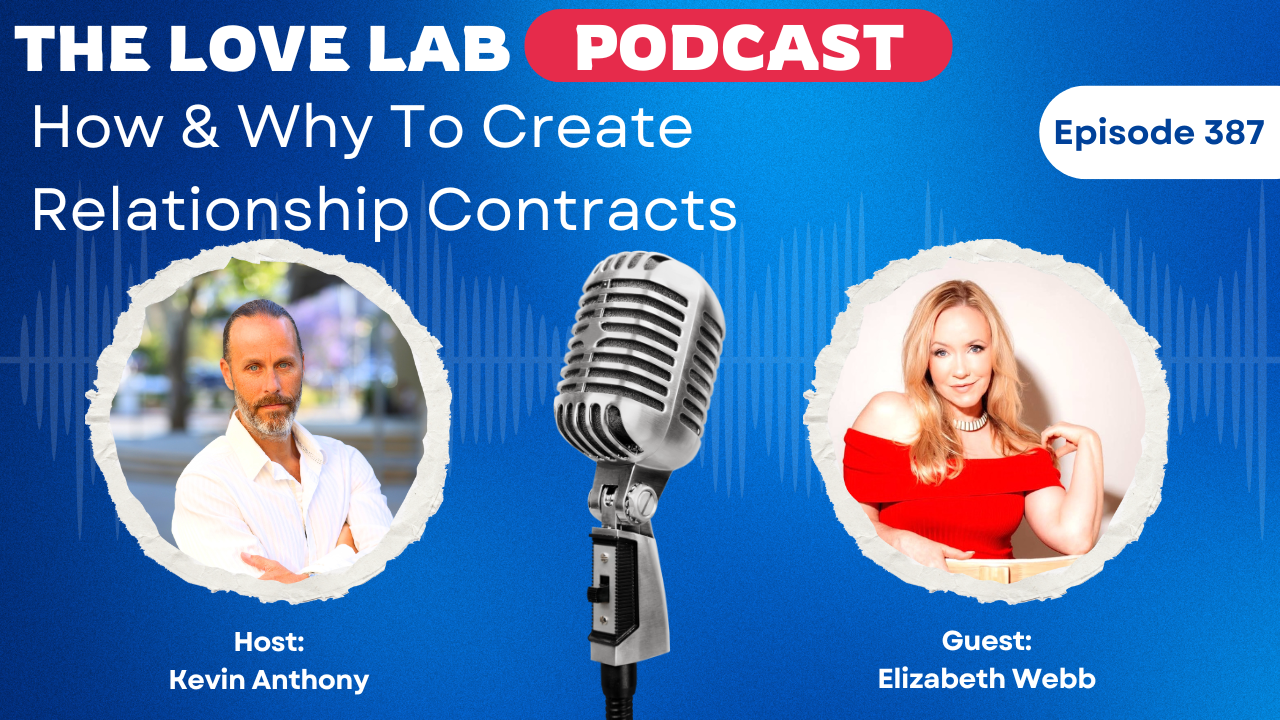
All right, welcome back to the Love Lab podcast. This is episode 387, and it is titled How and Why to Create Relationship Contracts. Some people call them relationship contracts. You could call them relationship agreements, but I think this is, I think it’s an important topic to talk about for two reasons. Number one, a lot of people end up in relationship contracts that they didn’t intend to end up in, and that’s something we’re going to talk about. We’re going to start talking about that, you know, with my guest when we get going with the interview question. So like, how does that happen? Why does that happen? How can we shift that? And then the other part is, how can we create conscious contracts? Now myself, I first came into this concept of relationship agreements, or contracts, from my earlier days when I was younger and involved more in the polyamory community, and in that community, it is a thing, like, people spend a lot of time sitting down, literally drafting documents and having revisions and like, it’s a whole thing in the poly world.
Kevin Anthony 1:36
But the beautiful thing about that is it really taught me the use of these and why they’re important, and how to do it well, so that I could take that into, you know, other situations, not just specifically poly, and so I understand the benefit of it, and I know how important it can be, and that’s why I thought this would be a good topic to talk about on the show. Today, I have a guest who’s going to help us step through these unwritten and also conscious contracts that we create, talk about why they’re important, and how to do them well. So I think it’s going to be a really interesting conversation, as always. Before we get there, a couple of quick ads. We have to pay the bills. You know how that goes?
Kevin Anthony 2:20
All right, ladies, did you know that the overwhelming majority of men consider receiving oral sex in their relationship a must? Well, of course you did, because men have been asking you for it your whole life. But do you feel confident in your ability to give great oral sex if you tend to avoid it because you don’t feel like you’re good at it, or if you feel that you’re pretty good at it, but want to get even better, then my new blow job mastery courses for you, I have teamed up with the amazing coach, read Wong of eternal love, to bring you a practical and easy to follow course that is guaranteed to increase your confidence and skill when giving oral sex to your man. In this course, you will get all the secrets to mastering the art of oral sex with step-by-step instructions and multiple live demos. Go to https://www.sacredfemininearts.com/bjmastery. That is https://www.sacredfemininearts.com/bjmastery. As I say all the time, I never thought I would make a course on that, but when my video on what men consider a great blow job went viral, and the women were all like, Oh my God. I had no idea. I just decided this information needed to be out there.
Kevin Anthony 3:20
And of course, Power and Mastery 3.0, which is the latest version of the popular men’s sexual mastery. Of course, if you’re struggling with erectile dysfunction, premature ejaculation, or simply want to increase your skills in the bedroom, then power and mastery is for you. Join the exclusive club of men who have taken their sexual performance into their own hands and become sexual masters. Mastering your sexuality is a key component to becoming the man that she has always dreamt of and craves. Don’t leave your sexual performance up to chance or the throw of the dice. Become a sexual master today by going to https://www.powerandmastery.com/sexual-mastery. That’s https://www.powerandmastery.com/sexual-mastery. So you know, we’re not just trying to help women improve their skills. We’re trying to help men improve their skills, to empower mastery is a really in-depth. Of course, it focuses on a lot of things, all the things your woman’s looking for, all the intimacy, the before intimacy, the during intimacy, the after intimacy, the sex skills. It’s all in there, in power and mastery. Both of those links are in the description.
Kevin Anthony 4:19
Okay. My guest today is Elizabeth Webb, and she is a practical priestess and an expert in positive psychology and human behavior. For over two decades, she has helped top leaders, celebrities, and change makers break free from life’s shackles, make empowered choices, and live a life they’re excited to wake up to. Elizabeth brings her signature wisdom and wit to her debut book, Made for Magic. Welcome to the show, Elizabeth.
Elizabeth Webb 4:48
Thanks for having me.
Kevin Anthony 4:50
All right, we’re just going to dive right in when we talk about relationship contracts. What does that even mean? Can you please explain to the audience what a relationship contract is?
Elizabeth Webb 5:03
Yes, so a relationship contract is a sacred agreement that is essentially designed for clarity, right? We could make it more flowery. We could make it more complicated than that. But when people start a relationship, and I’m sure you’ve had experience with this, but when people start a relationship, there can be a lot of unspoken expectations, and having specific agreements really is caretaking of the relationship and of the connection.
Kevin Anthony 5:41
Yeah, I completely agree. And I think it’s a thing that most people really don’t think of when they start a relationship. If they think of it at all, if they’re aware of it at all, it’s usually later on down the road when some challenge comes up, and then they decide they have to create some agreements around it. But you could get out ahead of that. If you thought about it from the beginning, like, Hey, we’ve decided that we’re in a committed relationship that we’re going to, you know, take this to that next level and be more serious. So what if we sat down and created some agreements to help guide, you know, the formation and the deepening of this relationship? I wish more people would do that from the start.
Elizabeth Webb 6:22
Totally, yeah. Something that I’ve noticed is that a lot of people get into relationships with people who cannot or will not meet their needs. So this is something that I actually recommend doing before you agree to being in a committed partnership with someone is determining this beforehand, not kind of like signing the lease or getting the CO owned house or, you know, like running to the courthouse or whatever, because you’re in love and it feels good, and you don’t want to kill the buzz by getting this clarity, which can feel like a major buzz kill, to introduce this adulting part of things. And I know that I have made that mistake in the past myself, just going with it and then on the back end of things, really only noticing that someone can’t meet my needs, or I can’t meet their needs once we’re really deeply in it, and it’s very then tethered and difficult to break apart, right? We’re invested, before we even knew what that other person was expecting or hoping or needing from us. So I would say that this relational contract or this relational agreement idea feels unsexy. It feels like a lot in the beginning, and also, the people who are going about love in this way are getting more of what they want.
Kevin Anthony 7:58
Yeah, I always find it interesting that in the beginning of relationships, people want to be on their best behavior, and they’re putting on the best version of themselves, right? And they’re doing all of these things that, of course, are not sustainable long-term in the relationship. And so you’re right, they can end up in a position later on where they realize that this person can’t actually meet my needs, because they probably were not really being totally honest from the start about who they were and what they were capable of, right? And so the idea of sitting down and making these agreements could potentially help you avoid that exact scenario. So yeah, I think that’s a great idea from the start.
Kevin Anthony 8:42
And I want to say too, I’m going to direct this mostly towards men, because I just have to call them out for what it is. As you said, I know it sounds unsexy, right? Like, that’s a phrase that you used earlier. Like it sounds unsexy, I would say that it sounds unsexy to most men, because really, like, already we got to do this. Like, you know, it’s work. She’s a pain in the ass. Like, why do we have to do this? But let me just tell you this, most women, at least most of the women that I would want to date, the ones that I would consider higher consciousness. Not only would this not be considered boring to them, but this would also actually be a turn-on for them. If you actually sat down with them and said, Hey, I’d love for us to set some agreements for the container of our relationship. Most of them would say, Oh, my God, you’re making me wet right now, right?
Kevin Anthony 9:43
Because they understand that value, I think, a little bit better than men do. So I say that I’m directing this to men because I’m like, if you think this is going to be a buzz kill and hurt the relationship in any way, more than likely she’s going to go, Wow, that’s a really mature. Thing for him to do. And I’m so glad that he’s thinking about this and he’s willing to do this with me from the start, like I think that would probably be a turn on for most women.
Elizabeth Webb 10:10
I say yes. I say yes, yes, yes. And it really depends on how the man is being about it, whether he decides to bring this up or not, and it could be the woman who brings it up, or it could be the man who brings it up, right? Let’s say in this case, it’s the man bringing it up. There are so many different ways to frame this, and we’re also talking about something that would take place more in, like, mid-dating, rather than, like, you know, no one’s sitting down. Most people aren’t sitting down and creating joint bank accounts on like, date two, right? This is like date 10 and beyond. Like, okay, these two people we are dating. It’s that we’re into each other. There’s a flow here. We’re going to keep seeing each other. Then that’s a time to, like, create a container. I feel everybody’s got a different timeline for that, but I would say, let me just address that for a second.
Elizabeth Webb 11:13
Let’s say you’re a guy who’s bringing up this idea to your woman. How we feel in your presence is always primary, but how you hold this for us will create a feeling of safety and trust, or it could make us feel highly uncomfortable and weird, depending on how you frame it and how you are about it, like I just had a girlfriend. She played a voice memo for me from a man with whom she’s considering getting back together. She played this for me a couple of days ago, and he sent her a voice note. It was probably she who started it, and I could tell he was going to ramble. So I was like, how long is this? She was like, oh, it’s like 12 minutes. And I was like, I can’t listen to the whole thing, but what I heard was him going in a lot of circles. They’re considering getting back together. He wants to sit down and create a mission statement. He wants to sit down and create relational contracts with her.
Elizabeth Webb 12:23
However, the way he’s being about it and presenting it to her was so feminine and scattered and rambling, and there was so much uncertainty and fear mixed into his message. So it was like, oh, I want to sit down, and I want to create this mission statement for you. I’m not sure if I can even meet your needs, but I need to understand your needs, and I need to. And she played it for me for like, a little too long. And I was like, wow, how does that feel for you? And she was like, feels complicated. And I was like, sounds really feminine. Like, yeah. Like, not wet, right? Like, no. We were both like, you know, not a hell no to him. But just like his presentation of this container didn’t feel containing. It felt leaky, messy, rambling all over the place, unsure, fear mixed in, along with this desire to create agreements with her. So we’re all human. His purity of heart was in it, right?
Elizabeth Webb 13:31
But if you’re going to do this, guys, we want to feel the trust, ability, and your certainty of, like, Hey, I love, I love what we’re doing. I want to make sure that we’re on the same page about some things. So, how about we get together for a little bit of time and just, I’d like to hear what’s on your heart about what a healthy relationship actually looks like for you, like, what do you need in order to feel like our dynamic is healthy?
Kevin Anthony 14:07
This is a great point that you brought up because, you know, this is really a whole other topic, right? Because we’re talking about relationship contracts, but you also brought up this, this fact that there’s a polarity that’s created in relationships, that’s basically what you’re describing. And when a man comes from the place of fear and neediness and, you know, insecure attachment and scattered chaos and all of that, it doesn’t come across in a way that feels masculine, safe, that she can trust that it’s an actual container. It just feels like chaos.
Elizabeth Webb 14:50
Yeah, word vomit on The Voice Note, totally.
Kevin Anthony 14:54
So that is, that is a good point for men. You know, it’s only going to land well. All, if you can deliver it with a little bit of confidence, and like, Okay, here’s what I need, here’s what I want, here’s why I need it, here’s why I want it. Let’s do this, right?
Elizabeth Webb 15:10
Sure, and because we’ve given this masculine way of being about it, I would feel remiss to not talk about, like, the feminine side, right? If you want to create a set of agreements with your possible future partner. So we’re talking about people who are entering a new relationship, it would be like, really coming from your heart, right? And being like, I’m feeling really good about this dynamic and being with you and spending more time with you, and I want to make sure that I’m not projecting or making things up in my brain about what it is that you need, or think about a healthy connection. And it would feel amazing to hear from you and hear your thoughts on what makes up a healthy dynamic for you and what you need in order to be happy long term.
Kevin Anthony 16:11
Yeah, one of the things that I always suggest whenever the feminine wants to communicate something to the masculine, especially something that’s important, that she not just go with. Here are the facts of the matter that she also shares. Here’s how I feel about it, and why, right? So, the underlying, and this is something a lot of women don’t get, and it’s unfortunate, because our society has done such a good job of feminizing men and masculinizing women that we’ve kind of lost this idea. But, you know, a lot of times for men like us, in the facts all the time, we’re like, just, just the fact,s man, like, we’re stuck in that sort of male, you know, super focused, you know, factual kind of brain.
Kevin Anthony 16:54
And so for us, we might look at a situation, you know, something, some dynamic that’s happening between ourselves and our woman, and think, Well, what’s the big deal? Like, the facts are this, like, it’s just the fact. Like, it’s not that big a deal, like, whatever, you know. But the reality is, is that to her, she’s not necessarily just dealing with facts. There’s emotions underneath that, right? And if she doesn’t share with us what the emotions are, sometimes we just don’t get it. And this is where you hear men say, I don’t understand what the big deal is. You don’t understand what the big deal is because you don’t understand the emotion that’s attached to whatever the request is. So that’s why I tell women all the time, if you can share, hey, here’s the fact. And if you were able to do this, or whatever the situation is, it makes me feel like this, and if you were able to do the thing I’m asking for you, I would feel like that.
Kevin Anthony 17:51
Now I know I’m speaking in vague generalities, but it’s the kind of thing, like, if we bring it back to relationship agreements. The fact is, I would like to have a relationship agreement, but then he might go, really, relationship Okay, whatever, blah, blah, blah, like, but if she were to share, I want to create relationship agreements, because by doing that, I will feel safer with you, and when I feel safer with you, I’m able to open up more, and when I’m able to open up more, I can share More Love with you. I can feel more connected to you, right? All of a sudden, he goes, Oh, whoa. Okay, that’s a whole different story than just creating agreements, right? So to your point, right? If you can communicate from the feminine sharing the emotions behind the needs, it goes a long way, much further than just sharing the need itself.
Elizabeth Webb 18:44
Agreed.
Kevin Anthony 18:47
I know we have a little bit shorter time today, because you have a busy schedule, and I want to make sure that we talk about the differences between unspoken contracts and spoken contracts. So want to shift the focus a little bit from what we’ve been talking about, and talk about unspoken contracts, because thus far, we’ve been talking about two people. They start dating, they decide they’re going to be serious, and then, you know, how do they go about sitting down and, you know, deciding, you know, how to start this process, and we’ll get more into that. But what about people who didn’t focus consciously on this, but have dated for a while, and there’s this idea that these unspoken contracts sort of get written without us even knowing. Explain to the audience what an unspoken contract is and how they happen.
Elizabeth Webb 19:35
So an unspoken contract comes from a pattern between two people that keeps playing out. So when you’ve fallen into a pattern with someone, there is this expectation on both sides, really, that this is part of our relational dynamic. So it could. Be as simple or nuanced or invisible as you like, you’re the strong one. I’m the weaker one. I’m the weak one. You’re the strong one. I lean on you most of the time because that just might be how the dynamic is. I’m gonna say some things that aren’t ideal, right? Like, we’re not like, oh, I don’t want that. Nobody wants to be the strong one all the time, and no one wants to be the weaker party all the time. But there are some relational dynamics that just fall into that this one’s the mess, and this one always has it together, right?
Elizabeth Webb 20:35
That can be an energetic agreement or an unspoken contract that just happens as a pattern over time. Or this person always pays the check, and this person doesn’t pay the check, or this person is always 20 minutes late, and this person is always there, waiting for them for 20 minutes, and they’re on time. So these are some examples of less-than-ideal relational contracts that are unspoken, that we fall into and we let play out, because we never say anything about it, and it’s only when we shine a light on something and go, oh gosh, like I feel like every time I’m with this person. I’m feeling drained, but I love them, like, what’s up with that? Oh, well, what’s the unspoken contract here that’s playing out? Oh, it’s that they come to me for support. It’s that they show up, maybe unregulated, and regulate from this well over here, and that’s part of our unspoken contract. I know I’ve definitely had that before, where the guy is, like, always really out of whack with his nervous system, and then we hang out, or we spend time together, and he’s like, Oh, this is so good for my nervous system. And I’m like, oh, it’s not for mine. Oh, well, I’m glad your nervous system is feeling amazing. Mine actually isn’t. This is unsustainable for me.
Elizabeth Webb 22:14
So with that particular gentleman, I realized that regulating himself and then showing up grounded was just not on the table, like it wasn’t an option with that particular individual. And there was an unspoken contract between us that I was cool, calm, and collected, and he was volatile, and like I grounded him, and he was the, you know, crazy, visionary, and we broke up over it. I was like, this unspoken contract sucks. This is a very good deal for him. So that’s one example, like real life example, right? And then there’s the thing that’s financial, there’s the thing that’s energetic. There are things that are about time, you know, I always come to you. You always come to me. So some of these relational contracts that are unspoken, they work for us. We’re like, oh, you know, I always go to her. She always comes to me. But we make it up. In other ways, it’s feeling reciprocal. In these other ways, it doesn’t matter we’re not counting because we’re both getting enough of what we need. In other ways, this can be unbalanced. True relationships are literally never 50/50; it’s just not. It’s never going to be even it just for both people needs to be, like, super worth it.
Kevin Anthony 23:39
And this is what brings me to the next question, which is, what is the main problem with these unspoken relationship contracts? So you just mentioned now that some of them aren’t necessarily a problem, but some of them are necessarily a problem. So why are these potentially such a problem in relationships?
Elizabeth Webb 23:58
Well, why would you think it might be a problem?
Kevin Anthony 24:04
Well, the number one reason is that we’re not voicing these things. We’re not communicating about them, and generally, one side or the other will build resentment over time as a result of it. That’s kind of the number one issue. Is like, yeah, bingo, yeah. Like you were just saying with your example, right? It’s like this was not helping your nervous system at all, and the longer you stayed in that, the more resentful you’d become over the fact that every time I spend time with this guy, I have to then go, like, meditate for two hours and take a bath and, like, try to re-regulate my nervous system.
Elizabeth Webb 24:37
Right? It started feeling like a liability, energetically, emotionally, for me, and I saw a path of a woman who would become bitter and resentful, right? So when we’re on a path that doesn’t work for us too long, that’s when this jadedness, this hardness, this um. Resentment, your word this, like resentment builds up, and none of us are at our best when we’re tolerating and there’s a pattern of toxic toleration that just looks like, wow, this really doesn’t work for me, and I just keep doing it, and I never really took the moment to shine a light on it or name it.
Kevin Anthony 25:23
Yeah, and I use the term resentment because it’s one of the things I see so so often when working with couples, for instance, you know, something happens in the relationship and they show up to their session and they are just off the hook about it, just like it’s such a huge thing, and the other partner on the other end is going, I don’t know, I don’t get it. I don’t see it’s really not that big a deal, right? And so what we have to generally get that person who thinks it’s not that big a deal to understand is that, yes, that one little thing isn’t that big a deal, but because there’s a mountain of resentment underneath it now it is a big deal, right? Because it’s been building, building, building over time. So what you really want to do is you want to be able to address those things in the moment when they happen, so that you don’t end up with a mountain of resentment over here that gets triggered later on by some small thing. Totally. So I sort of answered the question, right? But I want to hear your take. I love your questions. I want to hear your take on it, which is like, okay, so how then do people avoid having these unwritten contracts? Like, what can they do to avoid being in these sorts of things that create resentment?
Elizabeth Webb 26:46
Well, firstly, let’s know that none of this is going to be perfectly clean, and we can’t, even with the most likely planning and consciousness, avoid any of this, because it’s two humans coming together and just relating. And there are things that we don’t even know that we need until we don’t get it right, or things that we know that we cannot stand until it happens over and over again. So we might not even be able to predict all of the possible relational contracts that we end up in, because we can’t predict what that other person’s going to do, or, like, their childhood, what they’re coming with, their relationship history. So just know that, like, a lot of this is just going to have to, like, be handled along the way, and that that’s perfect, right? Go, oh, this is out of whack for me. That’s course correct. I’m feeling less close to you. What’s happening here? Why? Okay, let’s course correct.
Elizabeth Webb 27:46
So handling it on the way is a really beautiful way to just navigate it. It’s part of the dance, and not all of this can be done in advance, right? But getting clear on your needs and what they look like, not all of your desires, which is a beautiful thing to know as well, but like, the bare minimum of like, without these brass tacks, I’m not able to be in a relationship. So that’s different for every person you know; some people need a date night once a week. Some people need a date night once a month. Some people need to be together every day. Some people don’t want to be together every day. Some people want to share a bed. Some people don’t want to share a bed. Some people want to mix finances. Some people don’t want to mix finances. So some of this can be handled preemptively, but, like a lot of it, it’s just being in the dance, and when something’s feeling really off, it’s owning, like, Ooh, I’m feeling triggered right now, or I’m feeling less close to you. Let me take a moment and feel into why? Like, what’s going on? Oh, it’s this thing. I’m feeling taken for granted. You know, that’s a thing for women that I hear a lot. I don’t know if that’s a thing for men. Do you think that’s also a thing for men?
Kevin Anthony 29:17
Feeling taken for granted can sometimes be a thing for men. The way that would usually show up for us is if we feel like it’s not just about paying for everything, but if it feels like you know she’s always wanting, oh, you need to get me this, you need to do this, or you need to do that, you need to do that, and he doesn’t feel like she’s contributing in some other way to that relationship, then Yeah, sometimes that can be an issue for men. I would say it’s probably a little bit less often an issue for us than it is for women, but it can be.
Elizabeth Webb 29:49
Okay, got it, yeah. So think getting clear about your own needs and the desires and all the juicy, you know, extras, that’s a separate conversation, and I love that conversation. But right now, for the sake of relational contracts, it’s really about making sure that the brass tacks are in place and that the person is interested in meeting your brass tacks, right, that they can and that they’re willing and able, and then being willing to dance through the relationship and course correct along the way. That’s the kind of connection that we’re talking about.
Kevin Anthony 30:29
Yeah, I’m glad that you added in that idea of, as you put it, knowing what your brass tacks are, right? Because where this process really starts is with yourself. Just like everything in life, pretty much it all starts with you. Unfortunately, in relationships, people are like, well, he does this, and she’s that, and he won’t, right? It’s like, okay, first, let’s look at ourselves, see where we’re at, so understanding what it is that you need in a relationship, right? What are your, you know, brass tacks, as you put it, or your must-haves right, and also your deal breakers, getting really clear on that minimum standards exactly, and then, when you’re starting a relationship, clearly communicating those things to your partner. And I also like how you pointed out that there’s no way you could possibly anticipate everything from the start, but if you can just lay that foundation right?
Kevin Anthony 31:23
One way you can avoid getting into a relationship that you know is not going to work. So you’re setting kind of a foundation there, right? And then if this person is okay with those agreements from the start, so now you’ve got at least a foundation to work from, and then you just need to be open to, you know, basically renegotiating as you go along, and you get to know each other better. So that, of course, then leads us to, okay, so that’s a strategy for avoiding the unwritten contracts. Let’s talk about how we actually sit down and consciously create these contracts, because we’re suggesting to people, if you want to avoid unconscious ones, you’ve got to actually make some conscious ones, right? So then that begs the question, how do we do that? However, I’m going to pause for a short break when we come back, that’s what we’re going to talk about. We’re going to talk about creating conscious contracts. And how do you even go about doing that? And how do you do that in a way that doesn’t trigger your partner? How do you do it in a way that actually brings you closer together, rather than making you feel further apart? So we’re going to talk about that just on the other side of this break.
Kevin Anthony 32:34
Are you a couple? Are your relationship and sex life where you want them to be? Are there changes that you would like to make, but just don’t know how? Maybe you think there is nothing that can be done if you’re not 100% happy with where your relationship or sex life is, then get help today and change your life. Go to https://www.kevinanthonycoaching.com/couples/ and schedule a strategy call with me today so we can map out a strategy to get you where you want to be, so you can have it all your way. That is https://www.kevinanthonycoaching.com/couples/. And of course, creating relationship contracts or agreements are absolutely one of the many, many, many things that we can work on when it comes to couples coaching. So if you are listening to this and you’re thinking, wow, you know, that sounds like a great idea. I need that in my relationship, but I have no idea how to get started. Well, that’s one way you can do it. And of course, at the end, I will be giving Elizabeth an opportunity to share where you can find more about her work, too, and I know she’s got a book out and all that, so I’ll let her talk about that in just a little bit.
Kevin Anthony 33:38
So let’s talk then about conscious contracts. So we’re suggesting to people that it’s a good idea, not only in the beginning of a relationship to map out some basic contracts, but also as you go through the relationship, as it develops, as it deepens and you get to know more about each other, things will inevitably come up and creating some agreements around that would be a healthy relationship practice. So I know the first question you know anybody listening to this has is, like, the fuck do I start that conversation? Like, how does somebody begin to approach this topic?
Elizabeth Webb 34:17
So what would be the specific so, like, let’s be one of your coaching clients for a second, or be yourself, whichever one is okay, and come to me. Yeah, like, role-play a question with me so I can actually, like, answer it in real time.
Kevin Anthony 34:33
So let’s, let’s start with the scenario of I’m a male client. I’m coming to you. I’ve just started dating this new woman, and I’m pretty into her, but I’m feeling like, you know, maybe there’s a few things I’m not sure about, and I want to have this conversation with her about setting some basic agreements, but I’m afraid that if I do that, she’s going to somehow think it’s weird or. Or, like, not respond well to it, and it might jeopardize the relationship.
Elizabeth Webb 35:06
Okay, so how long have you guys been dating?
Kevin Anthony 35:09
About six months.
Elizabeth Webb 35:12
Six months. Okay, so you’re pretty invested then at this point,
Kevin Anthony 35:16
Well, we started kind of casually, like the first, you know, two months or so. We only had a couple of dates here and there, but the last couple of months, it’s been getting more serious. And, you know, I’ve been, I’ve been thinking that, you know, yeah, she, she could maybe be the one, but I don’t know. I feel like there’s, there’s, there’s a couple of things that we really just have to figure out.
Elizabeth Webb 35:37
What’s one of the things that you have to figure out?
Kevin Anthony 35:41
Well, I kind of feel like there’s some expectations in the relationship, and, you know, I’m not really sure how to, like, I’m not really sure how to bring that up to her about, you know, like, some of the expectations I feel like she has.
Elizabeth Webb 35:57
Okay, so what’s going to get? The best possible answer would be to hear what needs you’re either not getting met, or you’re afraid will not be met. So that could be like not enough time together. It could be financial. It could be, you know something about resources energetically, but being as specific as possible is what’s going to lay the groundwork for her to actually understand and for there to be forward movement.
Kevin Anthony 36:34
Yeah, I’m doing my best with improv here to come up with an entire relationship in the moment. Okay, how about I’m feeling like she’s not making the relationship enough of a priority.
Elizabeth Webb 36:52
Perfect with time?
Kevin Anthony 36:56
Yes?
Elizabeth Webb 36:57
So she’s choosing her time in a way that isn’t making you feel important. Yes, great. So then you get to have a relational contract conversation around how much time you want together in order for the dynamic to be healthy for you and healthy for her.
Kevin Anthony 37:18
But you know, I’ve tried to bring it up in the past, like, you know, the fact that she doesn’t really make me a priority, and, like, if her girlfriends are doing something, she jumps on that rather than check in with me first. But she just gets annoyed with me, and, you know, says I’m being, you know, needy or whatever.
Elizabeth Webb 37:35
Okay, so this is the perfect opportunity to get something in your relationship as an agreement that is based on facts, and because you’re the man, you get to create the masculine structure of how you guys both get your needs met for quality time? And it sounds like she might have a higher need for freedom than you have. That’s possible, from what you’re telling me, it’s possible that you desire a little bit more togetherness, and she desires a little bit more freedom. So what’s beautiful about this agreement is this is going to either reveal a major incompatibility, or it’s going to make you guys closer than ever. So I would go to her, and I would structure it like this. I would make sure that you are not in a moment where you’re activated, or where you’re pissed off, or where you’re feeling disappointed by her. I would really get grounded in your confidence, in your masculine power.
Elizabeth Webb 38:46
However, you do that and request a conversation with her. You know, just when you’re together next, you could say, is this a good time to check in about something with you? She can say yes or no, right? Because it might be like, No, I’m overwhelmed. Today has been crazy. This isn’t the right time, or it can be like, yeah, babe, I’ve got space. Sure? What is it? So I would just do a temperature check, but also read the room. If she’s overwhelmed, anxious about something, not the right time, catch her at a time when she’s seeming spacious, and she’s also consenting to having this check-in. And I would start with asking her how much time together really would feel desired and healthy for her, and let her just have the space to tell you, without even imposing any of your needs or desires at first. And let her say, you know, I like to be able to do whatever I want, whenever I want, or less. That some people feel that way, truly. They’re like, well, I want to do whatever I want whenever I want.
Elizabeth Webb 39:58
And if I see you some of the. Time, that’s great. You’re my casual part-time boyfriend, and it needs to work for me. Or it could be like, Well, I never really thought about that, and let her just share, don’t interrupt. And then after hearing her fully come to her with a proposal of how much time you’d like to see her. Like, listen, we’re in a committed relationship. I’m not seeing anyone else. And really to feel happy and satisfied and think that this is something that I’d like to continue to invest in. I really need to see you three times a week, and I need to know what nights those are, so that we can, so that I can plan my life around, so that I can say yes to guide time or yoga or work late and not like, think that I have to, like, catch you at the right time. And you know, does that work for you? Yeah? And let her say yes, let her say no, let her talk it through, but come with an open heart to fully listen, and also come with an idea of your brass tacks, like maybe three is the ideal, but you could live with two, or maybe to be in a committed monogamous relationship, you really need five. You’d like to be together every day, but the five will work two days off if you’re trying it on for marriage or to be the one. For some people, that’s true. Some people, they want to be together once a week. Some people want to be long distance, like, find out what planet she’s on about this, and share your own needs, and be willing to also hear answers that you don’t like.
Kevin Anthony 41:53
So if anybody who’s listening there, we did a little role-playing there of what that conversation might look like. And then, of course, there were lots of great little bits of advice along the way on how to do it. So hopefully that was a good example for you, just to reiterate a few of those things. Obviously, know what it is that you need, communicate it to your partner, give them space to actually share with you what it is they need, right? So don’t talk over them. Just let them say, here’s what I need, right? And then come to some agreements on what works for you. And one of the things that you said, which is very, very true, which is that, you know it’s going to be it’s going to be different for everybody, in other words, like, you know what she’s needing in that situation might be different than what you’re needing.
Kevin Anthony 42:44
And so you get to work together to see if we can negotiate something that works for both of us? And unfortunately, sometimes, even when people are doing this, like when they’re actually looking for the person that you know they think is going to be the one, and they’re taking action in ways like this, they will often look at it and go, Well, it’s just different. You know, the way she operates or the way he operates is different for me. So this, therefore, they’re not the one. And it’s like this idea that you’re going to find somebody that’s matched the same as you in every level,l like that is nearly impossible.
Elizabeth Webb 43:18
You will be so bored.
Kevin Anthony 43:21
So you get to work together, and that’s part of the process, right? Is working together to see what works for both of you, and also not compromising so much that you’re going to have that resentment that we talked about later on down the road. So I know we’re running out of time here, but I got a few more moments with you. So I’m curious what your thoughts are. You know, in the I mentioned early in the beginning of this that, you know, I had some experience in the poly world when I was younger, and that really taught me a lot about agreements. And one of the things that I found was really important back then was to actually write the agreements down. What are your thoughts on that?
Elizabeth Webb 44:09
Oh gosh. You know, I haven’t recommended to clients to write it down in the past, but I actually think that’s a really good idea.
Kevin Anthony 44:23
Well, I’ll tell you where that comes from.
Elizabeth Webb 44:25
It depends on the personalities, also of the two people, right? Because if they’re both pretty cognizant, it’s like, do you agree? Try out making an agreement with somebody, and if the the verbal agreement, if it sticks, and if it goes into practice, and if it becomes a new standard in the relationship, and it moves forward like that, I wouldn’t write it down, but if you have someone who has a history of like remembering the version that’s better for the. Am, then maybe do write it down?
Kevin Anthony 45:04
Well, you know that that idea comes from just having witnessed quite a few people in the poly community who didn’t write it down and then ended up having different ideas of what that agreement actually meant. And I have an actual personal story from my own, my my partner at the time, this is quite a few years ago, but my partner at the time and I, we were on our way to a weekend long sex positive event where this group took over an entire hotel, and there were workshops, lectures, parties, all kinds of stuff going on. And we had with us a friend of ours who was just basically hitching a ride out there with us in the car. And so, you know, it’s like a two and a half hour drive out to this place. And our friend says, So what are your relationship agreements for this weekend? And I pause, I was giving my partner an opportunity to, you know, speak up. I’m driving anyway, you know. And she turns around, and she says, Well, we don’t have any I’m like, swerving the car as I look at her go, you talking about, we don’t have any I go. And then I just list we had, like five main agreements that we had talked about beforehand, earlier on in our relationship.
Elizabeth Webb 46:11
Typically, for that weekend, or are they just relational agreements? And she was like, Oh, well, they don’t apply to this weekend?
Kevin Anthony 46:21
Well, yes, they so they, we didn’t this is, this was our mistake going into this is we didn’t specifically beforehand talk about that particular event, but we had prior in the relationship. Talked about, here are our agreements for our relationship. So in my mind, it was like those are still in effect. Nobody ever said they weren’t in effect, right? But it just blew my mind in that moment that, from her perception, we didn’t have any relationship agreements. And I remember even saying in the car right then, I’m like, we need to sit down and write this down, and I’m going to put it on a doc on my phone that I can share with you digitally, so you have a copy, and I have a copy.
Kevin Anthony 47:03
So anyway, I was just curious what your thoughts were, because I’ve seen a lot of times where people, I mean, that was an extreme example where she was like, we don’t have any, and I’m like, wait. But I’ve seen a lot of examples where people like, yeah, we have agreements, but we have a different understanding of what those agreements are.
Elizabeth Webb 47:21
What a beautiful point. You know, I haven’t recommended that in the past, but I had never really thought about the idea of writing it down, which definitely creates another level of commitment. I would definitely not recommend that in early dating. It’s just too much. It’s just too much for a new connection, but mid-level dating, committed, monogamous or poly, like when you’re really in the dynamic, and you’re definitely in a relationship, why not write it down?
Kevin Anthony 47:58
Yeah, I completely agree, and I think caretaking the connection, right, absolutely. And, you know, I think anytime that we can take steps to avoid misunderstandings or confusions or, you know, disagreements, I think it’s worth doing so. And these things can be complicated. I mean, you mentioned that at the very beginning, like these things aren’t necessarily simple and easy, right? And we all have our own ideas of what we think certain words mean. You know, especially myself, having dated multiple people from different cultures than mine. And you know my wife, you know when she was alive, she was born and raised in a completely different country, spoke a different language. And so, you know, our understanding of what the words mean sometimes isn’t exactly the same, and that can create problems, especially with agreements around things like, you know, girlfriends or boyfriends or whatever you’re allowed to hang out with outside of our relationship, right? Like, those can be big points of contention in relationships. So totally. All right, I know I need to let you go because you are pretty much out of time, so I’ll have to save the rest of my questions for another time.
Elizabeth Webb 49:14
Yes, maybe around two. You never know.
Kevin Anthony 49:18
That’s right. But before you go, please let the audience know how they can find more of you, your work, your book, and anything else you want to promote.
Elizabeth Webb 49:28
Oh yeah, thank you. So it would be my honor if you would check out my book. I’m so excited about this book. It’s called Made for Magic. It is a book that is for women about how to feel energy-rich and magical in a very draining, chaotic world of responsibility and problems. And exactly how do you do that? And it’s such a juicy read from my clients, my friends, people are just tearing through this book. They finish it usually just a couple of days, because it’s hard to put down. So you can find the book on Amazon or on madeformagicbook.com, which is madeformagicbook.com, and if you want to go there, you can even get the first chapter for free. And just see if it’s your cup of tea or your cup of bourbon, whatever you like. Just give it a little try.
Elizabeth Webb 50:24
And if you know you want the book, you can go on Amazon and get it. It’s made for Magic by Elizabeth Webb, and I have free resources. I’m positively Elizabeth on Instagram, and that’s my website as well. Positively, Elizabeth and I send out all kinds of free articles about positive psychology and relationships and juicy stories about my own life and clients, and just share as much light and practicality as I can at the same time. So feel free to be in my world and get in on this, get in on these tools, and all this transformation. Awesome.
Kevin Anthony 51:04
Well, I encourage everybody to go check out the book. And of course, the link to Elizabeth’s website, positivelyelizabeth.com will be in the description, so you can find that there, as well as finding her on social media. So Elizabeth, thank you for coming on the show and sharing your wisdom with the audience.
Elizabeth Webb 51:24
Thanks for having me.
Kevin Anthony 51:27
All right, everybody, that’s all the time I have for this episode, and I will see you next week.
Kevin Anthony 51:38
I hope you liked this episode of the Love Lab podcast. If you enjoy this show, subscribe, leave me a review, and share it with your friends, and for more free exclusive content, join me in the passion vault at https://www.kevinanthonycoaching.com/vault/. That’s https://www.kevinanthonycoaching.com/vault/. Thanks for listening, and remember, as Celine used to say, you’re amazing!

Kevin Anthony is a Certified Sexologist, Tantra Counselor, NLP Practitioner and a Sex, Love & Relationship coach. For over 10 years he has worked with men, women, and couples to have the relationships of their dreams, and the best sex of their lives! He is also the host of “The Love Lab Podcast”, creator of the popular YouTube channel Kevin Anthony Coaching, and creator of the popular online course series “Power and Mastery” as well as other online courses for both men and women.