Kevin Anthony 0:00
Welcome to the Love Lab podcast, the place to be for honest and real talk about relationships and sex, whether you’re a man or woman, single or a couple, this is the show for you. I am your host, Kevin Anthony, and I am here to help you have the relationship of your dreams and the best sex of your life.
Kevin Anthony 0:27
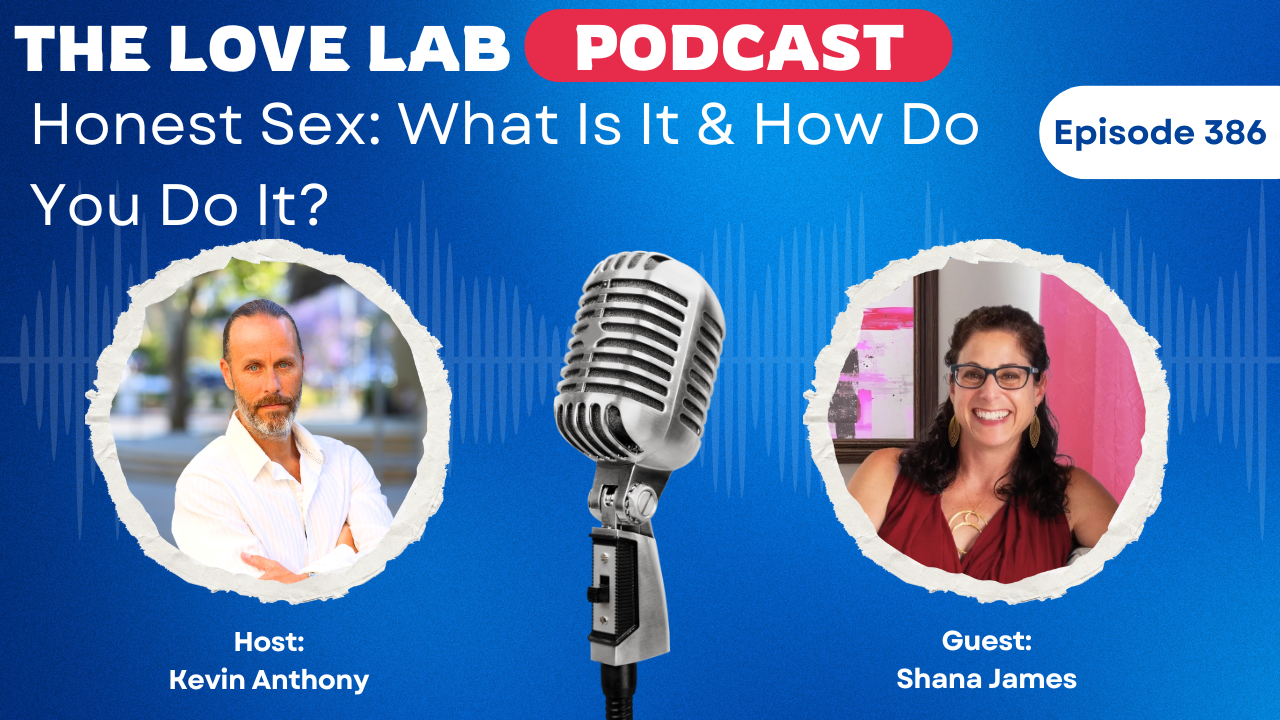
All right, welcome back to the Love Lab podcast. This is episode 386, and it is titled Honest Sex: What is it and how to do it? I have a guest on the show today who I’ll introduce in a little bit, and she actually wrote a book called Honest sex, and I am really curious to know what her idea of honest sex is. I know I have my own ideas of what I think that means they may or may not be the same, but I’m really curious about it, because I think that in our relationships, whether it’s we’re dealing with a relationship issue, or just in our day to day relationship, or we’re dealing with sex, I think the idea of honesty is critically important to the health and success of a relationship, and I think especially when it comes to sex, Too many people don’t share what they really want, don’t don’t ask for what they want. They get performative, even at times, right? And none of those things are really honest, and that can have some pretty negative impacts on your sex life. Can have some short-term negative impacts, like we didn’t get your needs met, but it can also have some long-term negative impacts as well.
Kevin Anthony 1:44
And so I think that the more honest we can be in our relationships and in our sex life, the better our relationships are going to be, and the better, the higher quality our sex life is going to be. And so I’m excited to have this conversation. I want to know, you know, what really is honest sex from, you know, somebody that has spent a lot of time, you know, diving into it. And you’ll hear in her bio what her background is, and I think it’ll make more sense why she’s so focused on, you know, what we call honest sex, when you hear about her background in teaching authentic relating and communication and stuff like that, because that all blends in with what we’re talking about here. Okay, before we get there, though, got to read a couple of ads. Got to pay the bills.
Kevin Anthony 2:36
All right, ladies, did you know that the overwhelming majority of men consider receiving oral sex in their relationship a must? Of course, you did, because, well, men have been asking you for it your whole life. But do you feel confident in your ability to give great oral sex if you tend to avoid it because you don’t feel like you’re good at it, or if you feel that you’re pretty good, but want to get even better, then my new blow job mastery course is for you. I have teamed up with the amazing coach, Ry Duong of Eternal Love, to bring you a practical and easy-to-follow course that is guaranteed to increase your confidence and skill when giving oral sex to your man. In this course, you will get all the secrets to mastering the art of oral sex with step-by-step instructions and multiple live demos. Go to https://www.sacredfemininearts.com/bjmastery. That is https://www.sacredfemininearts.com/bjmastery. That link is in the description, of course. And I say this whenever I read this a,d like never in a million years did I think I would make a course on how to give blow jobs. But when I did a YouTube video on what men think is a good blow job, the feedback from women blew my mind. I can’t even begin to tell you how many women were like, I had no idea. Oh, really. Oh, I’m not. I haven’t been doing it like that all you know, like, I was just like, Okay, there’s obviously a need for this. So, you know, if you want to be better at it and you want to enjoy it for yourself, because there is a component in there about how you can enjoy it for yourself. This isn’t just about giving to your man. Then go check that out.
Kevin Anthony 4:04
And of course, power and mastery 3.0, we’re not just trying to get the ladies’ skills up to speed for many years, going all the way back to, I think, 2015, I have had a version of power and mastery out there, which is the popular men’s sexual mastery course. And this is where we help men with erectile dysfunction, premature ejaculation, and, of course, sex skills. So if you want to join the exclusive club of men who have taken their sexual performance into their own hands and become sexual masters, then check out https://www.powerandmastery.com/sexual-mastery. Because mastering your sexuality is a key component to becoming the man she has always dreamt of and craves. Don’t leave your sexual performance up to chance or the throw of the dice. Become a sexual master today by going to https://www.powerandmastery.com/sexual-mastery. That link is also in the description, guys. It is 2026, there is no excuse to show up to your relationship and yourself. Sex life with poor skills, right? You just there’s just no excuse for it anymore. Of course, there’s no excuse for showing up with poor communication skills or lack of honesty, or any of the other things we’re going to talk about today, until I have a course for those, at least get your sex skills up to par. All right, enough of all that stuff.
Kevin Anthony 5:23
All right. My guest today is a relationship and dating coach for 20-plus years, and Shana James has humbly discovered the causes of disconnection and distrust in relationships, as well as how to build trust and keep passion alive. Shanna has facilitated decades of authentic relating workshops based on her training in communication, mindfulness, psychology, and sensuality, and specializes in helping clients date and create healthy relationships after 40. Welcome to the show. Shana.
Shana James 5:53
Thank you. It’s actually Shaina.
Kevin Anthony 5:55
Oh, sorry, I should have asked you that.
Shana James 5:58
Should I say it right in the middle? Or should I see it after? I guess we can cut this part out.
Kevin Anthony 6:03
That’s okay. You know, the thing about this show is, it’s real, and it’s raw, and it’s live, and if I screwed your name up, I’ll take the blame for that. I screwed your name up. I did not ask you if it was Shaina or Shanna ahead of time. So thank you for correcting me. You’re welcome. All right. So we’re talking about honest sex here. And as I said in the intro, I was like, I have some ideas of what I think it means, but tell us, from your perspective, you wrote the book on it, what does honest sex actually mean?
Shana James 6:36
Yeah, well, to me, honest sex means a lot of what you said, right? That we actually, we know ourselves. We’re honest with ourselves about what we like, what we don’t like, and what we want. I mean, to the degree, I think some people talk about it as sexual sovereignty, right, like you really know your own body, you know your own emotions, you know your own energy. To the extent that you’ve, you, you’ve explored, right? You’re not just kind of sitting around like, Oh, this feels good. You’ve explored the, the range, I would guess, I would say, of sexuality.
Shana James 7:17
So you know yourself. You also know the person or people you’re having sex with, and you would be able to say, you know, this is what they like, this is what they don’t like. This is right again. It’s it can change in the moment. And then the other piece of honesty is that you can speak up in the moment when you’re noticing, oh, I’m disconnecting, or something isn’t quite going the way that it feels pleasurable and amazing, or I notice over there that the person I’m having sex with, something seems disconnected or distant or not as pleasurable, right? So again, I’m kind of giving this whole stoop, but it’s like, I know me. I know the person I’m having sex with, and then in the moment, we have this honest communication or intimacy together, such that we are, you know, creating it.
Shana James 8:15
To me, I just thought of like, it’s like a symphony, but we’re, we’re practicing such that we could even say, hey, that note feels a little off. It’s not a blame, shame, or a tag game. It’s not about taking it personally. It’s just about, let’s really be honest here, so that we can create the best music we can create. I’ve never said it that way. It feels a little funny, but you know what I mean?
Kevin Anthony 8:43
Yeah, I think it’s, I think that’s a really great analogy. Is to use music, and, you know, as a musician myself, it’s one that speaks to me. But like this idea that when you have multiple musicians playing together, yes, right? You have to be, well, you have to at least first be in the same key, right? And you have to play things that worked with each other, yeah?
Shana James 9:08
And you know, you’re paying attention to each other as you’re playing, you’re not just doing your own thing, absolutely.
Kevin Anthony 9:15
And if we really want to go deep into the music analogy in general, with most music, you have to really be paying attention. You have to, obviously, be in the same key, and you have to be doing things that fit, you know, the rhythm and the melody of the song. Now, if we take that one step further, if you want to do things outside of that, we can compare it to jazz, right? So jazz goes outside a lot. However, jazz goes outside only because their skill level is so high, yes, that they can comfortably do that without turning the entire thing into a train wreck.
Shana James 9:58
So they trust each other. Yeah, there’s a. There’s the skill plus the trust plus the they’re paying attention, right? They’re listening to each other and attuning to each other, right?
Kevin Anthony 10:09
Yeah. And so if we bring that back to relationships, it’s like you have to have that level of attunement and that level of trust and that level of skill, and then if you want to go a little bit outside. You can do that safely. But this, this kind of actually leads me into my next question, which is, you know, the question I wrote was, you know, what do most people think is honesty and sex in relationships? Because, you know, I think a lot of people feel, yeah, I’m honest, yeah, of course, right. But you and I both know that’s not necessarily the case. So I mean, you’ve coached people for 20 plus years. What have you seen when you approach this topic with people?
Shana James 10:50
What I’ve seen is that so many people are not even talking about it at all. And you know, sometimes when I say, well, when was the last conversation you had about your sex life? I’ve had people say never. I’ve had people say decades. I’ve had people say for years. So the way I think about honesty is there’s honesty in the moment, while you’re having sex. There’s also honesty after, I call it the debrief, right, where you really check in to see, what did we both really enjoy? What went well? What do we want more of, you know, what was vulnerable or what didn’t we share in the moment, but we could that would help us grow now and then. There are the before conversations, which could be everything from STIs to trauma to, you know, things that actually really work well for me, or things that I love. So, you know, maybe we could say some people are not talking about it at all. Some people are honest. They’re not dishonest, right? But I think you and I know that the degree of honesty, or the depth of the honesty, makes a huge difference.
Kevin Anthony 11:59
For sure, I agree with you. What I’ve seen a lot in my practice, too, is people just simply don’t talk about it. And if they do talk about it, they talk about it very surface-level, yes. So you know, they avoid most of the hard, challenging things. They maybe talk about a few little things, and then they kind of blow the conversation off and try to get it over with as quickly as they can.
Shana James 12:28
Shame and so much fear and so much, you know, I don’t know that I really want to hear what my partner has to say, because then maybe I would find out something that I’m not as good of a lover as I think I am, right? There’s, there’s just so much wrapped up in it where, I mean, really, most of us were never taught to talk about it. I know my sex education, I think we talked about this when I interviewed you, that my sex ed was from a 70-something-year-old woman who basically taught us how to put a condom on a banana, and then basically was like, you know, keep your pants on. Have a great weekend and keep your pants on. There was no conversation about how do you talk about this and how do you navigate the emotional terrain of it?
Kevin Anthony 13:13
Yeah, well, much like you, my sex ed included. I can’t remember if it was one day. I think it was one day in high school, and it wasn’t even a whole day. It was like a class on that day. And if I recall correctly, basically what they did was yes, condom on the banana, and then they made us watch a movie called The Miracle of Childbirth, which depicted childbirth as the most agonizing experience that you would ever go through in your life. They did everything they could to make it seem as horrible and miserable and terrible as they could. Basically, just scare the crap out of you so you wouldn’t want to have sex. That was basically the extent of it. So you’re right. We didn’t learn any of this stuff, and this, this is why you know. This is why you and I do what we do. We’re trying to sort of correct that, right, bring healthy education to the arena of sex and relationships. And you know, sometimes I have people come to me and they’re, yes, there’s shame around sex itself, but there’s also shame around the fact that they never learned this stuff because they’re grown adults, and they’re like, shame that they don’t know any of these things. And I’m just like, there’s no shame in it. None of us was taught this stuff.
Shana James 14:30
Oh, I know. And the more play we can bring to it. You know, I love helping people create experiments and making it playful. So I know in my marriage, I was married and divorced a long time ago, but I know that it was so serious, it was so like, it was so loaded. You know that anytime we tried something new, there was just this whole both of us would get upset about something or take something personally. And so I think the more. We can learn how to play and take it lightly and even laugh in the middle of, like, Oops. You know, I don’t know, the position just got really funky. Or this doesn’t feel good, but we don’t have to have it as this horrible thing. It’s like, hey, let’s, let’s try something else. Or let’s just be honest in this moment about not necessarily getting what you need, or, you know, feeling what you want to feel.
Kevin Anthony 15:26
Yeah, I love that idea of laughing about it. You know, that’s something that, you know, my wife and I, we used to say all the time, which was, you know, we’ll try anything, and if it doesn’t work and it crashes and burns, we’ll laugh about it. And we definitely had those moments where, like, we tried, like, All right, let’s position you up here on this thing, and let’s and then, like, somebody’s getting a cramp, you know, like, I’m getting a cramp in my in my hamstring, and I’m like, I can’t hold this up anymore. We would just laugh about it. I won many, many years ago, when I was very young. I’ve told this story on the show before, where I was in a hammock with my partner at the time, and we were having sex, and one of the ropes in the hammock snapped, and we crashed to the ground. Fortunately, she was on top, so it made it a little bit easier, at least for her, anyway. But we laughed hysterically after we got over the Oh, that hurt.
Shana James 16:22
I don’t know where I got this, but I’m just real. I don’t even know if I’ve ever said this out loud to anyone, but when it’s happening. But one of my favorite lines in the middle of sex is, you know, we’ll, we’ll cut this part out of the movie. It’s like, I don’t even know where that came from, but it’s just that, that reminder of, Oh yeah, right. We’re not, we’re not, we’re not making a movie here. We’re not doing this for anyone else. We’re doing it for ourselves. That part was, you know, kind of awkward, rough, weird, whatever. But, like, all right, you know exactly.
Kevin Anthony 16:51
You just, you know, the thing I often say when I’m having this conversation about, basically, don’t take it quite so seriously, like, relax a little bit, have fun, is, you know, I have to quote Larry Flynt, right? Larry Flint from Hustler, the famous Relax, it’s just sex, right? Like, it’s that famous quote, If you ever went into haven’t been in probably 20 years, but, like, they used to have in downtown where I live, they probably still do, like, this giant hustler store, and you walk in there, and it’s set on the wall in giant words, relax. It’s just sex.
Shana James 17:24
You know, that’s amazing. What a mind shift.
Kevin Anthony 17:28
Yeah, exactly. Okay. So why do you think it’s so difficult for people to really be honest when it comes to sex?
Shana James 17:41
I mean, I think, as we said, None of us were taught these things. It’s been made very taboo in the media. It’s, you know, sex, money, all these things that we don’t get the education in. And then you add religion and family culture, and, you know, people not talking about it, and shaming, like outright shame, if you masturbate, if you have sex before marriage, like all these lessons or teachings that we’re getting from the people who are supposed to be the wise caretakers, right? It just all adds up to a whole bunch of shame?
Kevin Anthony 18:21
Yeah, shame is obviously the number one reason. I think that’s the biggest one, is there’s a lot of shame. And you’re right, it comes from society, comes from parents, it comes from teachers, it comes from religions, it comes from a lot of different places. So shame is a big one, and shame, unfortunately, prevents a lot of people from having open and honest conversations about sex and about what they need, what they want, what’s working, what’s not working. I would also say that in our modern society, especially with the, you know, the huge just popularity of porn, and not even just porn, but, you know, movies and TVs where they’re showing sort of soft core thing. It’s basically, it’s the same thing when we see models and all that kind of stuff. It’s creating this idealized version, idealized, exaggerated, impossible standard to live up to, which people are just like, Oh my god. How can I ever do that, or be that, or, you know, whatever. And I think that also adds to people’s reluctance to really talk about it, because they see that idealized version, right? They look at their sex life, it doesn’t look anything like that, right? And now here comes the shame again.
Shana James 19:41
Again, back to the shame. And then, you know, the whole first section of the book, honest sex is all about honesty and how to be honest with yourself and honest with other people, because it often is easier to start practicing honesty outside of sex, because sex is one of the most. Just taboo topics. So Right? I mean, the more honest you can get with yourself, and the more you can do that inner work to find the place in you where you believe in yourself and you trust yourself, and you know that you are good, no matter what things mistakes you make or things you you know that feel awkward or botched up, then you have the foundation to enter into a sexual relationship where you can be honest about that?
Kevin Anthony 20:26
Yeah, I do agree with that. And so there are a couple of things, obviously, you mentioned just now, starting with getting honest with yourself. And then earlier, you mentioned this idea of honesty before, during, and after sex, and I think all of those are really important. Let’s start with being honest with yourself, because ultimately, any change that we want to create in our lives always starts within ourselves. And this is a big point that I often bring up with clients, especially when somebody comes to me, we’re in what I call a strategy call. It’s that first call that we have to figure out if we’re matched to work together, and I get to explain how the program works, and they get to tell me what their main issue is.
Kevin Anthony 21:10
And in that call, one of the things that almost always comes up is the fact that this is going to be some deep work, and the change has to come from you, because, you know, a significant portion of the time the person comes to me, and if it’s a guy, he’s like, Well, she doesn’t want to have sex, and, well, she’s not willing to do this, and blah, blah, blah, right? And then for her, it’s like, well, he’s not showing up in this way, and he’s not doing this, and he’s not doing that, right? And I always have to say, Okay, those things are probably true, and we’ve got to start with you first, right? And so this idea that becoming honest with ourselves, I think, is really the first step and critically important. So, you know, how, like, what does that even mean for somebody, and how would they do it?
Shana James 21:57
Well, yeah, and as I was just thinking about being honest with yourself sexually. I mean, it’s like, have you taken the time to know your own body, right? Have you touched yourself, whether it’s sexually or non sexually, so that you actually know, oh, this is the kind of touch that feels good to me, or this is what I would ask for. If I really, if I could ask for anything, this is what I would want, I think sometimes people think about honesty in terms of fantasies, right? And fantasies are great, but I think there’s, it’s so much more layered than that, or nuanced than that, and I think also just, you know, as a kind of tip if you’re thinking about fantasies, sometimes fantasies can be based in feeling. I want to feel a certain way. I want to be cared for in a certain way. I want to be treated in a certain way. Versus, ooh. I want it to look like this. It’s got to be this position and this, and maybe especially for beings who are more feminine. You know, there’s maybe less of the visual cues and more of the like, Oh, this is how I want to be cared for. This is how I want to feel loved.
Shana James 23:04
So really starting to feel into the physical, like I said, the emotional, the energetic, and that’s just in sex, because I feel like it gives a little bit more of a concrete way to start to get to know yourself. But, you know, take some classes, read some articles, listen to some podcasts, and really start to explore for yourself. What would have me feel delighted? What would make me feel nourished? What would make me feel cared for? What would make me feel loved, even in the realm of sex, but then expand to all areas of your life?
Kevin Anthony 23:39
Yeah, it definitely starts with self exploration, because you cannot even know how to communicate to your partner what it is you need, what it is you want, what you like, what feels good for you if you don’t know, if you don’t know it right? Like it sounds so simple and basic, yet it’s true. And if we want to bring this back to the topic of shame that we were talking about earlier, this is something that’s come up many, many, many times over the years that I’ve been doing this work, and it comes up in this podcast a lot, which is this idea that, you know how many women have never even looked at their own genitals, right?
Kevin Anthony 24:22
And I’ve told this on the show many times, so I’ll keep it short, but for years, that just dumbfounded me, because from a man’s point of view, we know every millimeter of our genitals. We’ve looked at it in every direction. We’ve taken photos of it. We’ve bent over in the mirror to see it, as you know. We know it inside and out, and it used to blow my mind that women didn’t do the same thing, yeah, and obviously, you know, I’ve had a lot of women on the show, and I’ve asked several experts about this, why? Why is it different? And the answer that generally comes up is shame. Because as women, we’re taught not to touch it, not to. Look at it, not to like, hide it away all the time, right? And not only are they doing that from potential, you know, partners, people who may or may not have good intentions, but they’re also hiding it away from themselves.
Shana James 25:11
Right, right? I mean, I spent a lot of time in my 20s in very interesting women’s circles, where we would explore and look at ourselves, and right, and it was, it was, it was, there was the shame was something to get over. I mean, it was, it was not an easy thing to face the voices in my head and the thoughts and the fears and the What would people think, and what would my family think, and all of that. But I will say, I think my feeling extremely satisfied in my sex life, and feeling like it’s, you know, pleasurable physically, and it’s sacred, and it’s emotionally connected, and all of that really does start with knowing my own form, right? Okay, what does this look like? What does this feel like? How do I like to be touched? And there’s so much expectation that often happens between people.
Shana James 26:07
And you know, it’s amazing if someone does have the skill and they’re an amazing lover, but we can’t expect that someone is just going to know our body, because you can be an amazing lover, but everybody is different, and especially if you’re interacting with women every day. Everything we talked about this too, it’s like every moment is different, what we like and how we want to be touched. And you know the times where I’m just like, don’t, no nipples today, versus the other day, where it’s like, that is the most exciting thing you could ever do. And you know you have to be attuned in the moment to really pay attention and know what’s happening.
Kevin Anthony 26:43
Yeah, you’re absolutely right. We talked about this on your show, but we’ll reiterate it here, just for a moment, which is, yes, everybody is different. Every person is different. And as you said, for women, what they want or need in any given moment or session is going to be different? Going to be different? And you know, of course, guys always get frustrated by that, because, like, we just want to know the steps, like, just, boom, right? And I tell guys, you’ve got to change your mindset around that. Stop looking at it as I’m frustrated because today it’s not working, and now she wants something different, and look at it more from the point of view that this is a fun game. It’s a puzzle. I’m going to figure it out, right? It’s way more fun.
Shana James 27:27
Can we create in this moment that will never happen again? Because I’m so attuned to this moment, right here, right now, right? I mean, that’s to me. What’s amazing, too, is the spontaneity of, okay, we’re not going after some position or a certain type of climax or something, right? We’re in this specific moment right here, right now, with everything that is a limitation, right? Sometimes there’s pain, sometimes there’s whatever emotional stuff. I mean, those limitations and what feels good create something that will never happen again, which is beautiful.
Kevin Anthony 28:06
Yeah, and there’s, there’s something really beautiful about the impermanence of that. And I want to caution men who are listening, when you create something magical like that, don’t attach to it. Don’t be like, Okay, we had that exact thing. We’re going to recreate that next time, because the chances of that happening aren’t particularly good. But that’s not like doom and gloom thinking. The point is you’ll create something else, different, but also amazing. Yes, yes. You know, you mentioned something earlier as well that I think bears repeating. And I repeat it somewhat often on the show, but I just feel like it needs to be repeated again, which is, you mentioned this idea of fantasy, and you said that for women, a lot of times, it’s not so much about the actual fantasy itself. It’s about how she wants to feel. And one of the things that I have to remind men somewhat regularly is that just because she has a fantasy about something doesn’t mean she actually wants the thing to happen. And I illustrate this point very often by saying the stats tell us that the number one fantasy for women is a rape fantasy.
Shana James 29:25
Interesting, right? But it’s not necessarily what they want to happen.
Kevin Anthony 29:29
No, no. A woman doesn’t want to actually be raped, but it’s the feeling. It’s like you said, she likes, potentially she fantasizes about, that feeling of being able to totally surrender, that’s what it’s really about. So that’s a rather extreme example, but this idea that just because she shares a fantasy with you, because we’re men, our woman comes to us and she’s like, I have this fantasy of, you know, having a threesome with, you know, some guy with a 10 inch, whatever, you know, and I will go find him. Yeah, that might not be the best example, because most men would be intimidated by that one. But okay, she had, let’s say, she has a fantasy about, you know, playing with another woman’s supple breasts, or something like that. As a man, we’re like, all right, I know exactly who we can call you. And she’s like, whoa, whoa, whoa, whoa, slow down. That’s not what I really wanted, right?
Shana James 30:22
All right? Or it may be what I may want some day, and we can build up to that, or it may just be again, the feeling of that, or sometimes just getting to share those fantasies and right, get turned on together, and then actually what I really want is to be with you. That’s where the communication comes in because it’s like, okay, is this a fantasy you actually want to live out? Is this a fantasy you want to in? You know, ignite the passion between us, like we need deeper communication than most people have.
Kevin Anthony 30:54
Yes, and that actually is the perfect segue into what I want to talk about next, because I want to talk about what can couples do to learn how to go deeper, to learn how to be more honest, to open up, and to improve their sex life from that perspective. But we are about halfway through the show, so I’m going to pause for a quick break, and when we come back, we’re going to talk about some practices or techniques or things that people can actually do in order to improve their sex life.
Kevin Anthony 31:28
All right? Are you a couple? Are your relationship and sex life where you want them to be? Are there changes you would like to make, but just don’t know how? Maybe you think there is nothing that can be done if you are not 100% happy with where your relationship or sex life is, and then get help today and change your life. Go to Kevin Anthony coaching.com forward slash couples and schedule a strategy. Call with me today so we can map out a strategy to get you where you want to be, so you can have it all your way. And it’s https://www.kevinanthonycoaching.com/couples/, which is obviously my couples coaching program. That’s where we get to work on all of this stuff. And of course, at the end of the show, I will give Shan,a haha, got it right that time, I will give Shane an opportunity to share where you can find more about her work and her book. I always tell people, and you’ve heard me say this, if you’re a longtime listener on the show, I don’t really care who you work with. I just want you to get the help that you need. If you resonate with Shana, go work with Shana. She’s great. If you resonate with me, come work with me. That’s awesome, too. But I just want people to have the best relationships they can have and the best sex they can have.
Kevin Anthony 32:34
So, all right, so let’s talk about that. Then we’ve been talking about this idea that most couples don’t go deep enough, they’re not honest enough, they’re sort of holding back, maybe due to shame or other things. You know, how can people learn to go deeper? Learn to be more vulnerable, learn to be more honest, learn to communicate better in their relationships?
Shana James 32:59
Yeah, that’s great. I mean, one of my favorites is the debrief after sex, because if you can ask just a few questions, you get so much information, and then you get to use that the next time, right? You get to build and grow together. So usually I give people three questions, the first one being, what did you love about that? You know? What did you love about our experience? Second one, what would you have wanted more of, which I purposely phrased that way, instead of like, What didn’t you like or what was, you know, what wasn’t pleasurable for you? So in your mind, you can take what I didn’t quite enjoy or what I would have wanted differently, and you reframe it in what I want more of, because then your partner gets to hear your desires instead of your complaints, and we all feel a lot better when we hear desires versus complaints.
Shana James 33:55
And then the third one is, you know, is there anything vulnerable that you want to share, anything you want to share that you didn’t during but you now feel safe enough to share now. And the debrief could happen right after sex. It could happen the next day. There’s no set time that it has to happen, even though I’m going out of order. And this is the post sex. I do feel like this is a huge one that’s missed. And most couples, I say, you know, kind of hope and pray that sex will get better and yet. How can it? If you’re really not communicating so that you know what happened for your partner, right? You don’t have to know everything, but if you know the big things that were working or that they didn’t quite enjoy, then you can build on that in the future.
Kevin Anthony 34:43
Yes, I agree. I’m a big fan of the post sex debrief. It’s funny, though, when you mentioned that earlier in the show, I had the Do you remember the movie Liar, Liar with Jim Carrey? Oh, this is this hysterical scene where he’s having sex with. Boss, right? And they’re done, and they’re lying there in bed, and she turns to him, and she says, So how was it for you? Now, of course, the movie is Liar, Liar. And the premise is, is that he, his kid, wishes that his dad’s a lawyer, right? So he lies a lot for a living, and his kid wishes that his dad would stop lying, right? So then the spell happens, and he’s no longer allowed to lie. Can’t lie, so he turns to her, and he says, I’ve had better, to which she proceeds to throw him out of the room and through the doors and across the floor.
Shana James 35:30
But right? And this is why we frame the questions. And I, you know, understanding that we’re all vulnerable and being naked with each other is one of the most vulnerable times, and that’s why I feel like you don’t have to lie to say that something you know wasn’t enjoyable. And in that last part, you can say anything, but as we, you know, work on our communication skills to communicate in ways that people feel more connected to us, and they feel loved, and they can hear what we’re saying, as opposed to they want to run for the hills right the,n things tend to go better, agreed?
Kevin Anthony 36:07
So, a couple more things just on the post that I want to talk about. So you mentioned that it can be right after sex, or it could be later on. Yeah. Do you find that? I’m just curious. So I’m a big fan of at least shortly thereafter doesn’t have to be immediately like, oh my god, we both just had an orgasm, or I just whatever, and they’re like, Okay, now let’s talk. It could be there’s nothing wrong with that, but at least, like, within a short period of time, because I tend to find that if people wait too long, they just don’t talk about it. What?
Shana James 36:45
What are your thoughts? If that is the tendency, or if you’ve never done this and it could just drift off into not talking about it, I would say within 24 hours, or ideally, maybe even within 12 hours, if it’s nighttime, then having that conversation in the morning. You know, again, it’s like a muscle you’re learning to build, if you trust yourself, and you’re at the point where, oh, I could have a debrief 24 hours later, and I, you know, we both know that we would make some notes, or we would kind of understand what happened for ourselves, and we wouldn’t lose that. That’s fine, but especially if you’re new to this, I would say, having it sooner rather than later. But some people don’t want to do it immediately, because they just want to be in that afterglow or rest, or, you know, they don’t want to, they feel like they’re picking it apart. But I also just want to say you can do the debrief in a way that’s loving and caring, and it doesn’t have to feel like you’re poking at it. And that’s why the questions are framed in the way that they are, too.
Kevin Anthony 37:37
Yeah, and that was the second thing that I wanted to talk about, which is the idea, you know, you gave really great questions of, like, how to ask that without triggering somebody and really focusing on the positives and the things that worked well, I think is a really great way to do it, because, you know, it’s like we talked about earlier. You know, everybody is different. Every person is different, every moment is different sometimes, right? So this idea of like, well, I shouldn’t have to tell you, you know, or we just did it. You should know what worked and what didn’t work. And it’s like, no, no.
Shana James 38:12
And also going through perimenopause, I will say, I mean, everything feels different to me. And I think, you know, we can expand that to a woman’s cycle, like we said, you know, every day is different, every hour can be different. So to expect someone to know us, I mean, I don’t like expectations either. But what I what I think of is like, if you’re going to expect anything, or if you’re going to really, you know, go for something more, for attunement, like I want my partner to be attuned to me such that he is aware, you know, if I grimace or if I tighten, or if something starts to feel off, I want him to be aware of that I still I don’t expect it. I know that I also need to speak up and take responsibility, because, you know, maybe he didn’t notice that I clenched in that moment. But again, if we’re on the same team, or maybe we haven’t talked about that here, it’s like, I want couples to be on the same team and feel like, Hey, we’re in this together. And a win for you is a win for me. So right, let’s, let’s be in it together, instead of feeling work like we’re battling each other.
Kevin Anthony 39:25
Yes, yes, yes. This is something I talk about all the time, this idea that we’re supposed to be on the same team, yeah, and to Yeah. It really does blow my mind because I see this all the time. I see couples who really, if, if you’re really paying attention, they’re like, adversaries, yeah, you know they’re, they’re like, on two opposite sports teams, or they’re competitors in a marketplace, and they’re jockeying for position and control, and, you know, this, that and the other thing, and so painful. It really. Is, and it really makes it pretty much impossible to go to these deeper levels and to have the kind of relationship and sex that you and I are talking about here, the way you said, it is exactly right.
Kevin Anthony 40:13
A win for you is a win for me, right, and vice versa, and until couples can, really, honestly, to use that word again, believe and feel that as like, genuinely part of how they are and how they operate in the relationship. You’re always going to struggle with getting to that level of depth and connection that you’re looking for. It’s got to be on the same team, and sex is no different, right? You know, too many people look at it as, you know, my orgasm, my pleasure, my this, my that, and this goes in both directions. Where you should be looking at it in terms of, we, what are we creating together?
Shana James 40:56
Yes, what are we creating together for each other? My partner and I created a series of dates I’m imagining, you know, Betty Martin’s work, and the three-minute game, which is this exploration. It’s an experiment around touch, right? So you can, you can be giving, doing the touch, or receiving the touch, and there are all these mind-blowing distinctions around giving versus receiving, that you can be touched as a giver, you can do the touching as a giver, and the same with the receiver. Anyway, that’s a little more complicated. But from that, my partner and I did it when we first started dating, and from that, we created this series of dates where, you know, one of us gets to ask for, it’s a couple hours or an evening where it’s like, okay, this is what I would love for you to do to me, and then, you know, then he’ll have a date. Okay, this is what I’d love for you to do to me. Or this is what eventually the seventh date we created was a co-creation.
Shana James 41:55
So whatever you’re doing as a couple to find ways or times where you’re both giving to each other or creating what the other wants is really healthy and beautiful. And sometimes I even talk about simple five-minute exercises where it’s like, I call it a clinic. And for some people, that might be a little sterile, but you know, let’s do a five or 10 Minute Clinic where I touch you, and you get to tell me what would be even more amazing, or, you know, do you like this better or that better? Let’s actually get to know each other instead of waiting until the moment when we’re in the middle of a sexual experience. You can do it then, too. But for people who have never done that, you know, then, then you go into that experience with some more knowing, instead of fumbling around or trying to figure it out.
Kevin Anthony 42:47
Yeah, you know, when you first asked me, I swear I heard you say, buddy Martin, and I was like, buddy, I don’t know anything. Oh, no, Betty, yes, of course, Betty just didn’t click that for a moment, I was laughing to myself when I realized, but, yeah, so that work. And the idea that, you know, you can be giving with the energy of giving, but also giving with the energy of taking is a whole other thing. And this is something, man, this is, this is a pattern that my wife and I recognized years ago, because, you know, she coached in this space too, and she used to just to work in person with a lot of people and couples. And she would get couples in the room, and she’d be like, okay, you know, show me how you touch her, right? And she would be like, instantly, like, kind of sort of grossed out by watching him, you know, touch his wife, and they’ve been married for 20 years. And the pattern that we notice is that there were a lot of men who would come in and they’ll say, I’m such a giver, I’m a giver. I just give all the time. I’m just such a giver, right?
Kevin Anthony 43:56
But the reality is, what they were doing in all of that giving was taking right, and they weren’t understanding why women weren’t liking it right, because they could feel the energy of that. They could feel that he wasn’t really giving because he genuinely wanted to give to her, because he was genuinely concerned about her pleasure. He was just giving for himself, because he was deriving pleasure out of it, and he wasn’t really caring so much about what was happening with her. So that’s a challenge that some men have, and I like to call that out so that people can realize, you know, if you’re one of those guys and you think I’m just such a giver, I’m always a giver. I’m just such a giver, you might want to pause for a moment and ask yourself, are you really genuinely giving to your partner, or are you really just taking for yourself?
Shana James 44:41
Consider, right, where’s your attention when you’re giving? Is it actually on her, or is it on you? And I mean, that’s why creating these dates has been so amazing. And let’s say, for example, we’ll do it like once a month. And you know, one of us gets to choose what it is, and it’s. Sparked communication between us, right where we’re actually figuring out, Oh, this feels scary to ask for, or, I think you might think this of me, or all those things. But then also in the moment, we get to play both of those roles as the giver and the receiver, and, you know, oh, wow, I didn’t, you know, is this okay for me to actually receive? Oh, I, you know, I tend to give in this one particular way, but it may not be the way my partner actually wants to receive. So there are so many things to explore, and they can all, as we said in the beginning, they can all be light and playful. I mean, there’s going to be depth there, and sometimes tears there and upset there, but to not hold it as I’m breaking something, or this is so serious, we’re not going to recover from this. It’s like, No, we, we’re on the same team here.
Kevin Anthony 45:52
So we’ve talked mostly about, you know, sort of the after, but there’s also the before, which is what, what you were just kind of going over with the dates, right? So those, the dates that you created were ways of addressing these things in the before. Yeah, let’s also then talk a little bit about the dooring the during. Because the during, I mean, people struggle in all of these areas, to be honest. But during, sometimes people struggle the most because in that moment, they are deathly afraid of speaking up and saying that something isn’t going right. How can people do better during.
Shana James 46:29
Well, I like the saying an ounce of pre-framing is worth a pound of reframing. That’s a good one. Doesn’t have anything to do with sex, but when I think about it, it’s like, if you have pre framed that if something is not pleasurable, or we’re not feeling connected, or whatever, in the middle of sex, if you already both have agreed that if that happens, then hey, let’s pause, or let’s talk about it, then it tends to go a lot better than someone suddenly just being like, ah, You know, stop, or I don’t like that. So that, I think the more you can slow it down, and the more you can be again on the same team, kind of inside of a shared agreement, the easier it is in the moment, and then in the moment, I mean, I would say, with my current partner, I he was remarking on this the other day. He was like, it feels like you’re really asking for what you want in the moment, and that, you know, like you’re getting better and better at being able to say, like Ooh, you know, little to the left, or this or that.
Shana James 47:29
And I was like, Yeah, I mean, it’s, I’m about to turn 50, and I am just now feeling like I have landed in a place where, for the most part, if something isn’t going away that I want I can speak up, but I just want to acknowledge that for most of us, it’s, you know, wrapped in, again, that shame that we talked about, in the fear of hurting someone else’s feelings and making someone feel bad. And so again, that’s why pre-framing it can help. So in the moment, we’re not like, oh, you know, you can still have that reaction, what’s wrong with me? Or what am I doing that’s not working? Am I a bad lover? But we have also softened it by knowing that this is something that we’re doing together.
Shana James 48:13
So then, you know, in the moment, sometimes it’s helpful to have safe words. Some people like red, yellow, and green. Green, you never really say because it’s like things are going well. But Yellow, well. But Yellow might be like a pause or a slowdown, and red is like, hey, we really need to stop here. For some people, that simplicity works really well. For other people, they create an agreement that’s like, you know, we just ask to pause, or we ask to slow down, or, Hey, can I let you know something that would feel better? All of it can be awkward at first, but once you practice with it, and once you feel really safe with your partner, then it starts to get easier and easier.
Kevin Anthony 48:52
Yeah, I agree that I like the way you stated that, by the way, you know the pre framing reducing the amount of reframing, and that’s really, you’re absolutely right. Like, the more you can talk about these things beforehand, the easier it is in the moment, because you’re not blindsiding somebody right. Like, all of a sudden. Like, what do you mean? I thought, like, you know, so, so that definitely helps. I think also what we talked about earlier,r this idea of being on the same team, you know, like, if you’re working together as a team, I don’t know, pick your team sport, right? It doesn’t even really matter which one it is.
Kevin Anthony 49:29
And your goal is to, you know, score, whatever it is, you know, and, and, you know, one team members like, hey, this isn’t working. You know, everybody else is like, Okay, well, what else can we do? Right? Because they’re focused on the fact that they’re working together as a team. So I think if you can also do that, you know, it takes a lot of the pressure off, you know, I’m doing something wrong, or he’s or she or whatever. We also talked about the idea of, like, if stuff doesn’t work, just laugh about it, right? So that removes some pressure. Sure, too. And then last, oh, go ahead. Oh, yeah, you have another. The other thing I was just gonna say is, like, you know, one of the classic four agreements is, don’t take anything personally, yeah, like, don’t take, you know, if your partner says, Hey, that feels a little uncomfortable, I don’t like that, don’t take it. Oh, there’s something wrong with me. Like, she didn’t mean it that way?
Shana James 50:21
Yeah. The other one I think of, too, is, you know, the scarcity versus abundance. And some couples are in a scarcity of, well, we only have sex so often, or, you know, my partner isn’t turned on very much. There are some things to work through there, too. But if you’re in the scarcity of like, oh God, if we pause, you know, this is the end, or this is not going to happen. I’m not going to get the orgasm. I want all of those things, right? Then you’re already in a place where it’s kind of like walking a tightrope, you know, and it could just so easily break. And so if you can actually again, I think this happens over time, as partners get more comfortable, as you can remember, okay, when we slow down, when we reconnect, when we actually find what is more pleasurable, we’re actually going to be more likely to have, you know, whatever we were looking forward to.
Shana James 51:11
And I give an example of this in honest sex, where I talk about the myth of happy sex and how so many of the beautiful experiences, you know, our tears and just emotional openings. And there was a night where I wasn’t quite present, and my partner, you know, asked, like, are you really here? And I, instead of just being like, Oh no, no, I’m fine, I really took the time to go inside and look. And it turned out that, having been in a funeral that day, I was still devastated, you know, and I was trying to have sex, because this was a very short window. We lived long distance, and it was like the, you know, the one time we could have it.
Shana James 51:54
But what ended up happening is that, because He lovingly held me as I cried and felt through all of these emotions. Then, you know, we ended up making love in a way that was so intimate and connected and beautiful. But again, it’s one of those moments we will never repeat that moment. But had we just been like, you know, had he taken it personally, that could have just cut things off, or had I just said, Fine, I’ll just go along with it, you know, then it wouldn’t have really been intimate or connected. So, really getting to that place where you feel safe with each other is the foundation.
Kevin Anthony 52:29
Yeah, for sure. And I’ve talked about what you were the example you were just giving on the show a bunch, too, because it’s another place where guys often go wrong, which is that, you know, if you are deeply connected, or if there is something moving through your partner in that moment, it is not unusual for tears to happen in the middle of that deeply open and vulnerable act. And the problem is, when that happens, most men are like deer in headlights. Oh shit. What’s going on? What do I do? And then they want to go straight into fix-it mode. What’s wrong? What can I do? Blah, blah, blah, make you stop crying, right exactly, whereas the correct response in that is, you know, exactly what you experienced, which is to just hold space to allow those emotions to flow through.
Kevin Anthony 53:18
And, you know, give her some time to even figure out what’s happening for herself, because she may not even know or understand why you know. It could be that you touched a certain place inside her vagina and released some old trapped emotions. It could be she was at a funeral beforehand, and she’s dealing with that like you never know what it is. So just hold space for her. Hold her. You can stop moving. You can just cuddle her, whatever it is, like, that’s all you really have to do in that moment. And then we talked about the after, right? So in the debrief, after, you can talk about, okay, you know, what was, is there anything you need? You know, is there anything I can do to help you, like that sort of thing? That’s a big place where a lot of men just don’t know what to do. They usually make the wrong step, and then it creates more of a challenge later on.
Shana James 54:09
And I think one of the foundations there is to remember that you didn’t do something wrong. There’s actually something amazing happening, right? There’s a release, there’s a softening, there’s an opening that’s happening. It’s not something bad that you’ve done.
Kevin Anthony 54:25
Yeah, you know that’s a really good point. If she feels safe enough with you to let that out, that’s actually a good sign. Okay, we are just about at the end of the show. But there was one last thing that I wanted to talk about before we wrapped up. Okay, we’ve mentioned it many times, but we haven’t directly addressed it because we’ve been talking about, you know, how to be open, how to be vulnerable, how to communicate with each other, before, during, after, and some ways in which people can do that. You. But the thing that we haven’t really talked specifically about, we’re not going to go into detail about it, right?
Kevin Anthony 55:04
But I just, I want to voice it, is that a lot of what we’ve discussed today hinges on you having some relatively decent communication skills, right? And so we can’t overlook that, because people will often ask, you know, well, you know, how can I make sex better, or, how can I improve my relationship? And one of the first things you have to do is learn good communication, because everything else you want to do is going to depend on that. As my wife used to say, communication is lubrication. Oh, that’s amazing. Yeah. So I just, I was just wondering if maybe you could talk just a little bit about the importance of really taking the time in your relationship to learn how to communicate effectively.
Shana James 55:58
I mean, I think you just said it right. It is. It’s so important. It’s so important to communicate in a way where both people feel heard and feel understood and feel safe, to share more with each other. So I know you and I both do that with you know both people who are single and people who are partnered, one of the basic foundations that I imagine you teach people also is sharing from your own experience of what’s happening, right, using I instead of you. So anytime you say, well, you’re doing this, or you’re being this way, you put someone on the defensive, and you know, whatever that person’s doing, there’s something that then is happening inside of you, and maybe you feel sad about it, or maybe you feel lonely, or maybe you feel scared, right? Really being able to communicate, this is what’s going on for me.
Shana James 56:51
And I also think that context is something in communication that many people miss because it’s kind of invisible in the background. But when I enter into a conversation, and I say to someone, I want to have this conversation so that we can feel closer or we can have more pleasure in our lives, right? I’m setting a context. This is why we’re having this conversation. If I just go into a conversation and I say, hey, I want to talk to you about our sex life, usually people get scared, and they’re like, oh, shit, what’s wrong? What did I do? What you know, do you not want to be with me anymore? Am I a horrible lover? Like, we go to our worst-case scenario? So one thing I would really encourage as you’re starting to have a conversation, or more of these conversations, is give the why and give a why. That actually makes sense for how the two of you can feel closer, can feel more on the same page, can have more love, more pleasure, right? And if that’s not your reason for having that conversation, then do some work to figure that out, right?
Shana James 57:53
What would it take to have that be the basis of the conversation, versus you’re trying to change someone, you’re trying to fix someone, trying to write something I don’t know that you think is wrong, you know right. So I think sometimes you can, you can get into these communication loops right where, if someone doesn’t feel heard or doesn’t feel understood or doesn’t feel safe, then that just trickles all the way into, especially for women, into the bedroom, right? I can’t have sex with you today because of the conversation we had this morning, where I felt blamed, shamed, or attacked. And I think a lot of men are confused by that, like, wait, but that’s a totally separate thing. And for many women, it’s just, it’s just not.
Kevin Anthony 58:43
It is definitely not. So, yeah, this idea. So you said, Oh, you probably have, you know, some part that you teach as well. And when it comes to communication, you are absolutely right. Communication was always a piece of what I would teach, of course, you know, in coaching. But after doing coaching for a little while, I just, I just had this epiphany, because I just realized I can’t just because the way I would approach it early on in my coaching career was, as we would go along. We would work on little bits of communication as we would see things come up. Okay, let’s learn how to, and then I just realized that we weren’t really going to make the progress that we needed to make unless we solve the communication issue up front.
Kevin Anthony 59:34
So I created so now I have a whole it’s literally an entire session. It’s a module. I call it a mini master class; that is all just communication practices. And the funny thing about that is, is that when I’m talking to a couple, and they’re interested in working with me, and I start kind of explaining to them some of the things that we’re most likely going to work on, I always mention that piece, and I see the eye rolls, you know? And it’s like people like, no. No, I want to learn how to, like, you know, give better oral sex, or I want to learn how to, you know, have better orgasms. And I’m like, you’re not going to have those things unless you can figure this out first. Yes, no way. So it’s definitely something that we always need to, you know, basically, get on right up front, is like, we need to solve your communication issues. And this is another area where people think, well, of course, I know how to communicate. We’ve been married for 20 years.
Shana James 1:00:31
If you’re saying it like that, then you don’t.
Kevin Anthony 1:00:34
Exactly, but, but here’s, here’s the thing though, right? Just like we weren’t taught, you know how to have great relationships, or how to have great sex, or how to speak up for what we want, or any of those things. Most people were not taught how to communicate properly. I know I certainly wasn’t. I had to learn all that stuff. I took the workshops. I went to the nonviolent communication workshops. I’ve read that book a half dozen times, like I have tried all kinds of other techniques outside of that to try to improve my communication, like we just weren’t taught it. They certainly didn’t teach it to us in school. And most of us grew up with parents who didn’t know it either, and probably had most likely really dysfunctional communication, so dysfunctional, right?
Kevin Anthony 1:01:18
And that was modeled to us in our early years. So we just, not only did we not get the good stuff, but we got in patterned with bad communication styles, it is an absolute must. And I challenge anybody listening to this, if you think you’re a good communicator, try harder, practice more, read some stuff. I feel like at this point in my life, I’m over 50 now, I find that at this point in my life, I think I’m a really good communicator, and yet I am still finding ways where I can be better at it. And because it is, as we said, everybody is different. Every personality is different. And what I’m finding, you know, so since my wife passed, I’ve been dating again. I have a new partner, you know? We’ve been together for a while now, but we’re still sort of learning each other, and I’m still finding ways in which I can communicate things to her better, where I thought I was doing a good job, but it just didn’t quite work for her.
Shana James 1:02:17
Totally. My partner and I had one of those last night, right? I mean, it’s like you’re just willing to be a forever learner and to be humble enough to know that we are, that there’s always more to learn. I think that is a foundation of being a great communicator.
Kevin Anthony 1:02:33
Yeah, and hey, you know, I’m also a Gemini. We’re supposed to be the great communicators, right? And yet, still, I’ve had to spend a lot of time in my life learning how to do it effectively. Yeah, it’s not as easy as you think. I used to use the analogy all the time, like people are like, you know, well, of course, I know how to walk, you know. I’ve been doing it since I was, you know, whatever. However, whenever, one years old, whatever, when they start, you know, but, but if you, if you just, just go, like, to a public place and sit down and watch people walk around and, you know, if you’re into, like, Exercise Sports physiology, you can say, Oh, my God, that one’s doing this, that one’s doing this, like they’re doing all these horrible things with their gait that is, like, causing them back problems and all kinds of stuff. And they go, but I know how to do it, or breathing. Breathing is another example. Everybody knows how to breathe. I’ve been doing it since I popped out of the womb, right, right? Yeah. How many people don’t belly breathe, and they’re shallow, and they’re all this other kind of stuff. So those are just examples of things that we think we know, yeah, that we don’t really know until we consciously put the effort in to learn it.
Shana James 1:03:40
Yeah. It also reminds me, it’s like we know how to talk, but that’s very different than knowing how to communicate, which is also very different than knowing how to communicate effectively, right, yes, or compassionately, yeah, but those are great examples. I love this.
Kevin Anthony 1:03:53
All right. So, Shana, please tell the audience where they can find more about you, anything that you want to promote your work, and your book.
Shana James 1:04:03
Yeah, well, you can find my work at ShanaJamesCoaching.com. There are links to everything there. I do a, you know, a consultation session as well to see how I can support you in your love life. I also have two quizzes. One is, if you’re single and you’re wondering what might be blocking love from coming to you, and the other is what’s keeping you from having the best love and sex of your life, which I think you and I share in common, right? The best love and sex of your life. We know that it’s possible for people. We want people to have it. So, yeah, my website is a great place to go. You can see my podcast. I have two different podcasts, and your show will be coming out soon, which is exciting. So yeah, that’s the hub for all of it.
Kevin Anthony 1:04:47
Awesome. Shana, I want to thank you for coming on the show and sharing your wisdom. I really hope people check out your website and your book, because I know that it will be helpful and beneficial for them.
Shana James 1:05:00
Mmm, thank you. Thank you so much for having me.
Kevin Anthony 1:05:03
All right, everybody, that’s all the time I have for this episode, and I will see you next week.
Kevin Anthony 1:05:14
I hope you liked this episode of the Love Lab podcast. If you enjoy this show, subscribe, leave me a review, and share it with your friends, and for more free exclusive content, join me in the passion vault at https://www.kevinanthonycoaching.com/vault/. That’s https://www.kevinanthonycoaching.com/vault/. Thanks for listening, and remember, as Celine used to say, you’re amazing!
Kevin Anthony is a Certified Sexologist, Tantra Counselor, NLP Practitioner and a Sex, Love & Relationship coach. For over 10 years he has worked with men, women, and couples to have the relationships of their dreams, and the best sex of their lives! He is also the host of “The Love Lab Podcast”, creator of the popular YouTube channel Kevin Anthony Coaching, and creator of the popular online course series “Power and Mastery” as well as other online courses for both men and women.