Kevin Anthony 0:00
Welcome to the Love Lab podcast, the place to be for honest and real talk about relationships and sex, whether you’re a man or woman, single or a couple, this is the show for you. I am your host, Kevin Anthony, and I am here to help you have the relationship of your dreams and the best sex of your life.
Kevin Anthony 0:26
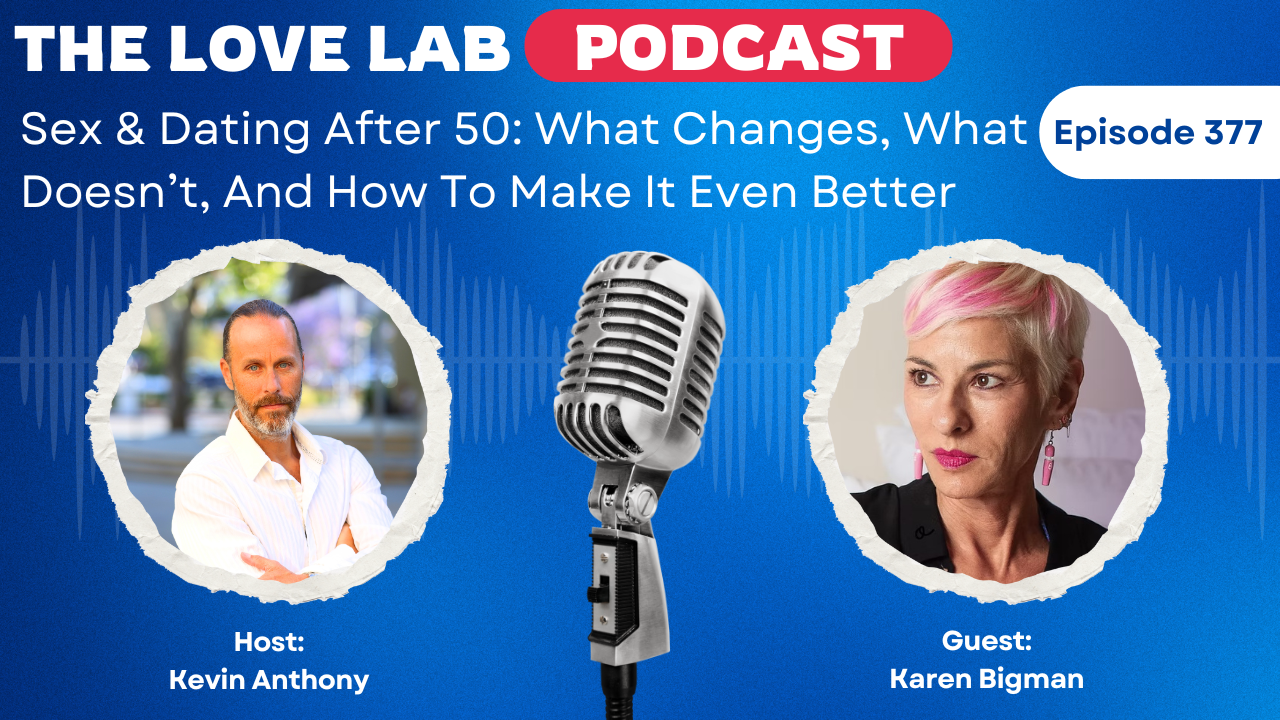
All right, welcome back to the Love Lab podcast. This is episode 377, and it is titled sex and Dating After 50: What Changes, What Doesn’t, and How to Make It Even Better. This has really been a topic that’s been coming up a lot lately. And when I look at my demographics, I can see that I have a lot of people that are in this demographic, which is interesting, because, you know, a lot of the topics that I cover, you’d think would be topics that maybe more young people would be interested in but I love the fact that that is not the case. Yes, I love the fact that young people are into it. They want to learn skills. They want to get better at sex. They want to know how to have good relationships.
Kevin Anthony 1:12
Great. I love the fact that they want to learn that early. But I also love the fact that older people are open to, hey, I’ve done it this way my whole life, or I was in this relationship for 20 years or 30 years, or whatever, and here’s what didn’t work out, and now I’m open to trying something different. I’m open to learning something new. I’m open to creating something better than what I had before. And I think that is really amazing. I commend anybody who’s in that place and is like, Hey, it’s time to start over, and I want to do it better this time. So I think that’s just really awesome. And what we’re going to be talking about today is the challenges that arise. So sex and dating after 50 I mean, you’ve got everything from, you know, potentially inexperience because you haven’t dated in 20 or 30 years. You have the changes that are happening in your body, you know, and maybe the last time you were active sexually or dating, like you were literally in a different body, right?
Kevin Anthony 2:20
And so now you’ve got to learn how to navigate that there’s the possibility that maybe there were skills that you never learned, being relationship skills or sex skills that you know. Now it’s time to learn. So there can be a lot of things that are important to know and to learn if you’re in this sort of sex and dating after 15, so we’re going to cover as much of that as we can today. I have a guest with me who’s going to share this. She specifically coaches people in this space, and of course, she’s lived it herself, so she’s going to share her knowledge and expertise in just a moment.
Kevin Anthony 2:59
But before we do that. A couple of words from my sponsors. Ladies, did you know that the overwhelming majority of men consider receiving oral sex a must in their relationship? Of course you did, because men have been asking for it your whole life. But do you feel confident in your ability to give great oral sex if you tend to avoid it because you don’t feel like you’re good at it, or if you feel that you’re pretty good at it, but want to get even better? Then my new blow job mastery course is for you. I have teamed up with the amazing coach, Reid Duong of Eterna Love, to bring you a practical and easy-to-follow course that is guaranteed to increase your confidence and skill when giving oral sex to your man. In this course, you will get all the secrets to mastering the art of oral sex with step-by-step instructions and multiple live demos. Go to https://www.sacredfemininearts.com/bjmastery. That’s https://www.sacredfemininearts.com/bjmastery.
Kevin Anthony 3:49
And of course, my goal is not just to help men get better blow jobs. My goal is to increase everybody’s skill level in the bedroom. And if you’ve listened to this show for any amount of time, you have heard me do this commercial so many times, Power and Mastery 3.0, which is the latest version of the popular men’s sexual mastery course. If you’re struggling with erectile dysfunction, premature ejaculation, or simply want to increase your skills in the bedroom, then power and mastery is for you join the exclusive club of men who have taken their sexual performance into their own hands and become sexual masters. Mastering your sexuality is a key component to becoming the man she has always dreamt of and craves. Don’t leave your sexual performance up to chance or the throw of the dice. Become a master today by going to https://www.powerandmastery.com/sexual-mastery. That’s https://www.powerandmastery.com/sexual-mastery. And I know I talk about this a lot, guys, but trust me, if she doesn’t want sex, it’s probably because you’re not very good at it, right? So go check that out. Get your skills, you know, up to speed, and both you and your partner will have a much, much better time. Oh, one last. The thing I just want to share with you quickly. I got to show it here on the shirt. On the show here, I got some new T-shirts. They say more orgasms, less wars. I got the man’s version here. I got the women’s version here, whatever color you like, whatever you like. Those are available on my website at https://www.kevinanthonycoaching.com.
Kevin Anthony 5:18
Okay, now that we’ve got all that out of the way. Let’s get into what we really want to talk about today. My guest is Karen Bigman, and she is the midlife sex and relationship expert changing the way we think about dating, relationships, and pleasure as we age. As a certified sex educator, menopause coach, and host of the podcast, Taboo to Truth, Life and sex after 50, she brings humor, real talk, and zero judgment to pleasure and relationship topics people only whisper about. Karen’s mission is simple: to show that midlife isn’t the end of great sex, it’s just the beginning. Welcome to the show, Karen.
Karen Bigman 5:59
Thank you for having me.
Kevin Anthony 6:00
I love that end of your bio. That line that says midlife isn’t the end of great sex. It’s just the beginning. I have had numerous friends, and some of them, for sure, women tell me that exact thing, you know, I have a good friend. She just said, you know, around 50ish or so post menopause, she just said her sex life, which was already great, was the most amazing that she’s ever experienced. So I love that you have that line in there, because I think it really is true, and I’ve seen it both in my own life and in the lives of clients and friends. So it’s great that you’re spreading that message. Yes, it’s possible.
Karen Bigman 6:44
Yes, yes. Bust that myth that we’re dead after 50. No way.
Kevin Anthony 6:48
Yeah. When I want to ask you about some myths as we go on, because I know there are more than just that, let’s start with women, and let’s start with sex for women after 50. What are some of the things that change for women regarding sex? You know, in that roughly 50-plus, you know range.
Karen Bigman 7:10
So, as women age, the average age for menopause is around 51 or 52 in the United States. So, what menopause is, for those of you who don’t know, is basically it’s defined medically as 12 months without a period. But what’s really happening is the hormone, hormones in the woman’s body are going through these crazy peaks and valleys and are very, very erratic. Those hormones are estrogen, progesterone, and testosterone, for the most part, and as these hormones are changing, we now know that many of them affect not just the reproductive organs, but they affect the entire body.
Karen Bigman 7:48
So the most obvious thing we hear is that women are uncomfortable. They’re having hot flashes, and they’re not sleeping. There are some mood swings, but there’s a lot more going on. So she’s got this crazy hormonal shift. And for those of you who’ve been partnered with females, those males partnered with females for a long time, you know that at certain times of the month, we tend to be a little more emotional. We tend to have different sex drives, different needs, and different things we want to eat. All that is changing, but now that whole cycle that we’ve been having for most of our adult life is getting just completely out of whack.
Karen Bigman 8:22
So that’s thing one as the consequence, we’ve got a lot of other things happening. So I mentioned hot, hot, feeling uncomfortable, emotionally out of our body. And then, from a reproductive or sexual point of view, the physical body is changing. We can start to experience dryness, painful sex, increased UTIs, urinary tract infections. Our libido can shift. Our ability to have an orgasm can shift. So a lot of things change as a result of this, and so that really leads us to a whole new way to approach sex and relationships that we don’t even know is coming, because it goes from sort of gradual to boom.
Kevin Anthony 9:05
Yeah. I mean, I’ve talked a little bit on the show here and there about the physical things that change, you know, the dryness and, you know, being uncomfortable, hot flashes, things like that. And we might talk about those a little bit more, but I think people understand those a little bit more at least. You know, for us men, it’s easier for us to understand, oh, it hurts, oh, it’s whatever, right? But what I’d like to focus on next is so that those things, those changes, are happening in your body as a woman. How is that affecting you, mentally, and how is that affecting, let’s say, how you show up in relationships, but also how you show up in the bedroom?
Karen Bigman 9:46
So a lot of things. So it’s funny, you’re saying that I had a conversation this past weekend with the husband of a friend of mine, and he was saying they were past menopause, but he was saying how his wife had become just like this completely different person. Like, what have you done with my wife, and it and it’s very much be the case. So what’s happening is, because all these hormones are changing, your emotional well-being is changing. So you may be suffering from anxiety or panic attacks or just an overall lack of daisicalness. You can be feeling depressed. So there’s a lot of emotions that can be raging one day, that you can be totally fine the next day, you can be erratic, so you may not have control over it.
Karen Bigman 10:28
And that alone thinking that you, first of all, you’re feeling crappy, and then you don’t have control over whether you can feel better or worse, because you don’t know what day, what will I wake up or in the middle of the night as or in the morning. Second of all, you’re not sleeping properly, necessarily, and you’re feeling crappy. So, anyone you know, we all know as educators, any doctor, will tell you, like, the key to good health or good anything, good relationships, good sex, is getting a good night’s sleep. So you know, we all know when we don’t sleep well, we feel like shit. So you’re not sleeping, so you’re physically not feeling well. And then I think this probably happens to both genders, is that you start to question your choices in your life, like, I think you’re just starting because this, you know, is this my life? Is this my situation? Is this where I want to be? So I think it’s affecting you in every you know, they say the biopsychosocial. It’s affecting you on every level, and it’s going to affect how you show up.
Kevin Anthony 11:25
Yeah, and one of the reasons I wanted to ask that question is because I know a lot of times, from the man’s point of view, he’s just not understanding what’s really happening over there. And so if we can bring a little bit more understanding, if we can shed a little bit of light on what she’s actually going through. I think that could, you know, help ease the situation a little bit? So another question, kind of similar to the last one, which is, and I’m really curious to know your thoughts on this one thing that I have noticed. And my wife and I, we used to joke about this, you know, when her cycle would come, and at certain points in her cycle, she’d be having certain feelings and emotions like the classic one, right? And a lot of women will describe this, they’ll say there’s a point in their cycle where they feel like, you know, the world is doomed and everything is, you know, just shit, and there’s nothing we can do about it.
Karen Bigman 12:19
And the tears are flowing, you know, they were out of milk.
Kevin Anthony 12:23
Yeah, exactly, exactly. But what, what, you know, my wife and I used to laugh about is that there appears, at least for many women, to be like they’re not necessarily aware that that’s happening, because they’re in it, right? And so, you know, obviously, we had a very strong relationship. We had great communication. And so we had already sort of come to this thing like, okay, if I’m in that state, you know, can you point it out to me? So I realized that the world isn’t ending, right? And so whenever she would get into that state, she’d be complaining about something, and I just look at her, and I’d say, Aren’t you due to bleed in a few days? And she would go, Oh, my God, you’re right. That’s why I’m in this mood, right? So I’d use that as an example, because I’m curious, you’re talking about all these changes that are happening during menopause. Does something similar happen there, where she may not herself be aware of where she’s at with her mood? I don’t know if it’s the same or not, but I’m just curious.
Karen Bigman 13:32
I think that with with the menstrual cycle, you know, like it’s sort of timed for most people, and many women are on the pill, so they kind of have a better sense of exactly when, when they’re in those those moods for menopause, the problem is that it’s erratic, so you don’t so, so first of all, it menopause, perimenopause, which is the pre quote, 12 months without a period, can start around 10 years before you actually go through menopause. So, say the average age is 51, so as young as 41, you could start having symptoms, and now they’re finding it’s starting earlier and earlier. So I just met a woman who’s, like, 34 or 36 who’s perimenopausal. So you can start having these symptoms.
Karen Bigman 14:11
So you’re not really, you can’t really connect it to anything. I know with my personal experience, like it probably was a combination of menopause and my own emotional state, but I went into like a really bad depression right around 40. And often doctors will throw antidepressants at you. And it could be that, in my case, it was probably a combination of hormones and depression, but it could very well be that you’re depressed, but it could also be that your hormones are shifting. So you don’t always know what doesn’t always make sense. There could be some other reason. The other thing you have to be really careful of, and I imagine you and your wife had a conversation that said, you can tell me when, when you think I’m getting my period, but there is nothing worse than my parents could have said to me, than are you on your period? Like, you’re acting crazy like that would have just set me into another complete spiral.
Karen Bigman 15:04
So you have to be extremely careful about how you’re approaching your partner, but it does behoove you to do a little research and say This is not like you. I’ve not seen you behave like whatever, or you don’t seem like yourself, maybe we ought to think about what could be going on and see, is it, you know, is it our relationship? Is it some physical something? Is something going on that’s not even related to menopause? Is there some other physical issue? So it’s it definitely like it’s just less predictable. It is part of the issue.
Kevin Anthony 15:41
Yeah, so you bring up a good point. I’m definitely not telling men that whenever your woman acts weird to say you’re gonna bleed, aren’t you right? That generally doesn’t go well. And that’s why I prefaced it by saying, you know, that we had good communication, and we had talked about it ahead of time because, because, you know, what she realized was that when she was in it, when she was in the hormones, when she was feeling it, she wasn’t always aware that that’s what was making her feel the way she was. And so she actually appreciated me just reminding her. It was just a reminder, right? It wasn’t like you’re acting crazy, or blah, blah, blah, or all this is you’re just saying that because you’re bleeding. No, it was just like a here’s a gentle reminder that the world isn’t going to end, and it’s probably just related to your cycle. And then you would go, Oh yeah, I feel better now.
Karen Bigman 16:32
But that, and you know, when you’re getting your period, like it’s a sign of life and vitality, right? When you’re approaching menopause, it’s like the narrative has always been: now you’re getting old. Like, I don’t want to I know when I started doing this, the first thing I did when I started this work was certify as a menopause coach. And my son knew I was doing it. I wasn’t quite into the sex as much, and not personally, but professionally. And he was with his stepmom, and she was complaining about something. He said, Are you in menopause? And she blew a gasket at him, because, like, the very idea that he was insinuating that she was going through menopause. So it’s becoming less taboo to even say the word.
Karen Bigman 17:14
And in fact, I love when I hear young women talk about menopause and are interested in understanding perimenopause, because it was not a word in my vocabulary when I was in my 30s and 40s. So it’s definitely something that can start the conversation that can be had. But I don’t think we always know that what we’re having, the symptoms we’re having, are actually related to menopause. And so there’s it’s wonderful today that there are conversations happening, and awareness is really important. And I think it’s even better for our male partners to be able to have an understanding and conversations like this, because I think you are part of the equation, and your ability to be empathetic to her and to understand what helps her be rational when she’s not, is going to make your relationship that much better?
Kevin Anthony 18:04
Yeah, and you know, that’s basically my whole point with that part of the conversation is to just bring awareness and understanding. So awareness and understanding for him means, hey, I can have some more compassion, right? I can not take it personally, right? And then, of course, for her to realize that, Oh yeah, okay, this is what I’m going through right now. So it’s not that he really is the biggest asshole I’ve ever met.
Kevin Anthony 18:30
So just having that understanding can go a long way towards easing the tensions that can arise in relationships between two people when that’s happening and and I like that you also mentioned, you know that it can, you know, perimenopause can start way early. I mean, my wife was already having signs of perimenopause in her late 30s, so even before 40. And, you know, obviously, as a coach and someone who works with this, she was aware of that, right? And she was, she was working with that appropriately. But a lot of times, women aren’t aware of it. And when it happens earlier, like that, they don’t make the association. They don’t go, Oh, I must be starting perimenopause. They just go, There’s no way that’s impossible.
Kevin Anthony 19:20
And like you said, right? Because the narrative has been so much that that means you’re old, or life is over, or whatever it is, like women will really strongly go into denial over that, which I think is kind of sad, because it’s just a phase of life, right? Like we all have phases that we go through, and that is a phase of life. Now, granted, it’s a big one. And I know, you know, being in my 50s, also, you know, most of my friends and my current partner, you know, have experienced this and been through it, and what I’ve seen for a lot of ways. It’s like there’s a part of this process that is like a deathing process where they have to sort of let go of who they were and step into who they’re becoming. So I wonder if you could talk a little bit about that part, because there’s another thing that I just don’t think guys really understand, is that this idea of letting go, of being able to procreate, whether or not they ever chose to in life, is like a big deal.
Karen Bigman 20:32
It’s interesting, because for me, I started hormone therapy very, very young, young, relatively speaking, I was in my late 40s, so I didn’t actually have like a moment when I said, Oh, my reproductive years are over. So it wasn’t quite as dramatic for me. I think there is definitely, certainly to the women that really loved the process of being pregnant and having children that, yes, there is definitely something to say we are we’re no longer able to do what we were put on this earth to do. And I think that’s also part of this narrative of that’s why we’re here. And so when we can no longer procreate, we’re washed up, right? I do think that’s changing, though. I think that that it’s, it seems to me, what I see more of is the focus on symptoms and less of the focus on that I can no longer have children.
Karen Bigman 21:26
The one related piece that I see a lot of, and I’m not saying I’ve, you know, everyone I spoke to, I’m sure that experience is valid and that a lot of people do have it. A lot of women have it is a loss of interest in sex. So as it relates to, maybe not so much sex for having children, but the whole idea that, like, I don’t, I don’t need it, I don’t want it. It doesn’t feel good, and I’m done with it like that; to me, is a greater personal loss, maybe because that’s what matters to me; that is a greater loss than I like. I had my kids. They’re grown. I’m like, ready to be a grandma, you know, like that. I’m fine with that. So, yeah, so I don’t know how it’s definitely it makes sense, but I have personally not thought of it that way, and I haven’t seen it in the people I’ve come across, but I get it.
Kevin Anthony 22:13
It definitely exists, because I’ve had multiple women share that with me, and it’s just part of the journey. And you know, everybody’s experience, of course, is different. And like you said, you had your kids, and you felt complete with that part of your life. And you know, for some women, maybe they started really late. They only had one child, and they were thinking, maybe they might want to have another. And then they realized they can’t, right, or maybe they never had them, and they started thinking, Oh, now maybe I want them, and they realize it’s a little late. And so there is, there’s a part of letting go with that, but let’s talk about the other part that you were just talking about, because this is definitely something that you hear a lot about, which is that idea that, Oh, after menopause, forget it. Sex is out. It’s not going to work anymore, it’s not going to be fun, it’s not going to feel good. My sex life is over. Talk about that a little bit.
Karen Bigman 23:03
Well, I think so, lots of things happen. So the hormonal shift not only affects your physical the feeling of your bulb of vagina getting very dry and just the comfort factor, but also your libido and your ability to have an orgasm can shift, which is what happened with me. So I didn’t know about the estrogen progesterone, which is a standard hormone therapy that you get when, not always, doctors will prescribe to someone who is a proper candidate for it. But testosterone is another hormone that we lose that is directly linked to libido and orgasm in women and men as well, but particularly in women.
Karen Bigman 23:43
And so that’s what my experience was, not that I didn’t want sex, is that I wasn’t able to have an orgasm. And I was, I was newly single, just divorced, and I was out like I hadn’t been terribly sexual in my marriage in general, or we hadn’t. And all of a sudden it was like, wow, I can, you know, what can I swear? And I think you can say what I tell the story, like I was dating someone. We were literally pulled over on 63rd Street fucking outside the Duane Reade pharmacy at like, 10 o’clock at night. And I, like, granted, having that kind of sex is not necessarily going to bring you to orgasm, but I just, like, I could not, you know, I wasn’t able to, so that was, like, a, what the fuck is going on here? Like, that was real, that was, I was scared. I’m like, is this it is like the universe saying, Well, you got a divorce. Like, that’s on you.
Karen Bigman 24:30
Now you’re not going to get to have sex anymore. So, so that whole realization is really something that makes me most sad are the women who accept that. I guess that’s just what it is, and often those are the people who are in long relationships, who are married or have been in long relationships, who say, Well, I guess that’s just the next phase of our relationship. So when you’re single, you’re like, okay, at least I have an opportunity to go out and try new things and figure it out. But that. That part is something that we really need to understand, that it’s our sex, our sexual health, is just as important as the rest of our health, and so that we can’t have to address that if that becomes an issue.
Kevin Anthony 25:14
Absolutely, I can only imagine, like being in a long-term, you know, I’m assuming not so happy marriage, since you left it and you weren’t having sex. But imagine being in that, finally getting out, and like, Yes, I can fuck again, right? And then you’re like, and I can’t orgasm.
Karen Bigman 25:34
Universe, what are you doing? What did I do? Right?
Kevin Anthony 25:40
But you know, I think, as you rightly pointed out, is that somebody who’s in that position has a bit more motivation to try to seek solutions, right? Because you’re like, Oh no, I’m not. No, I finally have the opportunity to get all that stuff I wanted in my marriage and couldn’t get. There’s no way I’m going to settle for no orgasms or no sex, exactly, whereas I think, unfortunately, people who are still in relationships, there’s all the other stuff that’s happening at the same time. So in other words, they’ve been together for a long time, you know, they haven’t maintained, you know, the relationship. They’ve let resentment build up, you know, for years, you know, unresolved stuff.
Kevin Anthony 26:20
And so you got all of that happening at the same time that this, you know, sexual ability is shifting. And so I think in that case, they don’t have a lot of incentive to try to fix the sex, because they probably weren’t having sex anyway, because of all the other problems in the relationship. And that is, I think, kind of a bit sad, but I do want people listening to know that, you know, it doesn’t have to be that way, right? So there, there are things that you can do that’s kind of the next thing I want to talk about. And, you know, obviously, there’s the things that you can do to address the physical stuff.
Kevin Anthony 26:57
But also, you know, people ask me this question all the time. They’re like, I’ve been married for 25 years, how can I start having sex again? We haven’t had sex in 10 years, and they don’t generally like the answer, but the answer is, take sex off the table and reconnect with your partner, like, learn how to establish some intimacy again. And by that, I’m not using that as a as you know, an allusion to the word sex. When I say intimacy, like, there’s a lot more than just sex that comes with that. You’ve got to start there, because if you don’t have that, you’re just you’re never going to get to the other one, right? So I’d say work on that, while also working on other things, so that is a good segue into, so if women are, you know, experiencing these types of things. What are some of the things that they can do?
Karen Bigman 27:45
So to to the point you were making about, you know, taking the sex part of intimacy off the table, I have something I call sex snacks. So I say, rather than going for like, tonight, we’re tonight, we’re going to have sex. Let’s put it on the calendar. It’s why not shave ex to your partner? Why not touch them in a way, give them the six-second kiss, and the 22-second hug that John Gottman says will release the happy hormone, so doing the little thing, so that would be like in a long-term relationship. But for your question, like, What? What can women do? So the first thing is, it’s only an issue if it’s an issue for you, just because I think you should be having sex, if you’re okay not having sex, it’s not for me to tell you. I mean, I think you’re missing out, but that’s on.
Karen Bigman 28:28
That’s your choice. I mean, I have a girlfriend who just has sex for her, for her boyfriend. She’s like, I don’t even care. I just wanted to take out the trash, and so I’m willing to have sex every day because that’s what he wants. And like, we’re done. I’m like, don’t you want to enjoy it? And that’s fine. So, like, that’s her choice. I’m like, you know, I can help you with and that’s fine. So like that. So that’s thing one. So, if it’s not important to you or to your relationship, then that’s okay. There’s nothing that’s your choice. But say it is. So the first thing you want to do is see, like, what is going on physically. And I will tell you that that is, first of all, it’s, it’s a hard thing to talk to your doctor about. Like, guys are always looking at their penis. They’re always being asked, Does it work? You know what’s going on? The doctors checking out your balls when you go and making sure you don’t have cancer and all that women like, it’s like, once you’ve, I’ve even heard that once women stop being in their reproductive years, that years that doctors don’t even give them an internal exam anymore, like, like, there’s like, the that thing is closed.
Karen Bigman 29:23
So you have to be able to start by saying, like, this is important to me, and so I need to advocate for myself and figure out what is going on. And I will say that in my case, even though my doctor was super progressive and she read the research and put me on hormone therapy when everybody was shutting it down, I went to her with this line, an orgasm was kind of, I’m kind of embarrassed about it, even though you delivered my children. And she first said, You know you’re well, you’re getting divorced. It must be in your head. So we’re first, you’re facing that. So like, you know your own body, and you know what you want. And so if that’s the case, and you still want to do it. You need to find a way. So I found my way to a sexual medicine clinic. And so the first thing is like, what is physically Is there something physically going on? So, is it the combination of menopause changes, and that you need some hormone replacement therapy? Is it that you’re taking medications like antidepressants, your eyes, I guess, that are affecting your libido?
Karen Bigman 30:21
Is it sexual trauma that has all of a sudden surfaced at this point in your life that you’ve never had to deal with? So like, are there? Are there things outside of that of like that can be well, fixed, is a big word for sexual trauma, but that you can address that will help bring you back into, into like, even navigating and wanting to navigate sex again. And so that would be like the first piece. And then it’s like, depending on whether you’re in a relationship or if you’re single, like what I would start with, definitely like teaching your body what it feels like to get aroused again. Start masturbating. Buy some toys, you know, do some self-care, some self, self-love, or however you want to put it, to get yourself used to feeling sexual again by yourself lingerie, and look at yourself in the mirror and start appreciating the beautiful body that you have that is now going on to this next phase. I mean, there’s, there’s a lot of that, like getting your body in order, and then you move on to the next piece. Yeah,
Kevin Anthony 31:20
Yeah, that’s great advice. I’m actually working with a client right now who’s going through that, and those are exactly the types of things that I have her doing to get back in touch with that, that part of who she is. So, yeah, great advice, man. We could do an entire show just on this, but I have so many more questions, because I want to talk about men a little bit, too. And I also want to talk about the dating aspect. After 50, we’re about halfway through the show, so you know, if we want to dive deeper into the menopause issue, maybe I’ll have you come back on the show again. I mean, I feel like we barely scratched the surface on that, but I got so much more I want to cover. So let me take a short break for a sponsor, and then when we come back, I want to talk a little bit about men, and then I really want to get into some of the dating challenges over 50 as well.
Kevin Anthony 32:13
Okay, ladies, are you tired of always picking the wrong guy? Does it seem like there just aren’t any good men out there? Are you struggling with your sexuality, or do successful relationships seem like a mystery you can’t quite crack the code on? Then it’s time to get help. Check out my women’s relationship and sex coaching program. In this program, we will work on removing sexual shame, becoming confident in your body, learning the sexual secrets that drive him wild, what to really look for in a man when dating, and how to break old patterns, like always choosing the wrong guy, and so much more. This is your opportunity to learn everything you have ever wanted to know about men, while also creating real, lasting change in your life. Go to https://www.kevinanthonycoaching.com/women/. It’s https://www.kevinanthonycoaching.com/women/. Now, if you want to know what it’s like to navigate. You know your body in your 50s as a woman, go work with somebody like Karen. She will absolutely help you with that. If you’re like I really just can’t figure out, wow, what? Who are these guys? What do they want? I don’t know what to do with them. Come work with me. I help you understand men. I’ll help you learn how to work with them.
Karen Bigman 33:24
So we’re a good team.
Kevin Anthony 33:27
Exactly, okay. So we were talking a lot before the break about, you know, women in the changes that happened post-50. And, you know, we’re I was really hoping, and I think we did a pretty good job of highlighting some of the challenges so that, you know, women can, of course, realize that this is a normal part of, you know, the aging process, and so that men can realize, Oh yeah, this is part of the process, right? And that can help ease some of the tensions as we go through these major life changes. But men are also going through changes around this time. What are some of the things that you see in men in this age group?
Karen Bigman 34:09
I think the biggest one is erectile dysfunction, not only the inability to have an erection, but also delayed and premature ejaculation, as well as some other physical issues, and again, something perfectly normal, 20% of men in their 20s, 30% in their 30s, et cetera. The incidence of erectile dysfunction in men goes up 10% on average, in every generation or every decade. So that is a big thing. And men are very, you know, and you understand men better than me, but it’s a big part of who you are. You’re looking at your penis every day your you know that is your driving force. And certainly, if you’re going to be getting in the bedroom with a woman, you want it to work properly.
Karen Bigman 34:51
And so there can be a lot of emotion attached to it. So men are feeling these changes as well. And what I noticed. And again, you’re the expert here, but they tend to want a Band-Aid, and they don’t want to tell anyone about it. And so, like, I have a friend who just likes, Hey, Doc, give me some Viagra. Like, we don’t really know what’s going on here, but like, let’s just throw in some Viagra. And women are kind of accepting they know, like, I might need some Viagra, but I imagine there’s a lot more emotion attached to it that they’re just not focusing on.
Kevin Anthony 35:23
Yeah, well, you know, as men, we we tie a lot of our self worth into our penises and our ability to use them, so when suddenly it’s not working anymore, when we can’t get an erection, when we can’t control our ejaculation, when we feel like we can’t satisfy our woman, that does have a fairly big emotional toll on us, for sure, and that will definitely lead to a lot of avoiding, a lot of denial. One of the things that you know a lot of women will share with me is that you know, when they were younger, they were used to guys constantly pushing for sex. Now they’re in this older age group, and they’re dating, and they’re the ones that are pushing for sex, and they can’t understand why he’s avoiding it, why he’s making excuses, why he’s trying to slow it down. And the answer to that, most of the time, is he’s scared shitless that he’s not going to be able to get a dick up like that. That’s the reality of it, right?
Kevin Anthony 36:23
So, yeah, that is a big issue for men in this age group. Now, obviously, Viagra can help, but there are a lot of other things that you can do as well. And it’s not just, Well, I’m post 50, so you know, that’s what happens. You know, I’m post-50 of constant reactions all the time, like all the time. Sometimes it’s just ridiculous and distracting. It’s so frequent, right? So that doesn’t have to be your reality. And so just like we were talking about with the women, you know, if that’s what you’re experiencing, you know, there’s no shame in it, right? Just get over that. Get to see your doctor and figure out what you can do about it. I’ve had on my show twice now, Dr Brandeis, who’s an amazing urologist. I think He’s based in the Bay Area, and he has an entire book, you probably can’t see it. It’s probably just off camera, right about there, called the 21st Century man, just full of great medical advice on how you can solve a lot of these problems.
Kevin Anthony 37:39
So there are definitely things that you can do for sure from the woman’s perspective. And I don’t know if you’ve had a lot of experience with this, but like for instance, I remember a couple years back when my wife was still alive, where we’re hanging out with a mutual friend of ours who was in her I’m trying to think where she was, I think her early 40s at the time, and she was telling us about her dating life, and she said, I don’t remember the exact number, but it was somewhere around five out of the last six men she’s dated had problems getting interaction.
Kevin Anthony 38:21
She wasn’t that old, right? And so curious, from your perspective, I don’t know if you’ve experienced this when you got back out into the dating world, but when you’re out there dating post 50, and you’re in your dating men who are having these challenges, like, what is that like? From your perspective,
Karen Bigman 38:38
What I have interestingly experienced more of is not the inability to get erect, but the inability either the inability to stay erect or the inability to ejaculate. And that was actually quite surprising to me, and a lot of times it has to do with being in your head. But I will tell you that the sexiest thing a man can do is to communicate, and especially with someone like me. And I think it’s a double-edged sword, because I’m like, you can tell me anything, and we can have a conversation about it. But at the same time, I think men are like, she must know everything. She must think. I mean, I had one guy who had a beautifully sized penis that worked very well in my body. Literally send me a text and say, Look like I’m really kind of embarrassed.
Karen Bigman 39:26
But like, what do you think of the size of my penis? And I’m just like, you probably wouldn’t have asked that of anybody else, but at the same time, like, how can you be that insecure when we just had, like, amazing sex the other day and and so, but the fact that he asked me showed me something about him. And so I think if we start with, like, what, you know, I had one guy, he said to me, Doesn’t, it doesn’t always work. So well, okay, like, if that’s the way, you tell me, I’m, like, well, you’re you’ve come to and I literally said we’ve come to the right place, because if anybody’s going to be able to have a good sexual experience with you, like, we’re going to figure this out. So I think it’s. It’s something that you want to rather than hold it in shame, like we’re not necessarily ashamed, like we go through menopause, like it is. It is a thing, you know, but you should not be ashamed of what you’re going through and talking about it with your partner. The earlier you bring up the challenges, the better the communication, the better the sex is going to be when you finally have it.
Kevin Anthony 40:25
Yeah, and the reason I asked you that question because I knew you were going to say something similar to that, which is that men who really stress out over this, this idea that they might have to admit that it doesn’t work as good as it used to. You know, kind of thing, they really stress out about it, because they think she’s not going to want to be with them anymore. Like, that’s it. It’s going to mean the end of the relationship. And what I have found, and I’ve talked to a lot of women about this, is that overwhelmingly, they say exactly what you said, which is, if you just communicate with me about it, we can figure it out. In other words, they’re far more forgiving than most men think they’re going to be.
Kevin Anthony 41:09
Most men think they’re going to be like, You can’t get it up. You can’t satisfy me. I’m out of here, right? Whereas the way most women react is exactly what you said. Okay, tell me about it. Let’s figure it out. Let’s figure out a way to make it good for both of us, right? So I was glad that you shared that, and that men, hopefully listening to this, can hear this from a woman. Like, yeah, just talk to me about it. Just share it with me. Like, let’s figure it out, right? That way, you can take some of the fear out of being able to voice, you know, the challenges that are going on.
Karen Bigman 41:44
And if I could also add just we’re having, like, with me when I first started dating, so I had, I get estrogen via an estrogen patch, so it’s, like, right between the vulva and the belly button. So I have like a sticker, a band-aid, whatever you want to call it. And one of the things I learned when I went to the doctor for sexual medicine is that I learned about vibrators. I’d never known. I knew I had heard of them, but I’d never used one until that point in my life, which was, I think, I was 52, and it like changed, changed. They literally had me try it in the doctor’s office. It was quite the experience. So that is part of the tools or toys, or whatever you want to call them, that are in my repertoire when I, you know, when I have sex.
Karen Bigman 42:22
So I was very embarrassed in the beginning to let a guy know, like, oh, by the way, when you put your hands down there, you’re going to come across a sticker that’s like, it’s on a sticker. It’s like, it’s my estrogen and, oh, by the way, I need to, need a, you know, a vibrator. And I was so nervous about it. And guys were like, Oh, great. Like, let me try this thing. So it’s sort of the same thing, like, we’re just so happy to be having sex, especially those of us who didn’t have it for so long. It’s like, well, however it works, we’re gonna make it work, and it’s gonna end, you know, my knee doesn’t work and, like, I can’t bet, you know, go on all fours, or, like, you know, my hip hurts, so we need a little pillow over here. Like, no, my neck. Like, we like, we’re all experiencing this. I think I wrote a post on LinkedIn about this a while back, where every guy I go on a date with within now, it’s even almost less, because I’m over 60, but like, within the first 30 minutes, you are going to hear about a knee replacement, a problem with the back, you know, like the high cholesterol medicine that he’s on. Like, we’re just, we got to make light of it, because it makes it so much more fun.
Kevin Anthony 43:22
Yes, and that’s exactly why I like having conversations like this, because we get to normalize it. This is the reality, like, why? Why are we all just denying it? Why are we trying to hide it? You know, shove it under, under, you know, the water under the covers or whatever. Pretend it doesn’t exist, like it’s just life, man, life is it’s amazing. In some ways, it’s completely fucked up. In other ways, it’s just, it’s just life, you know? So the more we can normalize it, I think the better it is for everybody. So I appreciate having these conversations.
Kevin Anthony 43:57
Okay, let’s talk about dating in the remaining time that we have left here. So obviously, we talked pretty much the whole show about, you know, the challenges with sex for both men and women. And you know how we can sort of ease that, normalize it, you know, laugh about it, you know, and try to make it better for all of us. But before we get to sex, there’s dating, oh yeah. What are some of the challenges that you see people post-50 face when getting back out into dating?
Karen Bigman 44:31
I’m going to say it from the obvious, from my perspective as a woman, as a heterosexual, fairly monogamous woman, like, that’s my I’m a serial monogamous more or less. So I’m waiting for the next monogamy, but right now I’m a serial dater. What I see a lot of is particularly with men wanting to jump right back into another relationship before they’ve dealt with the loss of the last relationship. Up thinking of it as a failure, and like, they have to, like, prove themselves, and they jump right back in before, one, doing any sort of introspection or work. And two, from a sexual point of view, like not having had any other sexual experiences, too, which I think are really important.
Karen Bigman 45:17
And I will say that I can’t say any exact mistake, because I was very aware that the first relationship I got in was my rebound, but it was still, I wanted to be in a relationship, because I wanted the safety of that. And it’s completely understandable that that’s what you’re looking for. You just had that for however many years, and now you’re out there. So I think, like, deal with your shit. I mean, it goes back to, like, it is sexy, like when I meet somebody who I mean, I met a guy, said, Look, I coached myself. I have my own therapist. I’m like, Yeah, I don’t think I’m gonna date you. Or I just, I just, we just broke up. I was married for 30 years. I’ve been single for six months. Yeah, go get late like you’re not, you’re not going to be ready for a relationship.
Karen Bigman 45:58
Now, if you don’t want a relationship, you just want to have some fun. Then, then, then absolutely, like, just, just be honest. So I would say like that. Like, don’t try to hide what you’re like if you haven’t been late in 20 years. Like, go out and have some fun safely and consensually. But go do that. So I think, like, the first thing is, like, processing what you just don’t, don’t you, if you don’t process it. You’re gonna just keep repeating it. And again, I made these mistakes, which is why I can I can talk to them. I just kept going out with the same guy over and over again, and the same experience would happen.
Karen Bigman 46:30
So I think that’s one and also know that, like, it’s so totally socially accepted now to and if you feel uncomfortable going to a therapist, go to a coach, a good coach, Kevin, or somebody who, like, they’re going to help you understand and look and process, so that then when you finally do end up in a relationship, or you meet somebody that you want to have a relationship with, you’re like, Okay, now I know how to how to manage this in such a better way, or I’m so much more adjusted instead of This, like, desperation to just be with somebody or you, you, you enter in something that you think you’re ready for, and they’re ready, and then you end up hurting them, or they hurt you, like it can you got to do some of that. But the best thing is to work on when people say, look, love yourself, work on yourself, like it sounds hokey, but it’s so important.
Kevin Anthony 47:18
Well, everything’s an inside job, you know? Book, I think it was by Jon Kabat Zinn, Wherever You Go, There You Are, a philosophy book, right? Like you take your stuff with you, right? I was interviewing a therapist recently, and she was telling me about a client that she was working with, and he was in there with his third or fourth wife. I can’t remember what the number was, but he was basically telling, you know, the therapist that, you know, his wife is crazy, right? You know. And then the therapist is saying, oh, okay, you know. Well, you know, tell me about your ex-wife, you know, she was crazy, too. And then he says, they’re all crazy. And it’s like, at what point do you realize that maybe the common denominator is you? Right?
Kevin Anthony 48:10
So I love that you brought that point up, right? Is, you know, if you’re coming out, because, you know, most, most people in the 50 plus, have been in previous relationships, right? That didn’t work out, which is why they’re single and they want to date again. So rather than just assuming that they didn’t work out because he or she was just crazy or, you know, had their mommy or daddy wounds or whatever it is, maybe take a little time to just look in the mirror and ask yourself some really tough but honest questions about how you have shown up in your past relationships, and definitely work with somebody you know, either myself, or you know, somebody like Karen or a therapist or whoever, can actually help you heal the patterns of the past so that You can show up better in the future. Absolutely great advice.
Kevin Anthony 49:05
What other types of things? So obviously, you know, there’s they’ve got to heal their own stuff, right? And I agree with you. Also taking the time. That was the second thing you shared, taking some time, right? So we’ll help you heal that. What are some other challenges people see when they’re back out there?
Karen Bigman 49:21
I just also want to talk just one more thing to the taking, the processing. One of the huge red flags to me when I meet somebody is when they are constantly like your therapist. The guest was dissing their ex. To me, that is a sign that they definitely have work to do, and they will never take responsibility in our relationship. So just to that point. So what are the other things? I think that the tendency is to jump on the apps and looking for jump on the apps and look for your soulmate. You’re looking for the. Person, the one, the thing that is going to solve all the problems that you have in life. And I think we set up expectations only to be disappointed repeatedly, and also to think that by looking at somebody in three lines and two pictures is going to be a way to actually get to know somebody.
Karen Bigman 50:19
So like, be realistic. At the same time, I think it’s really important to show up when you’re going to be online dating, to show up on the apps, as you would show up in life. If you go on and I say this to women a lot, like, Oh, men suck. Like, and I’m like, Well, if you think all men suck, then you are going to attract men that suck, because that, and you’re not going to discriminate. You’re just going to take anybody that comes in front of you, and you’re they’re going to suck. So you will, you will find that you will attract what you want you show up as.
Karen Bigman 50:50
So it’s very important that you show up as what you want to attract, and also have the courage to walk away when things don’t look right, even if they seem like everything is is peachy on paper, or, you know, you go on a few dates and you’re wildly attracted to them, but then you’re like, This is there’s something but, but I’m never gonna get anybody else like be, be strong enough in yourself to say, like, Yeah, I know that there’s something that’s more right for me than this. How does this person make me feel when I go out with them? Do I feel better about myself? Do I feel inferior? Do I feel insecure? Do I feel calm? Do I feel anxious? What? What am I feeling like in this experience, rather than she’s so pretty and I’m so attracted to her, and like, the sex is great. Like, that’s important, obviously, but can all that be built with the right foundation of a relationship?
Kevin Anthony 51:42
Yeah, we have really great advice. I’m wondering if there are any differences in what we’re talking here about, you know, men and women both sort of generically, you know, after 50, I’m wondering if there are any differences in the dating, like, are there some things when getting back out into dating that maybe are more stressful for women or for men? Do you notice any differences?
Karen Bigman 52:14
I think I’m like, I think women take it more seriously than men, and I don’t know that for a fact, and it’s been my experience. I have a friend in New York that I see when I go back there, and he was complaining to me that all the women on the apps just want my time. They just want to spend time with me. They just want to go, you know, like talk. And I’m like, Yeah, that’s why they’re on the apps. Like you are. The problem with the ads, that if you’re only going there for the likes, then that’s what we’re seeing. So, I would argue that men would probably say the same thing about women. So I think, I think it’s, it’s easier on. There are more single women than single heterosexual women than single heterosexual men I as I understand it statistically. So I think it’s a little harder.
Karen Bigman 53:04
I think that men are not sure how to be around strong women, and we don’t make it easy for them, because we’re so busy being tough and strong, we don’t let them do the thing that they are set, you know, the role that they’re supposed to play. Because we’re no longer these frail, needy beings. We’re so busy being strong, they’re like, Well, what do you need me for? And so I think there’s there’s a balancing that, like we each have to show up in a way that is going to be honest and genuine, but that also we need to communicate. I think men don’t ask enough questions.
Kevin Anthony 53:40
One of the things that I’ve noticed isn’t 100% true. Of course, nothing is 100% true. But I’ve noticed, like you were describing yourself, you’re like, you know, Well, right now, I’m sort of serial dating, but what I’m really looking for is the next monogamous relationship. And what I’ve seen in this demographic, once they come out of a relationship, and then they’re, you know, out there on the dating apps is a lot of women are looking for the next monogamous relationship, and a lot of men are like, Hey, I just got out of this, you know, 25 year relationship, where the last 10 years we had no sex. I’m gonna go play, right?
Kevin Anthony 54:20
And so what I see is this sort of mismatch in what they’re looking for, which creates havoc on both ends, right? Because you have a lot of guys not necessarily being super honest about that. They’re not totally upfront about the fact that that’s what they want, right? And then, of course, women are getting attached. And then he disappears, and then, and then that sort of thing. So that is one thing that I’ve seen. I was just curious if there was anything, anything else that you know, you had noticed, as far as differences.
Karen Bigman 54:47
I definitely see. I think honesty is key. You know, I got in a relationship a few years ago with someone, and it was very clear that he wasn’t ready. And I like, we had such a good time together that I sort of just ignored it. With the red flags. And I remember talking to my therapist, and she’s like, Well, what did it say he wanted in the profile? And it said, like, not sure what I’m looking for kind of thing. And I’m very clear. Like, I’m looking for a long-term relationship. I’m like, when someone tells you who they are, listen, you know, or when someone shows you who they are, believe them. Like, we have 10 women have a tendency to, like, no, no, no, it’s gonna be okay. It’s gonna be okay. I just heard. I was listening to a podcast today, and she was talking about attachment styles.
Karen Bigman 55:26
And I don’t want to go into the whole psychology, but, like, it was how an avoidant person getting in a relationship who had an anxious attachment style, gets in a relationship with an avoidant person, and it’s all great, and they’re super consistent. Everything’s great. And all of a sudden, they stop being consistent, and it trails off. And, it trails off. And I guess the thinking is that they, as soon as it gets too close, they push away, right? And so she said, You know, like you’re looking for someone that’s consistent. And she goes, Well, my client says, Well, he was consistent. He was always consistent in the beginning, and then he wasn’t. She’s like, and that means he’s not being consistent. Therein lies the point. So we really again, I think it’s, there’s nothing wrong with being honest.
Karen Bigman 56:09
I think if I can say one thing to the men in the room that like, honesty is sexy, if you know, if you haven’t dealt with your stuff, if you’re you just want to like, I like you, and I just want to date you and and have sex with you, and if it turns in something great, but like, that’s not what I’m looking for. Like, tell me up front, and it’s my choice then to jump in like I did. And, you know, hope for the best, but don’t like, you’re not deceiving me. At least you’re telling me. And if you really are looking for a relationship and this person isn’t right, like, don’t just ghost me. Just say hey. Like, this is just not working. It’s not what I was looking for. That’s fair too. But like this whole game and hiding behind the screens and not being able to, like you’re a grown ass fucking man, like be a man and talk, you know, and say what you’re feeling. And I’m sure there are women whom I could say that to as well.
Kevin Anthony 56:55
Yeah, that is really fantastic advice. Just be honest. And honestly, I wasn’t making a judgment about the men who just want to, you know, to fuck after not having sex for years. There’s nothing wrong with that. What’s wrong with it is when you’re not honest about it. Yeah, right. So, yeah, just go, be there. You’ve made another really good point, too. Because I tell women this all the time. There’s, I coach a group of women every week, and I have to repeat this over and over and over again. I go, you know, for the most part, you know, unless they’re a narcissist or, you know, pick up artist kind of guy in general, as men, we say what we mean? Mean what we say. So when he actually tells you, I’m not ready for a relationship. Listen to him!
Karen Bigman 57:48
I’m going to be the one. I’m going to change. Yeah, exactly, yeah. That does sound familiar.
Kevin Anthony 57:55
All right, we are just about out of time. Is there any last advice you want to give to men and women about anything to do with getting back out there and dating and sex? Post 50,
Karen Bigman 58:09
I think, like it is the best time of your life, it is an opportunity. I think one of the things that they’ve learned from brain research is that when women are postmenopausal, they actually have a positivity bias instead of a negativity bias. And so we have more of that, I don’t give a fuck attitude, but at the same time, we all, I think we’re all looking to be loved and recognized and for comfort and intimacy and sex. And I think if we can all just show up as who we are and be honest about it, like the world, which is, I want one of those shirts, like, just have orgasms every day. It would be just, we would have life would be amazing.
Kevin Anthony 58:48
I absolutely agree with you, I really do believe that, you know, yes, there are a lot of people out there experiencing problems in there, but it doesn’t have to be that way. I think that you can have really great relationships and really amazing sex post 50. I mean, I’m just barely post-50, but so far, my experience has been it keeps getting better. So I really want people to hear that, yes, we focused on a lot of the challenges and problems here, because I know a lot of people are experiencing those, but I also want you, whoever’s listening to hear that it doesn’t have to be that way, that there are solutions, and you can still have an amazing relationship and an amazing sex life, Regardless of your age. Indeed. All right, Karen, please tell people if they’re interested in working with you, because we identified a lot of challenges that people need help with. So tell people how they can find more about you and your work.
Karen Bigman 59:52
So my podcast is taboo to truth, life, and sex after 50, it’s both on all the podcast audio platforms as well as I have a YouTube. Channel at taboo to truth, podcast, website, taboo to truth, I actually have a master class, a sex ed adult, adult, sex head master class called hotter, Wilder, wiser, that I sell that goes through and explains all the physical changes and some of the things you can do to help bring back your sex life. And also a little section on dating post or midlife or post-50. So, any of those resources or just reach out to me directly.
Kevin Anthony 1:00:30
And they can all be found at taboototruth.com
Karen Bigman 1:00:33
Yes.
Kevin Anthony 1:00:34
All right. And that link, of course, will be in the description. Karen, thank you so much for coming on the show and sharing not only your knowledge and wisdom, but your personal experience as well.
Karen Bigman 1:00:44
My pleasure. Thanks for having me.
Kevin Anthony 1:00:48
All right, everybody, that’s all the time I have for this episode, and I will see you next week.
Kevin Anthony 1:00:58
I hope you liked this episode of the Love Lab podcast. If you enjoy this show, subscribe, leave me a review, and share it with your friends. And for more free exclusive content, join me in the passion vault at https://www.kevinanthonycoaching.com/vault/. That’s https://www.kevinanthonycoaching.com/vault/. Thanks for listening, and remember, as Celine used to say, you’re amazing!

Kevin Anthony is a Certified Sexologist, Tantra Counselor, NLP Practitioner and a Sex, Love & Relationship coach. For over 10 years he has worked with men, women, and couples to have the relationships of their dreams, and the best sex of their lives! He is also the host of “The Love Lab Podcast”, creator of the popular YouTube channel Kevin Anthony Coaching, and creator of the popular online course series “Power and Mastery” as well as other online courses for both men and women.