Kevin Anthony 0:00
Welcome to the Love Lab podcast, the place to be for honest and real talk about relationships and sex, whether you’re a man or woman, single or a couple, this is the show for you. I am your host, Kevin Anthony, and I am here to help you have the relationship of your dreams and the best sex of your life.
Kevin Anthony 0:23
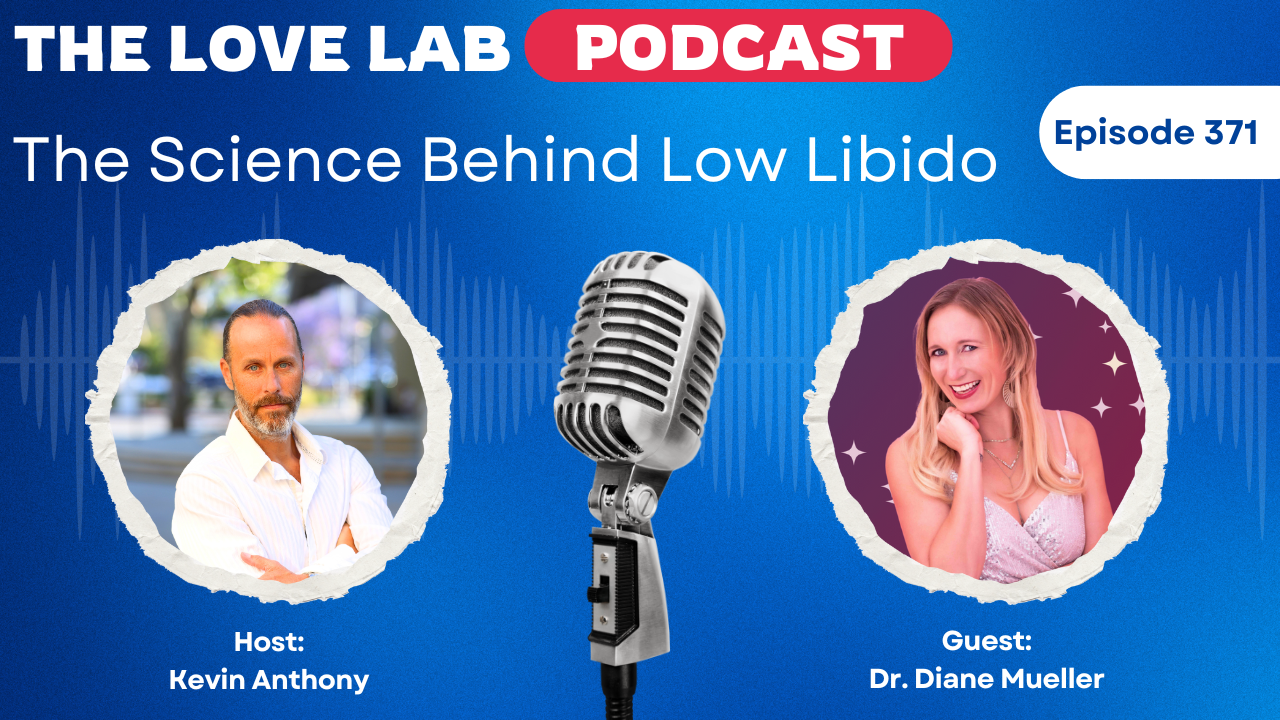
All right, welcome back to the Love Lab podcast. This is episode 371, and it is titled The Science Behind Low Libido. Now, if you’ve listened to this show for any amount of time, I’m sure you have heard me do shows on low libido before, it is one of the most popular topics. Like, if you’re working in the realms of sex and relationships, there’s, like, maybe a dozen topics, really, that just come up over and over and over again. And it seems people never get tired of the content on those topics, because they’re all searching for solutions. This happens to be one of those. However, today we’re going to cover it from a different angle. I normally tackle low libido from more of the psychological standpoint, because that’s more of my expertise. What’s going on in the relationship? What are the dynamics between the two of you? What’s going on with you personally, all of those types of things that can get in and block your turn on, basically.
Kevin Anthony 1:31
However, there are also actual medical issues that can cause low libido, and it’s always important to look at the whole whenever we’re trying to, you know, diagnose something, treat something, we need to look at it in its entirety. So just focusing on the psychological or, you know, what clients of mine often come to me and say was, while I was experiencing low libido, I went to my doctor and he said, there’s nothing wrong with me, right? So it’s like both sides have a tendency to look at these things only from their point of view, so I like to present a more balanced point of view, and that’s why I’m actually really excited to have this conversation today, because I have an absolute expert here to talk about the science behind low libido. So I’m really curious to ask some questions and dive in and learn a bit more on the science side of it.
Kevin Anthony 2:26
But before we do that, a few quick words from my sponsors, ladies, did you know that the overwhelming majority of men consider receiving oral sex a must in their relationship? Well, of course you did, because men have been asking you for it your whole life. But do you feel confident in your ability to give great oral sex if you tend to avoid it because you don’t feel like you’re good at it, or if you feel like you’re pretty good at it, but you want to get even better, then my new blow job mastery course is for you. I have teamed up with the amazing coach, Reid Duong of Eterna Love, to bring you a practical and easy-to-follow course that is guaranteed to increase your confidence and skill when giving oral sex to your man. In this course, you will get all the secrets to mastering the art of oral sex with step-by-step instructions and multiple live demos. Go to https://www.sacredfemininearts.com/bjmastery. That is https://www.sacredfemininearts.com/bjmastery.
Kevin Anthony 3:16
And of course, power and mastery. Power and Mastery 3.0 it is the latest version of the popular men’s sexual mastery course. If you are struggling with erectile dysfunction, premature ejaculation, or simply want to increase your skills in the bedroom, then power and mastery is for you join the exclusive club of men who have taken their sexual performance into their own hands and become sexual masters. Mastering your sexuality is a key component to becoming the man she has always dreamt of and craves. Don’t leave your sexual performance up to chance or the throw of the dice. Become a sexual master today by going to https://www.powerandmastery.com/sexual-mastery. That’s https://www.powerandmastery.com/sexual-mastery. Both of those links are in the description. You can find them there. We got a little something for the women. We got a little something for the men.
Kevin Anthony 4:06
Okay, my guest today is Dr Diane Mueller, ND, DAOM is a board-certified sexologist with dual doctorates in naturopathic as well as Acupuncture and Oriental Medicine. She’s the founder of the sex education center mylibido.com and hosts the libido lounge podcast, where she helps monogamous couples create more passion, desire, hotter sex, and better communication. Welcome to the show. And Dr Diane.
Dr. Diane Mueller 4:36
Thank you, Kevin. And I just want to like intro this with piggybacking off of what you just said in your intro. Because one of the things I have really found when people are kind of open to this idea of like, oh, I should look in all these other places for a root cause, is another layer that I find is that it’s so common when people are looking for root cause, I. And I’m saying this as cause, singular for a particular reason, because it’s so common that people are like, Oh, this is the root and we think oftentimes in holistic care, when we’re searching for the reason for something like little libido, like there’s this one magical root cause. Maybe it’s that mental, emotional, like you’re talking about, maybe it’s the physical.
Dr. Diane Mueller 5:20
But I want to, you know, just kind of piggyback off what you’ve said, and really help the listener to understand, like I would look at all of the content that we’re talking about today, almost like a pie chart. And in order to have an amazing sex life, an amazing relationship, a healthy libido, you’re going to have a wide variety of numbers of pieces of pie that need to be addressed. So it’s very, very, very common, for example, that people will get on testosterone replacement therapy, and then all of a sudden they’ll have an improvement in their libido. But if their relationship isn’t well, if, like, there are problems in their communication. Then, after three weeks of seeing that libido jump up, then the libido falls back down.
Dr. Diane Mueller 6:08
And in that situation, it doesn’t mean that testosterone is not important. It just means that if we’re looking at this as a pie chart, testosterone is one piece of the pie, and we need to make sure that we’re addressing all of them. So I really help that listener kind of orient to today’s content with listening to this as a hey, we’re looking for the root causes plural. Because in 15 years of doing patient-related work, I’ve never seen one single case after working with 1000s where there’s only one root cause. So, you know, just to kind of orient, you know, people to that as a framework for today’s call, I think it is important.
Kevin Anthony 6:49
Yeah, that is a very important point to make, is that it’s often not just one thing. And then the other thing is that, you know, one factor can potentially exacerbate another factor, right? So a particular factor may not be that big a deal in and of itself until it’s combined with other factors, correct?
Dr. Diane Mueller 7:09
Yep. And then we get into, like, the vicious cycle of, you know, cause and effect, right? Where we have, like, an emotional, say, imbalance in the relationship, well, that can create stress, and then we have stress hormones elevated. Well, when the stress hormones elevate, we tend not to handle our emotions as well. We tend to be more reactive, and that can lead to even more emotional, you know, imbalances, and that cycle continues. And that’s just like one of many kinds of like chicken and the egg. Things that can happen with this. So it’s more around, like, Okay, well, less, less about finding, okay, well, what is the chicken? What is the egg? And more around saying, Okay, well, all of these areas need to be addressed. And absolutely, like you said, I see it too. It’s just that compounding factor of how all of these things work together that oftentimes creates that bigger problem?
Kevin Anthony 8:01
Yeah, so let’s just dive right in with some of the medical issues that can potentially be in the way. I have a list of eight of them here, and we’ll see if we get through all of them or not. Maybe we will, but let’s just start with the top of the list. The first one I have on the list is circulation, and in parentheses, erection issues. So let’s talk about that. Because honestly, there’s no way we can talk about the medical issues with libido here without talking about guys dicks, at least for a few moments.
Dr. Diane Mueller 8:35
Well, guys dicks, yes, but also females’ vulvas, right? Because I think this is one of the big, kind of aha moments I want people to have here, is that anything we’re saying about these physical root causes, whether it’s we’re gonna talk about this or pelvic floor dysfunction, we’re gonna see that in the conventional medical world, there’s kind of a tendency to be like, Oh, circulation issues. As far as we need that erectile blood flow to help the penis be hard, like that comes up a lot, or like pelvic floor pain. People are like, Do your Kegels? That comes up a lot for women.
Dr. Diane Mueller 9:10
But what we actually see is that these kinds of things are in are important for both men and women. So yeah, circulation is obviously very, very much needed for that healthy blood flow to the penile tissue, but also to that vulva. It is helping that the vulva becomes nice and engorged. It’s helping the vagina become lubricated. That is not just an estrogen testosterone thing; that’s also a circulation thing. So there’s a huge relationship, then, with feeling in a sexual feeling good for a female, as well as sex being possible for a male. When it comes to circulation, one of the big problems I see here is that most of the time when people go and say, Hey, I’m having erectile dysfunction, I’m having vaginal dryness, many times like the proper testing is not even done. You look at this.
Dr. Diane Mueller 10:00
So, for example, it’s not uncommon that a doctor would say like, Well, let me look at your blood pressure. Let me do a basic lab to see if your kidney function is okay. And let me run your cholesterol numbers. And we run those basic things, and it’s like, Oh, your cholesterol looks decent. Your blood pressure is fine. You don’t have a kidney problem, so there’s no blood flow problem. You know, you still might get a little blue pill just to kind of help out. But the problem is, when I talk to cardiologists that I work a lot with sexual dysfunction, one of the things they tell me is, especially for men, that erectile dysfunction is one of the first signs that actually drives them to a cardiologist appointment.
Dr. Diane Mueller 10:42
Now, if we make it all the way to the cardiologist, we’re probably gonna get more testing done than just blood pressure, kidneys, and cholesterol, right? But a lot of times, people, when they do those basic tests, are like, they’re told they’re fine. They don’t think there are any other problems. And the problem is, we see, for example, that cholesterol numbers don’t correlate very well to plaque on the arteries. So if I’m going to say, okay, one of the biggest problems with blood flow is when the arteries harden and they don’t pump blood well, when they stiffen because of that plaque on the that plaque which was really leading to a lot of the vascular problems.
Dr. Diane Mueller 11:20
Well, if I do an ultrasound or a CT scan, where I’m actually looking for plaque on the artery, and I correlate that with cholesterol in the blood, cholesterol in the blood actually does not indicate very accurately what’s actually happening at that arterial level. So if we don’t actually do and work with our cardiologists, or have our primary care order a ultrasound of the carotids of the arteries called A, C, i, m, t, or do things like calcium scores, then we are missing this opportunity to say, oh, what’s actually happening on the vascular level, and we could have a problem there that we’re missing because we just did those basic labs.
Kevin Anthony 12:05
Yeah, you know, I was reading an article the other day that was talking about, basically, what you were saying, not in relation to, you know, erectile dysfunction or anything like that, but it’s just talking about cholesterol numbers and relationship to, you know, formation of plaque. And I’m reading this article and and it’s like, this new thing that they just discovered. And I’m laughing because I’m like, I have known this for 20 years now, and it is just, yes, it’s a mainstream article, but it’s literally just on the fringes of the mainstream right now. In other words, what you said is there’s no correlation between how much or how high your cholesterol number is in the buildup of plaque. Why is that? Because it doesn’t matter how much cholesterol is in there. What matters is how damaged the insides of your arteries are.
Kevin Anthony 12:50
So what you’ve got to look for is what’s damaging, what’s causing inflammation, what’s scarring the insides. I’m on a soapbox now because I get so irritated by this stuff. I’m like, I am not even in the health industry, I have known this for 20 years, and still, in the general public, it’s not well known, or even in most you know, regular doctors don’t quite get that. I’ll say this also, I’ve worked with a lot of men with erectile dysfunction over the years, and whenever they come to me, the very first thing I tell them is, Have you been to your doctor? Has he checked your heart? And almost every time, it’s like, no, why? And I go because erectile dysfunction is one of the primary indicators that you have a problem with your circulatory system. I’m like, the first thing you need to do is go get checked by your doc and then come back and we’ll work on the rest of it after that, but we need to at least make sure that that’s working. So exactly right.
Kevin Anthony 13:51
I’m glad that you talked about all of those things, because that’s one of the points I really wanted to make here, as far as on the men’s side, right? So when men are like, Oh, I’m having erectile dysfunction, and, you know, I’m having difficulty getting, I want them to understand there could be a legit medical issue there that needs to be addressed. And I also want them to understand how that can also affect the psychological end of it, right? So this is what we talked about earlier, right? There’s a physical, and now it’s having an effect on the psychological because it’s like, oh, now I can’t get an erection, and so now I’m starting to have performance anxiety, and that anxiety is raising my stress level. Maybe that’s now affecting my testosterone level, like all this stuff, my confidence is going down, right? So it’s all kind of tied together, and I wanted people to understand that from the men’s side, but now I want to get in, and I want to hear a little bit more from you on the female side of it. Let’s talk a little bit more, because you started to go there, and you talked a little bit about some of the issues that circulation can cause in women. Talk a little bit more about
Dr. Diane Mueller 15:01
That, yeah. I mean, in a lot of ways it’s very, very similar, right? You know, we are certainly as women. We are certainly not like women without penises, or, you know, humans without penises, our parts do, in many ways, work differently, but in many ways, there are a lot of similarities. And the similarities are that we do need blood flow to the tissues, to engorge to feel good, to soften the tissues, so that penetration feels good, to actually bring more blood, so that things like Kundalini, like oral sex feels good. And so with that, the biggest difference between the way testosterone impacts blood flow versus estrogen impacts blood flow, really is the quickness of it. So we need that same level of engorgement as women. So those same issues apply. You need the same lab tests from a standpoint of looking at cardiovascular health, and that should all be considered now, just on a day-to-day basis. How does this actually show up in the bedroom?
Dr. Diane Mueller 16:03
One of the biggest differences is really in the cycle of arousal, is that because testosterone, what testosterone does is testosterone allows that quick blood flow to the penile tissue, so that engorgement happens relatively fast. What estrogen allows is a much slower impact on the circulatory system. Now we know that estrogen is incredibly important for cardiovascular health, right? We know for sure that when women go through perimenopause and menopause, the earlier they start on things like estrogen replacement therapy, the better cardiovascular system and the better heart health has been shown in studies, but from like a day-to-day, how does this transfer into low libido? It’s actually quite similar to men. It’s just that for women, the result of improving circulation is still going to mean, hey, if everything’s working well, it’s still going to take longer for that blood to actually flow to the genitals and get gorged, just because that’s the nature of how that works for an estrogen-dominant human.
Kevin Anthony 17:06
So that’s a really interesting point that you just brought up, because men who are aware understand that women take more time to get aroused, but there are still a lot of men out there who approach sex with a woman, as in, I don’t understand, like I’m ready to go. Why are you not ready to go? Right? So I think it’s just, it’s really interesting to hear that even for the ones that may be aware, they are probably not aware that there’s a physiological reason behind it, and I think a lot of times they just think it’s a psychological reason. Oh, well, you know, it just, you know, they got to get more out of their heads, or whatever you know it is, it’s going on. But that’s really interesting. And I have to say, like, I don’t want this to sound the way it’s going to sound, but there’s no other way to say it, which is, I’ve done a lot of interviews. I’ve interviewed a lot of experts, and I it’s not that often that I learned something truly new that I didn’t already know. I just learned something truly new. I didn’t know that there was a difference in how quickly estrogen versus testosterone increase circulation. That’s totally new.
Dr. Diane Mueller 18:21
Yeah, yeah. And, you know, it’s interesting, too. And like, what you’re bringing up, like, I do think there is this. There’s this, like, almost like, Freudian belief that’s still circulating in our society of the penis and penetration is, like, the predominant, like, like, say what’s, what’s the best way of saying, this is the predominant superior, that’s the word I’m looking for, the superior way of pleasing a woman. And with that, I think one of the problems we’ve seen with arousal and desire. And to your point, hey, many men are still, even if they’re aware, still thinking this is psychological, that women take longer. But some of that is just based upon the fact that even in school, even, like both of my doctoral programs, when we talked about the arousal cycle, so even at a medical level, we were talking about this four-phase model that applies to men. You get this kind of excitement, you get this kind of crescendo. There’s this plateau before the crescendo, and then you kind of go into this refractory period.
Dr. Diane Mueller 19:22
And so we were taught that men and women work the same way, but it’s really interesting in psychology, and I’m sure you know this, so stop me if you’ve gone here, you don’t want to say this anymore. But for men, Desire comes before arousal, and for women, arousal comes before desire. And so the way that looks for men is like, Oh, I see this beautiful human walking across my kitchen. Look at her breast, look at her ass. Now I’m like, Okay, now I’m thinking all these thoughts. That’s desire, that’s the mind, and the arousal follows. And so another interesting thing with. A difference of these hemodynamics with the difference of the circulation for men versus women is that, for women, it’s arousal comes before desire. So again, desires of the mind, that’s like, I want to have sex. I’m horny. In the mind, arousal is the body responding.
Dr. Diane Mueller 20:14
So for women, you know, so many women are just waiting, and so many men are just waiting for their female partner to be like, Wow, I’m really ready for sex. But what’s happening for her is that she needs to be aroused before she even has those thoughts. So in order for this blood to flow, in order for that to happen, because of that arousal cycle, that’s where we get into the conversations around like, 20 minutes of warm up, 20 minutes of foreplay, 20 minutes of sensual massage, all of that. What we’re doing is we’re touching her body, and what we’re doing in that is we’re allowing her to actually feel the sensations in her body, to drop into those moments. Because that takes longer, too, because she doesn’t have the focused, compartmentalized awareness of the man. She has this diffuse awareness where she’s taking things in all the time.
Dr. Diane Mueller 21:06
So it actually takes her longer, typically, to drop in and be truly present with that body, her body, and as she’s doing that, as she’s more present, that’s part of what’s then driving that circulation, as she’s like, Oh, I feel these sensations, right? That’s what’s driving that circulation to her genitals. And this is where a woman like will oftentimes just decide to have sex, even though she’s not in the mood, and she’s gonna do it anyway, because it’s her obligation, right? And then 20 minutes into it, she might have a thought, and that thought is, hmm, this is actually feeling good. Like, why don’t I do this more often? And that’s because that’s the desire. It took her 20 minutes of being aroused to actually have that thought of, like, Oh, I like this. Like, I want this. I’m kind of turned on. So the desire comes second after she’s aroused, not the other way around.
Kevin Anthony 21:58
Yeah. And that’s a big difference, and definitely one that I don’t think a lot of men understand. Is that true 100% of the time for women, or is it true predominantly, and there are times where, you know, she has desire first?
Dr. Diane Mueller 22:15
Oh, it’s definitely not 100% of the time. I don’t think there’s anything that’s 100% of the time. And in particular, what I see is like in particular, that new relationship energy, you know, desire can come first, and often does. Also, another time that desire tends to be earlier on for a woman is when she’s on vacation, when she’s less stressed, because it really is super related to how much information she’s taking in in her brain. Like, for example, this is, like, the classic example I give for people is, Wow. Man is, you know, is this so stereotypical? But I use it because people get it.
Dr. Diane Mueller 22:53
A man’s watching a TV show, football, or whatever. The woman’s trying to get his attention, and she’s like, Honey, honey, honey. And he’s just so focused he doesn’t hear her like, that’s the ability of the masculine brain to like focus versus like a woman walks into a room and immediately, you know, immediately, when I’m like, I’m in my boyfriend’s house, I can see the fact that, wow, there’s a spaghetti stain on the floor that he forgot to clean up from last night. There’s a picture over there that’s out of place. The kids are doing all these different things. Oh, this. And I’m taking in 20 different things when I walk into the room that he probably is not, you know, aware of at any moment. So for the woman, that’s how the female brain works. Both have their superpowers, right?
Dr. Diane Mueller 23:35
And so I think that’s like, where you know what’s related to, like, how easy it is to have that desire around, like, if the more she’s able to be in the present, where there’s not all those stress and there’s not 20 different things consuming her her attention, the more she can actually tune into the moment. So that’s what it seems. And you know, the the couples that I’ve worked with, that’s what it seems to be most relate it to is like how what her state is at any moment, and how quickly she is able to drop those things and in the new relationship energy, even if she’s busy because of all those other chemicals in the new relationship energy, because the newness, that newness, or even from a safety and survival you know standpoint, requires that extra focus. And so it’s again, it’s like, okay, well, how much is she able to drop and like, focus super easily on that moment. That will be directly related to how quickly she can get into that desire a lot of the time.
Kevin Anthony 24:36
Yeah, and I asked you that question because I did want the men to hear that, because I, A lot of times, I do these shows and like, information is coming out, and I can already hear the YouTube comments and the peanut gallery, and I just want to preempt, like, a lot of that stuff. So when we were talking about the fact that, you know, it’s, it’s generally arousal first, then desire, i. Could already hear the peanut gallery. Well, my woman, blah, blah, blah, blah, blah, right? And so I kind of wanted to show that, that, you know, it can happen the other way as well. But, like a lot of things, you know, women are predominantly one way, but it doesn’t mean exclusively. And the same with men, right?
Kevin Anthony 25:16
So, you know, a perfect example on the opposite side is, we were just talking about, you know, how men have this ability to really focus and not necessarily take in the 40,000 details. And that is very true. That is absolutely true of the masculine, but we can learn to take in all of those things. If you take, say, somebody like maybe an investigator, right the second he walks through that room. He’s trained to notice every single one of those little things. You know, I worked when I was very young in my 20s, I worked as a lifeguard for a number of years, and that was a real struggle for me, because I had to take in everything that was going on. And there’s how many, you know, dozens of people, 100 people, and I’m trying to keep track of where they all are, and that sort of thing. And I really struggled with that. I had to develop it over time, like, how do I take in the whole picture and not miss anything, rather than being singularly focused on something?
Kevin Anthony 26:14
So I just kind of wanted to make that point, that we both can do both, but we do have a predominant way that we tend to operate, and for women, you’re right, that used to show up with my wife in ways outside of sex, too, like it wasn’t exclusive to sex. Like she used to say all the time, we’d go out for sushi, and I’d want to order, like, some yellow towel, you know, and then we’d order it, and she’d eat, and she’d go, Oh yeah, now that I’m eating it, I forgot how much I love yellow tail. And she would do the same thing every time. For years, it was hilarious. We used to laugh about it all the time.
Dr. Diane Mueller 26:53
Yeah, it’s true. And, you know, it’s like, and like you said, for women too. I think the other point I want to bring up with the female is, like, it is a practice. And like, the way I say for, for all humans. But I think, do you think this applies a lot to women? Is the practice of experiencing pleasure directly related to the practice of being present? So the more present we are with, like our mind, with them, with our lover, feeling the sensations, looking into their eyes, you know, just being fully immersed in the experience like the more easily we can be in the presence of that, the better. And you know, we know from like meditation, from visualization, from mindfulness-based stress reduction techniques, all of these things that are like teaching about being in the present, all of them are practices.
Dr. Diane Mueller 27:40
And so the more we practice is, the better we get at and the same thing is for like, okay, practicing dropping into the present, like, the more we practice that throughout our day, not even just from a standpoint of sex, but I also think from a standpoint of whatever we’re doing, just how much can we drop into the focus of the moment versus the multitasking you know that that we often do as humans, all of that is like, is really practice for for the bedroom. And I think the other comments that I think is probably pretty important to make, and maybe I’m going to lead you to some YouTube comments on this, but, but is, is for the people that are like, oh, you know, my wife that you know doesn’t do that, she’s like, you know, she’s like, just wants me all the time, or any of those things. My suspicion is like, like, the more we can drop our ego, which is not always easy to do, and realize that everybody has, you know, has moments. And even if there is desire that is there most of the time, my guess is there’s probably times where there’s moments that it’s being, you know, forced more than it needs to, and maybe the desire isn’t as much as it’s being led on, you know, to.
Dr. Diane Mueller 28:51
And it doesn’t mean that anybody is like a bad lover or all of these, like, Crap things that are going around with like me. It doesn’t mean any of this. But I’d really encourage people, if they’re like kind of shutting down, to be like, well, there’s, that’s not my wife, that’s not my partner, to actually be curious to say, like, huh? Is it possible that that could happen sometimes? And is it possible that I could be curious enough to ask my partner this and to see if that’s happening, even if it’s 5% of the time, you know, to see, like, are there opportunities for us to actually grow deeper in those moments? Because I’m actually taking the risk to be curious about it. Because I do think no matter where we’re at, there’s almost always the opportunity to go deeper. And if we’re saying and we’re coming and hearing information with like, Oh, not me, not me, not me. Usually, what’s happening there is we’re shutting down our curiosity to learn more and to go deeper. So I just wanted to throw that out there and hope that you don’t get too many bad YouTube comments.
Kevin Anthony 29:53
Oh, that’s okay. Any engagement is good, but that’s great advice. And. I would say that, you know, anybody that shows up and says, you know, that’s not at all, you know, my situation, I would be willing to pretty confidently say it’s probably because they’re not paying attention. Is as deeply as they could be because, because we’re not robots, we’re humans, right? And we fluctuate and we vary. So great advice. Okay, we’re about halfway through the show already, and we’ve only covered one of the eight, but we did talk about something else that I really wanted to talk about, which was the differences in arousal and desire, so that fit in right where we talked about it perfectly.
Kevin Anthony 30:40
So let’s do this. Let’s pause for a short break. When we come back, I want to pick a couple more of the things. There are a few here. I’m just going to cherry-pick out of the list, because there are a few that I really want to talk about that I think people may not be as aware of. So we want to bring that to the front. So we’ll do that as soon as we get back.
Kevin Anthony 30:57
All right, ladies, are you tired of always picking the wrong guy? Does it seem like there just aren’t any good men out there? Are you struggling with your sexuality? Or do successful relationships seem like a mystery you can’t quite crack the code on? Then it’s time to get help. Check out my women’s relationship and sex coaching program at https://www.kevinanthonycoaching.com/women/. In this program, we will work on removing sexual shame, becoming confident in your body, learning the sexual secrets that drive him wild, what to really look for in a man when dating, how to break old patterns like always choosing the wrong guy, and so much more. This is your opportunity to learn everything you’ve ever wanted to know about men while also creating real, lasting change in your life. So go to https://www.kevinanthonycoaching.com/women/ and sign up for a strategy call today.
Kevin Anthony 31:46
Okay, so we’ve covered number one out of the eight, which was circulation. It was a great conversation and really took us into some other interesting stuff that I think was important. I want to just cherry-pick a few more things here that I don’t think people are as aware of. So, for instance, number four on the list is inflammation here. I mean, how is there a link between inflammation and low libido?
Dr. Diane Mueller 32:16
So many ways. So, inflammation, I always like people to remember, is never the root cause, right? So we have to say what is causing the inflammation? So infections, toxins, diet, all of these various things can actually cause inflammation. We see that certain types of inflammation can actually inflame the brain. When the brain is inflamed, one of the things we see is that the upper regulatory parts of our hormonal system, which are known as the hypothalamus and pituitary, when we have certain things that are inflaming us and when these inflammatory molecules enter the brain, one of the things that can happen is those centers can stop signaling correctly places like our thyroid or our testes and ovaries.
Dr. Diane Mueller 33:06
So we can see, actually, a direct link, sometimes from inflammation to turning down our hormonal cycle or to turn down our thyroid. And of course, like when our thyroids are low, we’re exhausted, right? Nobody, when they have, like, low thyroid. I actually was just going through this recently. I had got my thyroid checked, and it was so low, and I was at a point where I was like, I knew it was almost certainly my thyroid, because I was at a point where I was like, I would try to leave my house and I would like, I’d go for a half mile walk, and I would feel like I was, like, dying from low energy, right? Like, not a lot the motivation to have sex when you can’t even walk for 10 minutes without feeling like you’re dying. So point being so like those types of ways, we can also see, also related to our circular circulatory conversation, that usually the main root cause of the circulation actually becoming a problem, and the plaque being on the arteries, we don’t just build plaque on the arteries for no reason.
Dr. Diane Mueller 34:04
One reason we build plaque on the arteries is that there’s so much inflammation, and these inflammatory molecules will actually nick the blood vessels. And when the blood vessels are nicked, well, we don’t like to have this as damage, so the plaque on the artery wall is actually a compensatory mechanism to say, Hey, we have these inflammatory molecules causing this damage. We don’t want a hole in our arteries. We don’t want this next, so we’re going to put a patch on it. That’s what the plaque is. So it’s, you know, kind of back to say, you know, it’s like, also related to that circulation conversation where, again, what are, what is like the precursor to the inflammation, and what is the result? So the precursors can cause the inflammation, but the inflammation can affect kind of those other, some of those other root causes. So it really is like, back to that chicken and the egg thing, we are saying is like, yeah, inflammation can do this, but it’s going to be through things like impacting our hormones, impacting our circulation, we see that when we’re neuro-inflamed, when we have things like toxins. There’s so much research on mold, toxins, on toxic metals, on pesticides, glyphosates, of actually being neurotoxic.
Dr. Diane Mueller 35:13
So when we’re neurotoxic, what that means is that our nerves are not working correctly, and so in order for us to have proper arousal, we also have to have our nerves, from our brain and from our spinal cord, sending the right signals to the genitals. It’s not just about circulation. It’s about the nervous system control there. We have to have muscles relaxing when they’re supposed to muscles contracting when they’re supposed to. Our arteries are doing the same. And all of that is under the control of our nervous system. And when our nervous system gets inflamed, those proper signals don’t happen. And therefore, we can have the resultant lack of responsiveness of our erogenous tissue because of that. But again, it’s like back to that kind of vicious cycle, really, is related to that inflammation?
Kevin Anthony 36:02
Yeah, well, it’s a good example of what we talked about earlier, how there can be multiple things happening simultaneously and affecting each other. And you know, one of the reasons I picked inflammation from the list is because it’s starting to gain some more traction, you know, in the mainstream these days, but there are a ton of people out there that are operating day to day with massive inflammation in their bodies, and they are completely unaware of it. And mainstream medical science, a lot of it, doesn’t understand this. So they, like you said, can’t walk down the street without being exhausted, right?
Kevin Anthony 36:40
And so therefore they have no drive for sex, and then they go to their doctor, and their doctor is like, I can’t find anything wrong with you. Like, I don’t know. Go see your psychiatrist, right? And it’s because they just don’t really have an understanding of that inflammation mechanism. And we’re just starting to understand a lot of the things that are causing it. You mentioned a pretty good list of them. There are others too. You know, one of the big, popular ones out in the media right now is the seed oils and how they’re potentially causing inflammation. So, you know, it’s another great example of how all of this stuff kind of ties together. Because you also then brought in the idea of thyroid issues, which is another one on the list.
Kevin Anthony 37:20
So since you brought it up, let’s just go there. Obviously, you already talked a little bit about how thyroid impacts it. I’m not in the health, you know, profession at all, but it is something that has been, you know, an interest of mine for decades now, and I do a lot of reading on this. And so like, I have a lot of things that really irritate me about the mainstream. And so like, a bunch of them are coming up right now. I’m realizing, as we’re talking about this, like, thyroid issues is another one of them, because it’s another area where we see a lot of mainstream doctors do not understand how the thyroid actually works, and a lot of times they will prescribe synthetic thyroid hormones that actually do more damage than good. Now that’s about the extent of my knowledge on I want you to jump in and talk about that a little bit.
Dr. Diane Mueller 38:14
One of the biggest problems with thyroid is the way we’re testing for it. So if you’re listening to this and you’re like, well, it’s like, I’m going to tune out because I already got my thyroid tested, and I know I’m fine. I would actually encourage you to tune in extra hard right now, because I see this over and over and over again. That’s the problem that I’m about to describe, which is the most common task that conventional medicine runs for the thyroid is TSH. And there are a few problems here with this, but one of the first ones is that TSH is not even a thyroid hormone. TSH is a brain hormone. It’s made by our pituitary gland, and what this gland does is it secretes this TSH, and its job is to tell the thyroid to secrete thyroid hormone so we can have situations when we are testing this and we’re like, oh, well, the TSH looks good. The brain’s doing its job, but the thyroid is not responding.
Dr. Diane Mueller 39:11
So very commonly, we are not even testing true thyroid hormone when we’re doing this test, and we’re just testing this brain and saying, well, the brain’s working fine. We’re just assuming that means the thyroid is working fine, which is just ludicrous when we understand how this all works together. The secondary problem with that is that thyroid hormone has two forms. Of it, two main forms. There are other forms too, but the two main forms. The first one is called t4, the other is called t3, and t4 is an inactive thyroid hormone. What that means is that it doesn’t do anything. It doesn’t give you energy, it doesn’t help with hair, it doesn’t help with mood, it doesn’t help with bowel function. It’s inactive, and it remains inactive until it actually turns into the active version called t3 now, t3 does all that I’ve mentioned. So it helps with energy, it helps with mood, it helps with hair, it helps with bowel function.
Dr. Diane Mueller 40:08
So sometimes I see conventional docs giving another test to somebody, which is usually T4, which is still not even testing active thyroid hormone. Because, again, we can have the brain making all the TSH just fine. We could have the thyroid making the inactive form just fine. But it could be a conversion problem where the thyroid is not converting it into the active form, t3 that conversion takes place mostly in the liver and mostly in the small intestine. So if we have a problem, let’s say our liver is inflamed from toxins. That could actually be a reason why we have that low conversion of the inactive t4 to the active t3 because much of that conversion is going to happen in the liver, and toxins, you know, the body’s too toxic, and the liver is inflamed from it probably not going to be working as well for that conversion.
Dr. Diane Mueller 41:04
Then we have other problems where it’s like even in monitoring those, those are just talking about the total output. Then we have to talk about the cellular utility, because we can make as much as we want, but if our cells are not able to use it, then it still is just going to run around in the blood and look fine, but it’s not going to actually impact the cells, which are the most important thing. So from that standpoint, we need to measure what’s called the free version of the hormone. And so the free version is like the active versions of cells can actually use. And then another component, and this is like not even getting into the autoimmune side. So, you know, try not to get too deep in the woods. But to really illustrate the problem here, another thing that’s not commonly tested is called reverse t3 so reverse t3 is another molecule from the thyroid that will block regular thyroid from working. So if I have all of my active cellular available thyroid hormone, which is called free t3 and that’s a really good marker to look at, because now I know I’m converting it, my cells have enough to use all of that looks really good, but if I had too much of this other reverse t3 it’ll kick the regular t3 off the cells, and so the cells can’t even use it, even though it’s available for them.
Dr. Diane Mueller 42:20
So one of the problems is that we’re not getting this full, complete picture. And we could throw on, like I said, thyroid antibodies as well, and go down a rabbit hole there, but then the other, the other big thing, and then I’ll pause here, but the other big thing for people to understand is the reference ranges of what we’re looking at from a lab perspective, to say this is normal, this is not normal. They are not based upon a healthy population. The way we get most of these reference ranges is we collect all the data, the labs of everybody that has their thyroid looked at, and we say, Oh, the top 2.5% are problematic, the bottom 2.5% are problematic, and the 95% in the middle are normal. Well, this would be really great and probably a really useful thing if we were taking that calculation and looking at healthy populations.
Dr. Diane Mueller 43:11
But we’re basically saying, Okay, anybody that’s testing their thyroid hormone is probably, most of the time, going to have a lot of thyroid symptoms. And so we’re saying, Okay, if everybody who has thyroid symptoms, you’re only considered bad if you’re, like, extreme on either end, and everybody else is normal. So, you know? And then in functional medicine, what we’re really doing is we’re saying, Okay, well, where are people actually testing their thyroid when it is normal, when they feel good, when they’re like, Well, you know, what does it look like when somebody’s like, I have energy, everything’s going well. And so that’s what we’re really doing in like optimized medicine, like functional medicine, as we’re looking at that much more narrow range to say, oh, even though you might not be diagnosed by your doctor as having a severe problem, if you’re not in that optimal range with these things, you could still have what we call a subclinical thyroid problem, which is really still a thyroid problem.
Dr. Diane Mueller 44:04
Your thyroid is still not working optimally. You’re still having symptoms, but we’re just going to take an intervention now, when it’s like, you know, a minor thyroid problem, before doing the watch and wait thing to see how bad you have to dB before we actually, you know, step in and do something. So big point saying, like, a lot of like, thyroid is so directly related to vitality, to libido, to drive to desire, and a lot of times, due to the test we’re using, as well as the way we’re interpreting the test, it’s being missed.
Kevin Anthony 44:36
Yeah, you brought us some really important points there, and that’s why I’m glad that, you know, we’ve picked some of the ones that we have. Because, again, as I mentioned earlier, you know, people will go to their doctor, and their doctor will say, you know, there’s nothing wrong with you. We did the tests. All is good, like, you know, go home and figure it out, kind of a thing, and then and then people are left with really no solutions, because they know something’s wrong, but their doctor. Or tells them there’s nothing wrong, right? And then they just get stuck there, and a lot of times they’ll lose hope. And so it’s really great to talk about these things, because then people can ask better questions when they go to their doctor.
Kevin Anthony 45:11
So, for instance, you really just clearly explained that they’re not even testing for the right things. So now, when somebody goes to their doctor and they think they might have a thyroid issue that’s affecting the libido, they can ask specifically, What are you testing for? And if you get an answer other than, you know, I’m looking for, you know, free t3 in the system, like then, you know, you either need to ask for them to do that, and if they’re not willing to do it, go find yourself another doctor, right? Another interesting thing that you mentioned was this idea of the reference ranges. If people aren’t aware that these things change all the time, this is another important thing to learn. Like, for instance, you know, I mean, I’m in my 50s now at this point, and one day I was, I was looking at a chart for like, average weight, for somebody my age and my height, and I’m looking at this chart, and I’m going, This isn’t right. So then I did a search for the same exact thing, but I wanted one from the 70s, right? Oh, are those charts radically different, right?
Kevin Anthony 46:19
So the thing is, you’re exactly right, like you’re told that this is a normal range, but it’s only a normal range in a sick, diseased population, like testosterone is another great example of that, right? Because testosterone levels have plummeted by about 50% in just two generations, right? So now we say, Oh, your testosterone level is fine. Well, is it fine, though, because we’re basing that on a normal range? That’s probably 50% less than what the normal range was 50 years ago, right? Or maybe a little bit more, and then, and then. So that’s part of it, right? And then there’s so we’re basically saying that you’re in the reference range. But then the other thing that you mentioned is, how many times do people get tested when they’re feeling good?
Kevin Anthony 47:07
This is a big problem I have with guys coming to me with testosterone issues all the time. They go, they go, they’re 40 or 50 years old, and they go. I went and had my testosterone tested, and I’m low. Okay, what’s your number? Well, the numbers in what they call the reference range. But the thing is, is you don’t know what your number was when you were younger and when you were feeling good, and it varies a lot from one person to the next. For one person, 1000 might have been normal for them, and for another person, 700 might have been normal for them. Now you go out and you get a test, and the test comes in and says, you’re at 600, right? Oh, my God, my number’s so low, right? It’s like, maybe, maybe not, right? So these are all important things that people need to know when they’re going and having these tests done. They need to ask these kinds of questions, like, and obviously, you know, if you, if you can, then of course, insurance never pays for it. But if you can have those things done, those tests done early, so that you can establish some reference ranges.
Dr. Diane Mueller 48:07
Yeah, exactly. I don’t know what our obsession is in medicine with, like, saying that the majority of people are normal versus saying, like, wow, look at these changes we’ve had. This is interesting. How we are getting sicker and sicker in these ways as a population, but we have this obsession with being like, most people are normal, most people are good, which is, you know, it’s really, really problematic, because most people are told they’re fine, but yet they’re still running around with symptoms. So, you know, I think the point is, in my mind, is like the self avocation is just so essential, and people actually seeing that, if you’re fatigued, if your sex drive is low, if you feel like there’s something going on, advocate for yourself and find a doctor that’s actually going to do their job and find it for you, versus saying, oh, labs look good. You’re good. If you don’t feel good, if you feel like something’s off, I guarantee Something’s off.
Kevin Anthony 48:57
Yeah, and that’s an important point. It’s like, trust yourself. If you feel like something is off, trust that go with it. Go see your doctor. If you’re not getting the answers that you would like, find another doctor. Get at least two opinions. Sometimes, honestly, I have literally seen situations where it is taking somebody three or four doctors to find somebody that actually goes, Oh no, here’s exactly what’s going on, right? Because all the others didn’t do the same testing, or, you know, whatever it is. It’s unfortunate, but that’s the world we live in. You’ve got to really do your research and try to find the best and look for more than one if you’re not finding answers to your problems.
Dr. Diane Mueller 49:43
Exactly so well said.
Kevin Anthony 49:46
Well, I know that you have a very tight schedule and you need to get going, and we are almost at the end of the show anyway, so I don’t think we have time to dive into any of the others. But just to quickly mention some of the others. On the list. So number one was circulation. We talked pretty extensively about that. Two was hormones. We started to talk about that, but there’s definitely more that we could go into, as far as menopause, andropause, that sort of thing. We didn’t cover the neurological system, but we did cover inflammation, thyroid issues. We briefly mentioned stress, but there’s definitely more we could talk about there. We didn’t get a chance to get into pelvic floor dysfunction or the dopamine system, but I just wanted to sort of mention those for people who are listening.
Kevin Anthony 50:33
We’re talking about the science behind it. What are the physiological things that could potentially be affecting your low libido, and that’s the full list. We talked about as many of them as we could squeeze into in this show today. But if you want to know more, you can always reach out to Dr Diane. So now is the perfect time to tell people how they can find out more about you and your work. Anything you want to promote.
Dr. Diane Mueller 51:01
I got a perfect free way for you guys to get started, which is going to take my libido quiz at libidoquiz.com, and what this is, is a free quiz that you put in your symptoms. It’s very, very detailed. And when you put in your symptoms, it’s going to spit out your top likely root cause or two, and it’s not only gonna tell you that, it’s gonna follow up with an email with a list of lab tests. So if you’re like, trying to, like, take notes on today and what’s important, what did we not get to, a really great resource is to go take my free quiz, because it will give you follow-up information and a lot more detail on what we talked about today. So again, super easy libido quiz.com, and also I go through these and more in my newly released best-selling book, which is called Want to Want It. So you can find that super easy as well. You can find that at want to want it.com, so those are generally the two easiest ways that we’ll really add on a lot on top of what we covered today.
Kevin Anthony 52:06
Awesome, and those links will be in the description, so please go check those out. Well, Diane, thank you for coming on the show and sharing your expertise. I really did appreciate it, because I really appreciate the fact that you’re coming from that more holistic point of view, and that we can really go deeper than what maybe your typical doc would do. So people are not only getting the benefit of having a doc come on and talk about these things, but also somebody that I think has a deeper level of knowledge than most. So I really appreciated that.
Dr. Diane Mueller 52:38
Thank you, Kevin, thanks for having me.
Kevin Anthony 52:43
All right, everybody, that’s all for today’s show, and I will see you next week.
Kevin Anthony 52:53
I hope you like this episode of the Love Lab podcast. If you enjoy this show, subscribe, leave me a review, and share it with your friends, and for more free exclusive content, join me in the passion vault at https://www.kevinanthonycoaching.com/vault/. That’s https://www.kevinanthonycoaching.com/vault/. Thanks for listening, and remember, as Celine used to say, you’re amazing!
Kevin Anthony is a Certified Sexologist, Tantra Counselor, NLP Practitioner and a Sex, Love & Relationship coach. For over 10 years he has worked with men, women, and couples to have the relationships of their dreams, and the best sex of their lives! He is also the host of “The Love Lab Podcast”, creator of the popular YouTube channel Kevin Anthony Coaching, and creator of the popular online course series “Power and Mastery” as well as other online courses for both men and women.