Kevin Anthony 0:00
Welcome to the Love Lab podcast, the place to be for honest and real talk about relationships and sex, whether you’re a man or woman, single or a couple, this is the show for you. I am your host, Kevin Anthony, and I am here to help you have the relationship of your dreams and the best sex of your life.
Kevin Anthony 0:27
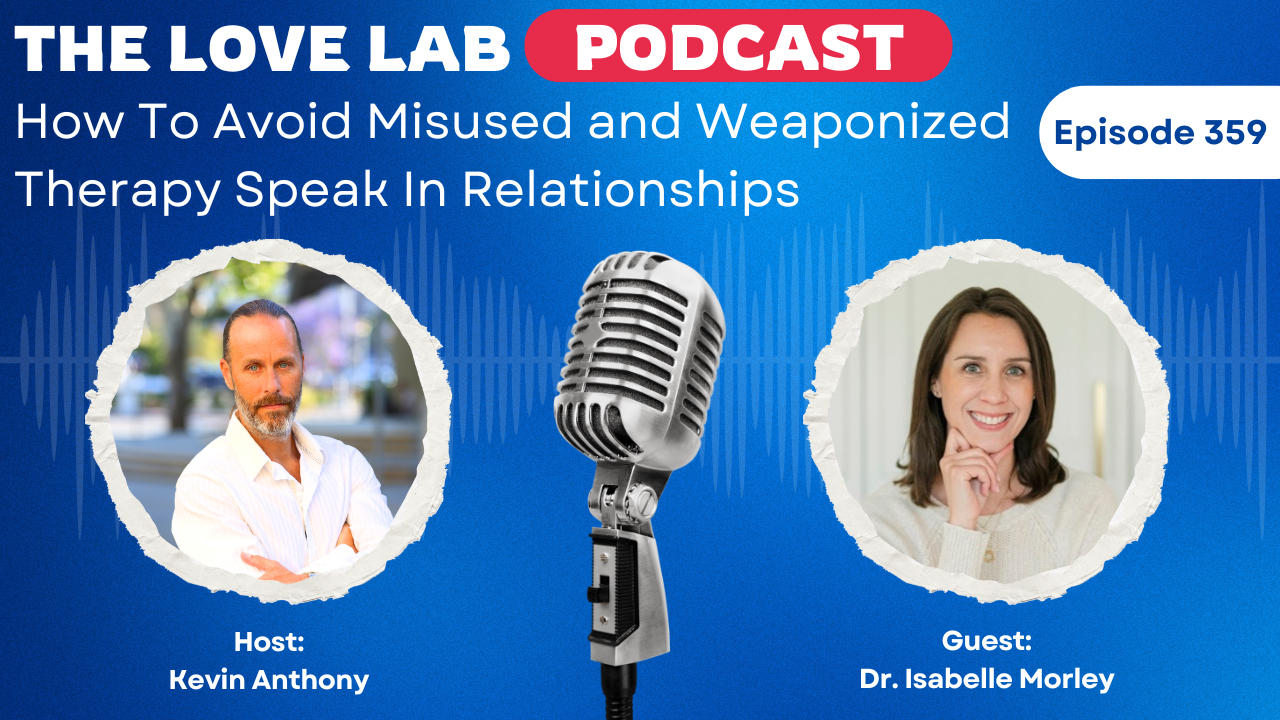
All right, welcome back to the Love Lab podcast. This is episode 359 and it is titled, How to Avoid Misused and Weaponized Therapy Speak in Relationships. This is going to be a really fun topic. Because, you know, in the past, this wasn’t so much of an issue because people didn’t know the terms, they weren’t really in the popular culture. But with the rise of self help and social media, we have seen a lot of this information really come to the mainstream in masses, and while, on the one hand, that’s a good thing, because it’s bringing more awareness to a lot of these things, as is the case with everything, there’s a healthy use of it and an unhealthy use of it. And one of the things that I have absolutely seen, and my guest today has absolutely seen, is that you know people, they see these memes on social media or, you know, they read the latest New York Times bestseller self help book, and they start looking at that and going, Oh, my God, this describes my ex perfectly, and I knew it. He’s a narcissist. And blah, blah, blah, blah, blah, right?
Kevin Anthony 1:37
And then they go back to their partner, and they’re like, Well, you know, I read this book and it tells me that you’re a dismissive, avoidant, and so therefore, blah, blah, blah, blah, blah, like this happens a lot, and the problem with that is it can cause more problems than you’re actually trying to solve. And so that’s what we’re going to talk about today. I have a guest with me who’s going to help me unpack this. We’re going to talk about, you know, sort of what we mean by therapy speak? What’s the difference between weaponizing versus a healthy use? We’re going to talk about some specific terms that are often misused and some of the problems with doing that. So that’s what we’re going to talk about on the show today.
Kevin Anthony 2:19
But before we do that, a short word from my sponsor, which is almost always me. And, you know, I’ve been reading for years now on this show, an ad for power and mastery, which is my, you know, men’s courses for men’s sexual mastery. I talk about it all the time, it’s at powerandmastery.com, it’s everything from how to solve erectile dysfunction to how to last longer than master your ejaculation to all of the other skills that make you a great lover. So that’s a powermastery.com.
Kevin Anthony 2:57
However, today I actually want to read an ad for a brand new course that I have for the ladies. Ladies, did you know that the overwhelming majority of men consider receiving oral sex a must in their relationship? Of course you did, because men have been asking you for it your entire life. But do you feel confident in your ability to give great oral sex if you tend to avoid it because you don’t feel like you are good at it, or if you feel that you are pretty good at it, but want to get even better, then my new blow job mastery course is for you. I have teamed up with the amazing coach, Ry Duong of Eternal Love, to bring you a practical and easy-to-follow course that is guaranteed to increase your confidence and skill when giving oral sex to your man. In this course, you will get all the secrets to mastering the art of oral sex with step-by-step instructions and multiple live demos. Go to https://www.sacredfemininearts.com/bjmastery. That’s https://www.sacredfemininearts.com/bjmastery.
Kevin Anthony 3:54
I never thought I would be making a course on this. This really came up from a video I did on YouTube that kind of went viral, and I was not expecting it, and just woman after woman after woman commenting on this video that I did about what men consider a good blow job. And so many women were like, This blows my mind. I had no idea. And I was like, Okay, well, I guess, I guess maybe we should put this information out there, but I’m obviously not the right one to teach that course. So until I found the right woman who had the skill set and was willing to take my point of view and combine it with hers, that’s how this came about. So go check that out https://www.sacredfemininearts.com/bjmastery. I’m actually excited to finally have an online course to offer to all of the women who have been coming into my practice lately.
Kevin Anthony 4:49
So all right, enough of that stuff. Let’s get into the meat of this. Dr Isabel Morley is a clinical psychologist and couples therapist. She is the. Author of They’re not gaslighting you, ditch the therapy speak and stop hunting for red flags in every relationship. She also writes for Psychology Today. Co hosts the podcast Rom Com Rescue, and lives in the Boston area. Welcome to the show.
Dr. Isabelle Morley 5:16
Thank you so much for having me on. I’m very excited to talk to you today.
Kevin Anthony 5:22
You know, you wrote a book called They’re not gaslighting you, ditch the therapy speak. So you know you are absolutely the right person to have this conversation with. You know what’s funny? You know? The subtitle is, you know, ditch the therapy speak and stop hunting for red flags in every relationship. I was at a fourth of July party this past weekend, and I saw a friend of mine there, and he shows up and he’s and he’s wearing his shirt that has a big red flag on it, and it says, I’m the red flag they warned you about.
Dr. Isabelle Morley 5:55
That’s pretty good. I like that on the nose, exactly.
Kevin Anthony 5:58
Well, hey, at least it’s honest, right, right. Okay, so before we dive into you know, sort of the real bulk of the conversation, let’s start with defining therapy speak. What? What do we mean when we say therapy? Speak?
Dr. Isabelle Morley 6:18
Therapy speak covers so much ground, but basically any disorder or term that is used in the therapy world when you’re in session, things like boundaries, holding space to clinical disorders in the DSM, we all consider this therapy speak, and it’s language that makes sense in the therapeutic relationship when you’re in session, working with Somebody or in the psychological field, and has now left the therapy room and is part of everyday conversation.
Kevin Anthony 6:48
So obviously it has a place, right? Like in the therapy world and in the context of a therapist client relationship, there is a good place, and it’s important that we have these terms so that, you know, we we can have an understanding of what we’re talking about when we’re relating with a client or potentially a colleague. But outside of that, why could this potentially be a problem?
Dr. Isabelle Morley 7:18
Therapy Speak can be distancing. And by that, I mean it can help you not be actually vulnerable or authentic in expressing your feelings, because you’re using these different terms, this vernacular that explains an experience without you having to divulge your specific emotional experience and feelings. And the problem with therapy speak is that it’s very often misused and or weaponized. And I make a distinction there, because misused means an inaccurate application of a therapy term that’s very different from a weaponization, where somebody uses a therapy term to blame another person to gain power and control over them and their relationship. And that’s something that I see abusive partners doing very effectively nowadays, which is, I think, maybe the biggest concern of all with therapy speak.
Kevin Anthony 8:08
Yeah, let’s talk about both of those a little bit more. You know, one of the reasons why this topic kind of spoke to me personally was because many years ago, when I was in my, I think, mid 20s or so, I was dating a woman who was getting her master’s in psychology, and so…….
Dr. Isabelle Morley 8:27
I know where this is going.
Kevin Anthony 8:28
Oh, of course you do. So, of course, she would come back to me and go, Well, you’re this, and you’re that, you know, because she’s learning all of these terms, right? She’s learning how to diagnose, and she’s coming back to the relationship and totally trying to apply it all to her own relationship, which I was not having. And I had to put my foot down pretty quickly and say, I’m not allowing you to be our therapist. Like you’re not gonna diagnose us, right? Like you have to, you have to leave that in school, but because I’ve personally experienced that, I know you know how difficult it can be in a relationship, and so when I saw this title, I was like, man, we need to talk about so you mentioned that there are basically two problems.
Kevin Anthony 9:21
One is the misuse, which I think was mostly what was going on in my personal experience. I mean, she was very new. She was just learning a lot of this stuff, you know. And this, I mean, this is going back over 25 years, right? So this stuff wasn’t necessarily in the mainstream. So, you know, I’m taking her word for what’s coming from, you know, her teachers in her classrooms, and her professors, and like, okay, what does this really mean? Is this really true? So there’s that, there’s the whole misuse of stuff, and then there’s, you know, the potential weaponization. Let’s talk about misuse. First, what are some of the most common ways that you see this therapy speak being misused?
Dr. Isabelle Morley 10:08
I think the main way is what you just described, where people gain awareness of these words, disorders terms, and then look at everyone in their life through a clinical lens, which is what every psych grad student does, and we have to be taught how to use these terms, and then we have to be convinced not to all the time by our professors, which is an interesting experience, where you are you’re given all of the tools to diagnose someone, and then a professor says, but that’s not someone’s full identity. And you don’t have to always look at people through that lens and be careful to not over pathologize people and they teach you out of it. What we see now is people gaining all of this information about psychological disorders, but there’s no one talking them out of using them all the time or being more judicious in their application. So people are looking at every behavior, every experience, every relationship, through a clinical lens and seeing how they could label it, instead of it just being normal but difficult, they can call it pathological in some way that offers them a sense of relief or a path forward or absolves them From responsibility. And I think that is happening almost constantly nowadays.
Kevin Anthony 11:23
This is going to be a really hard question for you to answer, but I’m curious, when you see this happening, what percentage of the time is the issue actually pathological?
Dr. Isabelle Morley 11:40
What percentage?
Kevin Anthony 11:41
Just a rough guess.
Dr. Isabelle Morley 11:43
I mean two, five, because the truth is, most often people come into my practice and they’re using these terms. They’re going through something very difficult; they’re not in a good place in the relationship. It’s often not pathological. It’s usually me having to tell them if it’s a pathological issue. It’s very hard for people to accurately assess, diagnose, and communicate when there is true narcissism at play or true OCD. So I’d say it’s a very, very, very low percentage when people are right.
Kevin Anthony 12:18
So let’s compare and contrast that, then, like, again, just a rough percentage, like, how many people come in using these pathological terms? But then, and, you know, we found out maybe two to 5% are actually pathological. But how many of them are actually coming in using the terms, thinking there’s a pathological issue?
Dr. Isabelle Morley 12:39
Everybody believes that they’re right about these words. Everyone who comes in and says they’re gaslighting me they’re a narcissist. They have to be bipolar, is pretty confident in their conclusion, which is difficult, then, as a therapist, to try to assess and then walk people back from these conclusions in a way that’s not so invalidating that they will work with you.
Kevin Anthony 13:05
Okay? So basically, everybody who comes in using these terms believes that there is an actual pathology there. What percentage of people who come to see you show up thinking that they already have a pathology happening?
Dr. Isabelle Morley 13:22
That’s a really hard question. I mean, I see couples, so invariably, every couple, at some point, will accuse the other person of gaslighting them. I mean, that is, that’s almost a universal accusation, getting into actual disorders. Maybe that’s more like 30% end up using that within the conflict.
Kevin Anthony 13:42
Okay, I know those are hard questions, and I totally put you on the spot with that, but what I really wanted to try to get across to the audience was the difference between how many people use the terms incorrectly think that there’s a pathology there because of, you know, really their lack of knowledge and experience in the field versus how many of them actually have a pathology, right? And there’s a huge difference there, right? And we know this to be true, there’s an inside joke in you know, when it comes to whether you do coaching like I do, or you do therapy like you do, there was an inside joke that I share with a lot of people in this industry, and that is, everybody’s a narcissist, right?
Kevin Anthony 14:27
Like we all laugh about it, because if you’ve done this work long enough, you’ve had a significant number of people show up and tell you their partner is a narcissist, and everyone they’ve ever dated is a narcissist, and they don’t understand why they keep attracting narcissists, right? And when you look at the data, and I’ve, you know, I’ve shared this on the show many times, it’s like one, 1.5 maybe 2% of the population have actual narcissism. But then, how can everybody be a narcissist? If the pop the stats show is. Yes, right? So that’s like an example of, you know, so many people thinking that there is a pathology here when there isn’t one.
Dr. Isabelle Morley 15:09
Because the truth is, humans at their baseline, at their healthiest, are a bit pathological, like we all have distressing experiences and emotions. We all behave badly sometimes, and all of the disorders that people now know about are just extremes of normal human experience. So we kind of all are narcissists, a little bit, sometimes in certain ways, with certain people. But that doesn’t mean that you have narcissistic personality disorder. And I think we’re we’re so quick to jump on people for their missteps and for their feelings that we don’t understand, and we label it as opposed to understanding that humans act that way and feel that way.
Kevin Anthony 15:56
I love that you brought up that a lot of these things that we call pathologies are just extremes of behavior, right? So you’re taking a behavior that is relatively common in the human experience, but when it gets exaggerated to a far extreme, then it becomes a pathology. And I think that’s important to understand for people who are listening, because you might see things that are, you know, I tell people, your ex isn’t a narcissist, they just have some narcissistic tendencies or behaviors, right? And there’s a huge difference between that, like a little bit of narcissism, versus you are actually clinically a narcissist.
Dr. Isabelle Morley 16:38
It is a big difference, but I don’t know that. People know that or agree with that. I think people think you’ve got a narcissistic flavor to you, then you’re a narcissist and you’re going to be a difficult person, when really there’s such a spectrum of not within any of these disorders, such a spectrum of presentation, and yeah, that we all have little bits and pieces of these traits and tendencies, but if it’s not persistent and pervasive and causing us distress and impacting our functioning, then it’s probably not a clinical issue.
Kevin Anthony 17:09
Yeah, and that’s really the point that I wanted to make, because I wanted people to understand that if you sense, you know, there are some tendencies or some behaviors that are similar to a pathology, not to, like, freak out immediately and run in the other direction, right? And then go tell all your friends that this person’s a narcissist, because you saw a behavior that is similar to, like, it’s the distinction is actually really important. It’s not just, you know, a minor thing, and I think, you know, tell me what you think about this, but I think one of the reasons why we as humans tend to do that has to do with what’s called a negativity bias, right? Like, I’m sure you’re aware of that, which is that we’re programmed, you know, for survival, to always look for like the worst case, you know, like thing, right?
Kevin Anthony 18:01
Because we want to absolutely avoid anything that is going to basically kill us, right? Like it’s programmed into our DNA to always be looking for problems. Something wrong. That tree moved over there. Maybe there’s a lion behind it, right? Like that kind of stuff. And I think we still do this in modern, you know, in our modern world, where we’re constantly looking for all the possible red flags, right? Like we just talked about before, and we get so caught up in that, that instead of looking for the positives, the places where the person and you know ourselves meet, and where we have things in common and where we share common values and goals, we’re always looking for the red flags. What do you think about that?
Dr. Isabelle Morley 18:44
I think it’s exactly right. There is such a need to protect ourselves, right? Whether it’s because it’s been biologically hardwired and that’s just how we view the world, and there’s a vigilance with which we approach our interactions, or because there’s so much focus on it right now in the zeitgeist of making sure you are assessing people to be good, healthy, romantic partners. And here’s what you have to watch out for. We are so programmed to be on the hunt for whatever these indicators, early signs, could be. And the issue is that humans always have early indicators that they’re difficult in some way. And if you jump on the first sign and draw a conclusion, and you know, end the relationship, you’re going to cycle through a lot of people, because we all have rough edges and growth areas that are never-ending, like lifelong work we have to do. And so you’re not going to find a perfectly formed human.
Kevin Anthony 19:43
Absolutely, and that’s, that’s one of the main reasons why you know this aspect of the conversation is so important. Because I do see people, you know, churning and burning, right? They’re just going through one person after another after another. Uh, because they’re constantly, you know, looking for that perfect person, that perfect match, that soul mate, that twin flame, right? Like, you know, those of us in this field, we cringe when we hear those words, right? I saw the look in your eyes, and therefore they’re, they’re not stopping to actually put in the work to make a relationship work. Somebody asked me in a group coaching session that I do weekly, what was one thing that I’ve learned over the years doing this work? And I was like, Whoa, what a great question. I never really thought about it. I don’t know how I could even narrow it down to one.
Kevin Anthony 20:41
But the thing that popped into my head in that moment was that if you really want to with, you know, with pathological, you know, issues as an exception, if you really want to, if you really want to invest the time and energy into doing the work, the personal work and the group work as a couple, you really can make any relationship work right now. I’m not saying that you need to stay in any relationship, like, just pick anybody and just make it work. No, there. There are better relationships than others, right? But, but that was a realization I’ve had after having worked with enough people, is that usually, what gets in the way and makes it not work are the lack of skills in knowing how to relate to another human being. And when you get all that junk out of the way and teach them some skills, oh, look at that, the relationship is suddenly working.
Dr. Isabelle Morley 21:39
I think that’s that’s such a good point, because the problem then, with therapy, speak, and this tendency to be vigilant towards others, is a lack of introspection and self awareness about where your growing edges are, what work you have to do, what what you are bringing into the relationship. And that is where people actually have agency and can make positive change. But if you’re always figuring out the ways in which other people have disappointed, you have red flags, have clinical issues, and never looking at yourself, then you will be able to figure out how you can be a better person than in all of these interactions and relationships and that, you know, stifles your own growth.
Kevin Anthony 22:20
Yeah, yeah. I tell people all the time, because, you know, when somebody is interested in potentially working with me, you know, if they’re married, that’s different, but a lot of times they’re dating, right? And so, you know, sometimes they’ll come to me say, Well, I don’t know if this relationship is going to work out anyway, so maybe, maybe once I get a new one, I’ll work with you or or they’ll come to me and they’ll be single, and they’re like, I don’t know, my relationships keep failing, but yep, let me. Let me start dating somebody first, and then I’ll work with you. And I say all the time, I’m like, this isn’t just about the relationship with whoever that is. This is about you learning the skills and becoming the best version of yourself.
Kevin Anthony 22:57
And hey, by the way, wouldn’t you want to learn all of that and become that person before you get into another relationship and then screw it up, and then have to start all over again. You know, it’s like, you know, I think I’ll change that tire on my car after I get a flat in the middle of the highway. Because, you know, what’s the point of doing it beforehand, right?
Dr. Isabelle Morley 23:18
See how far I can get.
Kevin Anthony 23:24
Let’s shift gears a little bit, and let’s move over to weaponizing, because I really want to make the distinction between the misuse and the weaponizing. Just talk a little bit about that and sort of how that shows up. Like, what does it mean to weaponize these terms?
Dr. Isabelle Morley 23:41
The weaponization of these words usually shows up as abuse, where people are labeling another person, and even if they think it’s accurate, they’re labeling somebody’s behavior or personality or or mood as pathological as a way of Putting all of the blame and responsibility on them and controlling their choices, their behaviors, their feelings. So by saying you’re overreacting to that because you’re borderline, or you’re asking me to change my schedule because you’re so toxic, or OCD, they’re actually becoming abusive towards the other person.
Kevin Anthony 24:21
So if somebody is weaponizing these words, wouldn’t that, in and of itself, be pathological?
Dr. Isabelle Morley 24:30
It tends to be yes. I mean the people who the most enthusiastically wield these words. And I can think of some examples that have come out in the past couple of years of celebrities who have used these words; they tend to be more of a clinical problem than the people they are talking to.
Kevin Anthony 24:50
Yeah. I mean, one of the examples, of course, that stands out to me. We were just talking a lot about narcissists, but this is very typical of what narcissists do. They project on. Everybody else, all the things that they’re doing, but it’s no, no, you’re this and you’re that, and you’re this and you’re this, right? So that in that is basically pathological.
Dr. Isabelle Morley 25:10
Yes, right. It’s an abuse tactic of being the victim, making the other person the offender. It’s just a new version. Instead of saying, Oh, you this my partner. They are abusive towards me. Now you’re saying, Oh, you have this clinical issue, and you are the reason why everything is going wrong in our life and our relationship, and you have to take responsibility and fix it. But it’s my concern is it’s very subtle, and that we give deference to clinical terms, right, like people respect the idea that you could have Bipolar, right, or you could be gaslighting someone, and so it’s a very effective way to control and manipulate another person, and that is what I find so scary about the proliferation of therapy speak.
Kevin Anthony 25:58
Do you think sometimes, because obviously there’s the pathological side of that. So people who are deliberately trying to control their partner through the weaponization of therapy, speak, but do you think that it ever reaches the level of weaponization sort of unconsciously, right, where they’re not necessarily pathological, and they’re not necessarily deliberately trying to control, but maybe there’s other motivations behind it that they’re not necessarily aware of.
Dr. Isabelle Morley 26:25
Absolutely. I think the best example is people’s weaponization of boundaries. That if you say, This is my boundary, it’s a way of saying you have to do what I’m saying, whatever that line in the sand that I’ve drawn, you have to do it because I’ve said, this is my boundary, and therefore if you disrespect it, right, that’s a boundary violation, and you’re a problem when really, people cross each other’s boundaries all the time, just because you’re bound, it doesn’t mean somebody has to respect it. So I think there isn’t always a malicious intent with that word, but it can be weaponized very frequently.
Kevin Anthony 26:59
Ooh, that’s a really good example. You know, in the coaching world, we spend a lot of time helping people actually set boundaries and understand why setting boundaries is important, and then setting appropriate boundaries, and therein lies what you’re talking about here. Just because you set a boundary doesn’t necessarily mean it’s an appropriate boundary.
Dr. Isabelle Morley 27:26
Yes, and sometimes, and people hate this idea, sometimes an appropriate boundary has to be a flexible boundary, if it’s someone that you care about, and their boundary is rubbing up against yours. Sometimes there is a negotiation or a conversation, and I think people are coming in with these hard lines and a lack of willingness to discuss them, to be flexible, to consider shifting anything which in the context of an abusive relationship, is great, you shouldn’t let people cross your boundaries, right and take advantage of you, but in healthy relationships, that rigidity ends up being a lot less productive. But with all of these terms, there is such nuance as I’m sure you see, like it depends on the person you’re working with, their relationship with the other person, and so it’s so hard to apply these hard and fast rules for all these clinical words, but that’s essentially what social media does, is they give you really general applications of what you should do, and that tends to not be very effective.
Kevin Anthony 28:31
Isn’t that true of so many things? Right? Yes. You know, I think when it comes to this, or really anything else. The beauty of social media is it can raise your awareness to something, but if it does raise your awareness to something, that’s the point at which you need to actually go and do more research, right? Whether that means reading an actual book written by an actual therapist, such as you, or whether that means going to see a therapist, or whatever it is like, do the actual research. Don’t stop at what you read in the meme on social media.
Dr. Isabelle Morley 29:09
Oh, if I could have everyone in the world hear that, that is exactly what I want people to know. Let social media spark your curiosity, but not inspire a conclusion like; let it make you wonder, and then go find out more. But don’t stop at that one meme that resonated with you, because it’s probably not the full picture.
Kevin Anthony 29:31
Yeah, it’s sad that the way culture has evolved, and this isn’t true in everything, not just, you know, the therapy speak that we’re talking about. But you know, our brains have been so hijacked and our attention spans cut so short that all we ever do is read the headline, right? Like, how many times has the media been caught writing a headline, writing an entire story, and then the very last paragraph of the story actually contradicts the headline, right? But so then they can’t be accused of lying, but then they get their message out, because the only thing anybody ever reads is the headline, right?
Kevin Anthony 30:11
Yeah, so it’s kind of similar, right? We’re, we’re so used to just taking these short, little 32nd, you know, sound bites or memes, and we’re not really truly learning the depth of what these things are about. And that’s that, honestly, is sad, and I hope that we can, you know, through episodes like this and conversations like this, start to change that a little bit.
Dr. Isabelle Morley 30:35
Yeah. I mean, I think that’s why I made the title of my book as provocative as it is, in part because you’re competing with a lot of clickbait information, and you have to capture people’s attention and then draw them in to learn more. But it is hard. You are you’re going up against a lot of really entertaining information, even though research more every day coming out shows that a lot of the information on Tiktok on Instagram is misleading, is inaccurate when it comes to mental health issues and relationships, but what gets attention is clickbait, extreme information, captivating stories and pictures, and that’s what people remember.
Kevin Anthony 31:19
Yeah, you know, as a content creator, I battle with this all the time because I try not to be hyperbolic in my titles or, you know, my little clips, because I want to be real and genuine as much as I can. And then at the same time, I realize I’m competing with all of that insane hyperbolic stuff that’s getting all the clicks. So I try to find a balance between something that is maybe slightly provocative, but without being hyperbolic, and it’s actually not easy to do.
Dr. Isabelle Morley 31:52
I believe it. I really do believe it. It’s a hard line to walk, and I think that a lot of content creators for the therapy world have nothing but the best intentions and are putting out really good information, but just because of the format of social media, it’s not going to be a full, complex, nuanced explanation of a disorder or a term, and so people are just taking snippets of information and drawing their own conclusions.
Kevin Anthony 32:17
Okay, we’re about halfway through, and I need to take a break, but when we come back, I want to talk a little bit more specifically about some of the terms and how they are misused and why that can be a problem, because my goal is to help everybody basically up their game, right? So you’re going to be having these conversations with your partner, I want to make sure you’re using these terms correctly so that you’re not causing more problems in your relationship, that you can actually use these in a way that could maybe help the relationship. But to do that, we’ve got to understand what they are and the appropriate ways to use them, so we’re going to do that as soon as we come back.
Kevin Anthony 33:00
All right, are you a couple? Are your relationship and sex life where you want them to be? Are there changes you would like to make, but just don’t know how maybe you think there is nothing that can be done if you are not 100% happy with where your relationship or sex life is. Then get help today and change your life. Go to https://www.kevinanthonycoaching.com/couples/ and schedule a strategy call with me today so we can map out a strategy to get you where you want to be, so that you can have it all your way. That is https://www.kevinanthonycoaching.com/couples/. That is obviously my couples coaching program. You know, if the work that I do resonates with you, that’s amazing, and please go check that out. And you know, I have lots of guests on, including my guest today, who do similar work, maybe the same work, maybe different work, maybe they take it even another level further. If you resonate with them, then go look them up. All I really care about is that people get the help that they need. So at the end of the show, of course, I will be giving Isabelle an opportunity to talk about where you can find her and buy her book, and potentially work with her as well.
Kevin Anthony 34:09
All right, let’s get back to the topic here. I have a list. There are actually 12 things on here. I doubt we will get to all 12, but I want to at least pick like a couple of big ones that we see. Let’s start with gas lighting, a huge term used all the time. Talk about ways in which gas lighting is potentially misused, and why it would be important to use it correctly, and how they could use it correctly.
Dr. Isabelle Morley 34:42
People have misunderstood the term gaslighting to mean that any time someone disagrees with your memory of an event, of what happened, or invalidates your experience, that they are gaslighting you, when, in truth, gaslighting is an abuse tactic where somebody systematically. Insidiously makes you doubt your sense of reality and lose self-trust, where you feel like you can no longer believe your reality is accurate. Now, invalidation can be a part of gaslighting. Lying can be a part of gaslighting. But as I’m sure you’ve seen, couples often disagree with what was said or not said, with how a conversation went, or they think the other person is being ridiculous and how they feel about something. And while that doesn’t feel good, that is not gaslighting.
Kevin Anthony 35:33
So the big distinction here is when somebody’s intentionally doing it, basically intentionally lying to you about an experience with the intent of manipulating you right, as opposed to simply not really accurately, like, let’s let’s just be honest here, human memories suck the worst, even if you have, like, a really great memory compared To most people, it’s just not really accurate. It’s not accurate for a lot of reasons. One, there’s often tons of data coming in, and our brain is programmed to filter it out, so we only catch parts of something. But then, when we rerun the scenario through our minds a bunch of times, it tends to change.
Kevin Anthony 36:17
And then, of course, there’s the fact that what somebody says to you, the words they use and the intention of what they were trying to communicate to you, by the time it’s received on your end and goes through your filters and your processing isn’t exactly what they were trying to convey. So all of those things come together to really kind of muddy the waters of our memory, right? So we think we have such a clear idea of what exactly happened. And look, if you’re honest, we’ve all been, you know, caught. I had, there were things that I thought for sure I remembered clearly. And then I saw the video, and I was like, remember that? That’s not the way I remember it at all, right? So, so there’s that, and I know when I was kind of mentioning the intentional part, you had a little bit of a reaction there, because I think you wanted to clarify something I said around that.
Dr. Isabelle Morley 37:13
Only because sometimes people gaslight without intentionality. Sometimes it is because they are just so self-consumed with their perspective and can’t fathom that another person has a different reality that could be true and accurate for them. They’re not intentionally trying to manipulate and gain power and control, but they are still doing it through gaslighting, which is what makes it a very complicated term and hard to pin down. Sometimes it’s intentional, sometimes it’s unknowing, but the real thing about gaslighting is it’s not just that it’s not what happened. It’s you’re crazy for thinking that’s what happened, and actually you’re the manipulative one for remembering it that way, or for not seeing what I’m saying. It’s this reversal of blame and responsibility, whereas if somebody says I remember it differently. I believe what you’re saying is true for you. That’s not how I think it went down. That is definitely not gaslighting.
Kevin Anthony 38:09
Thank you for adding that clarity, because I think that made it, you know, significantly clearer as to the difference between what actual gaslighting is. And I agree with you, I think that most people use the term for any time they disagree with, you know, the series of events that supposedly happened. Okay, let’s move on to some other terms, because we’ve got quite a few of them. Let’s talk about red flags next. You got that one in the title of your book too.
Dr. Isabelle Morley 38:40
So people love a red flag right now. And you know what? This is the chapter people have fought me on more than anything else, because people do not want red flags taken away from them. And I am not trying to take red flags away from you. I want you to have your red flags, but they mean? They’re supposed to mean true signs of threat of abuse, of somebody who is not ready to be in a relationship, of a person who’s going to be destructive in your life real, real flashing warning signs, as opposed to somebody who is imperfect, who has some growing to do, who has some skills to gain who doesn’t know exactly how to operate in a relationship in the healthiest way, and now people are so quick to jump on the first mistake and call it a red flag and and leave the person that nobody has a chance to to grow and change.
Kevin Anthony 39:38
I was literally just having that conversation via a voice message with a friend of mine this morning, as he was venting to me about his partner, you know? And I said, Well, he was, he was really venting about some communication issues. And one of the things I said in my response was, oh, okay, you know, she’s new to you know, communicating in the ways that you’re used to communicating. But the question is, is she open to learning new ways of communication, and is she actively working on it? Right? Yes. Because if the answer to those is no, then, okay, I get it. That’s a red flag. It’s really hard to be in a relationship with somebody who just can’t communicate and refuses to learn how to do so, right? But if she’s making an effort, if she’s trying, that’s a whole different story.
Dr. Isabelle Morley 40:31
Yeah, and it’s back to the idea that relationships have a cycle of harmony, rupture, and repair. You don’t get to skip rupture, but you have to choose repair. It’s the same for individual work; everybody is going to have issues that they have to work on, maybe for their whole lives. And it’s not necessarily that they have that problem or that skill deficit. The problem is when they won’t recognize it, won’t work on it, and won’t apologize for it. And I think that people just want perfectly formed humans who have done all the work, who have been in therapy, who know all the words and know their personality style, and that person doesn’t exist. I have never met that perfect person in my life.
Kevin Anthony 41:10
I was just gonna ask you, I was gonna say, as a professional, not only do you know all the people you’ve worked with, but all the professionals you know in the industry, how many perfect people have you met?
Dr. Isabelle Morley 41:20
I say, and not even me. You know, the best I can say is that I’m aware of my forever growing edges, but I don’t know any therapist, anybody who is who has done the work.
Kevin Anthony 41:34
Well, you’re really only done doing the work when you’re dead, and honestly, I’m still not even sure you’re really done at that point. You’re probably continuing on, just in another realm. You know, if we want to start going down the spiritual, you know, philosophical Road, probably when you’re done is when you merge back with source, right? That’s probably it. That’s probably when you’re done so however many lifetimes. Okay, I got a couple more terms. I definitely want to cover another one that you hear used a lot, is toxic. Everything is toxic. Masculinity is toxic, and everything is toxic, and he’s so toxic. Let’s talk about that term a little bit.
Dr. Isabelle Morley 42:26
I mean, my issue with toxic is that it means everything, and therefore it means nothing, right? If toxic means abusive, but toxic also means immature, like when you just say that word, all we know is that you think the other person is a problem and that you’re not a part of it, not a part of the issue, and it defers it puts all the blame on them. What I say with toxic is, tell me what you mean by toxic. Is it a dynamic that’s not working for you? Is it their communication? Do you think they have an actual clinical disorder? Is it abusive, or are they just not for you, right? Is something about the way they operate, not what you’re looking for, and maybe not toxic or bad or objectively wrong, but just not the right fit for you, in which case, you don’t have to call them toxic. You can just say they’re not the right fit for me.
Kevin Anthony 43:16
When I think of the term toxic, and I didn’t look this up beforehand, although be interesting to read the actual dictionary definition of it, but when I think of toxic, like when they put something on a bottle and say it’s toxic, it means it’ll kill you.
Dr. Isabelle Morley 43:31
Yes, but then you think of, you know, the Britney Spears toxic song, right? Which is this, like, very exciting but unhealthy sexual dynamic with someone, like it could mean so many things, and all you know is that it just it doesn’t feel good for you, or it’s bad for you in some way. But I think people should really push themselves to define what it actually means, and then if they want to use toxic from that point on, fine, you know, I’ll know what you’re talking about.
Kevin Anthony 43:58
Well, you know, it’s one thing to be using that term when you go see your therapist, right? But it’s another thing to be having a discussion with your partner and saying Your behavior is just so toxic, right? Like that can have some pretty devastating consequences.
Dr. Isabelle Morley 44:12
Yes, it’s just the new version of pointing the finger, and you’re using, you know, more and more clinical words for it, but what happens in that conversation is the other person has examples ready to go of the ways in which you’re toxic too, because you’re both probably toxic in different ways. And again, it just it skips the important part of the work, which is real emotional vulnerability and sharing what’s hard for you and how to fix it and address it together, and it skips to finger pointing, blaming, and accusation.
Kevin Anthony 44:45
Yeah, so stop using the word toxic. Stop it. Just stop it. Reminds me of one of my favorite comedy skits. Have you ever seen The Bob Newhart Show? Just stop it. Comedy. Look it up. After we get off this call, hilarious because he’s playing the part of a therapist, and a woman comes in and starts telling him a bunch of stuff, and he has a very, very, very funny response. You will resonate to some extent with it as a therapist, I’m sure, then email me and let me know what you thought about. Okay, I’ve got another one that we absolutely have to talk about here. I even made a note after our pre-interview call to make sure that I ask you about this one, and that is the term trauma bond.
Dr. Isabelle Morley 45:40
This one, this one doesn’t even really fit with the rest of the book, but it’s my pet peeve, so I put it in there anyway, because people use trauma bond so much now, and they use it to mean we went through something hard together, so we’re very close as a result. You know, we were in the same toxic workplace with our narcissistic boss. So we’re trauma bonded because we like went to war, and now we have gone through this hard time together, when trauma bond actually means the very complicated, unhealthy relationship that an abuser has with their victim or survivor, and the person who has been abused sort of defends and protects the more abusive partner because of their dynamic, and it comes from originally, Stockholm syndrome. And I admit that maybe I’ve lost the battle on this term because it’s so used in the other way now. But I just want people to be aware that this is what happens with semantic bleaching is now, trauma bond means something different, and we’ve lost a term to explain something really important and destructive in an abusive relationship. But like I said, I think it’s think it’s over now.
Kevin Anthony 46:53
Well, it’s not over till it’s over, as they say, but so you described what it actually is, right where, you know, its root stems from Stockholm syndrome, and that that unhealthy and sort of weird relationship that can happen between abuser and victim, right? But could you maybe explain how people are generally using it today? Like, what do they think it means today?
Dr. Isabelle Morley 47:18
Oh, that’s because they shared in a hard experience, in a trauma. Let’s just put a pin in the word trauma, because that is so misused now, too, because they went through a traumatic experience together. They’re bonded. They’re incredibly close. They’ve gone through something that has united them in this time, which is not a trauma bond; it’s just a social bond. You know, hazing, literally going to war, makes people very socially bonded, because they do go through something very hard together and have a shared experience. But that’s not a trauma bond.
Kevin Anthony 47:52
You know, sometimes I hear that term used in an even different way than either of those two, which is that, you know, some person has experienced some sort of trauma in their life, and this other person that they’re attracted to has experienced a similar trauma, and because they share in that similarity, that that sort of brings them together, but neither of them have actually healed that trauma, so they end up in This dysfunctional cycle over and over and over again, you know, triggering each other’s trauma, and they think that because they have that shared commonality, somehow they’re supposed to be together.
Dr. Isabelle Morley 48:32
Yeah, well, it’s like the classic example of how true narcissists and people who have borderline personality disorder often match up because they have usually trauma histories, and they interact, at least initially, in a way that feels positive to both of them, and ends up being very destructive, because, well, for many different reasons. But yeah, I mean, it’s an interesting, vague term that I see how it could be applied in many different ways, and I get its evolution, and I get that words evolve and change over time. But I think it’s also an interesting question for our field of when do we draw the line and pull people back from their new definitions of these words, and when do we just let them go?
Kevin Anthony 49:12
Yeah, you know, and even if we don’t pull them back necessarily, I think bringing awareness to the fact that these words might have more than one meaning is, in and of itself, important, because we’re talking about how people are misusing these words, and I think a lot of the problem is, is that people have different ideas of what they actually mean. This is one of the things that you said early on in this interview, is like, Well, okay, somebody comes in and uses the word toxic, right? Tell me what you mean by that. What does that even mean? And I think even if you’re not working with your therapist, if you’re having conversations with your partner and you’re using these terms, it’s important to say, Hold on a minute. What do you mean by that term? I want to make sure I understand. What you’re saying, because we just came up with three definitions for trauma bond, right?
Dr. Isabelle Morley 50:04
Yeah, yeah, and that is exactly what I do in my work, and what I am teaching other therapists to do, of like, the first thing to do is clarify what the person actually is communicating to you. Like, do they really think their partner is a narcissist, or are they trying to just convey how frustrated they are by that person and how self absorbed they think they are, and they actually recognize it’s not a clinical issue, because that in itself is so powerful and can help you get on the same page.
Kevin Anthony 50:34
Yes, indeed. All right, let’s just grab maybe one or two more terms before we wrap up. Another one that you hear a lot being used these days is love bombing. So, talk a little bit about what it actually is and when it is a problem?
Dr. Isabelle Morley 50:58
Love bombing is part of an abusive relationship, typically, where at the start of the relationship, the abusive partner comes on very strong and is in constant communication, giving gifts, showering you with affection, claiming to have the same values and life goals as you, saying that they’re your twin flame to draw you in and to start a really committed, intense relationship that begins to isolate you from other people and make you two the center of the universe. It’s also done after an abuse incident, in which, after abuse occurs, a person will come in incredibly loving and apologetic, and again showering you with gifts and affection to make you forgive and forget what happened and stay with them. The difficulty with love bombing is that it can mirror normal, healthy relationship behavior.
Dr. Isabelle Morley 51:53
During courtship, people bring gifts and they’re affectionate, and they communicate more frequently, and after a fight, people tend to be apologetic and try to reconnect and regain closeness. So again, it’s this extreme of a normal, healthy behavior, and the intent is to isolate and have power and control over another person. But it can be hard for people to tell that line in part, because what might feel like a normal level of affection to you could be overwhelming to me. And that doesn’t mean that it’s love bombing, but it means that it’s too much for me.
Kevin Anthony 52:28
Yeah, I see, I see a lot of women labeling things love bombing and then basically throwing up the red flag as a result, right? And so it’s really interesting, right? Because, honestly, all right, some of these guys, when I, when I talk to some of these women, some of these guys are going a little bit overboard with the stuff initially, yeah, but, but they’re not doing it in that intentionally harmful way to control them. What I’m seeing a lot these days is, you know, from the man’s perspective, especially as they start getting older and they’re still single, right? They start like, really going overboard to try to attract a mate, right?
Kevin Anthony 53:16
And so then women who have been, you know, hurt countless times throughout their lives, and are seeing this, and they’re going, Oh, my God, he’s love bombing me. This is a red flag. I hear it a lot from women who are dating that anytime a man comes on really strongly in the sense that he’s calling a lot, or he’s bringing flowers every day. Or, you know, he’s telling them early on that he loves them like they’re instantly their red flags are up, and they’re like, there’s something wrong with this guy, because he’s love bombing me, you know? And I’m thinking to myself, you know, sometimes there are just some nice guys who desperately want a partner who are trying real hard.
Dr. Isabelle Morley 54:03
Yes, and it might be too much for you, and that’s totally okay, but it doesn’t make it an abuse tactic, and that’s the implication if you’re love bombing or you’re being abusive.
Kevin Anthony 54:14
The second word in that is bomb.
Dr. Isabelle Morley 54:18
It’s a pretty loaded word, yes, it’s also so subjective, like, if it’s someone that you think is so attractive and hard to get, if they’re showering you with affection, you might love it. If it’s somebody that you think is not that cute, you’re not that interested in, and they’re texting you every day, you might be averse to it, but the person on the other side doesn’t know how you feel about it, necessarily. That’s where communication comes into play.
Kevin Anthony 54:45
Oh yes. Imagine that communication crazy idea. Imagine having a conversation with somebody. You know, this is so interesting, right? Because when I started doing. Coaching work, especially when I was, like, taking some early trainings and trying to, like, sort of hone my skills. I had this idea that I needed to have a gazillion tools in the toolbox, you know, to be able to give to clients. I’m like, I need, I need this tool, and I need that tool, and I gotta, you know, and over the years of doing it, I mean, the tools are great. There’s nothing wrong with the tools, right?
Kevin Anthony 55:22
But I really started to realize that the overwhelming majority of issues that my clients come to me with can be solved by learning good communication skills and having really open, honest, emotionally mature Conversations frequently with their partner, and it’s so interesting, right? Because, like, especially I mentioned earlier, I do like some group coaching calls, so I get to talk to a bunch of people all at once in one call. They come with all different problems, right? Probably eight. If I speak to 10 people in a call, eight of them, my answer is, you need to have a conversation with him.
Kevin Anthony 56:11
Do they actually know what you just told me? Because it doesn’t sound like they do, right? So it’s just, you know, you when you gave that advice about it comes down to having good conversations. I just kind of wanted to share with the audience my experience, you know, having done this now for quite some time that so so much of this stuff, not everything, but a lot of it can be resolved by learning how to really effectively communicate in a way that’s compassionate, in a way that can be heard by your partner and then doing so frequently, it’s just yeah, it’s kind of like it’s the most one of the most important tools in the toolbox.
Dr. Isabelle Morley 56:51
It’s the answer. But it’s also so risky. People find it so risky to be that vulnerable, to share their feelings or to share their needs, because it means the other person could not listen, could not care, could not agree, and so it does feel easier, safer, more protected, to just use a label, use a term, make the other person a problem, and not have to have that conversation. But you’re right. Talking to each other is the answer most of the time.
Kevin Anthony 57:20
Imagine that, right? I do spend a lot of my time simply teaching people the framework for how to have a good conversation. But at the same time, you know, I’m glad that it’s not super complicated. I’m glad that we don’t have to, you know, figure out how to get to Mars in order to solve our relationship problems, like the fact that it’s actually not that difficult, it’s a good thing.
Dr. Isabelle Morley 57:47
If we could just get out of our own way, it would be so much simpler.
Kevin Anthony 57:53
Absolutely, absolutely. All right. Well, Isabel, I want to thank you for coming on the show and sharing your knowledge your experience. It’s always wonderful to hear from another grounded professional with a lot of experience like just the way that you could just so clearly and calmly explain things that can be actually kind of difficult to understand for a lot of people, I think it’s just so valuable for people to hear here. So, thank you.
Dr. Isabelle Morley 58:26
Thank you. That means a lot to me. That is definitely my goal, because it’s there’s a lot of information out there, and I want everyone to gain a little more clarity on what these words mean and how to use them.
Kevin Anthony 58:37
Absolutely, so tell people where they can find more about you and potentially where they can get your book.
Dr. Isabelle Morley 58:45
So my book is wherever books are sold, Amazon, Barnes and Noble, Target. You can find more about me at my website, Dr. Isabel Morley.com, where I have resources and PDFs and my coaching. Or you can find me on Instagram at Dr Isabel Morley.
Kevin Anthony 59:00
Awesome, and those links are in the description, so please go check those out. You know, I love when I meet. You know, I interview a lot of people on this show, and you know, generally, if you’ve made it onto the show, it’s probably because I like you already. You know, like I’ve looked at your website, I’ve maybe read your books, we’ve spoken in a pre-interview call. But that doesn’t always mean that I would necessarily recommend that people go work with you. There have been a few where, like, they made it onto the show, and I was like, wow, that person was really difficult. Like, I couldn’t imagine sending a client to that person, right? But, but I would absolutely recommend, if you resonate with Isabel here to for sure, go check out her work and her book.
Dr. Isabelle Morley 59:47
Thank you. I was worried you were going to say the other direction. And this is one of those interviews I’m not sure.
Kevin Anthony 59:57
I would have just kept that to myself and let the audience decide. Right, if that were the case. But when I do resonate with someone, I feel like they have a really good grasp on their work, and I like to sort of reinforce that and let people know this is somebody that I would actually trust myself.
Dr. Isabelle Morley 1:00:12
Thank you. That means a lot to me, actually. Thank you. You’re welcome. Thank you for having me on. This is a great conversation.
Kevin Anthony 1:00:20
You’re welcome. Yeah, it was a great conversation. When I saw that topic come up, I was like, I really want to have this conversation. The clarity with which we discussed the terms, and mostly you bringing the clarity to the terms. I think it was really valuable. And I’m so glad that this is going to be out there, because I think it has the potential to really help people. So thank you all right, everybody. That’s all the time I have for this episode, and I will see you next week.
Kevin Anthony 1:00:54
I hope you liked this episode of the Love Lab podcast. If you enjoy this show, subscribe, leave me a review, and share it with your friends, and for more free exclusive content, join me in the passion vault at https://www.kevinanthonycoaching.com/vault/. That’s https://www.kevinanthonycoaching.com/vault/. Thanks for listening, and remember, as Celine used to say, you’re amazing!