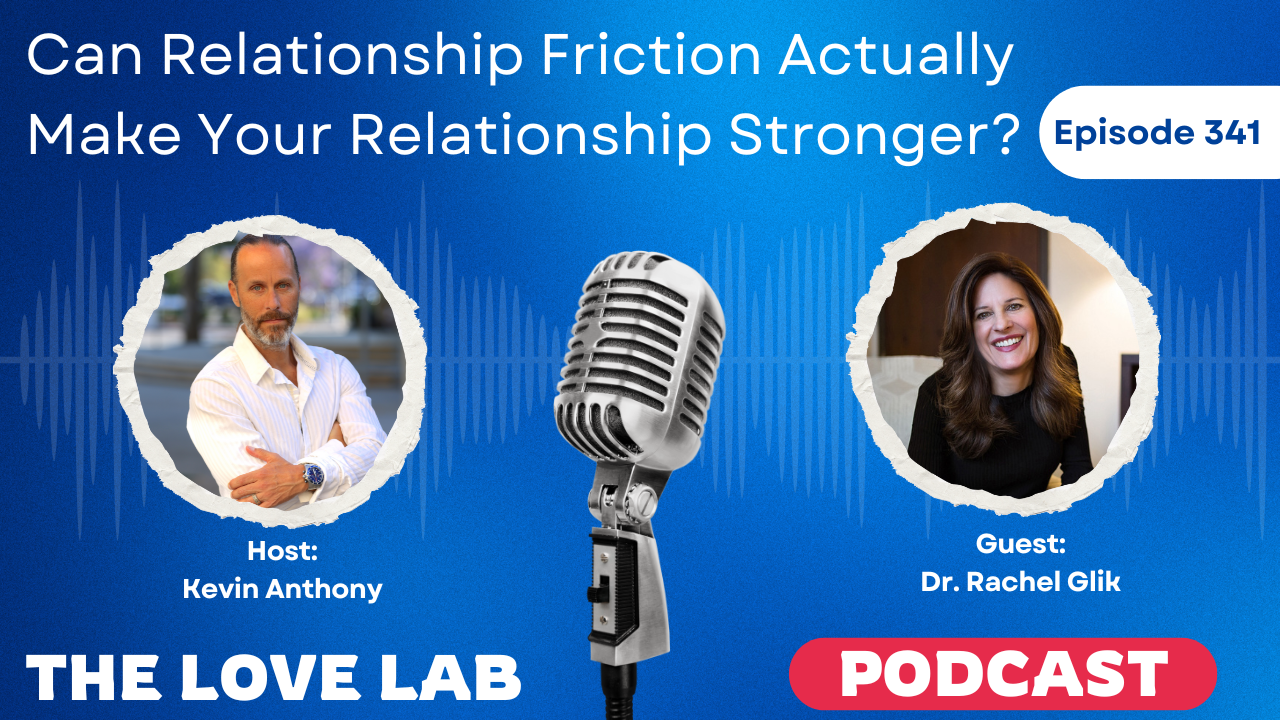
Kevin Anthony 0:05
Welcome to the Love Lab podcast, the place to be for honest and real talk about relationships and sex, whether you’re a man or a woman, single or a couple, this is the show for you. I am your host, Kevin Anthony, and I am here to help you have the relationship of your dreams and the best sex of your life.
All right, welcome back to the Love Lab podcast. This is episode 341 and it is titled, can relationship friction actually make your relationship stronger? I’m really excited to have this conversation today because I often hear sort of two camps when it comes to this topic or this idea. And the one camp is like, Absolutely, it will make your relationship stronger. You know, as long as you can successfully work through the issues and repair, you know, you can build up stronger from that. Okay, and then the other camp is, you know, if there’s constant relationship friction, you’re just stuck in, you know, dysfunctional relationship, and you’re just torturing yourself and blah, blah, blah. So what we want to talk about today is where is the line between that and does experiencing friction in your relationship actually helps, or do you just get stuck in this dysfunctional relationship loop that some people get stuck in. We’re gonna unpack all of that. Today. I have a guest with me. If you’re watching on YouTube, you can already see that. I will introduce her in a moment, but she is an expert in this she’s also written a book, which we’re gonna talk about on the show. So we’ve got a lot to cover in this episode.
But before we do that, a short word from my sponsor, power and mastery, 3.0 power and mastery. 3.0 is the latest version of the popular men’s sexual mastery course. If you are struggling with erectile dysfunction, premature ejaculation, or simply want to increase your skills in the bedroom, and then power and mastery is for you join the exclusive club of men who have taken their sexual performance into their own hands and become sexual masters. Mastering your sexuality is a key component to becoming the man she has always dreamt of and craves. Don’t leave your sexual performance up to chance or the throw of the dice. Become a sexual master today by going to powerandmastery.com and joining the exclusive club of men who have taken their destiny into their own hands, that’s powerandmastery.com.
Okay, so my guest today is Dr Rachel Glick. She is a licensed professional counselor with 30-plus years as a couples and individual therapist in private practice. She specializes in blending traditional psychotherapy with universal spiritual wisdom in her work with individuals, couples, and families. Since 2014 she has been a regular feature on the Fox 2 am show in Saint Louis as a relationship and mental health expert. She is also the author of A Soulful Marriage, which is the book I held up earlier, and we will talk about it during this show. So welcome Rachel.
Dr. Rrachel Glik 3:05
Thank you so happy to be here.
Kevin Anthony 3:08
All right, we got to just dive right in. I got to get right to the core of it right away. My first question is, is there such a thing as good conflict and bad conflict? Let’s define what we mean when we say friction and conflict. Is there such a thing as good conflict and bad conflict, or is there just conflict and then how we deal with it?
Dr. Rrachel Glik 3:29
There is definitely good conflict and bad conflict, but the first step is to really reframe we need conflict, at least from what I’ve learned by studying the wisdom of Kabbalah, which is really transformed by adding it with psychotherapy, my own marriage and my ability to help couples, is the idea that we’re here to grow, that we’re here to keep evolving. And so that, being said, the friction, or the disconnections and reconnections and navigating your differences, or when you really hurt each other’s feelings, or all of that is supposed to be like grist for the mill of looking at ourselves and seeing how we are not living up to our true selves, and how we can grow closer to that. So it’s a good sign when there’s friction because it means you’re being called to grow, but it’s a bad sign, or a bad indication if you aren’t able to approach your conflict in a healthy way, that is toward being able to have breakthroughs, or toward being able to grow closer from as a result of it, and that’s where people usually need so much more help in so many ways.
Kevin Anthony 4:30
Yeah, so you just dove in deep, right from the beginning there, which is great. I love it. You went, you went straight into the spiritual side. And this is something that I actually thought was really interesting about you in particular is, I read this in the bio that you’re combining, you know, basically modern psychology with also, more, you know, traditional spirituality. And so you went straight into talking about how, you know, the Kabbalah is, you know, teaching us that we’re here to. Grow and evolve, which you know is a beautiful truth, honestly. And you know, everybody always wants to know what’s the meaning of life, right? There’s, there’s potentially different answers to that.
But one of, I think, the most profound that I’ve ever come across was literally to evolve our consciousness, right, so our soul, right? And so there are lots of different ways we can do that, but I think one of the most powerful is actually through relationships. And this is something that I used to talk about long before I even did any work in this space, just because I learned that through my own personal experience, that I realized I was making some of the biggest, most impactful changes in my life through my relationships, The Good, the Bad and the Ugly, right? Absolutely. So I kind of just wanted to reiterate that, because you brought that up and, you know, it just kind of like floated by as we were talking about, you know, conflict. And I really wanted people to understand just how profound that statement you made actually was.
Dr. Rrachel Glik 6:05
Yes, so yeah, I agree. I think it’s really life-altering and kind of counterintuitive. But once it, once it’s in your mind that, oh, maybe this isn’t bad, that I’m having this feeling, this unwanted feeling in my relationship, or where something has changed in the relationship and we’re going in a little different directions, or things just that are happening that can seem scary or feel like a problem, or really when we start to see it as from a trusting place, trusting the process, and a curious place. If I wonder how this is here to help me grow, help my partner grow, help us grow closer, then it really is like, you know, holding on to something that can tether you to getting toward a much better place.
Kevin Anthony 6:47
I completely agree. I want to bring a little bit more nuance into the conversation, though, because, as I alluded to in the intro, I come across people sometimes in my work, who feel like relationships should always just be easy. Like, if it’s the right person and it’s the right relationship, it should just be easy. There shouldn’t be a lot of conflict. But I also run into people who are like, well, no relationships are supposed to be just hard and emotional torture and, like, constant conflict. And I don’t think either of those is correct, right? So I wonder if you could speak to that a little bit like, what is sort of the right amount of conflict. Like, how do we know if we’re in a dysfunctional relationship or a healthy relationship?
Dr. Rrachel Glik 7:34
Well, I do talk about it in the book like that, on the one hand, some conflict, even if it’s unhealthy, conflict, is shown, research-wise, to be better than no conflict, because no conflict means you’re really not growing and you start to not care anymore, like you’re really stagnant, or you’ve just detached. And it’s like there’s this, like, silent war going on inside that sometimes can end where it’s just too late you’re just done. So some like, you know, some when it gets heated or that you are impacted by what your partner does or doesn’t do, means that you’re still engaged and you care. So just that’s really important.
But that doesn’t mean again, the other extreme of that, tirades or unproductive, you know, blaming conversations on a regular basis without any movement of understanding, any you know, growth inside yourself, or how we’re going to be closer. That’s also the other extreme. That’s not good, and it’s it’s just a skill that we do not get trained in, which is how to listen, how to navigate our unwanted feelings in a way that we aren’t so dysregulated that we use, like these coping mechanisms for a quick fix. And, you know, it’s really an important training to learn how to, how to, to get in touch with oneself and navigate what happens when we start getting pushed, our buttons pushed.
And so I’m in the middle. I’m in the middle, like, I still think it’s really good that you have a conflict if you’re going to choose some extreme, you know because it means you care, but it’s not supposed to be so miserable all the time, you know. However, a lot of people have this fear that if we get disconnected or something is going wrong, then that means we’re in the wrong place. I picked the wrong person. We’ve grown too far apart, and that is just a falsehood. It’s natural to go through these phases. And so, you know, I would just encourage people to learn how to lean into it and learn how to get more effective as a communicator and as a listener, to resolve conflict. And that’s the that’s the sweet spot.
Kevin Anthony 9:36
Yeah, I agree in the middle, is definitely it some conflict is perfectly okay, especially if you’re using it as an opportunity to learn and grow. But too much conflict is not good. I asked you earlier, and we you kind of started to go there, but we didn’t quite go as deep, maybe as I was hoping we would. So I kind of want to come back to it, which is this idea of you. The type of conflict, right? Because, you know, when we say, Oh yeah, some conflict is good. Well, some people their idea of conflict is like, Well, we had a disagreement over something, whereas somebody else’s idea of conflict might be we had a screaming, raging battle, throwing stuff at each other, right? So I’m just wondering if we could talk a little bit about when we’re saying conflict, what do we mean by that? And what would we consider, you know, as a healthy conflict versus an unhealthy conflict?
Dr. Rrachel Glik 10:31
Well, I think all of it can be healthy depending on how you approach it. So even if it’s a little something that you know, like you really don’t like, the way you guys just, you know, handle the toilet or the or the dishwasher or the, you know, like can seem that can seem like a little conflict, but if you handle it in a way that’s very dismissive or controlling or critical, then it becomes a deeper conflict and a bigger problem. So a little thing can become a big thing, and could mean something bigger, and, but any, any kind of conflict is I, there’s never an opportunity that I’ve never seen it, where there isn’t some opportunity to bring benefit to oneself through the conflict and to in to trace it, to see where is it that it’s showing me something that I can look at about myself, that is going to help me become more of who I want to be, and then.
And so the bigger conflicts though can come up are like, and I list like specific. I’m very specific in the book. I go deep, but I really like specifics. So you, you know, there’s really both. But where I get specific is I have this marriage wheel, or long-term relationship wheel that goes over eight spokes, different areas where we could find conflict. Oh, yes, we’re going to cover those. Okay, yeah. So I won’t jump into that quite yet. And so that’s a way of getting, like, specific, and what areas are we having conflict? And some of the areas can each, each of those can be very serious. It just depends on how much of a difference there is and how you’re approaching something. Like, let’s say it’s your, you know, like you’re the way you do intimacy, emotionally or physically, you know that could become a bigger deal if it’s really strongly, something really important to you and not that important to the other person. So it really kind of varies with how serious the conflict is.
Kevin Anthony 12:14
Have you seen a situation where the benefits, and what you could learn from a conflict are outweighed by the danger of the conflict itself?
Dr. Rrachel Glik 12:26
Well, I guess it depends on what you mean by Danger, danger to the future of the relationship. I guess is that what you mean.
Kevin Anthony 12:31
Or potentially the individuals in it?
Dr. Rrachel Glik 12:34
Yeah, yes. Well, a healthy conflict is never going to be dangerous for an individual, it means people are being honest. They’re owning their feelings, they’re not accusing, they’re not abusing, they’re not being disrespectful, and they’re being honest with what they need, what they’re feeling, what they’re afraid of, what’s bothering them. So in that case, it’s never dangerous. It may be an uncomfortable and difficult conversation, but it should never be dangerous. Dangerous is when it’s you’re being manipulated. You know you’re in a situation where it’s manipulative, where the blame is being shifted to you on a regular basis, where you’re being character assassinated, all on a regular basis. However, it also could be considered dangerous that, if you’re really honest, then you may face some level of incompatibility that you might not be able to resolve, and so that’s where some people get afraid of the conflict.
But, in terms of like, psychologically dangerous, it doesn’t ever have to be psychologically dangerous if you learn and you have good boundaries yourself, and you also learn respectful ways to communicate what you feel and what you need and what’s bothering you. Yeah,
Kevin Anthony 13:42
I completely agree. The reason why I was kind of pushing a little bit on that issue is just because I have seen situations where people use the idea that it’s healthy, it’s normal, and it’s good to have conflict as an excuse to stay in abusive relationships. And what I really wanted the audience to get out of that was, and you did a great job of explaining, like, what does healthy conflict look like? And you listed a bunch of the, you know, things that you would be doing, like listening and, you know, communicating well, and like, all that stuff that you talked about is what is a healthy conflict.
And then you also laid out a few of the things that would be an unhealthy conflict. So I really just wanted people to hear that, because I have seen people can take a nugget of truth and misapply it and use it as an excuse for bad behavior. And I didn’t want that to happen at all from what we’re talking about, right? I didn’t want to say, Yeah, conflict is great and use that as an excuse to just go do whatever you want in your relationship and abuse the person in whatever way that you want. So I’m glad that we were able to kind of make that clear, because now we can kind of put that aside, and now we can talk about what healthy conflict looks like, and really focus our energy there and really spend the most of what we’re going to talk about now on. The healthy conflict, why we would want to do this, and how we do this. I want to definitely talk about those eight areas.
But before we get to the eight areas, could we talk maybe a little bit more about some of the benefits of embracing conflict as a couple, like, what, you know, If a couple is looking at it and going Man, I just, I don’t know about this, like, what are we really getting out of this? You know? What are some of the reasons they might want to kind of stick with it, put in the work and grow, right?
Dr. Rrachel Glik 15:34
Well, what this reminds me of, also, coupled with what you just finished up the last part of our conversation with is that a lot of couples feel that they should be able to just be themselves and talk the way they want to talk with the person that there’s their closest person, which is their spouse. And I always demystify, you know, I always try to break down that myth that and I say it in my own marriage, that I know that I have to be conscious on a written, intentional on a regular basis with how I use my words, no matter how long I’m with, you know, for the rest of my life with my husband, because it’s, it’s it can turn go south very quickly.
And that’s something that I like to, you know, the human ego. I learned from my teaching the teachers at the Kaballah center, that the ego will take a good thing and go too far with it. So yes, we want to be authentic, and we always have to look for the extremes and look for the going too far. And yes, it is important that you feel natural and authentic with your partner. But the paradox is, is that when we really embrace the conflict, it means becoming trained in it and being accountable and responsible for how we are coming across, and we often feel like communicating is just putting out our thoughts and feelings, no matter how it lands.
But that’s it’s much more. I have, like, two chapters on just preparing yourself for a conversation, and that is very new. And we and then people like, I have to go through all that. Yeah, you do, and you will benefit. You’ll be the benefactor of that. You will you. It’s a win. You will win every single time to go through a process embracing it means I’m going to be intentional. I want it to go well, and I know what I need to do like I know I at least need to be calm and I need to come from a place that I remember and have the perspective of what really matters to me, because when we’re angry or when we’re scared or when we’re feeling insecure, then we are just we forget about so many things that really matter. So I don’t know if that really answers that question.
Kevin Anthony 17:34
Well, yeah, that was a great follow-up to what we were talking about prior to that question. And it’s so funny because I get comments like that all the time on my YouTube videos where, because, you know, I’ll often do a video on a particular subject. It could be sex-related, it could be relationship-related, but a lot of it is, is like, yeah, how do you sort of do the prep work, right? Like, how do you prepare for this, how do you create the space for it, and how do you set yourself up for success? And I will often get those comments like, oh, there’s so much work. Just like, life is work. It’s like, is there anything good that’s ever happened or you’ve ever done or created in your life that wasn’t work somehow, right?
I mean, I just sometimes I want to say to these people, like, you know, half of them are probably spending a significant amount of time, you know, sitting there gaming or something. And I’m like, okay, so you’re some high-level gamer. How much work did it take to get there? Yeah, and it’s just, just trying to use examples that people might, you know, relate to. It’s like, yes, pick any area of your life and realize that it took a significant amount of work to be good at it. And what amazes me is how many people don’t think about that when it comes to their relationship. So there’s a significant number of people that are like I said in the beginning in that camp, if it’s just supposed to be easy and it’s just supposed to work, and he’s just supposed to know what I’m thinking and she’s just supposed to know what you know.
It’s just like it really doesn’t work like that. You made a comment earlier that we’re not taught these things, and we’re absolutely not. And this is, this is where, you know, somebody like yourself by, you know, writing this book and doing the work that you do, and also what I do through these podcasts, through my YouTube videos, and through my coaching work like this is what we’re trying to do, is teach people these things that they were never taught before, because they were never taught. You know, like you could teach things because people maybe were taught but weren’t taught far enough, or maybe weren’t taught in a certain way. But like you said earlier, I really believe the majority of us just were not taught at all. I agree, all we learned, If we learned anything, was observing primarily our parents, who probably had a dysfunctional relationship to begin with.
Dr. Rrachel Glik 19:46
Certainly unlikely that it was optimal.
Kevin Anthony 19:48
Yeah, exactly. So yeah, If we learned anything, we learned it through observation, and we probably didn’t learn it right? So, okay, let’s dive in. In to the common areas where conflict tends to come up. So we’re talking, you know, about conflict, and we’ve said about how you know it’s good if it’s used correctly, and we’ve kind of distinguished between good and bad. But to break it down, like to something that’s a little bit more real for listeners, let’s talk about some of the common areas that people tend to have conflict, and why conflict comes up in some of those areas. So I mean, I have the list of eight here, but if there are any ones in particular that you would like to talk about first that kind of stand out to you, maybe ones that you see more often in your practice.
Dr. Rrachel Glik 20:36
I think what’s standing out to me maybe it’s based on a couple I saw this morning, but it’s also a common theme, is the emotional connection, and that, that’s the first one that I tend to write about, is do feeling emotionally connected and that that brings up kind of attachment style. People have different ideas of what being closely connected, it looks like, and have a desire for and so I find that there’s a lot of conflict around some partners perceiving that they aren’t getting enough attention and enough care and enough priority, and other partners feeling like that they’re not enough. They feel like they’re giving what they can give, and they need, you know, to be appreciative of what they are giving. And so you know, when you have a difference in how you view what intimacy looks like, and your desire for intimacy, that that’s that seems to hit a lot of really hot buttons. In particular. It’s not casual it hits very deeply for people, for partners.
Kevin Anthony 21:34
How would one go about recognizing they have that difference? Because, like, one of the things that I see is it’s kind of, you don’t know what you don’t know. In other words, you’re having this conflict, right? And you’re not, you’re not getting what you like. Because, before talking about attachment styles, right? It’s like, how somebody’s showing you love versus how you’re receiving it. And it’s like, if there’s a mismatch there, and but a lot of times, people don’t understand that. That’s what’s happening because they tend to look at things through their own lens, right? And so a lot of people tend to say, Well, the way I should be giving love is the way I like to receive love, right? And so they have no clue or concept that the person on the other side might need something different. So I’m just wondering, like, how can how can they bring more awareness to that? How can people understand better that there might be a mismatch, and then what could they do, if there is one? How do they get more in sync?
Dr. Rrachel Glik 22:29
Yes, well, it’s really this is why it’s important that I have four pillars that are in the book. And the first pillar is your relationship with yourself. And that’s really that we’re each responsible for our happiness and well-being. And what that means is self-awareness that we need to know first, like what feels good and what doesn’t feel good. So when you start not feeling good inside, for some reason, usually we act out. We have protector parts that kick in and try to make us feel better by kind of unconsciously, just starting to react in some way. So the first step is really to self-awareness and to listen for, wait a minute. I am not feeling as fulfilled in this relationship, or that just hurt, or that just didn’t I feel suffocated, or I feel controlled, or I feel neglected, whatever that feeling is, to identify what it is, and then you start to be able to and you might need help from a therapist, or you might need help by reading to understand what does this mean.
And I’m really big on psycho-education, like when you learn about attachment styles, you can start to see, oh, maybe that’s why we have a difference. I have a different way that I like to attach or protect myself, and my partner does something very opposite. They might isolate to protect themselves. I need a connection to feel safe and grounded. So it starts with self-awareness, and then it’s important to communicate to have these this like, like the conflict is when you’re already starting to note it is a sign that something is brewing that is off between us and our connection, but also is pointing towards something that I need to learn more about myself, and so we always want to pause and look inward first see what is exactly that’s bothering me here, and what does it mean to me? What growth area might this be showing in myself? Maybe I have some healing to do for my childhood where I never felt like I was given the proper attention. I was always invisible because I had an older brother who was an addict, or for whatever reason.
And then from there, when you identify within yourself what you’re thinking and feeling, you want to own the part of it that may be familiar to you. I think this is about the way I am and what I struggle with. Then you can have a when you can communicate with your partner in a way that is where nobody is superior to anybody else, that you just want to share what you’re thinking and needing and feeling, then you can talk about how you do relationships and how that makes you feel when we’re too close, or when I’m not when you’re not as attentive or so the net. The next step is to communicate, is to learn how to effectively in a healthy way. To communicate so that you can identify what is happening I think we have a difference in our attachment style.
And then from there, you know you can, then you can start to problem solve. You don’t want to rush to fix it too soon, without really unpacking it and understanding what it means to each partner and really making sure you feel each heard like thoroughly heard and understood, then you can try to find some common ground. Okay, well, these are some hard boundaries for me. I need some connection, but I’m willing to have my softer boundaries that maybe we can make it a little more intermittent, and I can have more time with my friends, or do more things that help me feel more fulfilled. That would be like a way to compromise.
Kevin Anthony 25:40
Yeah, I love that you brought up. The part of it kind of starts from within, right? This is a common theme. Like anybody who’s been listening to this show for a long time, you know that not only do I talk about that, but so many of the experts that I have on this show say the same thing. It always starts from within. You gotta do the inner work yourself. And I love that idea of reflecting upon, okay, what is it that I need? What is it that I’m feeling right? And getting really clear on that first, and then the next part that you mentioned was, you know, doing, having the conversation right, so being able to communicate. And hopefully, my listeners are familiar with attachment styles, because I’ve done several episodes on Attachment styles, good, yeah, which is, which is great.
But a point that I kind of wanted to make was that, you know, if you have the knowledge of, say, attachment styles, that’s great. That gives you a framework from which to have the conversation. But even if you don’t have that framework, you can still have the conversation. You can still talk about, here’s what I’m feeling, here’s what I am thinking, even if you don’t necessarily have the technical terms or the framework of, well, I’m a dismissive, avoidant, and therefore, you know, I mean, that’s great if you, if you have that level of awareness. But even if you don’t just simply communicating here’s how I feel when you do X, I feel like Y, right? You know that sort of thing. So Don’t, don’t like, if you’re listening to this and you’re thinking, I don’t really, I don’t really know how to explain, you know, via the attachment style framework, it’s okay, right?
You can still have that conversation with your partner and just more sharing your feelings. That’s the idea is, because that’s how those things come out. When you say, oh, when you did this, it made me feel this way the other person would be like or might be like, Oh, I had no idea that that action made you feel that way. When you do that action to me, I don’t feel that way, right? And so you can start to, you can start to get a feel for those differences. And it really goes a long way towards bridging those gaps. Absolutely
Dr. Rrachel Glik 28:00
Yes, and you don’t need to know, go become a theorist on attachment style, to learn a few basics. Even just like, just knowing that there is such a thing, it’s enough. Sometimes, like, oh, people do this differently. We’re not all the same. That already starts to take the pressure off of this, the kind of way we can get into a little myopic view and take things to mean what they don’t really mean.
Kevin Anthony 28:26
Yeah, absolutely. And that is a really important point. We are all different. There are some people that might be a little bit more like us than others, but we’re all different. So I don’t think anybody should ever assume that no matter how well you get along in your relationship, that this person does the thing you know everything the same way you do. You should always assume that they’re their own individual and you should seek to understand how they operate, how they work, what they need, what they want. That’s kind of like a baseline of getting into a relationship. Here’s a whole different person. Let me learn how they work.
Dr. Rrachel Glik 29:02
And it’s like, I, you know, I like to think of it, not as they do that, but I like to look at I do that like even, even though I know this, it still can happen so quickly, where I am, where I catch myself. Hopefully, I catch myself thinking that I expect my husband to be like myself, you know, and it’s a constant stretching of oneself, to go out of jumping to conclusions, to go out of thinking my way is better or right, and it’s an exercise gym of really cultivating becoming a better person, because we have to be patient, and we have to think, Get people to benefit the doubt, and we have to think out of the box of what our worldview is on a regular basis.
Kevin Anthony 29:47
Oh, yes, and that is a challenging thing for a lot of people to do,
Dr. Rrachel Glik 29:53
But it’s worth it. It’s way worth it.
Kevin Anthony 29:56
Oh, absolutely. I mean, if you want to have a successful long-term relationship, it’s a request.
Dr. Rrachel Glik 30:01
Yeah, and you feel better about yourself. You become the kind of person through the process that you feel more full inside because you feel like you’re growing to who you’re closer to your soul, really.
Kevin Anthony 30:14
Yeah, you know, that’s a really important point that you just brought up. Because I will, from time to time, get people who are interested in working with me, and they’re at the end of their relationship, or they’ve just broken up, right? And one of the biggest questions they always have is, well, I don’t know. Maybe, maybe I should just wait until I’m in a relationship, and then, and then maybe we can do some work together, right? To which I always respond, no, no, now, now is the time for the exact reason that you just said, because it’s not just about solving the relationship problem, it’s about becoming the best version of yourself that you can be. And wouldn’t you rather do that now so that when you do enter into the next relationship, you’re already in a better spot, right? And it’s amazing to me how many people are like, no, no. Let me just wait until I get in there and F everything up, and then I’ll figure out how to fix it. It’s like, no, no. That’s not the way it should work, exactly.
Dr. Rrachel Glik 31:12
And that is the that’s the same mentality that we have because it’s not viewed as something to train in, that we still think we can wing it or it’s not relevant until we’re there. But there’s so much preparation. And I’ve had people, some people who were saying, Oh, I don’t need this book yet because I’m not in a relationship. And I have others who are like, Oh my gosh. Like, I this is really to prepare me to be in one and, and I love the latter, because it’s, it really is true. There’s no, no point where we can’t learn more and take care of like becoming the best version of ourselves to help us be successful and happy in a relationship.
Kevin Anthony 31:51
Yeah, absolutely. It’s I say, you know, no matter where you’re at, you’re in a relationship, you’re not in a relationship. The best time to become the best version of yourself or learn this is always right now.
Dr. Rrachel Glik 32:01
Right exactly. I love that. Yeah, that’s great. Yes.
Kevin Anthony 32:05
I need to take a short break. And then when we come back, I want to talk maybe a little bit about some of the other common areas where conflict tends to come up. And then, of course, I’ve got a few more questions after that.
All right, are you a couple? Are your relationship and sex life where you want them to be? Are there changes you would like to make, but just don’t know how maybe you think there is nothing that can be done if you’re not 100% happy with where your relationship or sex life is, then get help today and change your life. Go to https://www.kevinanthonycoaching.com/couples/ to schedule a strategy call with me today so we can map out a strategy to get you where you want to be. That is https://www.kevinanthonycoaching.com/couples/. That’s obviously the couples coaching program that I do. And as I always say, because I always read ads on this show for stuff that I’m doing, and sometimes stuff that other people are doing, but a lot of times it’s very similar to what my guests are doing. And I tell everybody on the show, all I really care about is that you get the help that you need. If you’re listening to Rachel and you’re like, she is I resonate with her. She’s got what I need. Please go find out where her practice is and hire her. I don’t care who you hire, just hire somebody to get the help you need.
Okay, let’s dive back into the common areas where conflict tends to come up. So we covered emotions so far. What are some of the other maybe bigger ones that you see?
Dr. Rrachel Glik 33:44
So the other ones that I see are maybe just go over them, and then, you know, but all of them can be big, depending on each couple. But then after emotional, the emotional connection is the sexual and physical connection, which obviously can be a big issue. It’s known. Research shows that it’s a bigger issue when it’s not going well. People don’t deem it as that important when it’s going well, but when it’s not going well, they rank it as a really high problem and a really big issue. But that’s kind of common, I think, for a lot of issues, and the next area that can cause either joy or problems would be in your domestic relationship, like, do you do roommating Well? Do you share responsibilities? Well in the house? Do you feel like you’re equal partners?
And that can create a lot of resentment when that’s not going well together. And so that could be the main thing that couples are facing is that they don’t have the same view of how you divide mental load, physical load, emotional load in a home, especially when there are children, and that brings the next up, the next area, which is parenting. Do you parent similarly? Do you share the responsibilities? Well, do you have a different Do you have similar ideas about bedtime and about how you parent and how much schoolwork versus play? All those kinds of things. And then there’s the community, which is, again, this could be a big problem, or it could be an asset. This could be like that you, you as a whole, that if you have children or pets like you as a whole, they can’t form a community. And you’re in-laws, you form a community.
And sometimes it’s like why people don’t want to leave if they’re not even if they’re not happy, or why some people are really unhappy because they’re really having issues with how much the in-laws are involved, or the way the family does things and doesn’t match your values or your views or make can make you not feel like a priority depending on how your partner handles their family. And then there is your financial friendship. I call them friendships. They’re each like a different intimacy or a friendship. Are there secrets? Do you see the same values around that? Do you see it as we versus mine, ours versus mine? And then there is the, let’s see, I usually have one that I have to think a little harder to remember spiritually. I don’t think we covered spiritual, spiritual Exactly. Thank you. I always have just one that, like I need a little help with this.
So the spiritual one could range anywhere from, do you see politics the same? You know, like you see that your worldview is the same, your values are the same? Do you think of something bigger than yourself? Is that important to you in your life, and do you share a similar view of that? And if you’re different, are you then supportive and respectful of each other’s spiritual path? And the more you’re in alignment, the more that can be an asset and can take the whole relationship to a whole new level. So some couples, you know, could also be about whether they have a purpose together. They see themselves as having purpose as a couple, a purpose in making the world better that can also fit under spirituality.
Kevin Anthony 36:55
Yeah, are there any of these eight friendships that you see when they’re out of alignment, just there’s nothing you can do about it, and you need to move on. Are or are all of them fixable in some way?
Dr. Rrachel Glik 37:12
I would say, what makes something unfixable? It also depends on, how much desire you have in life, or an optimal relationship, you know, like, and what some of the trade-offs are. But what makes it, I find not optional, where you can’t really work with it is at the center. If you picture a wheel, those eight spokes, and you picture at the center of the wheel as the hub, I describe that as the desire, the desire to grow the capacity for insight, the desire to grow the desire for life, the desire for the relationship, the desire to have more in life, and when that is so not aligned, then it’s really hard to work with that. Then you can’t really that along with communication, is that it’s the tire around the whole thing. If you don’t have a desire for the relationship and it’s important enough to you, and you’re not really motivated to grow then, or you don’t see where you that’s important. Then that’s that’s hard to work with any of the differences.
And then that’s really what can kill. Kill it, I would say. And then some of the differences are that some people change along the way. Or I heard about a couple recently who was deciding whether to actually go forward and get married. And their religion is very important to them, but they have opposite and contradictory and negative views of each other’s religions. So I’m curious as to why these people are even still navigating that. Because it’s not just like one is casual about it and whatever. So sometimes those kinds of things, if it’s like if you’re really vastly different on your values of something that really is an important part of your life. Then, you know, it is kind of like climbing an uphill battle that it’s a little it’s a little harder when you don’t have affinity and that way.
Kevin Anthony 38:51
Yeah, I agree. I like the way you shared about the hub and thinking about all these other things as the spokes and that hub really being the desire. Because, you know, there is sometimes, and you may see this also, I don’t know if you do. You can tell me if you do, but like sometimes, what I’ll see is, you know, I read an ad earlier for my couples coaching program, and sometimes I will have one person of the couple reach out to me and say, I we really need to do this. We really need to do that, to which my immediate response is, always, is your partner on board? Yeah, and if not, there’s, there’s no point in even getting started as a couple. I can work with you as an individual to be, you know, your best version of yourself, but I can’t work with you to as a couple if you’re not both on board. So in other words, if that hub isn’t there, right, if you don’t both have the desire to do some work on this, right, then it’s likely not going to go anywhere, and then you’re just going to be frustrated with me as well as your relationship, right? So yeah, I love that idea of that Hub’s got to be there.
Dr. Rrachel Glik 39:56
Now sometimes I do find, I just did a seminar yesterday for therapists. And one was bringing up a situation of a couple where one didn’t seem to have much desire to grow. It was just so angry and but, you know, sometimes we have to, I find that I’m sort of a hopeless optimist, and you know, in a sense that sometimes I still try to see if there’s an opening. Can start with one person, at least, this is what I have found. And then sometimes, I’ve seen partners when you change how, when you’re doing your change, like you said, meeting individually, but you are keeping in mind that how, for your own sake, first of all, just making your own naturally good changes that have, that has a quantum effect, where that can sometimes create an inspirational opening, like, Oh, I like what I’m seeing and then, but also when you are making your changes with the mindset of I wonder how I can start adjusting myself. That can help my partner feel more comfortable for growth.
And maybe I could speak his or her language better, or their language better, and sometimes some simple things of just having more fun together start to kind of soften things, and then they may be more open to growing. So sometimes there isn’t a way in, but generally speaking, I’m very similar to you in that I don’t want to work harder. You know that they’re not really capable, they’re not really candidates for couples counseling. Both really aren’t in and invested.
Kevin Anthony 41:21
Yeah, and that’s, that’s what you were describing, is really the approach that I take with them. If I find that their partner really isn’t invested in wanting to do this, then it’s like, then we shift our work into the personal, right, and we just work on you. And one of the things I will tell them is exactly what you just said, which is that as you’re changing, right, and as you’re showing up as a different version of yourself in the relationship, there is a likelihood, not a guarantee, but a likelihood, that you will see the other half start to notice that and either shift themselves or at least become interested in maybe wanting to participate in some of This, right? So there’s always that possibility. Yeah.
Okay, the next thing I want to talk about is because we’ve talked about, you know, conflict, and what it is, and the different areas where people have conflict, we’ve also talked about some of the benefits of why people might want to really work on this. I want to kind of switch now to some of the keys to successfully navigating a conflict. So, you know, we’ve talked a lot about why they should do it and kind of where the areas of conflict look like, but I would love to leave people with something tangible they can take away like they’re maybe they’re sitting there going, oh yeah, that’s, that’s exactly the kind of conflict that we’ve been experiencing. What do I do about it? What are some of the successful keys to navigating conflict?
Dr. Rrachel Glik 42:45
So the first step is to prepare yourself to have a potentially difficult conversation or a conversation that is tricky, that you really spend some time examining and asking yourself questions like to get so that you really get to know, like, Why do I want to talk about this? Why is this bothering me? I call them the five W’s the why the what? When the weather, you should even bring it up. And then the way, the way is like several chapters just on the way. So the prep work is the first step is to turn with pause and turn within and see, get to know really what it is that’s bothering you. What does this mean about your growth? How does this feel familiar? Have I been in situations like this before? Like, if it’s triggering insecurity, it’s really important that you identify that and then you do some work on reassuring yourself. Like, I know I’m worthy. I don’t need I don’t want to feed and invest in the belief system that how somebody treats me is a reflection of my worth, for example.
And then when you feel calmer and you feel a little bit, have more self-awareness, which puts you in more control of yourself, then you can approach the way, which is like, how do you actually approach your partner? To talk about communication is sort of the key to initially start making some changes. And then you want to make sure that you I call it the love seat listening method, where you create an environment that’s safe, that each person is going to feel heard and understood. And I get into a script because we, our ego, will jump in and make us think we’re good listeners, but we’re generally not all of us. Some are better than others, but it’s a trainable skill.
And so then when you really make sure you take the time with whatever conflict you’re dealing with, that after you get grounded in yourself, that you then become intentional as you approach your partner with I would like for us to talk about this so we can actually grow closer as a result of this conflict we’re having. And I want to really understand you, and I’d really like for you to really understand me, and then see what kind of breakthroughs we might find, and then from there, how we can find some common ground and how we can adjust shift things. So it really first has to come by calming down.
Kevin Anthony 44:55
For sure, I love that you brought up the loveseat method. That is something I wanted to ask you about. Well, I’m wondering if you could describe in a little bit more detail to the listeners how they might be able to utilize the loveseat method.
Dr. Rrachel Glik 45:07
Yes, so that the idea of, you know, similar to the hot seat, you know, like, that’s where I came from, for me, is like that you want to put each other in the instead of the hot seat in the love seat taking turns. Because when I watch conversations in I’m looking at my couch over there, you know, like when I watch conversations unfold, then it’s so natural that we aren’t really having a back and forth hearing it’s just, I’m saying this, and I’m responding to you with an ex, with an explanation, with the justification, with a you know, so you really need the first step in the love seat. The listening method is that you’re going to be taking turns, that you’re going to like. You can even hold an object, something fun and playful like you want to also keep it light as much as possible. And sometimes a script makes it already a little feels a little silly and awkward. It’s not normal.
So sometimes that’s actually good. It takes you out of the the rant, you know, the tirade type of energy, or the shutdown type of energy, there’s, you know that there’s going to be room for both to speak. So taking turns is key. And then when you are the speaker, you want to make sure you decide who’s going to go first, and you get into an environment that’s not too late at night. I have a whole list of likes from a handout I give my clients, of like, what are the ways that you can set yourself up for more success with the conversation. And so you don’t want to be late at night, you know, you don’t want to be drinking, you don’t want to, like, start stacking a bunch of issues on top of each other, but you want to decide who goes first, and you want to sit in an environment where you are as much need any and eye to eye as possible because it reminds us this is a human soul who I adore underneath it all, and I’m just mad right now, or I’m just scared right now, or whatever.
So then when you’re speaking if you’re this, the speaking partner first, if you’re in the love seat, if you’re the love seat partner first, then you want to use language that doesn’t trigger defensiveness. So you want to say, I feel this. This bothers me. When I need this, I’m scared that comes from vulnerability and not from attacking. And what it was really what I want to try to share is that it’s important for me that you hear is blank. How I perceive the situation is a blank, kind of thing. And then the listening partner is to simply start with just repeating back what you heard. You don’t have to get fancy about it and get deep or just initially, just so I’m so what I thought, what I thought I heard you say, is be tentative because you don’t want to assume you know more than them on themselves. So what I heard is this, is that you really, this is really, you feel really neglected, or you feel like I’m attacking you all the time, or whatever the case may be, and what you really like is blank. Did I get that? Is there something I’m missing? Is there more?
And then, you know, you can move to a little bit more advanced, which is to reflect feelings that’s more empathy. So I sense that you must be, maybe you’re feeling this and that, or then you want to, really want to normalize it or validate it, that that makes sense. You know that would that doesn’t feel good when somebody, when you feel alone, that’s a terrible feeling just to and then you see, you can see in the body language if they relax, and the venom is out of the eyes or the tension out of the shoulders, when you feel heard, you feel loved the same thing. And then you switch. And then you, you know, you know, you say, Did you Is there anything else can we switch now? You know you can set a timer, even so that it doesn’t go on too long with one person knowing that you can keep switching back. And then you say, Okay, now I would like to hear from you. How do you perceive the situation? What would you like me to make sure that I hear about your feelings and your needs and what how you look at this?
Kevin Anthony 48:39
Yeah, that is an amazing practice. And I think you know, if the only thing that people listening to this take away is that practice, they’ve already significantly improved their relationships. So thank you for sharing.
Dr. Rrachel Glik 48:54
That’s hard to do. I want to reiterate that don’t feel discouraged if you fail at it. I even struggle with it. And I teach it every day, practically, but it really, you know, but keep trying at it, and you can I list it, you know, it’s a thorough thing I list in my book. And as well that, you know, it’s like a road map of how you can walk through the steps.
Kevin Anthony 49:14
Yeah. And, you know, it’s as you were describing it. There was like, Oh, I really want to point this out and point this out. And I’m like, we just don’t have time in the show. But like, like you said it’s not necessarily as easy as it sounds because there’s little pitfalls in there, such as, like, one of the steps is to repeat back, right? And the way you said it is the proper way to say it. Okay, what I heard you say is right, as opposed to, it’s my turn to repeat back, and I go, okay, so what you said was, right, because you don’t know, right? Yeah, exactly. There are little traps in there that you can get caught in that can make the process more difficult. So as you said, you’ve really outlined it here in the book, right? So if you really want to know the details. Details of that process so that you can refine it and really get it down. Then, for sure, buy the book. And, as you said, just it’s gonna take practice. It’s gonna take practice, and there’s gonna be urges there to want to like, I really wanna respond Right exactly. You have to learn to resist those.
Dr. Rrachel Glik 50:19
And that the ideal is to get to a place where this happened with my husband and I together a couple of months ago, where we actually then can ask, start softening, and asking each other questions. Like, so do you what do you think that growth is for you in this life, what might this be of benefit to you? This is where it kind of adds a dimension that I haven’t seen out there, that I’ve kind of mixed other communication styles that are my favorite, and then added, you know that, then you can open yourself up to support each other, to care about each other’s souls, to see well, how is this helping you, perhaps go to your next level of growth for you personally here and then, and I can share with you what I think that this is about. For me, when I really slowed down and examined myself, then you feel you, and then you feel again like you’re on each other’s team. You’re not like against each other. You’re here to support each other. Yeah, absolutely. That takes it to such a quantum level of appreciation, depth, and oneness.
Kevin Anthony 51:11
Yeah, that is really that’s so funny. That’s a theme that has come up through, like, the last several episodes of this show, this idea of working together as a team as a couple, you’re supposed to be a team and you’re supposed to work together as a team to solve the problems, as opposed to, we’re on two separate teams here, right, competing against each other, which is, unfortunately, how you see a lot of relationships, right? Yeah. So I love when those themes come up because that is something that I believe very deeply in, and so I’m glad that that theme kind of comes up. So as people are listening week after week I hope it’s sinking in, is the point?
Dr. Rrachel Glik 51:52
Yes.
Kevin Anthony 51:53
All right, so we’re pretty much at the end of the show, and I want to give you an opportunity if there is any last advice you want to share to the audience about conflict and how they might be able to manage it, and then after that, I would love for you to tell people where they can find more about your work and your book.
Dr. Rrachel Glik 52:10
Great. Yes. Well, there’s something else that I would love to inspire for couples, and that is the idea of repair, that while we are going through conflict, there are a lot of things we can do to take it further, to heal what happened, and sometimes incidences occur, we really need to repair it, and that’s really by taking accountability and really hearing how you impacted them with something that you did, and making sure that that’s thorough. And there’s also something that I love that I have a whole section on called reassuring statements. And there are so many things that we can say, even when we have to bring up something that’s difficult to say or maybe to hear. There are so many ways that we can say it, by knowing our partner, especially, that can reassure them before you say it, after you say it, and you can still be honest. But I think reassuring statements go a long way.
Kevin Anthony 53:03
Yeah, that idea of repair is really, really important. I had somebody, I’m not remembering his name off the top of my head right now, but I had another guest on. He wrote a book called Your Apology Sucks.
Dr. Rrachel Glik 53:16
That’s amazing. What a title. I love it. Yeah.
Kevin Anthony 53:19
As soon as I saw that title, and, like, I want to know more about that. And the whole idea was, you know how to really apologize and how to start that repair process because it’s such an important key.
Dr. Rrachel Glik 53:28
It is absolutely.
Kevin Anthony 53:31
All right. Could you please tell the listeners where they can find out more about you and the book that you’ve written?
Dr. Rrachel Glik 53:38
Yes, so you can see, I have a website, Dr. Rachel glick.com, and there’s no C in Glick, just D, R, R, A, C, H, E, L, G, l, i, k.com, and then I have a meet a media tab, and I have a book tab. And in the book tab, you can see, like, five different places where copies are sold, but Amazon left bank books and a local place, Barnes and Noble is what I meant to say, and a couple of other places. And, yeah, those are the places that you can get the book.
Kevin Anthony 54:08
Awesome. Well, the link will be in the description, of course. And I was sharing with Rachel before we got on the actual show here, that I haven’t had a chance to read the book yet, but I have had a chance to go through it, and from what I’ve seen so far, it looks really great, and I’m actually excited to read it myself. So I think there’s going to be a lot of great information. And from what you’ve already shared on the show, I’m sure that there is. So I highly recommend to people that if they are, you know, experiencing difficulties in the relationship, or they just want to know more about this subject as a way to grow and be better in the relationship, to pick up the book for sure.
Dr. Rrachel Glik 54:46
Thank you so much.
Kevin Anthony 54:47
Well, Rachel, thank you for coming on the show. I appreciate you coming on and sharing your knowledge and your wisdom with everybody.
Speaker 1 54:54
My pleasure. Really appreciate you having me.
Kevin Anthony 54:57
All right, everybody that’s all the time I have for this episode. And I will see you next week.
I hope you like this episode of the Love Lab podcast. If you enjoy this show, subscribe, leave me a review and share it with your friends, and for more free exclusive content, join me in the passion vault at https://www.kevinanthonycoaching.com/vault/. That’s https://www.kevinanthonycoaching.com/vault/. Thanks for listening, and remember, as Celine used to say, you’re amazing!

Kevin Anthony is a Certified Sexologist, Tantra Counselor, NLP Practitioner and a Sex, Love & Relationship coach. For over 10 years he has worked with men, women, and couples to have the relationships of their dreams, and the best sex of their lives! He is also the host of “The Love Lab Podcast”, creator of the popular YouTube channel Kevin Anthony Coaching, and creator of the popular online course series “Power and Mastery” as well as other online courses for both men and women.