Last Updated on November 18, 2024
What You’ll Learn In Episode 255:
Are you in a healthy relationship that is worth staying in and working on, or are you in a struggling relationship that is not serving either of you? Do you know how to tell the difference? In this episode, Kevin Anthony talks about the signs you are in a healthy relationship, the signs you are not in a healthy relationship, what soulmates and twin flames really are, what woundmates are, and how trauma bonding fits into this whole picture. You may be surprised by some of his recommendations!
Links From Today’s Show:
❤️ FREE EXCLUSIVE CONTENT ❤️ The Passion Vault → https://www.kevinanthonycoaching.com/vault
👉🏼 MAKE HER WEAK AT THE KNEES
If you are ready to make big changes and finally become the man you have always wanted to be, then Unleash Your Inner Warrior Program is for you → https://www.celineremy.com/go/warrior
👉🏼 COUPLES COACHING WITH KEVIN ANTHONY
https://www.kevinanthonycoaching.com/sex-coaching-couples/
👉🏼 OUR HAND-PICKED PRODUCTS FOR YOU
We have hand-selected some great products to help support your Health, Sex Life, and Relationship! Purchasing products from us and/or our affiliates helps support the work that we do and ensures we can continue to help as many people and couples as possible! → https://www.kevinanthonycoaching.com/products/
Kevin Anthony 0:11
Welcome to the Love Lab podcast a safe place to get real about sex. Whether you’re a man or woman single or a couple, this is the show for you.
Céline Remy 0:20
We are your hosts, Kevin Anthony and Céline Remy and we are here to guide you to go from good to amazing in the bedroom and beyond.
Kevin Anthony 0:28
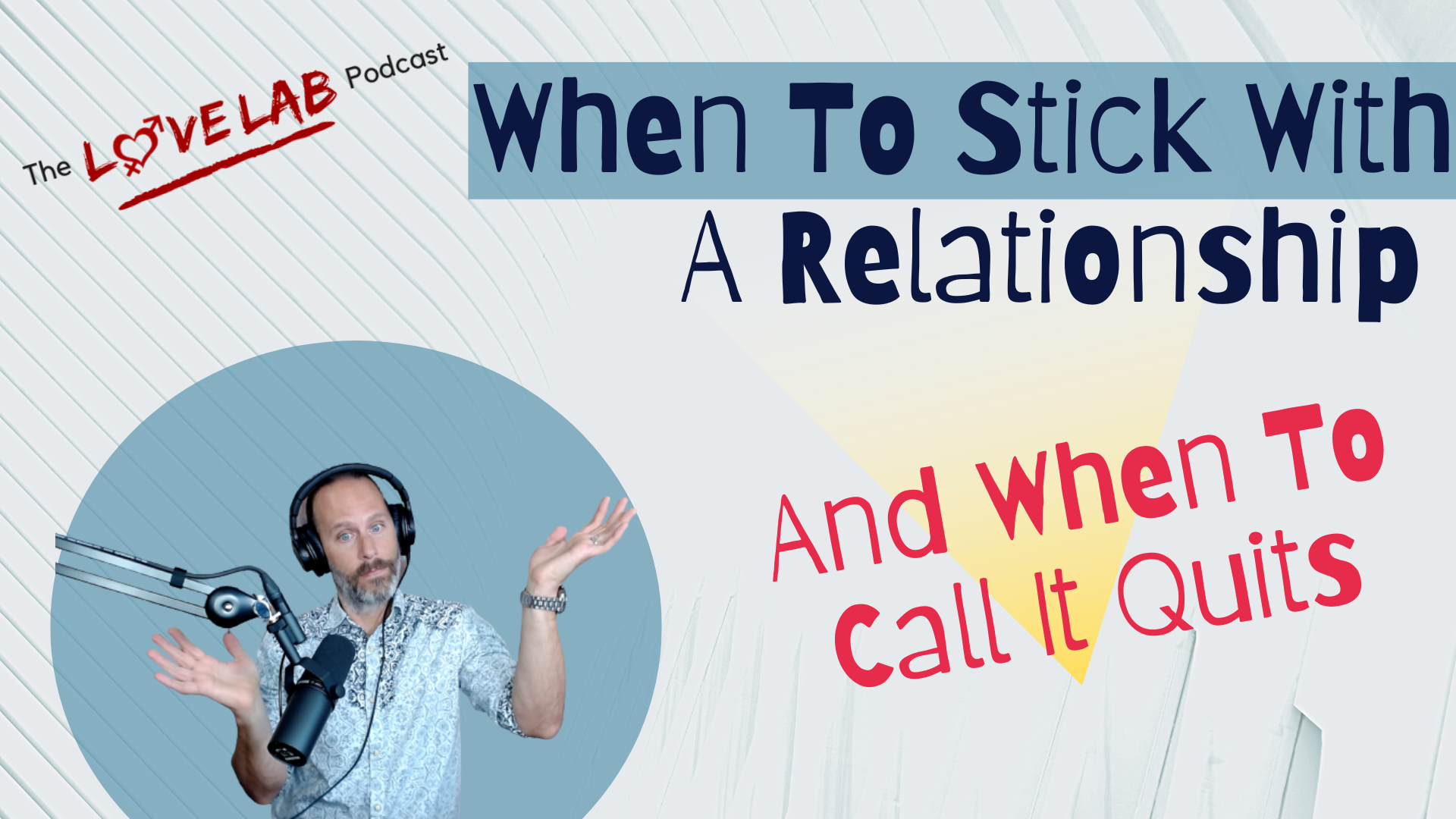
All right, welcome back to the Love Lab podcast. This is episode 255. And it is titled When to Stick with a Relationship and When to Call it Quits. And I actually have a subtitle on this one, which is Soulmates or Wound mates. So the idea for this show came from a conversation I was having with a friend recently, we were talking about some mutual friends of ours, and how they were struggling with something. And one of the things I said was, you know when Celine and I had found out, they were getting married, we both rolled our eyes and went, Oh, no, this is not going to be good. This is a bad idea. And the reason we felt that way, was because we had watched these two individuals, just trigger each other over and over again and break up and get back together and then break up again, and then get back together again, and then break up again and then get back together again. And so from our point of view, we thought, wow, these are two people that really should not be together. And yet here they are making a major life decision.
And so recently, I was speaking with a mutual friend, as I just said, and hearing a little bit more about the saga as it continues, and it really got me thinking about it. And my response to my friend was, you know, they don’t sound like soulmates to me, they sound like wound mates. And I’ll explain what I mean by those as the show goes on. So I thought, you know, we should really have a discussion about, you know, when should you stay in a relationship? When should you make the decision to leave a relationship? What does it even mean to be soulmates? What does it mean to be wound mates? What does it mean to be trauma bonding with a partner? So we’re going to cover all of that stuff in this episode.
But before we do a word from our sponsor, do you want to join the secret club of men who are great in bed and check out power and mastery, it is the most complete sexual mastery training for men. Whether you want to have harder erections, last longer, or increase your sexual skills, there is something for you at https://www.powerandmastery.com. That, of course, is the men’s Sexual Mastery Program that Céline And I created, it is fantastic. I know that it is summertime and a lot of people are focusing on vacations and beach days and spending time with the kids. But there is no time, like right now to fix your problems. So if you need help with your erections, if you need help with lasting longer if you need help with simply being a better partner in bed, then check out https://www.powerandmastery.com.
Okay, so I’m going to start first with signs, you should stick with a relationship. I know a lot of times we kind of like to cover the negative stuff first, and then leave you on a high note, I’m not gonna leave you on a negative note. But for some reason, it just made more sense to me today to start with signs you should stick with a relationship. So let’s kind of set the ground for what is a healthy, positive relationship. Because once we do that, when we move into the signs that maybe you should move on, or we talk about wound mates and that sort of thing, you’ll have a better understanding of how it compares. Alright, so these aren’t in any particular order. My lists usually aren’t in any particular order unless there needs to be an order. There just as I brainstorm, you know, what is a healthy relationship? I write it down. So number one, the relationship excites you. And this one I wrote down because having another conversation with a friend talking about a relationship that she is in. She was indicating to me that yeah, when she thinks about getting together with this individual. It’s not only is it not exciting for her at this point, but there’s even a little bit of like I gotta, I’ve gotta go out with him again.
So when you’re thinking about this time that you should stick with the relationship, like what makes a healthy, fun relationship to be in, it should excite you, you should get when you think about the fact that you have a date, you should get massively excited and turned on, you should be looking forward to it all week. And honestly, even if you’ve been together for a long time, when you think about that relationship, or, Hey, it’s date night, because you should have a date night, even if you’ve been married for 25 years if you’ve been listening to the show long enough, you know this already, you should always have a date night, you should be looking forward to it, you should be happy about it, you should be thinking about going, Yeah, I can’t wait for that. Obviously, you know, life throws things at us. And it might not be that 100% of the time. But it shouldn’t be like that the overwhelming majority of the time. Number two, there is mutual love and respect. Now, when we get to things like wound mates and trauma bonding, those people will tell you that there is love Oh, I love him so much, or I love her so much.
But is it really love? And that’s a question that I would pose to you. Is it really love? Or is it simply trauma bonding, we’ll talk more about that later on. So there should be mutual love. There should also be respect. I’ve seen a lot of relationships where people say they love each other, but boy, they do not act in a respectful manner towards their partner. And of course, I have to question then do you really love this person? Because if you’re not treating them with respect, do you really love them, or are you just saying that? Number three, both parties have the best interest of the other party in mind. So this is really important, when you’re in a healthy highly functioning relationship, you should have not just your own best interest in mind, but the best interest of your partner as well. You should be functioning as a team working together not only for the greater good of the relationship but for the greater good of each person that is in the relationship.
Now, that doesn’t mean sacrificing yourself, you know, in a way that is negative or harmful. We’ll talk more about that when we get to the trauma part later on. But you should definitely have the best interest of your partner in mind. And unfortunately, what you see in a lot of unhealthy relationships is most people are really out for themselves and what they can get out of the relationship and how they can, you know, profit the most so to speak. And not really concerned so much with how the other person is doing and whether or not they are thriving and being successful and becoming the best version of themselves they can be. This brings me to number four, which is you are each other’s champions. So your partner should be your absolute champion. Like if anybody on this planet other than yourself is going to advocate for you. It should be your partner. And that’s really important. We don’t always see that in relationships. It’s another thing that is kind of a clear pattern in relationships that don’t work where, you know, one person is not really being the champion for their partner. So this shows up in a lot of ways. We talked in a previous episode. I had Guy Blaze on and we’re talking about, you know, when you meet your part partner’s family, and one of the things that he said is your partner should be your primary advocate to their family, right?
So here I am, I’m going to introduce my partner to my family. I should be my partner’s advocate, I should be telling my family, what a wonderful person this is. And look at all the things she does for me and look at how much she loves me and look at what she’s doing in the world, how she contributes, look what a great person she is, I should be telling my family all that and being her advocate. And every partner shouldn’t be doing that. And that’s just one example like, you know, meeting the family. But the idea is you should be the champion for the other person you should be telling the world how amazing this person is. Unfortunately, what we see a lot in relationships is even if the person really is amazing, and they really do feel that their partner is amazing, out of fear of potentially losing that person to another man or another woman or something else. They don’t champion their partner, they don’t tell the world how amazing this person is. They don’t promote them. You know, I have seen so many times where women either don’t tell their man or don’t tell their girlfriends, what an amazing lover, their man is for fear that Wallace, if all the women know, he’s a great lover, they’re all gonna want to have sex with them. Okay.
I mean, that is obviously the fear or lack approach. But honestly, you should be champion championing them. You should be telling people how amazing this person is. I mean, I’m just using one example when it comes to sex. And I can see where that might be a little bit of a tricky or triggering example for some people, but, nonetheless, you should be out there telling people how amazing this person is, and they should be doing the same for you. Number five, there’s physical attraction. There should absolutely be physical attraction. We have a tendency these days to sort of underplay that. In other words, we say, well, it’s not just about physical attraction, it’s not just about looks, it’s not just about, you know, how good the sex is. And that’s all correct, you’re right, it is absolutely not just about those things.
Unfortunately, we tend to go to the other side of the spectrum. And we say, well, not only is it not about those things, but those things aren’t really that important, and you can do without them. And I disagree with that. I think that if you’re going to be in a long-term, committed relationship with somebody, you need to be attracted to them. You need to be physically and emotionally and mentally attracted to them, it basically needs to be attractive in every way. And we’re gonna, we’ll get to this on this list as well. But it’s actually the next one. So I’ll just go to it on the list. It’s the next one, which is the sex is satisfying for both of you. In order to maintain a long-term, healthy, happy relationship, you do need to have a good sex life, whatever that means for you. Now, that’s going to be different for everybody. But you should, it should be the same for both of you. And you should both agree that sex is an important part. And that is a healthy part of your relationship.
Now, I know I already hear in the comments, a few people saying, You don’t need to have a sex life or sex in your relationship to have a healthy relationship. Because I’ve been married for 40 years, and we haven’t had sex and 20. And we love each other. I get it. I know that there are examples of that. In general, however, a healthy, happy, highly functioning relationship includes a healthy sex life. In order to have a healthy sex life, you need to be physically attracted to the person. Now, can you have sex with somebody that you’re not physically attracted to? Yeah, you can? Is it ever going to be as good as the sex that you have when you are physically attracted to somebody? No, it’s not. It’s just not the way you show up when you look at somebody like a starving, lying, looking at a gazelle, and you’re just like, Yeah, I’m going to devour you is always going to be better sex than not really attracted. But I’m kind of horny, and I want to have sex, so let’s do it. They’re just not the same thing. So this should be a physical attraction. And the sex should be satisfying for both of you, you should both feel like your sex life is satisfying. Next on the list, you’re able to communicate well with each other.
So you know, signs that you should stick with a relationship or another way of saying signs you’re in a healthy, highly functioning relationship is you’re able to communicate well with each other. Now, when we talk about signs, you should move on lack of communication isn’t necessarily a sign you should move on. But it is a sign that you need to fix your communication. And if you are unable to fix it, then that might be a sign to move on. But the good thing about communication is there are a lot of strategies that we can employ to actually fix the communication and we’ll talk a bit more about that later. Okay, next on the list, you share similar values. So this is this one is really important. And I think it really gets overlooked, which is you know, there are certain high-level values, how you see the world what you believe is important in the world. And those really need to be in alignment when you are in a healthy relationship. And, you know, I kind of started this episode talking about this particular car Paul, who is constantly in this sort of trauma pattern.
And sometimes one of the reasons for that is you just have a misalignment in values, like what you value as being important in the world. And so what happens is, you hold a value, something that’s really important to you. And your partner doesn’t hold that same value or worse, doesn’t think that your value has value. Right? So they don’t understand then why you operate the way that you do based on the values that you hold. So, therefore, they don’t respect your actions in the way you show up in the world. Right? So if you value something, let’s say and it’s you’ve made your whole career around that particular value, and your partner doesn’t really respect that value, because it’s not a thing that’s a value to them. Well, then now they’re basically invalidating your whole career and your whole because it’s not like Well, why do you waste your time with that, right? This is so unimportant, and you’re over there going. But this is a huge value for me, and the way that I show up in this world. So it’s really important to have values in alignment because if they’re not in alignment, they’re going to lead to a lot of conflicts.
Next, your strengths complement each other. So this is really good, too. You know, because we’re going to talk a little bit about soulmates and some of the misunderstandings about soulmates or twin flames or whatever you want to call it. But sometimes we think that we need to be so similar in order to have a great relationship, that everything’s got to be the same. You want a high level of similarity for sure. But that doesn’t mean that everything has to be the same. So when I say your strengths complement each other, it means that I have strengths maybe that you don’t you have strengths, maybe that I don’t. But those strengths come together, and we fill in the gaps. And we support each other with our strengths. And that’s really important. That’s, that’s something that if you want to make your relationship, a central focus of your life in this world, which I recommend that you do, I think way too many people treat their relationships as sort of second, right? Like, their career is more important than their friends are more important, or whatever is more important than now.
Oh, yeah, by the way, I also have a relationship. I don’t think that’s the way that you should handle a relationship with somebody that you’ve chosen to spend your life with, I think that your relationship should be number one and should always come first. Jobs come and go. Friends come and go. Opportunities come and go, right? All that stuff comes and goes throughout your life. But if you’ve committed to somebody to be in a long-term relationship, that is something that shouldn’t come and go, it’s something that should come and stay. In which case, you need to make it a number one priority. And so if that’s what you’re doing, then your strengths should complement each other. In other words, you’re filling in those gaps. And that is, what is helping to champion each other to support each other. To excite you like wow, this is amazing. I always struggle in this area. And here’s my partner, who just perfectly fits that and fills that in for me, and I do the same for her. Wow, amazing.
Next, your major life goals are in line. So what is it that you want in the world? Do you want kids? Do you not want kids? Do you want to own a house? Do you not want to own a house? Do you want to own several houses? Do you want to spend part of the time in one state or another or part of the time in one country or another? You know, do you want to achieve a certain level in your career? What are your goals? And are they in line? Let’s say somebody is wanting to be a professional musician. And their goal is to tour the world. Playing music. Awesome, great, wonderful. Nothing wrong with that. But what if your partner’s goal is to ground and nest and stay in one place and build a home? Obviously, that’s a life goal that is not in alignment. So there’s going to be resentment and there’s going to be constant struggle because one person is going to want you to be around all the time. And you’re gonna be like, but no, I really want to be out on the road, right? And you can see where there’s a problem there. Or you might as the one out on the road, want your partner to be out on the road with you all the time. And they’d be like, No, I don’t I don’t really want to do that. One simple example. And there are many, many other examples that you could use, but the As your major life goals should be in alignment. Next, you support each other through life’s difficulties. Mm-hmm. Okay, this one is really important. I, unfortunately, know too much about this having, you know, had to be the sole supporter for Céline when she was sick.
But when you’re talking about whether should you just stick with a relationship look, not everything’s going to be rainbows and unicorns, and butterflies, and beautiful all the time, like life throws shit at you, it just does. And the longer you’re together, the more chances are, that life is going to throw some shit your way. So the question is, how do you react to it? Do you show up? Do you handle it? Do you take care of it? Does your partner know that they can rely on you? Or do you moan? Do you complain? Do you think this isn’t worth it? I need to get out of here, oh, this is terrible. You know, how do you show up and support each other when life gets difficult? That one is really, really important. And the last one is, your relationship makes the world a better place. So your relationship, when you are together, should I say make the world a better place, but as you should be adding to the world. So that doesn’t mean that you have to contribute in some major way.
Like, somehow you were in politics, or you wrote a best-selling book together, it’s like, it doesn’t even have to be something like that. It could be as simple as the other couples that you interact with on a regular basis, look at your relationship and go, Wow, that’s truly amazing. I want to be more like that. And I’m going to try to emulate what I see in them. It could be simply your children looking up to you, as models have a healthy relationship. I mean, that’s making a positive difference in the world, because those children will then go out and have more harmonious relationships, and then their children and so on, right? So there are lots of different ways that your relationship can make the world a better place. But it should be, it should be in some way, contributing to making the world better, as opposed to when we get to the side you should move on, which is your relationship creates more chaos in the world. So we’ll talk more about that when we get to the next, the next part of this.
So there you go, those are signs that you should stick with a relationship, so signs that you’re in actually a healthy, high-functioning relationship. Now, there are many more that you could put on that list. Those are just, you know, 12 of the things that came up for me when I sat down to write this show as things that were important. I’m sure if I spent even longer I could come up with more, but you get the idea. You have a framework, you understand what to look for in? Is this relationship healthy? And is it something that’s worth sticking with? Because you know, number 11 Was you should support each other through life’s difficulties. So when life gets hard, you know, there are decisions sometimes that need to be made. And if you’re looking at your relationship, and you’re going, yeah, look at all these other amazing things that are happening in this relationship. This is worth sticking with. This is worth putting the time energy and effort in no matter how hard that is. So hopefully, you understand the point I’m getting across there with the science that you should stick with a relationship.
So the idea is now we’ve laid the framework, we understand, at least to some extent, what a healthy high functioning relationship is. Now we have to contrast that and go okay. What should we be looking for, to decide if this isn’t a healthy, high-functioning relationship? If maybe it is time to move on. So I have a list of those. I’m going to read them to you in a minute. But first, I’m going to break for our second sponsor. Are you a couple are your relationship and sex life where you want them to be? Are there changes you would like to make but just don’t know how? Maybe you think there’s nothing that can be done? I challenge you to make this year the year that changes. If you’re not 100% happy with where your relationship or sex life is. Then get help today and change your life. Go to https://www.KevinandCéline.com/sex-coaching-couples/ the link is in the description and schedule a strategy call with me today so we can map out a strategy to get you where you want to be. So you can have it all your way again go to https://www.KevinandCéline.com/sex-coaching-couples/, the link is in the description. So, you know, I put that ad in here this week. Sometimes I do the one for my Men’s coaching program, but I put the one for couples in here this week because that’s what we’re talking about today, right? We’re really talking about couples here. And when you hear that list of signs, you should stick with a relationship. If that doesn’t sound like your relationship, then you probably need to do some more work. And if you need help with that work, you should be going to https://www.KevinandCéline.com/sex-coaching-couples/ link is in the description.
All right, alright. Next signs you should move on. So now we’re getting into it. We talked about soulmates sort of. We didn’t really talk about soulmates yet, but we talked about healthy relationship signs, which I’m going to put in the soulmate category, which is not necessarily soulmate, but we’ll get to that. And then we have wound made. So you’re in this relationship, but it’s not working, and you’re trying to decide whether or not you should stay in it. So what are some of those signs? Number one, the relationship brings more stress than ease. So look, not every relationship is going to be easy all the time. I can honestly say that my relationship with Céline was something that was easy all the time. But I also understand that that’s not true for everybody. But your relationship should be easy, most of the time, the overwhelming majority of the time, it should feel easy, doesn’t mean it’s always easy, but it should feel easy.
Even the challenging things shouldn’t feel so burdensome. One of the things that we see in relationships that are not highly functioning is that they just create more stress than anything else. So you end up sort of in this constant state of stress. And the reality is, is that in our lives, we’ve got a ton of other things to stress us. All you have to do is turn on the news, it’s nothing but stress, fear, stress, all the things you should be worried about all the things that don’t go on right in the world. You go to your job, it’s always about deadlines, or cutbacks or layoffs, or, you know, bad coworkers, or bosses, it’s just stress all the time. You’re commuting to work, you’re sitting in probably tons of traffic, which is stressful, right? There are so many things to stress you out in the world, when you come home to your partner and your relationship, your partner and your relationship shouldn’t continue to add more stress to that. So that is a big red flag. If your relationship is creating more stress than ease, that may be a sign that it is time to move on.
Number two, you have frequent unresolvable fights. So you know, number one, and number two, and number three, well, and number four, most of these come from me thinking about the couples that I mentioned earlier on one in particular, but others as well. And it just, I was like, Okay, what are signs that this isn’t working, I just sat there and I thought about what I observed from multiple of these couples and then I just wrote them down. So one of them is you have frequent unresolvable fights you are fighting very frequently is the best word maybe not very frequent. But frequently, as opposed to every once in a while an argument comes up, but you are having frequent fights. And one of the things that you’ll find when people are having frequent fights, is that they’re often the same things that they are fighting over, over and over again, because they never resolved them in the previous fight.
So if you have frequent unresolvable fights, that is also a sign that you may need to move on. Not necessarily, I’m not saying that just because you fight you have to break up with the person. So remember, these are, these are signs that indicate maybe you should move on. If you have multiple of them, then that is an even stronger indication. Some of these you might be able to work on and move through and everything will be fine. And some of them maybe not. When we get to the whole trauma thing, though, I think it’s going to make a little bit more sense as to why you should be paying attention to these signs. Okay, number three, you constantly trigger each other. You shouldn’t be triggering each other over and over again. This idea of triggering each other reminds me of a client Céline had two or three years ago who was also working with another practitioner And, you know, I want to give him credit, because he really was approaching his problems from multiple angles and taking action. Amazing, great, that is very commendable.
However, when he was describing the work that he was doing with this other practitioner, it was really obvious to Céline and me that the work was triggering his trauma over and over and over again. Now, you know, sometimes when you’re doing work in therapists will tell you this too, sometimes you got to, you got to get down in there, you got to get into the shadow stuff, and you got to stir things up, and you got to bring it to the surface. And that can sometimes be triggering. Fair enough. However, if session after session, month after month, sometimes year after year, you continue to poke at that wound, and trigger it over and over and over again, what you are potentially doing in that situation, is creating more trauma. So here you are doing all this work trying to resolve trauma. And instead, what’s happening is you are re-triggering the person and making them re-experienced that trauma over and over and over again, thereby seeding that trauma even deeper into who they are.
So if you’re in a relationship that is creating more trauma than it heals, which is the fourth one on the list, then that is a sign so you’re constantly triggering each other. Right? That was number three on the list. Those triggers are potentially creating more trauma than they’re actually healing, then that’s a sign that you should move on. So when we look at these couples that are saying, but We’re soulmates, we’re meant to be together, this is what it’s supposed to be. And they are just triggering the fuck out of each other, over and over again, creating more trauma, more stress, more dis-ease, to me is not a healthy relationship and not one that you should stay in and certainly not one that you should go, hey, why don’t we get married, that’ll fix everything, or worse, worse. Here’s another one that I see. Sometimes the relationship is in this, this triggering mode and trauma mode, and they go, I know what we need. Let’s have children that’ll fix everything.
Oh, my God, no. Absolutely not. All you’re going to do is imprint all of those trauma patterns, right on those kids, and then set them up for a hard life and bring more chaos into the world. All right, next on the list, one or both partners is not doing the work to fix the relationship. This is one that I see a lot. When I work with clients. I have mostly until recently worked primarily with men. And so I often see or hear from the men that, you know, obviously, they’re doing something because they’re working with me, right? So they have signed up for coaching with me, we’re working on it, we’re getting through what we got to get through. And then inevitably, because we’re working on their relationship and their sex life, I’m saying, Okay, now you have to go back to your partner, you either need to have this conversation, and here’s how, or you need to do this practice with her, or you need to bring up this particular subject. And the response is, she won’t talk about it, she won’t do it. She’s not interested. Right. So if one or both partners aren’t doing the work to fix the relationship, then that is a clear sign that this is probably not the right relationship for you.
Now, I always tell clients that, you know, because sometimes they’ll ask this question. And Dr. Jane Greer and I actually talked about this on this show as well. But I often get asked the question, well, my partner is not really into it. So is it really worth me working with you and working on this stuff? If she’s not on board? And I always answer that, yes, absolutely. For multiple reasons. First of all, all you can control is yourself. So at least if you’re taking the steps to work on yourself, you’re taking control of the things that you can control. Number two, everything is an inside job. So you will be massively surprised at how she changes when you show up differently. So it may be that she’s acting in response to how you’re showing up and that by you doing the work and changing yourself. She might show up differently. So you know for sure, it is worth showing up and doing the work. Another reason is hey If this relationship doesn’t work out, at least you will have done the work before you get into another one. Because sometimes clients will send me well, I’m going to wait until I’m in a relationship. And then and then I’ll do it.
And I’m just like shaking my head go, are you crazy, you’re gonna wait until you get into a relationship and make a bunch of mistakes and potentially screw it all up, and then you’re gonna start to work on it. That’s like saying, I’ll go out to the store and buy a fire extinguisher once a fire starts in my house. No, of course not. You’re gonna have all that stuff, you’re gonna have your fire extinguishers ready, beforehand? Oh, don’t worry, I’ll get insurance after I get into an accident. What that doesn’t make any sense. So yes, there’s absolute value in going out there and doing the work. So you want to be doing the work no matter what. But if your partner isn’t willing to also do some work, that is a potential sign. Next on the list, you don’t share the same life goals. I’m not saying that every goal has to be in 100% alignment, but the major life goals should be if you want to be in a monogamous relationship if you want to have children, if you want to own a house, if you want to, you know to do any of those major things in life, you want to make sure that those are in agreement.
And if they’re not, you are really setting yourself up for a very challenging relationship. And it’s kind of like we talked about before with the I want to go travel the world and play music and no, I want to stay home and ground and raise a family like those are conflicting goals. And that often leads to failed relationships. And I mean, just look at most of your rock stars and musicians and actors and whatnot. I mean, there’s a whole bunch of reasons for that in their lifestyle, but that is potentially one of them. Number seven, your values are not in alignment. So again, with the values, you can see that some of these things are the opposite of the first list I read, but not all of them. So obviously, you want to make sure that your values are in alignment. Ooh, number eight on the list, your partner disrespects you. No matter how much you are disagreeing about something, no matter how challenging a situation may be, you always should treat your partner with respect, no matter what.
And if somebody is continuously disrespecting you, you’re having those frequent unresolvable fights, and they’re doing so in a way that is disrespectful to you. And it’s obviously a sign that you should move on. And the last one, your relationship creates more chaos in the world. So we kind of talked about that one already. But the idea that your relationship should be adding to the world, by either being an example of a healthy, high-functioning relationship, maybe raising good kids, maybe teaching what you know about relationships, whatever it is, you should be adding value somehow, to the world. What we see sometimes in these relationships that shouldn’t stay together, is it’s really bringing more chaos into the world. So they start dragging their friends into their chaos. They’re a bad example. Maybe they are disrupting events because they’re, I don’t know, they’re at their friend’s wedding. And they get into a huge argument nervous, like, oh, man, that was awkward. It could be, you know, just being a really bad example for their children.
It could be that you know, I mean, it could even be they get in such an argument, somebody storms off and jumps in their car and goes out drinking gets into an accident, and kill somebody, right? Like, there are so many ways that negative energy can leave the relationship and affect the outside world around it. And you really don’t want that your relationship should be affecting yourself, your partner, and the world around you in a positive way, not in a negative way. So those are some signs that potentially you should move on. So you know, the title of the show, when to stick with a relationship, when to call it quits. If your relationship shows, several or all or mostly signs from the first list, then that’s a valuable relationship that is worth sticking with even if it is difficult in a particular moment, even if there are some challenges. It’s worth sticking with because there’s value there and you can potentially work through those things. If on the other hand, your relationship shows more signs on the second list, then you might think about whether this is really the right relationship and are you best served by staying in it? Is your partner best served by staying in it?
Is the world as a whole best served by staying in it? And I have to say I have to give credit to a friend and longtime friend of ours, who was in a relationship for about 10 or 11 years. And when they first got together, they had said, We will stay together as long as our relationship puts more good into the world than not. And somewhere around the 10 or 11-year mark, they were struggling. They were really having a difficult time. They were pretty big pillars in the community. And they, they, they said, Okay, sounds something’s not working here. And they decided to take a vacation kind of a little personal retreat the two of them together and sit down and have a serious discussion about where the relationship was at and whether or not this relationship was still contributing to the community in the world the way that it did at one point. And they both realized that it wasn’t anymore, and it was time for them to move on. And, I mean, this was many years ago, but it was a really beautiful example for me of how you could do that. I mean, that was what they were that is what they now call conscious uncoupling. Before the term conscious uncoupling even existed.
So that was really beautiful. And that was an example of really being honest about his relationship, contributing more to the world in a positive way than not. Okay, so now that we’ve talked about signs of a healthy relationship, here are the things you should look for to determine whether or not you should stay signs of an unhealthy relationship. Here are the things you should look for. To determine whether or not you should go we need to talk a little bit about soulmates wound mates and trauma bonding. Why do we have to talk about that? Because I can’t tell you how many times I have seen relationships where the parties involved, sit there and say, but we are soulmates. We are twin flames, we have to stay together it was meant to be meanwhile, they’re triggering the fuck out of each other all over the place. They’re in constant chaos and turmoil and that chaos and turmoil is spreading outside the relationship and affecting the people around them. So let’s get clear. What is a soulmate? What is a twin flame?
What is a wound mate? What does it mean to be trauma bonding, we need to be able to recognize all of those things and understand what they are so we no longer use them as excuses to tolerate dysfunctional relationships. Okay. Selena and I did an episode a long time ago, it was episode 73. And it’s titled do twin flames slash soulmates really exist? We did that episode in response to two personal friends of ours who kept calling themselves twin flames. And we’re constantly in this trauma cycle. They’ve been broken up, I don’t even know how many times, and now they are still back together again, triggering each other some more. I mean, years this has been going on. So if you want to know deeper about twin flames versus soulmates, do they exist, and all that kind of stuff, go check out episode 73. I’m just going to give you a real high-level overview of the two. These are the definitions that we had from that episode. Soulmate: two separate individual souls that are so similar that they feel like they are cut off the same cloth. The purpose of meeting your soulmate is to further your spiritual growth and do your spiritual work.
Okay? So when we say soulmate, we mean somebody that is so similar to us that they feel really, really familiar, and that we are supposed to be together and do some work together. But all right here is the big key. Here’s the big key. It doesn’t mean that you have to be in a romantic relationship. And that’s where people get confused with soulmates. They think that but they’re my soulmate. We’re supposed to be together in an intimate relationship. No, you can be in each other’s lives, and you can still further your spiritual growth and do your spiritual work as friends, as business partners, as acquaintances. Whatever it is, you don’t necessarily have to be in a romantic relationship. So if you think you’re soulmates, but you can’t figure out how to be in a harmonious high functioning relationship, then maybe that’s not where you’re supposed to be and don’t use the fact that Oh, We’re soulmates as the excuse to stay in a dysfunctional relationship. Does everybody understand that? So I have that conversation frequently with people. So yeah, it’s one of those things that gets me a little excited because I just see this, in my opinion, misinterpreted a lot.
All right, next twin flame. It’s a concept that comes from ancient philosophy, mystics, and sages, that says that, at the time your soul was created, it splits into two and the two halves are one-half is divine masculine one-half is the divine feminine. So this idea is that it’s two separate physical individuals, but they’re actually the same soul that split itself. And so when they come together, they feel whole. Hence twin flame. I have seen a lot of people believe that they are indeed twin flames. Honestly, I don’t know if this idea of twin flames really exists or not. Maybe it does, maybe it doesn’t. But again, it is not an excuse to be in a dysfunctional relationship. If you can’t figure out a way to heal your divine masculine and your divine feminine together in a relationship. And you’re just going to keep re-traumatizing each other over and over again. And that is not a healthy relationship to be in. And I don’t want to hear that. Yeah. But we have to stay together. We have to duke it out. We got to get in there and spend years in the trenches doing the shadow work and beating the fuck out of each other because we’re twin flames. No, just No, stop it. Stop it all right. Again, you can still be in each other’s lives, you can still work on things. But maybe if you are not in that relationship, you’ll be able to do it in a way that is not constantly triggering and re-traumatizing.
Okay, that brings me to the concept of wound mates. You know, one of the things that’s interesting is, you know, I’ve been doing this work for so long. I have. I’ve coached a lot of people. I’ve read a lot of books. I’ve spent countless hours just talking with Céline about this work. I have interviewed a lot of psychologists, psychotherapists, coaches, and authors. And there’s, there’s a lot of knowledge that sort of inside me that sometimes I don’t, I don’t really remember now even where it comes from. Right. So in other words, when I had that conversation with my friend that started this whole episode, and I said, Man, it doesn’t sound like they’re soulmates to me, like they keep saying it sounds like they’re wound mates like this. This word wound mate just came out. And I was like, I’m not even sure where that came from, like, did I just make that up? Or does that really exist? Right?
So of course, I had to look it up for the show, and no, I did not make it. I obviously read it somewhere along the line or what and somewhere it’s just in my sort of subconscious. So what is a wound mate? As defined by author Jeff Brown in his book and uncommon bond roommates are those relationships that are sourced in unresolved emotional patterns, issues, and holdings not to be confused with soulmates which will also trigger shattering material in at to the surface, but which hold a greater deal of promise at the heart of soulmate connections is an opportunity to work with the shadow in a growth full manner, working the material as grist for the soul mill, while wound mates just flounder in the mud, trigger after trigger downward spiral after downward spiral attached at the waist. Wound mates are trouble with a capital T.
When I read that when I was researching this episode, and I read that I thought, I just have to just quote that because it was so well said, which is, you know, wound mates just flounder in the mud trigger after trigger a downward spiral after downward spiral. And yet they are constantly attached doing this over and over and over again. And so that’s why you know, the subtitle of this episode is, are you soulmates? Or are you wound mates, because sometimes it’s really hard for people to tell the difference between the two. They think that they’re doing soulmate work, and they’re working on the shadow and they’re doing so in a growth all manner when the reality is, they’re just stuck in trigger after trigger a downward spiral after downward spiral. And so the reason why I gave you the two lists at the very beginning of the show, was because I wanted you to know how you can tell the difference between the two. If your stuff if you’re looking at list one and going yeah, that pretty well describes where we’re at, then you know that it’s potentially a soulmate relationship. And even if it’s not a soulmate relationship, like don’t get hung up.
Everybody wants to think they’re in a soulmate relationship, and most people really aren’t. Doesn’t matter if it’s soulmate by definition or not. Is it a healthy, high-functioning relationship where you’re learning and growing as a result? That’s list number one, or is it an unhealthy relationship that is just triggering and triggering and triggering and creating deeper trauma patterns that you’re just going to have to work even harder on to get out of later on? So that was really the point of those two lists. And now that we get to sort of the definitions of what is a soulmate, what is a twin flame? What is a wound mate? I think it makes more sense as to why those lists are important. Now, I got one more thing that I want to reach to you that I feel is important here. And that is the idea of trauma bonding, because when we’re talking about wound mates here, often what we’re talking about is trauma bonding. And some of this when I read it, you’re gonna go, oh, that’s only in extreme cases. Some of it is extreme cases, but some of it is not extreme cases.
And I’ve seen it as a coach in relationships with people who really thought they were soulmates’ twin flames, but really what they were doing is trauma bonding. Okay, so here it is. And this comes from Psychcentral.com. This is where I found this particular little piece. If I ever read anything, where I’m actually reading it word for word, I’ll always quote where it comes from. Other times I just sort of either paraphrase or just, it just comes from me, and not from anywhere in particular. Okay, Jama bonding is the formation of an unhealthy bond between a person living with abuse and their abuser. Trauma bonds are not just found in romantic relationships, they can happen between family members, friends, and even co-workers. So, but notice, they say not just in romantic relationships, I’m speaking right now in terms of them in romantic relationships. So this bond is forged through affection alternating with abuse, the contrast between the two makes the affection seem more valuable and leaves the person hanging on for the next outpouring of positive reinforcement. Hmm, I have witnessed this too many times. Okay, depending on the type of abuse you’re experiencing, you might not feel safe leaving, or self-advocating. According to research, victims of intimate partner violence, develop bonds with their abusers to survive the abuse. So instead of fighting back or fleeing, you focus on the good parts of the relationship. And ignore the rest, you rationalize the fact that you’ve stayed by making excuses on behalf of your abuser. This sets you up for a repeated pattern of disregarding abuse, you become habituated to the relationship dynamic and increasingly powerless leaf.
Okay. Now, having read that, I know some of you are thinking, this is only talking about extreme cases where there’s physical abuse. No, that is not true. If you really pay attention to what I read there, it is not just relationships where there’s physical abuse, there is mental emotional abuse as well. And if you’re in one of those relationships, where you’re constantly fighting, constantly triggering each other, that could potentially be that mental-emotional abuse cycle happening over and over and over again. And then somebody says, Well, I can’t leave because We’re soulmates. Right, you see how this all comes together? People who are stuck in these negative abusive relationships, who then rationalize the abuse and stay in the abusive relationship by saying, but We’re soulmates or we’re twin flames, we have to stay together, we’re doing this deep work is really important. Could that be true? Yes, some of that could be true. And a lot of times, it’s literally trauma bonding.
So it’s really important to be able to distinguish what is a healthy soulmate relationship where you are working together to heal your traumas, right, and become better versions of yourself. Versus we’re in an unhealthy trauma bonding relationship where we’re literally wound mates, we’ve bonded over the fact that we’re both broken, and we’re continuing to stay broken, or worse yet, break each other even more through this cycle of abuse and trauma. So, really important to be able to distinguish between those things so that you can make good decisions and sometimes the right decision is you shouldn’t stay together. Now, you know, Selena and I, we always said, We love love and we love seeing people in happy, healthy relationships. And our goal whenever working with anybody was always to help them stay together and create one of those high-functioning relationships. However, there have been a few times over the years in the past when working with clients couples, where we literally had to say, we do not think that it is in the best interest of either of you to stay in this relationship and It was always hard for us to do that we didn’t want to do that. We wanted to see people stay together and build healthy, happy relationships.
But sometimes, it’s just not possible with the combination of individuals that make up that relationship. So that’s really what this episode was about. It was about helping you to recognize are you in a healthy, happy relationship that is worth staying in and working on and growing together. Or are you in a dead-end, go nowhere abusive, re-traumatizing relationship that you are justifying by saying things like We’re soul mates, or we’re twin flames, or, you know, we were meant to be together to work through our shadow stuff. Whatever excuses you’re creating. I hope that this episode has helped you in some way. Begin to identify which one of the two that you are in. And remember, identifying is only the first step. Once you know where you’re at. You need to make some decisions. And sometimes those decisions will be difficult, but you need to make some decisions about whether or not you should stay, or you should go. Like the song said, Should I stay or should I go now? Alright, I’m not gonna sing anymore. All right. I hope you enjoyed this episode. And that’s all I have for you this week, and I will see you next week. We hope you liked this episode of the Love Lab podcast. If you enjoy this show, subscribe. Leave us a review and share it with your friends.
Céline Remy 56:44
And for more free exclusive content. Join us in the passion vault at https://www.kevinanthonycoaching.com/vault. That’s https://www.kevinanthonycoaching.com/vault.
Kevin Anthony 56:58
Thanks for listening.
Céline Remy 56:59
And remember, you’re amazing!
We hope you liked this episode of The Love Lab Podcast. If you enjoyed this show, leave a comment and share it with your friends.
RATE & REVIEW THE LOVE LAB PODCAST
—> LEAVE A 5-STAR REVIEW ON APPLE PODCAST
ASK A QUESTION FOR THE NEXT EPISODE
—> Click here to leave a message directly to Kevin and Céline to be answered on the air.
Thanks for listening and remember you are amazing.

Kevin Anthony is a Certified Sexologist, Tantra Counselor, NLP Practitioner and a Sex, Love & Relationship coach. For over 10 years he has worked with men, women, and couples to have the relationships of their dreams, and the best sex of their lives! He is also the host of “The Love Lab Podcast”, creator of the popular YouTube channel Kevin Anthony Coaching, and creator of the popular online course series “Power and Mastery” as well as other online courses for both men and women.