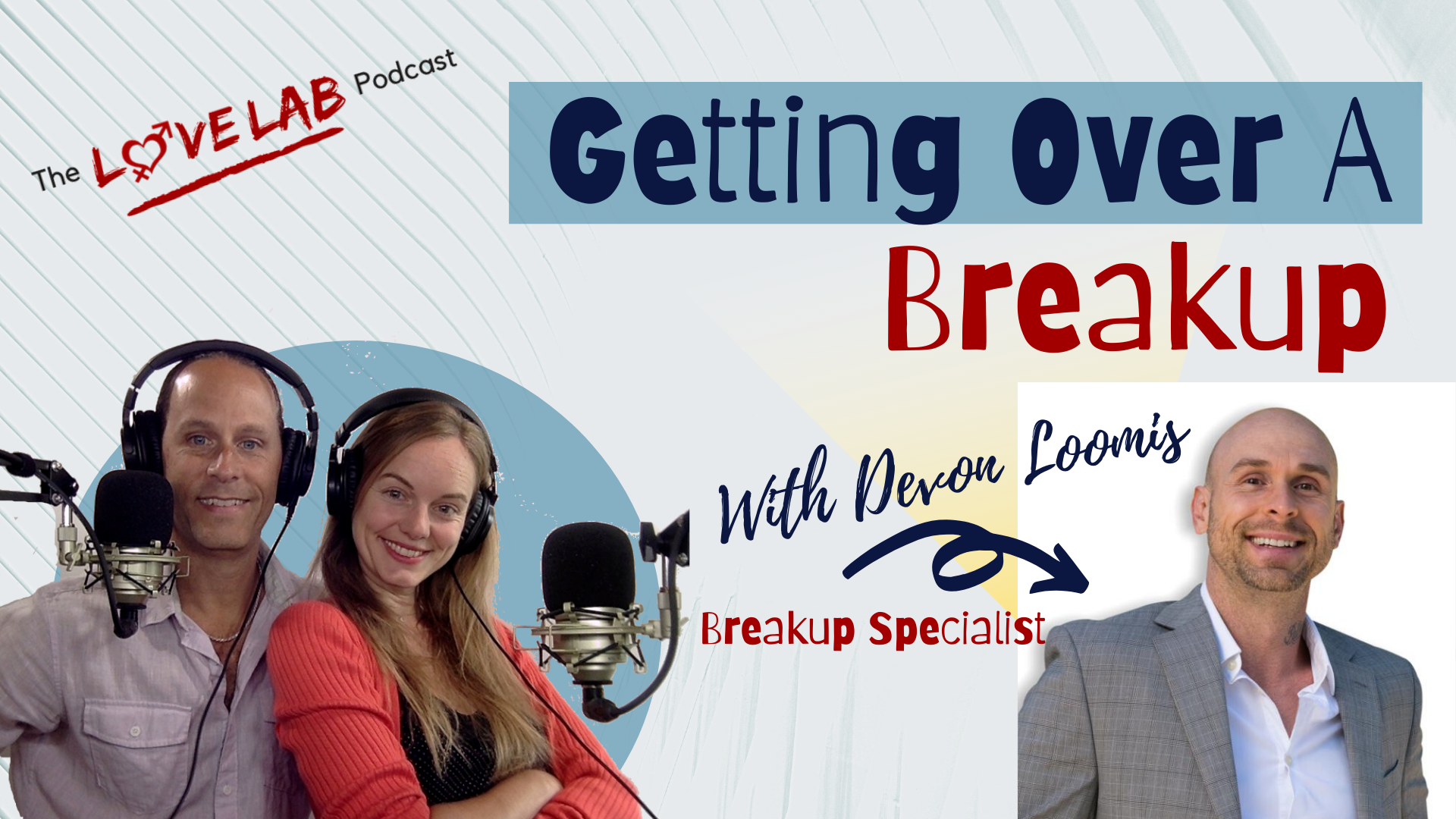
What You’ll Learn In Episode 96:
Ever had a bad breakup? If you are like most people, the answer is YES. Do you want to know how you can get over a breakup without the prolonged suffering so many experience? In this episode, Kevin & Céline talk to Devon Loomis the “Break up Specialist”. They cover the stages of a breakup when it’s time to break up, the most common mistakes people make, and Devon’s best breakup advice.
Links From Today’s Show:
 Devon Loomis is the founder of TheRelationshipCoach.com and is a breakup specialist. He partners with people to help them get through any breakup, over any ex and offers them a clear path to finding authentic love. As someone who tends to work with outliers, he offers effective processes and insights when nothing else seems to help.
Get Devon’s FREE Beyond The Breakup Playbook here.
Kevin Anthony 0:11
Welcome to the love lab podcast a safe place to get real about sex. Whether you’re a man or woman, single or couple, this is the show for you.
Céline Remy 0:20
We are your hosts Kevin Anthony Céline Remy and we are here to guide you to go from good to amazing in the bedroom and beyond.
Kevin Anthony 0:27
Alright, welcome back to the love lab podcast. This is Episode 96 and it’s titled getting over a breakup without prolonged suffering. This is what I think is gonna be a really fun and interesting episode. One because we have a special guest, but two because it’s actually something that I know you and I have a fair amount of experience in.
Céline Remy 0:51
What are you insinuating Kevin?
Kevin Anthony 0:54
I actually even wrote a piece about this a while back that was supposed to be put in a book I didn’t actually write it for the book. I wrote it on my blog at the time on my old coaching website. And then an author actually contacted me and wanted to publish it in their book, which never ended up making the final edit. But all of that to say that we’ve got some experience and we’ve got some really good questions. And so I think we can have a really great discussion between the three of us on this.
Céline Remy 1:21
Absolutely. So even though we have experiences we brought in a specialist. And so this episode is for you. If you want to move on after a breakup, you want to heal your broken heart or you want to know how to break up better, basically. But before we introduce our guest, let’s just give a quick shout out to our sponsor power and mastery.
Céline Remy 1:40
So if you want to join the secret club of men who are great in bed, then check out power and mastery at power and mastery.com. It is the most complex sexual mastery training for men. Whether you want to have a harder, stronger, longer erections last longer, or expand your sexual skills. So go to power and mastery.com.
Céline Remy 2:01
All right, so today we have Devon Loomis here with us. He is the founder of the relationship coach.com. And he is a breakup specialist. He partners with people to help them get through any breakup over an ex and offers them a clear path to finding authentic love. As someone who tends to work with outliers, he offers effective processes and insights when nothing else seems to help. Alright. Welcome, Devin.
Devon Loomis 2:31
Thank you so much for having me. It’s a pleasure to be here with you all.
Kevin Anthony 2:36
So I will probably start talking very generically about breakups. But I am curious since you specialize in outliers at some point in the conversation, I want to maybe talk about a few of those outlying cases because I find it very fascinating. Basically, what you’re saying is you specialize in the hardest cases, right, like the ones that seem to fall outside, so there’s probably some nuggets in there that we could get to Yeah,
Devon Loomis 3:00
I would say not necessarily the hardest cases, but the outliers when I reference outliers I’m referencing the people who are willing to go and have are ready to go to the deepest levels of consciousness and of inner work. And that those are typically outliers. And the processes available for them are far more effective than the processes that are available to the people who are just starting their path and inner work. Hmm.
Kevin Anthony 3:25
Cool. All right. Yeah, that’s gonna be interesting.
Céline Remy 3:28
So of course, I think anyone listening knows what a breakup is. So we don’t have to get into a definition of it. You don’t think you haven’t lived long enough? What I’m really interested in is actually when do you know it’s really time to break up and the reason I’m bringing this up is that what I’ve done is I’ve witnessed clients that have seen me for like multiple years, and they’re still in the process of breaking up really soon, you know, six years, 10 years in you know.
Céline Remy 3:59
I’ve witnessed them doing this push and pull dynamic and they just keep thinking about breaking up over the years and nothing happens. So, in your opinion, when do you know it’s time to break up?
Devon Loomis 4:13
Great question. So this brings us to a point of clarification of looking at what people are really experiencing or wanting to experience. Typically people talk about they’re in relationships. And we’re in relation to many different things throughout the day and in our lives. But I think what most of us are looking for is a partnership. And if both people are not willing to show up and sit in the discomfort and do the work, this applies to a business partnership, this applies to romantic partnership, if the other person or if we’re not willing to show up and sit into this discomfort and work through the issues, there’s no longer a partnership.
Devon Loomis 4:47
And what I recommend people doing if they can’t come to a conclusion or a resolution together to seek out professional help, if that still is denied or rejected, because even oftentimes, we seek out professional help and that first-person, we go to See isn’t intuitive, or they just aren’t on this. They aren’t aligned with us. So then we seek someone else out. If that process doesn’t work, and both people aren’t willing to show up to do the work, it’s time to call it quits and move on to something else.
Céline Remy 5:12
Hmm. I love what you bring in because that’s exactly the situation my client is in like he’s working on his own sexuality and doing different things on his wife is like a totally different reality. And I’ve been supporting him and like, do the work. And you never can tell that the other person is going to change but you are going to change and be a changed man.
Céline Remy 5:34
And it’s either going to help you move through this, you know, or it’s going to inspire your partner to show up as a different person. But it’s so interesting because he’s still holding on to that little hope, that little glimmer of like, it’s still may be possible and I don’t want to lose everything. So I’m like, I’d rather be in this mediocre relationship that going for what I really want
Devon Loomis 5:59
The powerful agent of change called pain is usually what pushes us to say enough is enough in anything.
Kevin Anthony 6:09
Absolutely. So, you know, obviously, both people have to be willing to get in and do the work. And if somebody’s not willing to do that, that might be a sign. But I was wondering maybe if we could drill down a little deeper on this as you like, when is it the right time? Like, what are some of the things that you have seen with your clients that are the thing that motivates them to finally make a change? Like, what’s the last straw on the camel’s back for most of the people that you see?
Devon Loomis 6:35
Usually, it’s just the wearing down process. We have been worn down so much, I keep trying, I keep trying to make this work. They’re not listening to me, and they’re not willing to show up. It’s really just wearing down that’s the main primary one.
Devon Loomis 6:48
The second one I would say is toxic relationships. people realize, especially with this, this pandemic thing that’s going on, people are stuck in close quarters, and they’re realizing how toxic that connection is. And it just, it’s becoming overwhelming in their nervous system and they’re feeling it and experience it and they just start screaming out for help.
Céline Remy 7:08
Mm-hmm. Okay, so that’s a great segue you’re bringing, so they’re realizing their relationship is toxic, and they’re like, Okay, it’s time to break up. Granted, hopefully by the time this episode airs, everybody will be out of lockdown, and they can take action. But like, what advice do you have for them to have them to start taking action once they had the realization? Okay, it’s time What advice do you have to take action?
Devon Loomis 7:36
Usually, that requires support. So a lot of people who reach out to me before I actually start working with them, they’ve already made a decision that they’re ready, but they can’t seem to gather the internal strength to make that move. And that’s where support is so helpful. Whether it’s with therapy counseling, someone like myself is really important to get some additional support. Just like when we want to go to the gym and we want to work out and we can’t get that motivated.
Devon Loomis 8:00
Sometimes in order to get the ball rolling, we need some additional support. So I recommend getting some support. And usually, people turn to friends. The problem with that is, most of our friends don’t offer the best result. Not the best advice even though they have good intentions,
Kevin Anthony 8:14
right? We did an entire episode on why you should stop taking relationship advice from your friends.
Céline Remy 8:20
Yeah. The whole episode because much like bad advice or
Kevin Anthony 8:25
bad advice we witness even within our own circles is mind-boggling, isn’t it? Yeah. Yeah.
Devon Loomis 8:32
And that’s our first go to right. That’s our first go to.
Céline Remy 8:35
Absolutely. And like we said in that episode on why you shouldn’t listen to your friends for relationship advice. It was like, unless your friends are professional coaches, or have an outstanding relationship, like don’t even bother because the models we have and if they have also bad relationships, it’s like they’re not gonna give you what you need or a different perspective. They’re only going to see it from that little like box. Plus, they’re also biased.
Devon Loomis 9:00
Right, because there is like, you know, women will go to their best girlfriend and their best girlfriends gonna take her side. Like, if you’re getting advice from somebody, it needs to be somebody who’s not biased, somebody who’s neutral third party who can clearly assess the situation and give real feedback, not just tell you what you want to hear. Absolutely two things come up for me in that, and one is that are grieving. So one of the first processes that we need.
Devon Loomis 9:23
So getting a lot of people, a lot of times people try to get over a breakup, but there’s a process we need to go through. And one of the first parts of that process is the grieving process, there was a real loss. And people try to move on too quickly from that, and they don’t actually honor the grieving process tapping and experiencing those feelings.
Devon Loomis 9:39
And our friends usually get tired of hearing us regurgitate the story of all the pain, we get tired, they want us to move on. But the thing that that’s important is to honor that grieving process and to understand that it’s usually going to take longer than our friends and our family think is reasonable.
Devon Loomis 9:56
Just get over him. You know, yeah, great advice.
Céline Remy 10:00
Eggs. I’m still processing it. Yeah. So it’s so good you bringing this up? Because that was our next question. We kind of want to like take down a breakup and see what are the stages really of a breakup. So obviously grieving is one of them. But if you were like if there was a step by step
Kevin Anthony 10:19
map, yeah. What’re the typical stages that somebody goes through when they’re going through a breakup?
Devon Loomis 10:24
Well, the map is one going through it blind, and just banging into walls. The second one is taking the breakup pill, it’s a magic pill helps you get over everything. You don’t have to ever have to think about anything again, you just take it one night, and you’re over it the next day. Right. So um, the first thing is making that decision, making the decision that it’s over and usually we need to make that decision every day.
Devon Loomis 10:47
Every day that we wake up in the initial phase, whether we did the breaking up, whether they even if they didn’t offer us clarity or a clear ending. We have to every day decide, you know, what it’s over. And then in that, we experience a process of the intense withdrawal phase. And it’s like withdrawing from a drug, especially if there was a lot of connection, a lot of sexual chemistry, we have a withdrawal of oxytocin of dopa mean of serotonin.
Devon Loomis 11:12
And we’re having a real neural chemical withdrawal, in addition to the mental attachments, the future trip and all the projections that are no longer there, they’ve vanished. This future I have with this person, our sense of security is no longer there. And that creates a very intense withdrawal from that relationship. So there’s a lot of things we can do as far as neurochemical support. As far as doing things that give us a sense of being in control because there is no control like a workout routine, an eating routine, something that brings, you know, routine into our life and a sense of control.
Devon Loomis 11:42
The next stage which these aren’t linear, kind of like the grieving the five stages of grieving, these aren’t linear, but then we experience the grieving period, the grieving phase where we need to tap in and experience all of the pain. With that comes looking at the relationship Because all relationships, we draw relationships or partnerships into our life to learn certain things, yeah, to experience life with them, and connection and beauty and all these things, but there are deeper life lessons while we draw people into our life.
Devon Loomis 12:12
And usually, we don’t ever look at those things. So in order to really find closure, a lot of people have difficulty with closure, right? It’s in, it’s hard to move on. And we bring the connections and attachments of past relationships in a future into future relationships because we never really achieved closure and a part of actually experiencing closure is mining the relationship after it’s over. Because a lot of times after a relationship, we oftentimes we get more out of a relationship after it’s over.
Devon Loomis 12:40
By looking back at the relationship and exploring all of the lessons, all the red flags all of our triggers, all of the stuff that came up in that relationship that we didn’t address, exploring what it was there to teach us. And then integrating that into our experience and then all of a sudden we find closure, which helps with closure because we see This wasn’t in vain. My love wasn’t in vain. I didn’t waste all these years there was purpose in here.
Devon Loomis 13:05
And then we get to the learning stage, which is where we put on the hat of the student, which points back to the episode you guys did about friend relationships. Because of how, where were we taught about a partnership, we were taught from our parents. And if we weren’t taught from our parents, we were taught from our friends who were also taught from their parents, and how many of them are in deep, authentic, ecstatic, you know, transparent relationships. So if we didn’t, right, if we’re looking at them for a model of that, then we’re just going to be flying blind.
Devon Loomis 13:38
So it’s important to after that to not just do what the biggest mistake people is, is to jump into another relationship to try to ease the pain, but to actually go through all these stages and then put up put that put on the hat of the student and really learn about deeper authentic romantic relationships and sexual space like what you guys teach, you know, to really do a deep dive and put on that how to student Learn.
Céline Remy 14:01
Mm-hmm.
Devon Loomis 14:02
And then we’re ready. And then we’re ready for something more beautiful, more ecstatic, more transcendent, more tasty and juicy and just healing than anything we’ve ever experienced when we actually go through the process. Mm-hmm.
Kevin Anthony 14:15
I like that part that you brought up about the most common mistake that people make, which is to just immediately move on to the next relationship, because we see so, so many people do that. I’ve even heard experts recommend the best way to get over somebody is under somebody else to get under somebody else. Yeah.
Devon Loomis 14:34
So for anyone listening, I literally have my, my fist against my head, you know, out of frustration from hearing this song.
Kevin Anthony 14:40
Yeah, yeah, exactly. I mean, we hear and I imagine in your line of work, you probably hear that a lot too.
Devon Loomis 14:47
Mm-hmm. It’s really frustrating hearing it from the experts who recommend that because that, denies the deeper levels of our being that need to be seen and explored. It’s just like, let’s move on to this physical aspect and ignore all the inner world. That really really needs to be addressed.
Céline Remy 15:01
And let’s use pleasure and sex as a way to not feel so that you can disconnect yourself from yourself even more. And then sex never serves its greater purpose. Fantastic. It’s,
Devon Loomis 15:12
it’s really, it’s a lot like, you know, taking a medication to mask the symptoms. It’s like, yeah, makes you feel better, but you haven’t solved the underlying condition. And on that point, what’s really so talking about outliers, I work with a lot of people who are on the empathic end of the spectrum, what they do when they try to go through that process of letting me just get under someone, or on top of someone or let me just try to hook up with people.
Devon Loomis 15:36
It doesn’t resonate with them, and they feel that they’re forcing it and then they think something’s wrong with them because they’re not able to access intimacy into me, you see, or into them, they see. And so they feel like there’s something wrong with me. I’m not able to do what all everyone else seems to be doing and so they feel something’s wrong with them. They’re not.
Céline Remy 15:54
Mm-hmm. And it’s what everybody else seems to be doing on social media and full disclosure. There’s a big difference between the glamorous shot you see of your friends on Facebook or any social media and what’s truly happening in their lives. So don’t judge yourself from the glossy pictures you see, because you really don’t know what’s behind all of that.
Devon Loomis 16:14
Very true.
Céline Remy 16:15
So I’m curious about what you see from the clients, you work with people you work with as the most difficult part of a breakup that they experience.
Devon Loomis 16:26
The closure part, the closure part, there’s so many answers that they didn’t get. Why, you know, why did it have to end? Or did they really love me? There’s that big question. Did I do enough? Is there something I could have done differently? That’s a huge question. So So being able to find closure is the hardest thing. Aside from the initial withdrawal phase, that’s the hardest thing for people to, to get to.
Kevin Anthony 16:56
So that’s interesting because I mean, we’ve all broken up in many relationships, probably more than I care to admit. And I can tell you that in a lot of those breakups, I was in exactly that place where I never got answers, even though I would even directly ask the questions, I would never get the answers to it. In some cases, I got answers years later, but never when I really needed them.
Kevin Anthony 17:21
And so my question then is, when people are struggling with that closure, and they’re not getting the answers that they want, how do you help them with that? Like, how do you help them actually get closure?
Devon Loomis 17:32
Great question. So, hypnotherapy is what I use. Because our subconscious has access to all of the answers or superconscious when we transcend our conscious analytical mind. It’s like when we so there’s a lot of confusion when I bring this up. I usually don’t use the word hypnotherapy because of the stigma that’s placed on it because of Hollywood and stage hypnosis where people bark like dogs, which that’s completely false. That doesn’t happen. Those are willing participants and hypnotherapy those processes.
Devon Loomis 18:00
This goes back to the origins of Western psychology with they’re extremely effective. So we have our analytical mind that tries to figure out all of these answers right tries to solve problems and it can be useful, then we have our subconscious. So when we are going to say something and we forget what we were going to say, it was just on the tip of my tongue, I forgot what I was going to say. And then we remembered it like three in the morning because it was still there. It was in our subconscious, it’s nothing bluish.
Devon Loomis 18:25
And then we have our super consciousness, which is where we get into the collective mind field with hypnotherapy, or what I call interactive meditation because all it is is getting you into a state of meditation, of relaxing the conscious mind. And from that place, the person, the hypnotherapist, or the person facilitating that session, has clear access and can interact with the subconscious and superconscious aspects of mind.
Devon Loomis 18:48
And when we can, when we do that, we are able to ask those questions that we never got answers to, were able to clearly see why the relationship played out on everything. Honestly, every single answer that we have a question too, we’re able to get clarity in that situation in that session in a hypnotherapy session.
Céline Remy 19:09
That’s awesome. I love this. I use a process that’s different. I’ve never been trained in NLP, Kevin is, but for me, it’s something that I kind of created off or that created it. And then later, I learned that there was like part of a process and had a name and all of this. And so the way that I used it is, in a sense, I’m kind of like using hypnotherapy on my software. What I do is recreate the scenario and change the outcome.
Céline Remy 19:37
Like I make it the way I wish that it had happened. And so even if it’s making up something, it could be like having the closure so I could witness like, imagine that that past boyfriend like having a discussion with me telling me it’s not your fault, it’s me or whatever, you know, it doesn’t really matter. But I do that enough time in my head that I come to a place where I feel Complete, where it kind of there’s no difference right between the reality of what I created.
Céline Remy 20:06
And that technique has helped me cope in so many different ways to just kind of like rewrite things, I tend to use it more for myself, like if I didn’t say what I wish I would have said, rather than having other people say things to me, but in extreme cases where the person is like having no contact with you or don’t want to ever address, like, talk to you again, then I think it could be very useful to do something like this because ultimately, it’s all for your own process of liberating yourself.
Devon Loomis 20:36
You know, what’s really interesting about that two things one, isn’t it interesting how, when we just allow the process to take place when we just give ourselves over to just being open and all of a sudden processes come to us and then we find out Oh, this is already established. This is part of some bigger thing. It’s interesting how that happens. Right? Absolutely. So and the second thing is, there’s no inherent meaning in life, we’re meaning-making machines.
Devon Loomis 21:03
So something could happen to my friend. And they could believe that life is against them. Everything is set up for their failure. And the same situation could happen to me. I might believe it’s setting me up for something. It’s preparing me for something. So we create that meaning. And so what you’re talking about is, yeah, that’s another process I use as well, of actually creating the meaning Why did it end? Well, we can make up the meaning of why it needed to end or why it ended. Oh, yeah, you’re dropping truth
Kevin Anthony 21:29
bombs on the audience. They’re the meaning of the events that happened in our lives really are the meetings that we give to them. Absolutely. Yeah.
Céline Remy 21:39
Wow, this is huge. So I want to take a 30-second break for a little ad and then continue. We have some more questions for you here. Devon. It’s been awesome so far, and I can’t wait to continue diving into here but before we’ve got a question for you listening, are you longing for deeper levels of sexuality? Coupled with emotional intimacy, spirituality, and just true connection, then our sexual power and passion VIP program is for you.
Céline Remy 22:10
This next-level intimacy coaching for modern couples is designed to help you bring the passion back between the sheets and beyond. This 90-day program is truly for the couple that does not want to live a life of average and wants to be synched up sexually so that they can thrive with more purpose and passion in life. So if you are curious about joining our VIP program, go to Celine remy.com, forward slash passion and you can find more about it.
Kevin Anthony 22:42
Alright, let’s dive right back into this because this is a great discussion. So and by the way, before I move on to the next question, I know you think you invented that technique. It is straight up out of the NLP manual.
Céline Remy 22:57
I know But still, I invented it.
Kevin Anthony 23:02
But you know, here’s what I would say about that, that I think is very cool is that? Yes, in a sense, you did invent it. And what it does is it actually validates the techniques of, of NLP and hypnotherapy because they’re sort of universal truths. They’re things that work, you know, no matter what you call it, or who decided to put it into a particular format and brand it and label it and call it something. It’s something it’s a tool that we all have that works.
Céline Remy 23:26
And I saved myself thousands of dollars, having to like go for the training to be certified to do what I already knew what to do.
Kevin Anthony 23:37
Alright, right, so let’s go. Let’s move on because we’ve got more questions. So the next question that we had on the list was about the most common mistake, but we kind of already covered what the most common mistake people make is? But here’s the thing I know that people make way more than just one mistake. So since we already talked about the most common one, I’m wondering if you could share with the audience some other common mistakes that you see people make when going through a breakup,
Céline Remy 24:00
oh, and I will add specifically and this is more for maybe our female audience, what I hear all the time is I’m trying to get over him and like, I can’t stop thinking about him or I’m constantly checking on social media, what my ex is up to. I was hoping you might cover a little bit of that.
Devon Loomis 24:23
So a couple of things. There’s two here, I want to address the social media they’re reaching out because that is huge. That’s a huge part of everyone’s process that I see. But before that, one of the things that I see goes back to the same root issue of why people try to get with someone else to try to experience some sort of pleasure to numb themselves. So they reach for food. They’ll reach for just vegging out on TV all day.
Devon Loomis 24:48
And that doesn’t feel good by the end of the day or by the evening if you’re not doing something productive. So it’s really a, an attempt to numb oneself and there are many different ways that that shows up. The second thing is that Then the social media and the mental reaching. So it’s interesting in life, we typically focus on the negative. For some reason, the way that we evolved, we’re more prone to focus on the negative, like, we need to be more aware of the Tiger that might eat us. So we tend to focus on the positive.
Devon Loomis 25:17
But when it comes to relationships, and breakups, specifically, we have this thing called positive hindsight bias. And what we do is we look back and remember all of the positive things from the relationship, all of the good stuff, all the good feelings, oh, I really missed this about them. The reason why is because we’re in such deep pain, that our mind wants to seek pleasure and escape the pain. And so it’s looking back to that relationship for all of the positive things. So it can help us It can alleviate that pain.
Devon Loomis 25:47
So it’s really important to have something our minds going to lie to us. It’s not going to present the negatives, balanced with the positives. So it’s important to write what I recommend people do is writing down a list of all of the misalignments All of the bad situations all the red flags everything in that relationship that needed to be looked at so that we have something objective to look at when our mind tricks us and it wants to go check their social media and see we have something to actually look at to reference because our minds gonna do that to us.
Céline Remy 26:16
And that’s awesome that’s also when the third party comes in so handy because when you work with people, you literally that person that’s helping them get over their own mind that’s tricking them in thinking that this was the holy grail of relationship when you’re watching them and what they went through and you’re like, no, this was and let me help you remember that?
Devon Loomis 26:35
Absolutely. And another thing that that I see that I’d like to bring more awareness to collectively as people think that love is the issue. People think you know, now I gotta shut my heart off from love and I don’t believe in love. And we throw this term love in into our vernacular and we don’t really distinguish what love is, and the issue is in love. The issue is mental attachments. It’s the mind playing tricks with And creating all these attachments that keep us stuck. So the goal is to not ever shut our hearts off.
Devon Loomis 27:05
We might experience that during the grieving phase. But we’ll have love moving forward. When we look back on a relationship where we had a deep connection, we still have a love for that person. And that’s good. That is important. It’s a good thing to have, we don’t ever want our hearts shut off. The thing is to move beyond the mental attachments to be able to participate in and this goes it’s a spiritual practice, right? What you guys teach is deeper spiritual practice sexuality is it can be a spiritual practice, the romantic partnership can be a spirit, there are spiritual paths that take us deeper.
Devon Loomis 27:33
So to get us to the space where we can participate in life. experience all of the pain the good stuff, and at the same time be free from it. It’s like a Do you have second for a story? Just to share a story? Yeah. So it’s like the ancient schools of Dionysus. They would take in the Mystery Schools of Dionysus in Greece, they would take initiates into a big theater. What are those things called?
Devon Loomis 27:57
They have the steps theater, amphitheater. Yeah. And so they would bring these initiates in one at a time and sit them in the back of the apple theater. And it would bring them down. They didn’t know what this play was about.
Devon Loomis 28:08
They didn’t know what they were doing. But they would bring them the initiate down. And they would participate and play this role. In this big theatrical thing of life of all the pain, the suffering, the joys, the ups, and downs. And periodically, they would take that initiative back and sit them in the back row of the amphitheater, all alone to watch this unfold. And then they would get them, bring them back down, pull them back.
Devon Loomis 28:28
The goal was to help get them to understand that while they were here, in this story, participating in it, they also have the option of being free from it and stepping back and being an observer of everything going on at the same time. And I think that that’s the deeper meaning or what everything points to, in every spiritual or every self help every practice that we’re looking at. I’m
Devon Loomis 28:53
sorry if I derailed too much. No,
Kevin Anthony 28:55
no, no, no, that’s great. Well, you know, Anytime that anybody can take something from the mystery school and sort of decode it makes it easy for people to understand. That’s great because that knowledge has been occulted for a very, very long time. And the reason is, is because very powerful. So anytime that we can kind of de occult that and bring that back out into the light where people can actually see it and use it, it’s a good thing. So,
Céline Remy 29:22
so you both the actor, the observer, I like to always call it like, I’m the director of my movie in my life. Like I literally do that often. Growing up, I would imagine, I was like, oh, I’m in the musical right now. So I would go like and sing along or like, Oh, this is my comedy show right now. Or like, whatever that was, I literally have always understood that, that I could take both.
Céline Remy 29:42
I could be the spectator, the observer, I could be the participant and that you also have the ability to switch the channel. If you’re not liking the sad story right now, like the drama you’re in. You can switch to a comedy or to a documentary or whatever that is like instead Switch in a second because you have that power.
Devon Loomis 30:03
Yep. Absolutely.
Kevin Anthony 30:05
All right. So we got a couple more questions here. I want to make sure we get at least a couple of them in before we’re out of time here. The next question we had was whether or not you had any tricks to help people speed up the healing process.
Devon Loomis 30:20
So I don’t have any tricks. But I do have hope. Because I oftentimes get people who have been, and I don’t want, I want to, I want to make sure that people hear that I’m not trying to put down talk therapy or traditional therapy because it can be very useful, very helpful. But I oftentimes get clients who have been in therapy for two years plus trying to get through a breakup, and I do it in six weeks, because of the processes of accessing the subconscious mind and I’m not the only one who does it.
Devon Loomis 30:51
So there’s plenty of people out there who can help facilitate that, accessing the subconscious mind and moving through it and when we do that, we anything in life, we get an expedited result.
Céline Remy 31:03
Absolutely. So it’s more about choosing the right process over than trying to go for it too quickly. It’s more about like actually turning off your head and starting to listen. In the work I do. It’s more like we always talk about the wisdom of the body. But he has like also the wisdom of the subconscious, like really like that set switch of turning off again, that mind that’s chatter that’s holding us back and listening to that deeper wisdom.
Devon Loomis 31:27
Well, the body is a representation of the subconscious. So when we feel pain, when we feel heartbreak, we feel in our heart Why it’s not because our heart is hurt. It’s because our subconscious projected into our body. So yeah, the body has deep wisdom.
Kevin Anthony 31:40
Well, and I like you know that that question was kind of a trick question in the sense that yes, there may be some techniques that you can use to speed up like the hypnotherapy and at the same time, your answer was great because it’s important for people to know that there are no shortcuts, but you have to deal with the underlying pain of it.
Kevin Anthony 31:59
Before you can move on, yes, and a lot of what we talked about so far kind of was hinting in that direction. But I wanted to make sure it was made really clear that you can’t just shortcut the process, get under somebody else, take a pill, whatever it is, and just it’s all magically better. Well said.
Céline Remy 32:16
So what I love to talk about is a term that that can come up as like conscious uncoupling. And hide can show up so now we’ve looked at the breakup, break up processes, we know everybody goes through that at some point, but like, Are there ways to do that better? And what is conscious uncoupling? How do you make that more beautiful? The beauty of the breakup?
Devon Loomis 32:39
The beauty of the breakup. So in my adult life, the most of almost all of the break, actually, every breakup that I’ve experienced, except for one was what you would call what I would call a conscious uncoupling. And that’s where both people in order to access that space both people have had to have done some sort of inner work so that there’s not this boy blame game. It’s like, Look, we’ve already sat in the discomfort.
Devon Loomis 33:03
We’ve tried to come together, our life paths just aren’t aligned. You know, we’ve tried, we’ve but but this just isn’t working. So I wish you well on your journey and the other person wishes them well. And yeah, that we still have to go through the grieving phase and go through the whole process, but it’s a more harmonious thing. Yeah.
Kevin Anthony 33:20
Yeah, that that’s beautiful. I like the way that you stated that, you know, one of my, it’s a friend of ours that I’ve known personally for a really long time. And early on, when I first got to know him, he went through a breakup that sort of served as an example for me, you know, from that point on, which is, he was with a partner for 10 years. They actually had quite a seemingly, at least from the outside, great and close relationship.
Kevin Anthony 33:49
But at some point, they noticed that they weren’t really aligned anymore. And so what they did was they literally took a vacation, they went down to Hawaii, they did a little ceremony and what they looked at Was does the two of them being together, create more positivity for themselves and for the world around them than it would be apart? And they literally sat and said, do the two of us being together?
Kevin Anthony 34:16
Is that better for ourselves in the world that if then if we had separated, and the conclusion they came to was that it would actually be better for themselves and the world around them if they continued on on their separate paths, and they very consciously did that. And I remember hearing that story being told that from him and thinking, that was fucking amazing. I didn’t have any examples like that. Prior to that. I was like, wow, okay. We mean, you can actually do that.
Devon Loomis 34:44
That’s beautiful.
Céline Remy 34:45
Mm-hmm. So this is like for all of you listening. It is possible. breakups don’t have to be traumatic. I have more happy peaceful breakups than traumatic ones. The ones that were harder were literally when I was like a teenager. In my early 20s I was just starting with, like having skills didn’t have any. But once I started doing like software communication and understanding that it didn’t have,
Céline Remy 35:10
yes, there is a grieving process and some pain in letting go of your potential your idea, which is not even the reality what you thought it could be. It’s being willing to let go of that. But it doesn’t have to be this dramatic experience.
Devon Loomis 35:29
Well said, and something that gets people stuck a lot of the times at the end of the process, even if it’s harmonious is they think I’m never going to be experienced that level of connection or sex or whatever, again, and from my experience, that’s only a thought.
Céline Remy 35:47
From my experience. It’s only a fault. It’s always gotten better.
Kevin Anthony 35:51
Yes. Well, that makes three of us for sure.
Kevin Anthony 35:59
I think With that, it’s like if you allowed yourself to be open enough to experience it once, you just have to allow yourself to be open enough to experience it again, it’s really about your own self. It’s not about what the other person brought. That’s my personal feeling.
Céline Remy 36:13
I love this, Kevin. So we’ve got two more questions. There’s always our special question that we reserve for the end. But what we’d love to what would be your best breakup advice that you could give to our listener, like on how to do it nicely, or whatever is your best breakup advice, if you could sum it up.
Devon Loomis 36:33
Understand that it is happening for a reason, a deeper reason that what you’re perceiving, if you’re in the middle of pain and blame, and to take a step back, and delve into all of the uncomfortable feelings and explore them, and if you need help, and you feel like you’re stuck, then seek out someone who can help you with that process because it doesn’t need to drag on for
Céline Remy 36:54
years, huh? Yep, absolutely. So Devon, our last question. was the one we prefer the best. We are very curious what do you think is your best sexual talent?
Devon Loomis 37:08
Presence.
Kevin Anthony 37:09
Hmm, that’s a great answer. So you know, that’s something that a lot of people don’t even think about when it comes to sexuality but we actually have a whole video on it in our power mastery course that we promoted at the beginning of this episode where we really go into deeply what that means and how important it is a very good skill to have
Céline Remy 37:37
Now, are you single Devon? I am just trying to help you out there.
Céline Remy 37:44
has got a lot of wisdom to share. I know you have a beyond the breakup playbook for our listeners that they can find at letting me just double-check the relationship coach com/free but we’ll put also the link in the description below. Please share with our listeners. How they can have more of you.
Devon Loomis 38:02
So what I do is I offer that free playbook and what I offer isn’t for everyone. Usually, I link up with people who are ready to really delve in and do deep work. And so what I do is I set up a free 45-minute call, where we explore where you are getting get more context for where you’re at in life and the relationship to break up, you get a feel for what I do, and we see if there’s an alignment there.
Devon Loomis 38:25
And if there is an alignment then we can discuss working together in the future. And it all starts with just getting that free playbook. Mm-hmm
Céline Remy 38:31
awesome. So again, go to the relationship coach com/free and you can find more about Devon there and
Devon Loomis 38:39
And also I do a live video. I go live on Facebook every night on Devon Loomis, on my regular page, my business page and I answer any questions about breakups and higher romantic relationships every night.
Céline Remy 38:54
That’s awesome, Devon, thanks for doing that. This is great resource so make sure you tune in and check him out and ask him one more question. This was a fantastic conversation. We got a lot of like nuggets and beautiful wisdom being shared. So thank you so much for being here today with us, Devon.
Devon Loomis 39:11
Thank you for doing everything that you all do.
Kevin Anthony 39:14
All right. Thank you, Devon. And thank you, everybody, for listening. That’s all the time we have for this episode. And we will see you next week. We hope you liked this episode of the love lab podcast. If you enjoy this show, subscribe. leave us a review and share it with your friends.
Céline Remy 39:34
And for more free exclusive content. Join us in the passion vault at kevinanthonycoaching.com/vault. That’s kevinanthonycoaching.com/vault.
Kevin Anthony 39:49
Thanks for listening.
Céline Remy 39:50
And remember, you’re amazing.
We hope you liked this episode of The Love Lab Podcast. If you enjoyed this show, leave a comment and share it with your friends.
RATE & REVIEW THE LOVE LAB PODCAST
—> LEAVE A 5-STAR REVIEW ON APPLE PODCAST
ASK A QUESTION FOR THE NEXT EPISODE
—> Click here to leave a message directly to Kevin and Céline to be answered on the air.
Thanks for listening and remember you are amazing.

Kevin Anthony and Céline Remy are an international husband and wife team who joined forces to create a worldwide movement of true sexual empowerment. Kevin, “The Truth Warrior,” is a Men’s Coach, Tantra Counselor, and Couples Relationship Coach. Céline, “The Intimacy Angel,” is a Holistic Sexologist, Certified Sexological Bodyworker, Relationship, and Intimacy Coach for men, women, and couples. Together, they are truly the ‘Power Couple.’ They host ‘The Love Lab Podcast,’ and are co-creators of ‘Power and Mastery,’ an online educational training system that teaches the exact process to any man who desires to bring his ‘A’ game consistently to the bedroom. They guide couples and men on how to go from ‘good’ to ‘AMAZING’ in the bedroom and beyond.