Last Updated on April 3, 2020
What You’ll Learn In Episode 57:
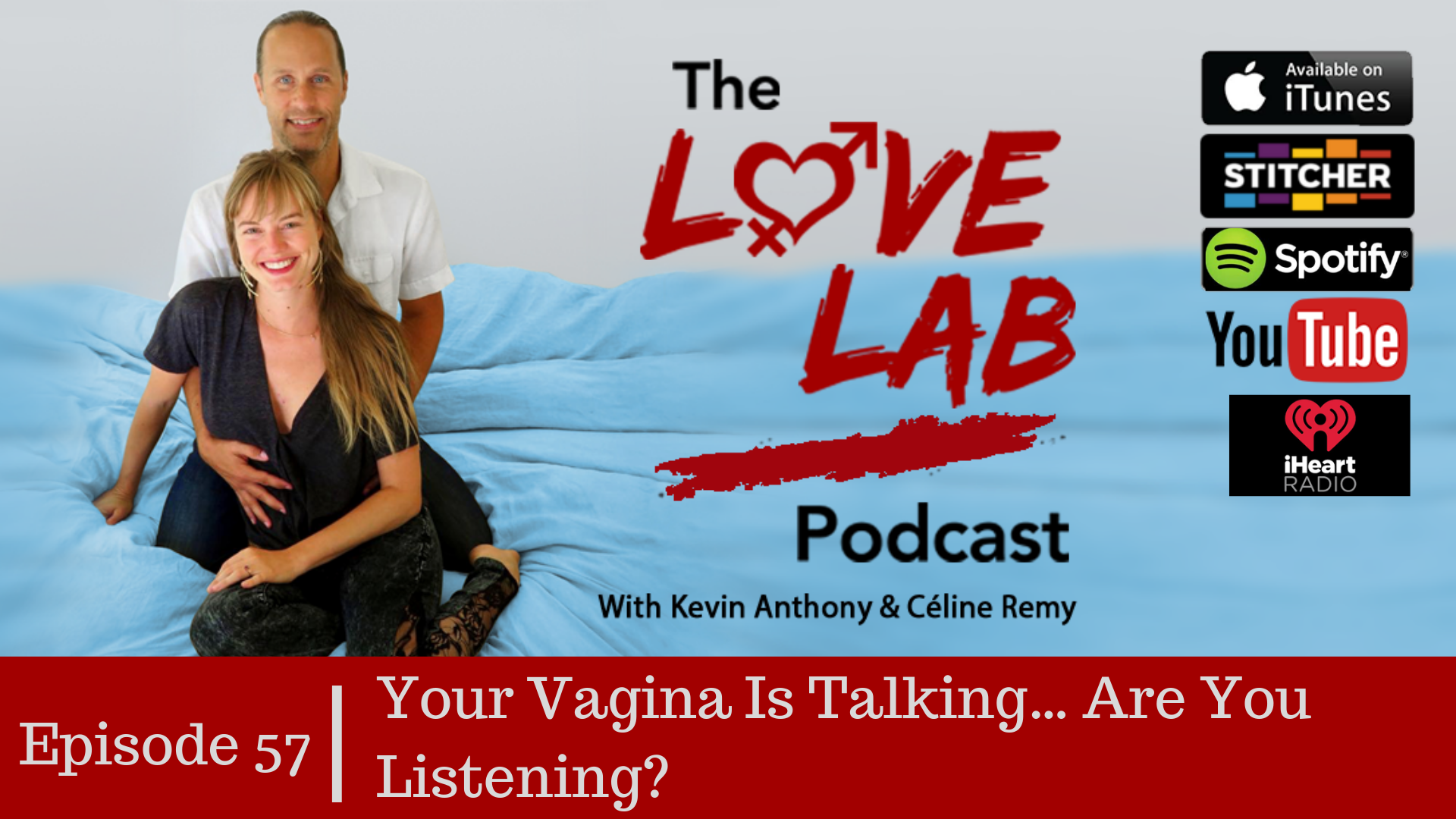
Did you know that vagina can talk? Are you listening? In this episode, Kevin & Céline discusses the physical and emotional ways in which your vagina gives you messages. They also help you interpret those messages and figure out what to do about them. Also included in this episode is a “7 Steps to a Healthy Vagina” protocol.
Links From Today’s Show:
“Petals” by Nick Karras
Céline Remy 0:11
Welcome to the love lab podcast a safe place to get real about sex. Whether you are a man, woman, single, or couple, this is the show for you because well, sex matters. We are your hosts, Kevin Anthony and Celine Remy.
Kevin Anthony 0:28
Welcome back to the love lab podcast. And this is Episode 57. And it’s titled, your vagina is talking. Are you listening?
Céline Remy 0:37
Yes. Oh yeah.
Kevin Anthony 0:40
Well, what does it say?
Céline Remy 0:43
stinky, smelly, dirty. vagina.
Kevin Anthony 0:46
No, that’s not what it says.
Céline Remy 0:48
It’s not what it says. But that’s oftentimes what people think. These are a lot of the words that are associated with the vagina. I know we had fun when we were prepared for this show. And I wanted to say like, Hey, what are the different names to to call the female challenge failure?
Kevin Anthony 1:09
And we came up with a shortlist because this list could apparently be extremely long if you research it.
Céline Remy 1:17
You know, just to name a few things like pussy, punani, cunt
Kevin Anthony 1:23
Vag-g, twat, vag, slit, snatch. Cuch, yoni, girly bits
Céline Remy 1:32
The muff, so bad, lady garden, bonner garage
Kevin Anthony 1:39
Look up the tattoo on the internet where a woman had boner garage tattooed on her belly I think with an arrow pointing down.
Céline Remy 1:44
The bearded clam, the furry taco, honeypot, kitty… Okay, you name it right?
Kevin Anthony 1:55
We could go on.
Céline Remy 1:57
We could create a song you know. We were practicing it earlier and thought about singing it when we would deliver it. But now we didn’t.
Kevin Anthony 2:05
Oh yes, I want to hear you sing it.
Céline Remy 2:08
Another episode… You know in French, we call it “la moule”, which is basically like the mussel. And what you were telling me is that in English, it would be called clam
Kevin Anthony 2:21
right? Yeah. Well, when you say muscle you mean mussel as in the seafood mussel? Yes, I said we wouldn’t really say that in English, we would call it a clam or a bearded clam. Although these days, there aren’t very many bearded clams left, they’re just shaving glands.
Céline Remy 2:40
Well, the reason we brought this up is, you know, all these words are often having a negative connotation, they somewhat derogatory terms. I think it’s really sad that we address our body parts with these terms. And what that does is, first of all, well, it helps us make fun of them. Oftentimes, it makes us disconnect.
Céline Remy 3:02
This is an exercise I do in my irresistible program because I have women really realize that the words we use are powerful when it comes to our vaginas to our policies. And if we are not feeling empowered by a word, or if we find a lot of shame associated with it, that’s the vibration we carry. And that’s the vibration that’s carried within our bodies as well.
Kevin Anthony 3:26
Yeah. And you know, I mean, this is true for men and women, too. I mean, the first thing that we really need to establish is that words have power. They really do have power. And if you don’t think they have power, look at all the laws that prevent you from saying certain words. Look at all the censorship that goes on on the internet. If words didn’t have power, why would we bother to censor them? Right? So words have power.
Kevin Anthony 3:47
And if you think about it, okay, we give you a whole bunch of slang terms for vaginas. Some of them are kind of cute and fun, but some of them really are derogatory. And also think to like, Okay, if you want to say that somebody is, you know, you dislike them, you want to call them a name. What do you say? He’s a dick.
Céline Remy 4:06
Yeah. Right.
Kevin Anthony 4:07
So that’s again, another negative
Céline Remy 4:10
connotation.
Kevin Anthony 4:12
Yeah, so Yeah, exactly. So one thing that we really need to do is we need to get away from doing that. Why would we reference a part of our body that is, you know, I mean, I want to say special, but like, any part of our body is special, why would we use a derogatory name, especially when we know that these words have power?
Céline Remy 4:30
Hmm. So, okay, our title is your vagina is talking. Right? And are you listening? And really, what we wanted to do in this episode is to do a little bit of a reframe. So first, we understand that the way we address it, the emotions we put behind it matters and makes a difference about how you feel in your body and how you feel about your body. But next, we want to take it further.
Céline Remy 4:57
Because what if what was happening was in your body, and more specifically, with your vagina was more like, signs or clues and that you have a giant I was like, giving you like little signs and fees to be like trying to tell you a message?
Kevin Anthony 5:17
Yeah. So you know, one of the things that we’ve noticed, not just in our own lives, but also with working with clients is that whatever’s going on with your vagina, you know, maybe you’re having recurrent yeast infections, or you’re having something else going on. Or maybe everything’s great, maybe you’re juicy than you’ve ever been. whatever it is that’s going on generally parallels something else that’s happening in your life, absolutely, probably in your relationship, but it could be in your life in general.
Kevin Anthony 5:47
And so we started to notice some patterns, that certain types of things that are going on, tend to be present when certain things are happening in your life.
Céline Remy 5:58
Absolutely. And I this all came up from a conversation that you and I were having over in the bedroom, and I’ve said something along the lines that, hey, since we’ve been together, it’s been like over three and a half years. I have not had a single yeast infection.
I realized that. What I realized is that I used to have way more yeast infections. That’s when I had different partners. And that’s really what we will start to delve in. It’s like, there were really like lots of other things. Maybe just maybe that was a way for my vagina to let me know that I was not having sex with the right partner.
Kevin Anthony 6:38
Yeah, absolutely. I mean, I can use an example from my own personal life, my last relationship before you and I were together, towards the end of the relationship, when things started kind of breaking down and not going so well. She was having constant issues with her vagina. And it really was a sign it was a sign like, wow, this is not working.
Céline Remy 7:00
Absolutely. So if we start to think about it this way, rather than being a nuisance, and annoying, and something that we must act on right away and like, take action, what would have corrected? Maybe it could be something that is like a gentle knock on the door of like, hey, something’s going on. Why don’t you pause and listen? And we’re not saying like, don’t take action. Obviously, when you have an issue, proceed really need some help, you know.
Céline Remy 7:29
Then you don’t want to wait too long if you have a UTI and gets to your kidneys. But you want to look deeper than just the physical symptoms. And so some of the things that could be happening, and we’ll go more in details are things like, hey, it could be because you’re in the wrong relationship. It could be because you don’t want sex with that person. It has nothing to do with how much you love them. But maybe your body didn’t want sex in that moment.
Kevin Anthony 7:56
Yeah. And I think it’s important to say because the way you phrase that initially, you don’t want sex with that person. But you have to realize that this is a total subconscious thing. So you and your mind might be saying, I really want to have sex with this person. But it’s your body telling you otherwise. It’s that subconscious. That’s saying, No, no, no, no, no, I don’t care what your mind says. This is not right for you.
Céline Remy 8:21
But if you look at it, you know, in past relationships, right, we all have had examples where we like, I knew it. I knew that this relationship wasn’t really right for me, or I shouldn’t have done that. But I didn’t listen.
Kevin Anthony 8:35
Yeah, that’s the thing is most people don’t have that clarity until way after the fact after they’ve suffered and gone through a horrible breakup. And I all this happens then, a year or whatever, later on, they go, Oh, yeah, now I realized that it wasn’t good.
Céline Remy 8:50
And here’s something really important, if that’s you, like, slow down and remember, how did your body feel when you were not in the right relationship? Where did you feel sensations? How did your vagina respond? What was happening with your body? and start to know, okay, so when I felt angry, or when I felt resentment, or that I was incompatible, and I still said, Oh, well, I still want sex, I’m going to go for it. Like, that’s how it felt.
Céline Remy 9:20
So that now you can start tracking it is like when you start to see that in your life. You might be like, hey, do I want to go back down that road again? Or do I want to take a different one? Right?
Kevin Anthony 9:30
Yeah. What tells us what some of the symptoms you might experience that are trying to tell you something?
Céline Remy 9:38
Absolutely. So I think one of the first ones is a chronic yeast infection. When you have, you have weird discharge and it Jeunesse, and it’s very interesting because when you think of it, the symptoms of a yeast infection are okay, so there’s a bit more destruction normal, but there’s this kind of burning, itching sensation. Where do you like her and it makes you feel so angry, like you so irritated from the inside out? Right? So the
Kevin Anthony 10:15
question is, which came first? Is it that you were irritated by your relationship that’s causing irritation in your vagina? Or vice versa?
Céline Remy 10:26
Absolutely. Well, that’s the thing. And so okay, knowing that and there are other physical things to wear. When you have recurrent yeast infections, people think it starts from your vagina, but it really starts from your guts. And we’ll talk more that’s when we’ll go through seven steps to keep your vagina healthy. But it really starts with your guts and with your digestion and with your probiotics.
Céline Remy 10:53
So yes, there’s the emotional component and peace and then there’s also the physical a logical thing of like, maybe not having good digestion and not good guts, health, and if you rebalance it, and sometimes, that’s what happens people only a mother vagina, and like, I’m just having yeast infection. So I’m just going to shove a clove of garlic up my vagina after this, by the way, are, you know, if it really doesn’t disappear, you might go to the doctors, they’ll give you strong antibiotics and stuff like that, and you put suppository or things. Yeah,
Kevin Anthony 11:27
yeah. But you know, what happens when there’s something else causing it?
Céline Remy 11:32
It disappears, but then it comes back,
Kevin Anthony 11:35
and then it comes back and keeps coming back? Because you’re not addressing the underlying car?
Céline Remy 11:42
Absolutely. So for me, one of the reason, two things, number one, I had kind of like more like Candida and that’s only once I was able to rebalance my guts that I stopped having that. But then it also was not the perfect relationship. And I did have a lot of like resentment of things that weren’t always fully said, I love the person.
But there are a lot of things that annoyed me, things we couldn’t talk about or things that irritated you. Yeah, strangely. So we just like sharing that to give you an idea. Another thing so that was our yeast infection.
Céline Remy 12:22
Another thing that’s very common is a UTI urinary tract infection. And I’m going, to be honest, I’m not super familiar with it, because I’ve never had that in my entire life. But I do know that it can be very painful. Also lots of irritation. And we were just talking with a friend this weekend about it because she used to have chronic UTI’s.
That’s also why we’re talking about our upcoming episode. And she was like, “Yeah, I wasn’t listening.” Then I said, so what made you listen? And she said. Well, I started to see patterns, where I constantly had a UTI after having sex with the same person or after a certain situation happened.
Kevin Anthony 13:08
And so you know, urinary tract infections, if you don’t take care of them can very easily end up in your kidneys.
Céline Remy 13:16
Yes. And what’s interesting with kidneys Thank you so much. It’s such a good job making me shine. So, kidney in Chinese medicine is very connected to your genitals to sexual energy, but the deep emotion behind kidneys is fear. And so the emotions of fear is most likely very present when there’s UTI whether it’s fear of the relationship future of something happening, not happening being supported, not being supported. Yeah. Yeah, not being loved. I also do think that strong some anger in there as well, you know.
Céline Remy 14:04
And so, the question again, is more like, Hey, what’s really going on? You know, you’ve got one UTI once, you know, maybe you didn’t wipe properly, you played annually and then had like vaginal penetration and you know, things weren’t fully clean. That’s how you can get a UTI.
It’s something people don’t always realize, you know, you can, it’s very important to not mixed, you know, and touching the anus and then touching the vagina, you know, why front to back? That’s exactly why you should why front to back. And so, you know, maybe it happened once and there’s something there.
Céline Remy 14:39
And then well, it’s not really a big deal. You just pause you, you take your cranberry juice or whatever you’re doing, or whatever if you go to the doctor, whatever works for you to clear this out of your system. If it never happens again, that’s okay. If it’s more of a recurring thing, then that’s really when you want to start to ask the questions and be willing to listen. Are you listening?
Kevin Anthony 15:03
What else I know there are some other things on the list.
Céline Remy 15:05
Yeah, so I’m really excited to talk about the vaginismus, because, okay, it shows up as painful, very tight vagina, which makes penetration either extremely painful or sometimes even impossible. And I was doing some new training and research and there was a story of this woman who was an older woman who was experiencing vagina smears. And so the solution that she opted for was to go see, like a pelvic floor therapist and sex therapist, where they worked with doing a dilator inside the vagina.
You work into putting something in the inside the vagina, and it dilates and expands, so to like, how can we stretch that vagina to get it ready, so that it starts to be okay with being open so that you can have sex, that’s not painful.
Céline Remy 15:58
That’s the idea behind it. It’s an novel idea. It’s a grand idea. But it takes a long time, it can be very uncomfortable, and there are not always fantastic results. Then she started to work with somebody different, who not only looked at the physical symptom but started to address the emotional component part of it. Within a discussion and a whole practice that they went through, she realized that she was holding stuff against her partner. You know, they had been together for like, decades or two decades, as a long time.
Céline Remy 16:31
They had things that were not being said, and they both worked through this emotional process together, the husband was present. And they both cried, and they hugged and they share their, their deepest feelings and fears. Guess what? her vagina they started to open up and guess what her vagina opened up to.
Kevin Anthony 16:51
You know, it’s funny when I listened to that technique, which I don’t really know anything about this technique of trying to sort of force it open. But to me, it sounds like there’s something blocking the door. And rather than going to remove what’s blocking the door, so that the door will open easily. Somebody just bashing on the door, trying to force it open, trying to smash whatever’s in the way out.
That just sounds ridiculous debate, like figure out what the underlying causes this is the number one problem we have with Western medicine, is they never address the underlying cause. All they do is address symptoms.
Céline Remy 17:25
Yeah, we do a little patch here and another patch there. And then oops, with that, that we created second problems that now we need to address and it’s kind of a never-ending cycle. So okay, I think there’s two more that I want to address.
Céline Remy 17:39
One is kind of related to the vaginismus, which is, as we are aging, and we’re going through perimenopause, and menopause and hormones are changing. Sometimes the vaginal tissues are becoming way thinner. And has to do with our progesterone levels and different things in the body. But that makes it that some women literally will bleed with intercourse because the vaginal walls are becoming too thin. It’s not happening very well.
Céline Remy 18:11
Another really fascinating story around that is that oftentimes we’re like, well, there’s nothing you can do, or maybe use this progesterone cream or do this, you know, and it can help us move, you know, but oftentimes, it’s again, because they’re not having the type of sex that they truly need, or crave. And sometimes they don’t know they want it like they don’t know, that’s not what they want.
Céline Remy 18:36
They like well, this has sex has always been done, but they have shifted, and they may need some slower sex, they may need more emotional connection, they may need spiritual connection with the sexuality, like so many different elements into it. And when you finally bring that in, suddenly, again, you’re able to have sex. And it’s like, Yes, in the body. That was a problem. But I think a lot has to do with all the other stuff.
Kevin Anthony 19:03
Absolutely. I think you know, most people, they really don’t realize it. Again, because Western medicine doesn’t recognize it. But they don’t realize the power that our emotions have on our physical body. And, you know, that’s like you say a lot when working with clients, right? The issues are in the tissues, right? There’s a lot of emotional stuff that can literally get stuck in the body and cause a whole range of problems.
Céline Remy 19:30
Absolutely. Sometimes, you know, people think, well, if I just talk enough about it, it’s gonna resolve itself. That’s kind of the purpose of therapy. And it only works to a certain degree, because we got to get into the body, we got to move the shit out. We’re going to like, get this moving and out and changing and shifting, and no matter how much you’re going to talk about it. It’s not going to resolve it.
Kevin Anthony 19:53
Yeah, there’s a great book I read years ago, I believe it was called molecules of emotion. Oh, yeah. Thank you. I think it is a title. Anyway, there’s the woman, Candace bird who wrote it, you know, she was the woman that discovered the opiate receptor in the body. And basically, what she learned from her many years of research was that we tend to think that all these emotions are stored in our brain, we think of our brain is the emotional center of the body.
Kevin Anthony 20:21
So if you go off that model, then this idea that your issues are stuck in the tissues doesn’t make any sense, right? Because, well, how could something that happened to my arm or my leg possibly be influencing my emotional state or anything else. But anyway, what she discovered in her work was that there are receptor sites all throughout the body.
Kevin Anthony 20:44
And so these emotions aren’t just stored in the brain. It’s not just a chemical reaction that happens in your brain, it actually happens in different parts throughout your whole body. And so yes, those emotions can actually be stored and created in other parts of your body. If you’ve never read the book, it’s a great book, I would check it out.
Céline Remy 20:59
Well, and you know, I studied with Mantak Chia, who’s like the Taoist master and the Taoist philosophy, each organ hold emotions in the body. And they really see that our tissues, our muscles, and our organs hold stuff, okay, so it’s not a new concept. And if you think about it, the uterus is the strongest muscle that pretty much exists.
Céline Remy 21:23
So imagine the amount of tension of trauma of stuff that can be stuck in the biggest muscle of the body. And if you don’t address it, and the emotional component of it, that’s when things just go wrong. And so the last thing that I was thinking about that I wanted to address is in regards to infertility. Because this is a very recurrent problem that a lot of people are dealing with in this day and age.
There are a lot of things that are contributing to basically putting our hormones out of balance, which makes it so much harder for people to conceive when they choose to conceive.
Céline Remy 22:02
And women that have been on birth control for decades and have suppressed their natural cycle, then they get off the pill and they go like, oh, why isn’t my body functioning properly? And it’s like, well, you’ve been suppressing it for decades. You
Kevin Anthony 22:17
know, there’s such a long list of things in our modern society that are contributing to the increased infertility and the lower birth rates that I mean, that would be like a several hour shows in itself, just to cover all of those things. That maybe we should do a show on that.
Céline Remy 22:35
Yeah, let’s put it in our little notes. But back to infertility. I think, you know, different things here too, because I’ve met different women to where they had a deep fear of being a mother, and yet they wanted to be a mother. And until they resolved that, or until they really became one with their body. And like some women were terrified of giving birth or of having to like, connect with their vaginas.
Céline Remy 22:59
Once that finally got healed and changed. They were able to conceive. So there’s a lot of things that can happen. And that’s why it’s so important. We asking you the question again, your vagina is talking. Are you listening?
Kevin Anthony 23:12
Mm-hmm. Well, let’s say that you are listening. And you’re hearing the things that your vagina is saying to you. So then the question becomes, what do you do about it?
Céline Remy 23:25
Hmm? Yeah, so I mean, you got to be proactive. If there is an infection in the body, there’s something going on right away, choose whatever path for healing that resonates with you, there is really not one path, one solution that fits all, whatever you choose, you need to be okay with it, you need to feel that this is the best solution and that this is going to help you 100%.
Céline Remy 23:51
If you have a doubt, or if you’re not fully into it, then don’t do it and find one that resonates with you. So that’s number one. But then you want to be proactive, if there’s nothing going on right now, what can you do to keep your vagina healthy and balanced? And that’s really what these seven steps are more about, okay? It’s not in time of crisis so much that it is as a guideline, to start to establish good relationships with your body with your busy with your vagina.
Kevin Anthony 24:19
Yeah. So and maybe just to add to like, what do you do in the emergency situation? So obviously, you can see your doctor, there are natural remedies as well. You can try to figure out like, how can you calm down the irritation, the inflammation, any infection that might be there. And then once you’ve gotten past that, I would highly recommend doing the deeper emotional work starting to look at your life and your relationship, your relationship to your body and your relationship to your partner.
Kevin Anthony 24:54
You know, past traumas you might have had this, there’s a lot there that you could potentially be digging into. That might give you some real keys as to you know, why you’re having recurring problems if you’re having problems. So, you know, listen to what your dad is telling you. But then you got to do something about it. You can’t just go Okay, yeah, great, awesome. Heard, you
Céline Remy 25:18
You have to make some changes. And you know, also, when you’re doing this deep work, especially for us, women, I think, get some support, I really, really think that it’s key in, in the success because we learn by resonance. So if you can be surrounded by positive role model women that are that have been for there’s a woman that has wisdom that you don’t have yet have, it will make a difference. And I think it’s really essential to not just be along on this road by yourself.
Kevin Anthony 25:46
Yeah. And I think too that subtle thing that you do every day can make a big difference. So we started off this show, kind of joking about all these crazy names that people have created for vagina. And yeah, it’s kind of funny, and we all laugh about it, haha. But we did make a very strong point that words have power. And so think about how you relate to and treat your vagina every day. And this goes for men too. But the topic of this show is women, right? So you know, maybe start using better names. Mm-hmm. You know, like in the spiritual sort of communities, people like the term Yoni.
Kevin Anthony 26:29
And they like that term because that’s a term of reverence. That’s like a term of like, you know, people worship the Yoni, they see it as the Goddess, they see it as something that’s special. You know you don’t have to use that word. But pick something that kind of has those feelings associated with it. So talk about it differently. Don’t complain about it all the time. say good things about your pussy, your vagina, how much you love it, call it good names, take good care of it physically. And that that comes into the seven steps, right? So
Céline Remy 27:00
Number one, then in your seven-step is, how do you wash your vagina? Like there’s this idea that you know, we started with saying dirty, smelly, stinky, and it’s, it’s, it’s such a myth, our vaginas don’t need like they have a delicate pH, right. And that’s what keeps the half of the vagina in balance. And if, if it’s not acidic enough, the flora is going to get out of balance. When you use soap in your shower and your soap in and out and scrub, scrub, scrub, scrub scrub, you have basically removing all of these really good…
Kevin Anthony 27:34
Or using douche is another….
Céline Remy 27:37
Yes, just exactly. You are like really putting the natural balance of the flora out of balance and creating an environment that is not being able to kill the bacteria as they come in. So it becomes like a place where you can get more infections.
Kevin Anthony 27:54
So if it seems dirty or smelly in some way, that is your vagina telling you something. It’s telling you something’s out of balance because a normal healthy vagina doesn’t look bad. Doesn’t smell bad. doesn’t taste bad, huh? It doesn’t.
Céline Remy 28:12
Thank you, Kevin. I think we need to hear that a lot. As women, I still have fear sometimes where I’m like, Oh my god, they ever do, like, oh, let’s have oral sex. I was like, Oh my god, I didn’t shower this entire day. And you know, we’re like in the sun and sweating. And you’re like, so what I’m like, I might not be as fresh.
Kevin Anthony 28:30
I didn’t care
Céline Remy 28:31
Exactly. And so it’s a really good reminder. So never use soap inside your vagina. Clear, clean water, just warm water rinse off will be plenty enough and you will be totally fine. Next, think about what you wear. So wearing cotton underwear versus the synthetic underwear is cotton or bamboo or natural fibers that are breathable. Again, remember your vagina is a self-cleaning oven. And it has like all these bacteria inside to keep in balance and it needs to be able to breathe. If it doesn’t breathe. Well, it just starts to grow stuff.
Kevin Anthony 29:11
Well, yeah, so so the synthetic fibers don’t allow it to breathe, which means it traps in excess moisture, which of course they can be a breeding ground for bacteria. Absolutely. So you wanna thank Kevin, thank you. This goes for men. Also, you know, that’s the thing is like, maybe a lot of people listening to this are like, why is he talking so much? He doesn’t have a vagina. What the fuck does he know? It’s like, Yes, I don’t own one. So I don’t have as much experience, but a lot of these general advice things go for men too. So men should be wearing cotton underwear.
Kevin Anthony 29:46
Because the same thing can happen you can have a buildup of bacteria, especially if you are not circumcised. Right and that’s a whole nother thing. I’m not gonna go there cuz it’s not the topic of this show. But
Céline Remy 29:58
number three, you want to sleep naked. Just like Kevin was mentioning about breathing, not dropping moisture and now sometimes we spend like anywhere between six to nine hours of like sleeping so you will make sure that your body can breathe and you’re not like again, like all like wrapped into things and sweating and especially if you’re going through perimenopause or menopause you’re going to be sweating much more and you know, just want to be able to sweat it all out without it being trapped. And number four, you want to choose organic tampons and pads or clothes pads during your menstruation if you are still bleeding.
Céline Remy 30:37
The regular tampons are really important to know that regular tampons are usually bleached with chlorine. And during the process, a chemical called dioxin is produced and dioxin is an endocrine system disruptor. And it has been linked to breast cancer and weakening of the immune system. So you want to go with tampons that organic or at least that rain is not allowed that it’s it hasn’t been bleached. Remember you put this inside your vagina inside the delicate tissues of the vagina. And I mean, we, whatever you put in gets absorbed
Kevin Anthony 31:11
well, and you have to keep in mind, what do we use bleach for? Oh, hmm, we use it as a disinfectant, right? That’s basically what bleach is used to kill bacteria. So what do you think putting bleach inside a vagina that has a very delicate internal Flora? What does that going to do?
Céline Remy 31:29
Yeah, not the best for sure.
Kevin Anthony 31:31
Right? Exactly. So obviously, anything organic, but also, you know, potentially consider not using tampons at all,
Céline Remy 31:39
like using a cup. And maybe we’ll do another whole episode on that. But menstrual cups are awesome, different ways, using cloth pads, and they’re really easy to use. I’ve been using them for four decades now. And it’s been awesome. Well, number five, you want to monitor anything that goes on with your vagina. And it’s very important to know your vagina, that means you want to look at your vagina, you want to be familiar with what goes on, you want to know that when you are ovulating, there might be more of an egg-white stretchy fluid that comes out and it’s totally normal.
Céline Remy 32:11
But you also want to know that if it starts to smell different, or have a different color, or just feel different than something is not right. Trust yourself. If there are discharges, there’s an itching or pain, you need to know that something is happening, like trust yourself and seek support if need be to correct the imbalance.
Kevin Anthony 32:32
You need to know your baseline. Absolutely if you know because the symptoms may not always be as clear as it’s burning. Right now. It might not be that obvious. So you got to know what a normal healthy baseline is.
Céline Remy 32:45
Yeah, well, it’s like kind of checking it out. Like, do you smell your pussy? Have you ever put your finger inside your vagina and then liked it? You know, I did that all the time. This is like how I check things up. How do I know? Yes, I smell fine. Yes, and everything is good. And if something’s not exactly right, that’s how I know. And that’s how I can prevent and stop something before it gets totally out of balance. Because usually, you don’t get like really sick right away.
Céline Remy 33:08
There’s always like, like little signs first, and if you know the signs and you can like course-correct right away, you won’t have to go like the off-balance route, as you know, as deep.
Kevin Anthony 33:20
Yes. So, you know, you might not have to go quite as far as Celine does. But that’s up to you. But at least keep an eye on what’s happening down there. So you have a baseline,
Céline Remy 33:32
huh? Good. What’s on number six. And we talked about this earlier using a good probiotic. Because of understanding that all of this starts, you know, from your guts. And if your guts are out of balance, the vagina probably will be out of balance. And the thing is, there are even some probiotics that are specifically designed to keep the vaginal flora imbalance and blah, blah, blah. So sometimes you can give you a little like, boost.
Kevin Anthony 34:00
Yeah, well, you know, if your gut is out of whack, you probably have a whole lot more problems than just your vagina. So it’s a very important area,
Céline Remy 34:07
cemented foods, this is what we do. And this is really good probiotic. So think probiotics and high-quality ones. Number seven, okay, use vaginal steaming sometimes where you vagina you know, you give your face, like a facial and esteem. And that’s kind of what vaginal steaming is, is like a facial for your vagina to give some nice tea with some herbs. And it helps you to pause to slow down, especially since we always go go go, we don’t take time to connect with our bodies.
Céline Remy 34:38
You sit over the steam the pot that has boiling water with herb and you allow this to start to relax you you can use the power of the herbs to rebalance your body. Make sure before you start to attend that that you research it well, you need to be careful because we using really hot water, you don’t want to burn yourself, you don’t want to use essential oils, because it could burn the delicate tissues. So you need to find somebody who knows how to do it and guide you before you attempt to do it.
Céline Remy 35:07
There are spas that offer that there’s plenty of people on the internet. I mean, I offer that you can reach out to me. So all of this is available, but giving you vagina his team will make her feel really good and happy.
Kevin Anthony 35:18
Yeah, and you know, herbs, herbs have a lot of powerful qualities to them. That’s why we eat them. That’s why we make all kinds of herbal remedies out of them. I mean, they’ve been used for thousands of years to treat a whole range of conditions. So there’s kind of an idea nowadays that like, you know, oh, the steaming is a bunch of BS stuff like how could this potentially work, but it works through the power of the herbs?
Céline Remy 35:46
Absolutely. And even just the heat, the gentle steam, there’s something about that.
Kevin Anthony 35:51
And then I think you know, if there’s only one thing, these were our seven steps. And what we hoping is that this episode gave you some confidence, confidence to trust yourself, the confidence to trust your body and listen to it and confidence that who you are is perfect. You vagina is beautiful, healthy, happy, thriving, appealing. All vaginas are beautiful, by the way.
Kevin Anthony 36:18
In fact, a friend of ours did a book years ago called petals. I think we’ve mentioned it on this show before. But he was a professional photographer. What he did was take photographs up-close photographs of women’s vaginas. And all women, every color, age group, grooming style all across the board.
If you’ve never seen this before, and you’re a woman, you should really look at it because so many women spend most of their lives going around thinking they’re weird in some way. I got this weird thing or mine looks like this or that or whatever. And when you see all of these different shapes and sizes and colors and configurations, you’re like, Oh, yeah, that’s totally normal.
Céline Remy 37:00
Absolutely. Then remember, your vagina is talking idea.
Kevin Anthony 37:06
All right, everybody. It’s all the time we have for this show. And we will see you next week. We hope you liked this episode of the love lab podcast. If you enjoyed this show, leave a comment and share it with your friends.
Céline Remy 37:22
And if you want more, we have an entire digital library with the best sex tips and Relationship Advice at Celine Remy. That’s kevinanthonycoaching.com So join us in the sex vault to continue this adventure.
Kevin Anthony 37:39
Thanks for listening.
Céline Remy 37:41
And remember, you’re amazing
We hope you liked this episode of The Love Lab Podcast. If you enjoyed this show, leave a comment and share it with your friends.
RATE & REVIEW THE LOVE LAB PODCAST
—> LEAVE A 5-STAR REVIEW ON APPLE PODCAST
ASK A QUESTION FOR THE NEXT EPISODE
—> Click here to leave a message directly to Kevin and Céline to be answered on the air.
Thanks for listening and remember you are amazing.

Kevin Anthony and Céline Remy are an international husband and wife team who joined forces to create a worldwide movement of true sexual empowerment. Kevin, “The Truth Warrior,” is a Men’s Coach, Tantra Counselor, and Couples Relationship Coach. Céline, “The Intimacy Angel,” is a Holistic Sexologist, Certified Sexological Bodyworker, Relationship, and Intimacy Coach for men, women, and couples. Together, they are truly the ‘Power Couple.’ They host ‘The Love Lab Podcast,’ and are co-creators of ‘Power and Mastery,’ an online educational training system that teaches the exact process to any man who desires to bring his ‘A’ game consistently to the bedroom. They guide couples and men on how to go from ‘good’ to ‘AMAZING’ in the bedroom and beyond.